
In my extensive research on hybrid electric drive systems, I have encountered a critical issue that affects the performance and safety of such systems: the pumping of DC-bus voltage during regenerative braking. This phenomenon is particularly prevalent in engineering equipment where permanent magnet synchronous motors (PMSMs) are employed within AC-DC-AC power conversion frameworks. The hybrid electric drive system, which integrates an engine-generator set with a supercapacitor energy storage system, offers advantages like high power density and rapid peak power compensation. However, during regenerative braking, the PMSM often feeds excessive electrical power back to the DC bus, leading to voltage pumping that can degrade the operational performance of the engine-generator set and jeopardize electrical safety. In this paper, I propose a novel feed-forward compensation control strategy designed to suppress this DC-bus voltage pumping, thereby enhancing the reliability of hybrid electric drive systems.
The hybrid electric drive system under consideration consists of several key components: an engine coupled with a generator to form an engine-generator set, a dual-PWM power conversion circuit (including a PWM rectifier and a PWM inverter), a load PMSM, and a hybrid energy storage system comprising supercapacitors and a bidirectional DC/DC converter. This configuration is common in applications such as construction machinery, where transient power demands are high. The primary function of the electric drive system is to provide efficient and responsive power delivery to the load motor, while the energy storage system handles instantaneous power fluctuations. The DC bus serves as the central hub for power flow, connecting the generator, inverter, and storage system. A critical challenge arises during the braking phase of the PMSM, where energy regeneration can overwhelm the storage capacity, causing voltage spikes on the DC bus.
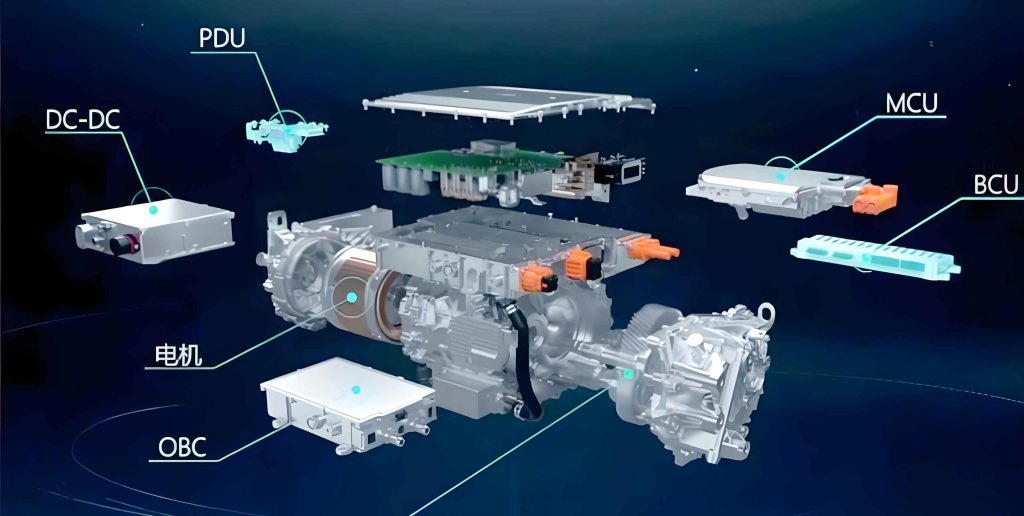
To understand the root cause of DC-bus voltage pumping in this electric drive system, I analyze the power flow dynamics during regenerative braking. The PMSM operates under field-oriented control (FOC), which enables four-quadrant operation. During braking, the motor acts as a generator, converting mechanical energy into electrical energy that is fed back to the DC bus. The power regenerated by the PMSM, denoted as \(P_{\text{load}}\), depends on its speed \(n\) and electromagnetic torque \(T_e\):
$$P_{\text{load}} = \frac{n \cdot T_e}{9.55}$$
For a surface-mounted PMSM with \(i_d = 0\) control, the electromagnetic torque is given by:
$$T_e = \frac{3}{2} n_p \psi_f i_q$$
where \(n_p\) is the number of pole pairs, \(\psi_f\) is the stator flux linkage, and \(i_q\) is the q-axis current (torque current). During braking, \(i_q\) becomes negative, and its magnitude is often maximized by the speed outer loop controller in FOC to achieve rapid deceleration. This results in a high regenerative power output, especially at initial braking speeds. The supercapacitor energy storage system is tasked with absorbing this power, but its ability to do so is limited by the bidirectional DC/DC converter’s duty cycle and the supercapacitor’s voltage level.
The mismatch between the inverter’s duty cycle and the bidirectional DC/DC converter’s duty cycle is a fundamental reason for voltage pumping. In the electric drive system, the inverter’s modulation index \(M\) relates the AC-side voltage magnitude \(|u_s|\) to the DC-bus voltage \(u_{dc}\):
$$M = \frac{|u_s|}{u_{dc}}$$
For the PMSM under FOC with \(i_d = 0\), the voltage magnitude can be approximated as:
$$|u_s| = \sqrt{(\omega \psi_f + L_q \frac{di_q}{dt})^2 + (\omega L_q i_q)^2}$$
where \(\omega\) is the electrical angular velocity, and \(L_q\) is the q-axis inductance. During braking, \(|u_s|\) tends to be high due to the motor’s speed and current, leading to a large \(M\). Conversely, the bidirectional DC/DC converter in buck mode (for supercapacitor charging) has a duty cycle \(D\) defined by:
$$D = \frac{u_{sc}}{u_{dc}}$$
where \(u_{sc}\) is the supercapacitor voltage. At the start of braking, \(u_{sc}\) is typically at its minimum, making \(D\) relatively small. This disparity in duty cycles causes an imbalance in current matching. The inverter’s DC-side current \(i_{\text{inv}}\) flows for a longer duration than the DC/DC converter’s high-side current \(i_{Ldc}\), resulting in excess energy that charges the DC-bus capacitor \(C_{dc}\). According to the capacitor equation \(i = C \frac{du}{dt}\), this leads to a rapid increase in \(u_{dc}\), i.e., voltage pumping. This issue is exacerbated in hybrid electric drive systems where the engine-generator set continues to supply power, further contributing to bus voltage instability.
To address this, I propose a feed-forward compensation control strategy that modifies the q-axis current reference in the FOC structure. The core idea is to introduce a droop regulation factor based on the DC-bus voltage error, which adjusts \(i_q^*\) to limit regenerative power and align the inverter’s duty cycle with the DC/DC converter’s. The control strategy enhances the traditional dual-loop vector control by adding a feed-forward path from the DC-bus voltage to the speed outer loop output. Specifically, the q-axis current reference is computed as:
$$i_q^* = i_{q_{\text{max}}}^- + m \cdot u_{dc}$$
where \(i_{q_{\text{max}}}^-\) is the negative saturation value from the speed controller, and \(m\) is the droop regulation factor. This factor is derived from the error between the DC-bus voltage \(u_{dc}\) and its reference \(u_{dc}^*\) using a PD controller:
$$m = k_p \cdot (u_{dc}^* – u_{dc}) + k_d \cdot \frac{d(u_{dc}^* – u_{dc})}{dt}$$
Here, \(k_p\) and \(k_d\) are proportional and derivative gains, respectively. When \(u_{dc}\) exceeds \(u_{dc}^*\), \(m\) becomes positive, reducing the magnitude of \(i_q^*\) (making it less negative) and thus decreasing the regenerative power. Conversely, when \(u_{dc}\) is below \(u_{dc}^*\), \(m\) becomes negative, allowing for higher regenerative power. This dynamic adjustment helps match the power flow and mitigate voltage pumping in the electric drive system.
The design of the feed-forward compensation loop requires careful tuning to ensure stability and responsiveness. I model the current inner loop as a standard second-order system with transfer function \(C(s) = \frac{\omega_n^2}{s^2 + 2\xi\omega_n s + \omega_n^2}\), which can be simplified to a first-order lag \(C(s) = \frac{1}{T_c s + 1}\) for low-frequency analysis. The overall compensation structure involves the DC-bus voltage dynamics, where the open-loop transfer function is derived as:
$$P(s) = \frac{k_v k_p}{C_{dc} s (T_{vf} s + 1)}$$
with \(k_v = M \cdot R\) representing the voltage-current relationship in the generator side, and \(T_{vf}\) as the sampling time constant. By applying the pole-zero cancellation method, I set \(\frac{k_d}{k_p} = T_c\), leading to a closed-loop transfer function of a type II system:
$$G(s) = \frac{P(s)}{1 + P(s)} = \frac{\frac{k_v k_p}{C_{dc} T_{vf}}}{s^2 + \frac{1}{T_{vf}} s + \frac{k_v k_p}{C_{dc} T_{vf}}}$$
Optimal damping is achieved with \(\frac{1}{2} \sqrt{\frac{C_{dc}}{k_v k_p T_{vf}}} = 0.707\), allowing for the calculation of \(k_p\) and \(k_d\). This design ensures that the feed-forward compensation responds swiftly to voltage disturbances without compromising system stability in the electric drive system.
To validate the proposed control strategy, I conduct simulation studies using a MATLAB/Simulink model of the hybrid electric drive system. The system parameters are summarized in the table below, which provides a comprehensive overview of the key components and their values. This table helps in understanding the simulation setup and the scale of the electric drive system.
| Parameter | Value |
|---|---|
| Load motor rated speed \(n^*\) (r/min) | 2000 |
| Load motor dq-axis inductance \(L_{dq}\) (H) | 6.9e-4 |
| Load motor inertia \(J\) (kg·m²) | 0.018 |
| Load torque \(T_f\) (N·m) | 150 |
| Stator flux linkage \(\psi_f\) (Wb) | 0.32 |
| Number of pole pairs \(n_p\) | 4 |
| DC-bus voltage reference \(u_{dc}^*\) (V) | 575 |
| DC-bus capacitor \(C_{dc}\) (F) | 3e-3 |
| Supercapacitor bank \(C_{sc}\) (F) | 0.3 |
| Speed controller output saturation [min, max] (A) | [-260, 260] |
| Supercapacitor max charging current (A) | 200 |
| Braking resistor activation threshold (V) | 640 |
| Feed-forward gains \(k_p, k_d\) | 3, 12.2 |
The simulation scenario involves the PMSM operating at rated speed, with braking initiated at 0.1 seconds. I compare the performance under normal regenerative braking (without feed-forward compensation) and with the proposed feed-forward compensation. The results are analyzed in terms of speed, q-axis current, power flow, DC-bus voltage, and duty cycles. The following table summarizes the key outcomes, highlighting the effectiveness of the control strategy in the electric drive system.
| Metric | Normal Braking | With Feed-Forward Compensation |
|---|---|---|
| Braking time (s) | 0.0054 | 0.0145 |
| Peak q-axis current \(i_q\) (A) | -260 (saturated) | -60 |
| Peak regenerative power \(P_{\text{load}}\) (kW) | High (approx. -50 kW) | Reduced (approx. -20 kW) |
| DC-bus voltage peak \(u_{dc}\) (V) | 633 (10.1% overshoot) | 594 (3.3% overshoot) |
| Inverter duty cycle \(M\) at braking start | ~0.9 (over-modulation) | ~0.5 (linear region) |
| DC/DC duty cycle \(D\) at braking start | ~0.3 | ~0.3 |
| Generator power fluctuation | Severe (positive/negative swings) | Minor (near zero with small overshoot) |
As evident from the simulation data, the feed-forward compensation strategy significantly reduces the DC-bus voltage pumping. The q-axis current is limited, which decreases the regenerative power and allows the supercapacitor to absorb energy more effectively. Although the braking time is extended due to reduced torque, this trade-off is acceptable in many applications where electrical safety takes precedence. The duty cycle mismatch is mitigated, with the inverter operating in the linear modulation region, thereby improving the overall stability of the electric drive system.
Further analysis of the power flow dynamics reveals additional insights. The power balance equation for the DC bus can be expressed as:
$$P_{\text{gen}} + P_{\text{sc}} + P_{\text{load}} = C_{dc} u_{dc} \frac{du_{dc}}{dt}$$
where \(P_{\text{gen}}\) is the power from the generator, \(P_{\text{sc}}\) is the power from the supercapacitor (negative during charging), and \(P_{\text{load}}\) is the load power (negative during regeneration). Under normal braking, \(P_{\text{load}}\) is large and negative, while \(P_{\text{sc}}\) may not match it instantly due to duty cycle constraints, leading to a positive \(\frac{du_{dc}}{dt}\). With feed-forward compensation, \(P_{\text{load}}\) is reduced, bringing the system closer to equilibrium. This is crucial for maintaining the integrity of the electric drive system, especially in hybrid configurations where multiple power sources interact.
The proposed strategy also has implications for the design of hybrid electric drive systems. By actively controlling the regenerative power, it reduces the reliance on braking resistors, which are often used as a passive safety measure but dissipate energy wastefully. This aligns with the energy-efficient goals of hybrid systems. Moreover, the feed-forward approach can be integrated with other control techniques, such as model predictive control or adaptive algorithms, to further optimize performance. For instance, one could extend the compensation to include variations in supercapacitor voltage or load conditions, making the electric drive system more robust.
In terms of implementation, the control strategy requires measurement of the DC-bus voltage and computation of the PD compensation. This can be easily achieved with modern digital signal processors (DSPs) commonly used in electric drive systems. The additional computational load is minimal, as the PD controller involves simple arithmetic operations. Furthermore, the strategy does not alter the core FOC structure, making it compatible with existing motor drives. This practicality enhances its adoption potential in real-world applications, from construction machinery to electric vehicles.
To provide a more comprehensive understanding, I derive the mathematical model of the entire hybrid electric drive system. The state-space representation includes the PMSM dynamics, DC-bus capacitor, and supercapacitor with bidirectional DC/DC converter. The PMSM equations in the dq-frame are:
$$\begin{aligned}
\frac{di_d}{dt} &= \frac{1}{L_d} (u_d – R i_d + \omega L_q i_q) \\
\frac{di_q}{dt} &= \frac{1}{L_q} (u_q – R i_q – \omega L_d i_d – \omega \psi_f) \\
\frac{d\omega}{dt} &= \frac{1}{J} (T_e – T_f)
\end{aligned}$$
The DC-bus dynamics are given by:
$$C_{dc} \frac{du_{dc}}{dt} = i_{\text{gen}} – i_{\text{inv}} – i_{Ldc}$$
where \(i_{\text{gen}}\) is the generator-side current, \(i_{\text{inv}}\) is the inverter input current, and \(i_{Ldc}\) is the DC/DC converter high-side current. The supercapacitor voltage dynamics are:
$$C_{sc} \frac{du_{sc}}{dt} = -i_L$$
with \(i_L\) being the inductor current in the bidirectional DC/DC converter. These equations form a nonlinear system that can be linearized around an operating point for control design. The feed-forward compensation effectively adds a corrective term to \(i_q^*\), which influences \(T_e\) and subsequently \(P_{\text{load}}\). This intervention helps stabilize \(u_{dc}\) by reducing the power imbalance.
Another aspect worth exploring is the impact of parameter variations on the electric drive system. For example, changes in supercapacitor capacitance or motor inductance can affect the system’s response. The feed-forward compensation, being based on voltage error, is inherently robust to such variations because it directly addresses the voltage deviation. However, tuning the PD gains may require adaptation for different operating conditions. I suggest an online tuning method using heuristic algorithms or gradient descent to optimize \(k_p\) and \(k_d\) in real-time, ensuring consistent performance across diverse scenarios in the electric drive system.
In conclusion, the feed-forward compensation control strategy presented in this paper offers a effective solution to the problem of DC-bus voltage pumping in hybrid electric drive systems during regenerative braking. By analyzing the duty cycle mismatch between the inverter and bidirectional DC/DC converter, I designed a droop regulation mechanism that adjusts the q-axis current reference based on DC-bus voltage error. Simulation results demonstrate a significant reduction in voltage overshoot from 10.1% to 3.3%, along with improved power flow matching. While braking time increases slightly, the benefits in terms of electrical safety and system stability are substantial. This strategy enhances the viability of hybrid electric drive systems in demanding applications, contributing to more efficient and reliable power management. Future work could focus on integrating this approach with advanced energy management systems and validating it through experimental prototypes.