
In the development of modern electric vehicles, the electric drive system plays a pivotal role in determining overall performance, efficiency, and reliability. As these systems become more integrated and compact, managing thermal loads becomes increasingly critical. High temperatures can lead to component degradation, reduced efficiency, and even system failure. Therefore, understanding and analyzing the steady-state temperature field within an electric drive system is essential for optimizing design and ensuring long-term operation. This article explores the thermal behavior of an integrated electric drive system, focusing on heat source distribution, heat transfer mechanisms, and the application of the lumped parameter thermal network (LPTN) method for temperature prediction. Through detailed analysis, we aim to provide insights into thermal management strategies that can enhance the performance and durability of electric drive systems.
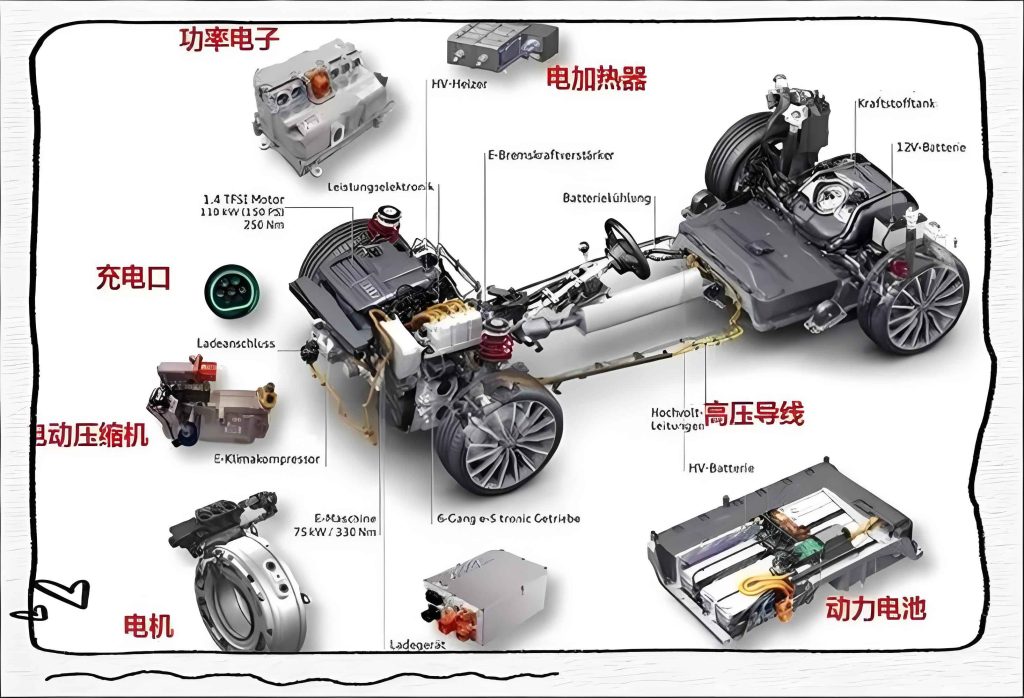
The electric drive system in electric vehicles typically includes components such as motors, gearboxes, inverters, and differentials, all integrated into a single unit. This high level of integration leads to complex thermal interactions, as heat generated in one component can affect others. In this study, we consider a novel integrated electric drive system that combines a permanent magnet synchronous motor with a two-speed transmission. Such systems are designed for compactness and efficiency but face challenges in heat dissipation due to limited space and high power density. The primary goal is to model the steady-state temperature field to identify hot spots and guide cooling system design. By employing the LPTN method, we can efficiently calculate temperatures at key nodes, balancing computational accuracy with resource constraints.
Heat generation within an electric drive system stems from various losses, broadly categorized into electromagnetic and mechanical losses. Electromagnetic losses occur in the motor, including copper losses in windings and iron losses in the core. Copper losses result from electrical resistance and can be calculated using Joule’s law. For a given electric drive system, the copper loss $P_{ ext{Cu}}$ is expressed as:
$$P_{ ext{Cu}} = I_N^2 R_a$$
where $I_N$ is the rated current and $R_a$ is the winding resistance. Iron losses, comprising hysteresis and eddy current losses, depend on magnetic flux density and frequency. The tooth iron loss $P_{ ext{Fet}}$ and yoke iron loss $P_{ ext{Fej}}$ are given by:
$$P_{ ext{Fet}} = K_a p_{10}^{50} B^2 \left( \frac{f}{50} ight)^{1.3} G_t$$
$$P_{ ext{Fej}} = K_a’ p_{10}^{50} B^2 \left( \frac{f}{50} ight)^{1.3} G_j$$
Here, $K_a$ and $K_a’$ are empirical coefficients, $p_{10}^{50}$ is the iron loss coefficient, $B$ is the magnetic induction intensity, $f$ is the frequency, and $G_t$ and $G_j$ are the masses of the tooth and yoke iron cores, respectively. These losses contribute significantly to the heat load in the electric drive system, necessitating effective thermal management.
Mechanical losses arise from friction and fluid interactions within the transmission components. These include gear meshing friction losses, oil churning losses, windage losses, bearing friction losses, and synchronizer losses. For gear meshing, the sliding friction power loss $P_m$ is:
$$P_m = f v_s F_n$$
where $f$ is the sliding friction coefficient, $v_s$ is the relative sliding velocity, and $F_n$ is the normal load. Oil churning losses, which dominate in lubricated systems, involve viscous dissipation. The side-related churning loss $P_s$ and meshing-related churning loss $P_n$ are combined as:
$$P_s = \frac{1.474 f_g u_0 n_1^3 D^{4.7} B}{A_g imes 10^{26}}$$
$$P_n = \frac{7.37 f_g u_0 n_1^3 D^{4.7} B}{R_f \sqrt{ an \beta_b} A_g imes 10^{26}}$$
$$P_J = P_s + P_n$$
In these equations, $f_g$ is the immersion factor, $u_0$ is the kinematic viscosity, $n_1$ is the rotational speed, $D$ is the pitch diameter, $A_g$ is the configuration coefficient, $R_f$ is the roughness factor, and $\beta_b$ is the helix angle. Windage losses $P_w$ occur due to air resistance and are modeled as:
$$P_w = 2.04 imes 10^{-8} (1 + 2.3t) R
ho^{0.8} n_g^{2.8} R^{4.6} \mu^{0.2}$$
where $t$ is the tooth width, $R$ is the pitch radius, $n_g$ is the gear speed, $
ho$ is the fluid density, and $\mu$ is the fluid viscosity. Bearing losses $H$ are calculated from the friction torque $M$ and angular velocity $\omega$:
$$H = M \omega$$
Synchronizer losses, critical during gear shifts, generate heat from friction between the synchronizer ring and gear. The total heat flux $q$ is:
$$q = \xi T_0 v_c$$
with $\xi$ as an energy conversion factor, $T_0$ as the equivalent friction stress, and $v_c$ as the relative sliding velocity. These diverse heat sources must be accurately quantified to model the temperature field in the electric drive system.
To manage heat dissipation, understanding heat transfer modes is essential. In an electric drive system, heat transfers via conduction through solid components and convection to fluids such as oil or air. Conduction heat resistance for a flat wall with area $A$ and thickness $\delta$ is:
$$R_{\lambda} = \frac{\delta}{\lambda A}$$
where $\lambda$ is the thermal conductivity. For cylindrical components like shafts or gears, the conduction heat resistance over length $l$ is:
$$R_{\lambda} = \frac{1}{2\pi \lambda l} \ln \frac{r_2}{r_1}$$
with $r_1$ and $r_2$ as inner and outer radii. Convection heat resistance depends on the convective heat transfer coefficient $h_c$, which varies with flow conditions. For instance, in the air gap between rotor and stator, the Reynolds number $Re$ is:
$$Re = \frac{v \delta}{ u}$$
where $v$ is the surface velocity, $\delta$ is the gap length, and $ u$ is the air kinematic viscosity. The convection coefficient for rotor end faces $\alpha_{ ext{end}}$ is piecewise defined based on $Re$. For bearing surfaces, convection is modeled as forced convection in pipes, with coefficients for laminar, turbulent, and transitional flows. Similarly, for gear and shaft surfaces, cross-flow over cylinders is assumed. These models enable the construction of a comprehensive thermal resistance network for the electric drive system.
The lumped parameter thermal network (LPTN) method simplifies the complex thermal behavior into a network of nodes and resistances. Each node represents a component or region with a uniform temperature, and resistances represent heat transfer paths. Based on energy conservation, the steady-state heat balance equation for node $i$ is:
$$Q_i + \sum \frac{T_j – T_i}{R_{ji}} – \sum \frac{T_i – T_k}{R_{ik}} = 0$$
where $Q_i$ is the heat generated at node $i$, $T_i$, $T_j$, and $T_k$ are temperatures, and $R_{ji}$ and $R_{ik}$ are thermal resistances. By solving this system of equations, the temperature distribution across the electric drive system can be determined. This approach is computationally efficient and suitable for design-stage analysis, providing quick insights into thermal performance.
In applying the LPTN method to our integrated electric drive system, we first identify key nodes. These include motor components (e.g., stator windings, rotor core), transmission elements (e.g., gears, bearings, shafts), and housing parts. The network topology is derived from physical connections, considering conduction paths through solids and convection paths to cooling fluids. For example, in the differential section, nodes represent gears, bearings, and housing, with resistances accounting for gear-to-shaft conduction and gear-to-oil convection. The heat balance equations are formulated and solved using numerical methods like Gaussian elimination. This process allows us to predict temperatures under various operating conditions, such as different gear ratios or loads.
To illustrate, consider the electric drive system operating in low gear, where loads are higher and efficiency lower, leading to greater heat generation. Using system parameters—e.g., a permanent magnet synchronous motor with rated power 36 kW, rated speed 400 rpm, and first gear reduction ratio 1.8—we calculate steady-state temperatures. The system is cooled externally with water and internally with transformer oil for lubrication and cooling. Ambient temperature is 25.0°C, and average oil temperature is 50.2°C. Solving the LPTN equations yields temperatures at all nodes, revealing critical hot spots. For instance, gear surfaces often exhibit the highest temperatures, indicating potential failure risks. This analysis helps in redesigning components or enhancing cooling strategies for the electric drive system.
Validation through experimentation is crucial for verifying LPTN predictions. A prototype of the integrated electric drive system is built and tested under controlled conditions. Temperature sensors (e.g., PT1000 thermistors) are placed at key locations, such as windings, bearings, and housing, while external temperatures are measured with infrared thermometers. The system is loaded using a magnetic powder brake, simulating real-world operation. Comparing experimental data with LPTN results shows good agreement, with errors generally within acceptable limits (e.g., below 10%). Discrepancies may arise from simplifications in the thermal model, such as neglecting inhomogeneities in winding insulation or air gaps. Nonetheless, the LPTN method proves effective for preliminary design, enabling rapid assessment of thermal performance in electric drive systems.
Further optimization of the electric drive system can be guided by thermal analysis. For example, identifying high-temperature components like gear teeth allows for material selection or cooling enhancements. Adding cooling channels, improving lubrication flow, or using thermal interface materials can reduce resistances. Additionally, the LPTN model can be extended to transient analysis, capturing temperature variations during dynamic operations like acceleration or regenerative braking. This holistic approach ensures that the electric drive system maintains optimal temperatures, enhancing efficiency and lifespan. As electric vehicles evolve, advanced thermal management will remain a key focus, with methods like LPTN providing valuable tools for engineers.
In conclusion, thermal management is integral to the reliable operation of electric drive systems in electric vehicles. By analyzing heat sources and transfer mechanisms, and employing the LPTN method, we can predict temperature fields and identify improvement areas. This article has detailed the process from modeling to validation, emphasizing the importance of integrated design. Future work may involve coupling thermal models with electromagnetic and mechanical simulations for multi-physics optimization. Ultimately, effective thermal management contributes to the advancement of electric drive systems, supporting the global transition to sustainable transportation.
To summarize key aspects, the following table outlines common heat sources in an electric drive system and their typical contributions:
| Heat Source Type | Description | Typical Power Loss (W) | Primary Location |
|---|---|---|---|
| Copper Losses | Resistive heating in windings | 500-2000 | Motor stator and rotor |
| Iron Losses | Hysteresis and eddy currents | 300-1500 | Motor core |
| Gear Meshing Friction | Sliding friction between teeth | 100-800 | Transmission gears |
| Oil Churning | Viscous dissipation in oil | 50-400 | Gearbox sump |
| Bearing Friction | Rolling and sliding friction | 20-200 | Bearings |
| Windage | Air resistance | 10-100 | High-speed components |
| Synchronizer Losses | Friction during gear shifts | 50-300 | Transmission synchronizers |
Additionally, thermal resistances can be categorized as shown below:
| Resistance Type | Formula | Typical Values (K/W) | Application Example |
|---|---|---|---|
| Conduction (Flat Wall) | $R_{\lambda} = \delta / (\lambda A)$ | 0.01-0.1 | Housing walls |
| Conduction (Cylinder) | $R_{\lambda} = \ln(r_2/r_1) / (2\pi \lambda l)$ | 0.05-0.5 | Shafts and gears |
| Convection (Forced) | $R_{ ext{conv}} = 1 / (h_c A)$ | 0.1-1.0 | Coolant flow over surfaces |
| Convection (Natural) | $R_{ ext{conv}} = 1 / (h_n A)$ | 1.0-10.0 | External air cooling |
These tables highlight the diversity of thermal factors in an electric drive system. By integrating such data into the LPTN model, we can achieve accurate temperature predictions. For instance, the heat balance equation for a node representing a gear tooth incorporates losses from meshing and churning, along with conduction to the shaft and convection to oil. Solving these equations iteratively refines the temperature map, guiding design decisions. Moreover, sensitivity analysis can identify which parameters most influence temperatures, allowing targeted optimizations. For example, increasing the convection coefficient through better coolant flow can significantly reduce hot spot temperatures in the electric drive system.
In practice, the electric drive system must operate under varying environmental conditions, such as high ambient temperatures or limited cooling capacity. The LPTN model can be adapted to these scenarios by adjusting boundary conditions. For instance, if ambient temperature rises to 40°C, the model recalculates temperatures, potentially revealing new limitations. This flexibility makes LPTN a valuable tool for robustness testing. Furthermore, combining LPTN with finite element analysis (FEA) can provide detailed stress distributions, linking thermal expansion to mechanical integrity. Such multi-disciplinary approaches are essential for next-generation electric drive systems, which push the limits of power density and efficiency.
Another critical aspect is the cooling system design. In our integrated electric drive system, we use a combination of internal oil lubrication and external water cooling. The oil not only reduces friction but also carries heat away from gears and bearings. The convection heat transfer coefficient for oil flow depends on viscosity and velocity, which vary with temperature. Thus, an iterative process may be needed to couple thermal and fluid dynamics models. For simplicity, the LPTN method assumes average values, but for higher accuracy, computational fluid dynamics (CFD) simulations can complement LPTN. This hybrid approach balances speed and precision, ideal for iterative design cycles in developing electric drive systems.
Looking ahead, advancements in materials and cooling technologies will further enhance thermal management. For example, using phase-change materials or heat pipes can improve heat dissipation in compact electric drive systems. Additionally, real-time thermal monitoring with embedded sensors can enable adaptive cooling controls, optimizing energy use. The LPTN method serves as a foundation for these innovations, providing a scalable framework for thermal analysis. By continuously refining models and validating them with experiments, we can ensure that electric drive systems meet the demanding requirements of modern electric vehicles.
In summary, this article has explored the steady-state temperature field analysis of an integrated electric drive system using the LPTN method. From heat source modeling to experimental validation, we have demonstrated a comprehensive approach to thermal management. The electric drive system, as a core component of electric vehicles, benefits from such analyses through improved reliability and performance. As integration levels increase, thermal challenges will grow, making methods like LPTN indispensable for engineers. By fostering a deep understanding of thermal behavior, we contribute to the development of more efficient and durable electric drive systems, paving the way for a sustainable automotive future.