
The pursuit of superior Noise, Vibration, and Harshness (NVH) performance is paramount in the development of modern electric vehicles (EVs). While generally quieter than internal combustion engine vehicles, EVs present unique NVH challenges, particularly emanating from the electric drive system. This core assembly, typically comprising a traction motor and a reduction gearbox, is subjected to a complex interplay of excitation sources. Electromagnetic forces originating from the motor and dynamic meshing forces from the gearbox collectively form the primary internal excitations governing the system’s vibro-acoustic behavior. A comprehensive understanding of these excitations, especially under transient operating conditions such as acceleration, is crucial for predictive design and refinement.
This work presents an integrated methodology for the transient NVH analysis of an electric drive system. The primary challenge addressed is the simulation of NVH characteristics under acceleration, a common and critical real-world driving scenario. Traditional electromagnetic finite element analysis (FEA) tools are typically constrained to steady-state operation at fixed speeds. To overcome this limitation, this study proposes a workflow that combines electromagnetic, multi-body dynamics, and structural-acoustic simulations, employing numerical interpolation to synthesize transient excitation forces.
The core of the electric drive system under investigation consists of a 4-pair pole interior permanent magnet synchronous motor (IPMSM) with 48 stator slots, coupled to a two-stage reduction gearbox. The housing structures are manufactured from ADC12 aluminum alloy. The holistic approach begins with the accurate characterization of the system’s structural dynamics, followed by the extraction of excitation forces at discrete steady-state operating points. These forces are then processed to create a continuous transient excitation profile for a full-throttle acceleration run-up.
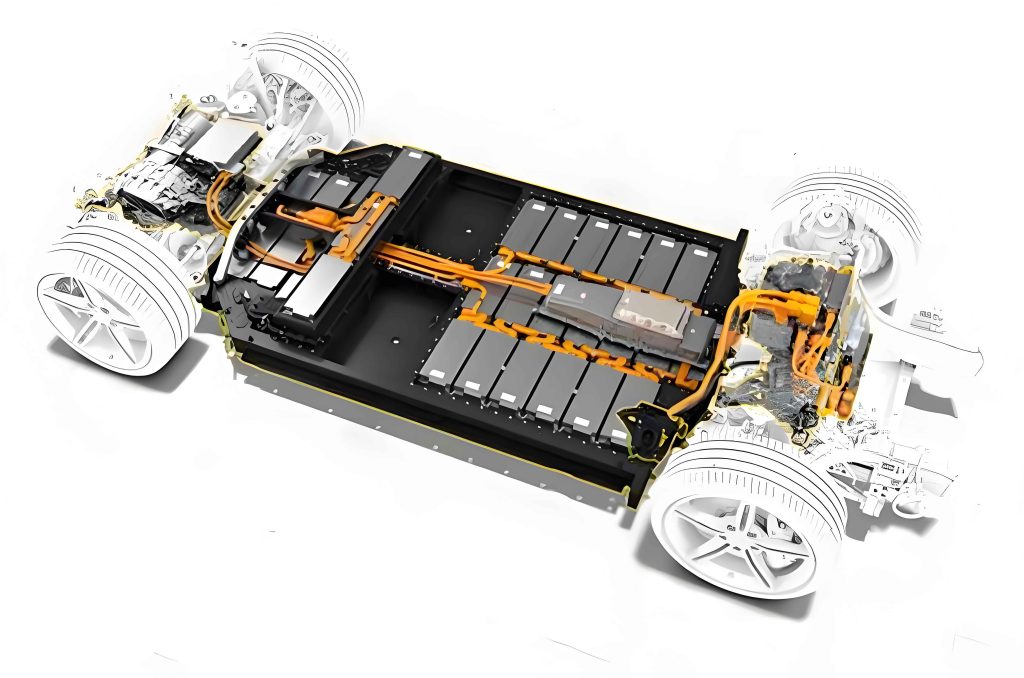
Excitation Sources in the Electric Drive System
The NVH behavior of the electric drive system is governed by two principal mechanical excitation sources: electromagnetic forces in the motor and gear meshing forces transmitted through bearings.
Electromagnetic Force Waves
The electromagnetic vibration and noise of the motor are predominantly caused by radial electromagnetic force waves acting on the stator core. The instantaneous radial electromagnetic pressure $p_r(\theta, t)$ in the air gap can be approximated from the radial flux density $b_r(\theta, t)$:
$$
p_r(\theta, t) \approx \frac{1}{2\mu_0} b_r^2(\theta, t)
$$
where $\mu_0$ is the permeability of free space, $\theta$ is the mechanical angle, and $t$ is time. The air-gap flux density $b(\theta, t)$ is the product of the magnetomotive force (MMF) $f(\theta, t)$ and the specific air-gap permeance $\lambda(\theta, t)$: $b(\theta, t) = f(\theta, t) \lambda(\theta, t)$. For an IPMSM with integer slots, the interaction between the fundamental stator MMF and rotor harmonic MMFs generates force waves of primary concern. The order $r$ and frequency $f_r$ of these dominant radial force waves are given by:
$$
r = 2n_1 p \quad (n_1 = 0, 1, 2, …)
$$
$$
f_r = 2n_2 f_1 \quad (n_2 = 0, 1, 2, …)
$$
where $p$ is the number of pole pairs and $f_1$ is the fundamental electrical frequency. Thus, the main electromagnetic excitations occur at even multiples of the electrical frequency (e.g., 8$f_1$, 16$f_1$, 24$f_1$ for an 8-pole motor) and are of low spatial order (multiples of the pole number), which are efficient at exciting structural deformation.
Gear Meshing and Bearing Forces
Within the gearbox, time-varying stiffness, transmission error, and gear profile modifications induce dynamic meshing forces. These forces are transmitted through the shafts to the supporting bearings, which subsequently excite the gearbox housing, leading to structure-borne noise. The frequency of these excitations is primarily the gear mesh frequency (GMF) and its harmonics. For a gear pair, the GMF is calculated as:
$$
f_{\text{mesh}} = \frac{N \cdot n}{60}
$$
where $N$ is the number of teeth on the gear and $n$ is its rotational speed in RPM. In a multi-stage electric drive system, multiple mesh frequencies exist, and their interaction with the housing modes is a key factor in the overall NVH signature.
Integrated Analysis Methodology
The proposed methodology for transient NVH analysis involves four key stages: 1) Structural Finite Element Model (FEM) Development and Validation, 2) Steady-State Excitation Force Calculation, 3) Transient Excitation Synthesis via Interpolation, and 4) Forced Vibration and Acoustic Response Analysis.
1. Structural Dynamics Modeling and Correlation
An accurate structural model is the foundation for reliable NVH prediction. A detailed finite element model of the complete electric drive system was developed.
Stator Assembly Modeling: The stator core, windings, and slot insulation were modeled with high fidelity. The laminated core and windings were treated as orthotropic materials to capture their directional stiffness properties correctly. The material properties were iteratively tuned based on a correlation with experimental modal analysis results. Key radial modal frequencies and shapes were matched.
Correlation Results for Stator Assembly: The table below shows a comparison between simulated and experimental modal frequencies for the stator assembly, demonstrating good agreement.
| Mode Shape | Simulated Freq. (Hz) | Experimental Freq. (Hz) | Error (%) | MAC |
|---|---|---|---|---|
| (0,2) | 673 | 667 | 0.8 | 0.67 |
| (1,2) | 857 | 831 | 3.1 | 0.69 |
| (0,3) | 1846 | 1797 | 2.7 | 0.84 |
| (1,3) | 2129 | 2036 | 4.6 | 0.58 |
| (0,4) | 3346 | 3520 | -4.9 | 0.76 |
| (1,4) | 3942 | 4207 | -6.3 | 0.56 |
| (0,5) | 5055 | 5236 | -3.4 | 0.59 |
Housing Modeling: The motor and gearbox housings were meshed with second-order tetrahedral elements. Bolted connections between housings were modeled using a combination of bar and beam elements. The housing FEM was also correlated with experimental modal tests.
| Mode | Simulated Freq. (Hz) | Experimental Freq. (Hz) | Error (%) | Description |
|---|---|---|---|---|
| 1 | 1218.7 | 1245.6 | -2.1 | Axial compression at bearing |
| 2 | 1423.8 | 1446.9 | -1.6 | Global axial bending |
| 5 | 2103.4 | 2139.5 | -1.7 | Global 2nd order axial bending |
The final system-level FEM, incorporating the correlated stator, rotor, shafts, gears, and housings with proper connections and mount constraints, forms the basis for the forced response analysis.
2. Calculation of Steady-State Excitation Forces
The acceleration profile from 1000 RPM to 9000 RPM was discretized into a series of steady-state operating points. Excitations were calculated at each point.
Electromagnetic Forces: A 2D transient electromagnetic FEA of the IPMSM was performed for each operating point, defined by torque and speed. Ideal three-phase sinusoidal currents were applied:
$$
\begin{aligned}
I_A &= \sqrt{2}I \sin(2\pi f_1 t + \phi) \\
I_B &= \sqrt{2}I \sin(2\pi f_1 t + \phi – 2\pi/3) \\
I_C &= \sqrt{2}I \sin(2\pi f_1 t + \phi – 4\pi/3)
\end{aligned}
$$
where $I$ is the RMS current, $f_1$ is the electrical frequency, and $\phi$ is the current advance angle. The radial electromagnetic force density on each stator tooth was computed and integrated to obtain concentrated nodal forces for structural input.
Gearbox Bearing Forces: A detailed multi-body dynamics (MBD) model of the electric drive system was built, incorporating flexible housings (from the correlated FEM), detailed gear micro-geometry, bearing stiffness models, and flexible shafts. The time-varying torque output from the electromagnetic analysis served as input. The MBD simulation solved for the dynamic response, from which the time-history of forces at all bearing locations was extracted and transformed into the frequency domain.
3. Synthesis of Transient Excitation via Cubic Spline Interpolation
To simulate the acceleration condition, the steady-state excitation forces (both electromagnetic and bearing) needed to be transformed into a continuous transient excitation profile. Assuming the structure behaves linearly within the frequency range of interest, the principle of superposition holds. The dominant orders (e.g., motor 8th order, gear 22nd order) were extracted from each steady-state frequency spectrum.
For each excitation point (e.g., a specific stator tooth or bearing node) and each force component (X, Y, Z), the amplitude of a specific order at all discrete RPM points forms a data series: $F_{\text{order}}(RPM_i)$. A cubic spline interpolation function $S(RPM)$ was constructed to fit this data. The cubic spline ensures a smooth curve that passes through all data points and has continuous first and second derivatives. For an interval $[RPM_{i-1}, RPM_i]$, the spline function is:
$$
S_i(RPM) = \frac{M_{i-1}(RPM_i – RPM)^3}{6h_i} + \frac{M_i(RPM – RPM_{i-1})^3}{6h_i} + \left(F_{i-1} – \frac{M_{i-1}h_i^2}{6}\right)\frac{RPM_i – RPM}{h_i} + \left(F_i – \frac{M_i h_i^2}{6}\right)\frac{RPM – RPM_{i-1}}{h_i}
$$
where $h_i = RPM_i – RPM_{i-1}$, $F_i$ is the force amplitude at $RPM_i$, and $M_i$ is the second derivative parameter solved from continuity conditions. By applying this interpolation to the RPM-time profile of the acceleration run, a continuous transient force signal $F_{\text{order}}(t)$ for each excitation order is generated.
4. Forced Response and Acoustic Analysis
The synthesized transient forces were applied to the system-level FEM: electromagnetic forces distributed on stator tooth nodes and bearing forces applied at bearing center nodes. A transient dynamic analysis using the mode superposition method was performed to obtain vibration velocities at key locations.
Acoustic radiation was computed using the Acoustic Transfer Vector (ATV) method. ATVs represent the linear relationship between normal surface vibration velocity and the sound pressure at a field point. The sound pressure $P(\omega)$ at a microphone location is calculated as:
$$
P(\omega) = \{\mathbf{ATV}(\omega)\}^T \{\mathbf{v}_n(\omega)\}
$$
where $\{\mathbf{ATV}(\omega)\}$ is the pre-computed acoustic transfer vector and $\{\mathbf{v}_n(\omega)\}$ is the vector of normal surface velocities from the structural simulation. This process yields the sound pressure level over time, which can be post-processed into order tracks versus RPM.
Experimental Validation
A prototype of the electric drive system was tested on a dynamometer in a semi-anechoic chamber to validate the simulation results. The setup included:
- Sensors: Accelerometers on the motor housing, gearbox housing (including differential and input bearing caps), and system mounts. Microphones at a 1-meter distance from the system enveloping surface (front, rear, left, right, top).
- Test Condition: Full-throttle acceleration from 1000 RPM to 9000 RPM.
- Data Acquisition: Vibration and acoustic data were acquired synchronously and processed into order-cut plots.
Results and Discussion
The simulated and experimental results were compared for key orders across the acceleration run-up. The overall noise order tracking from the experiment identified significant contributions from motor orders (e.g., 8th) and gearbox orders (e.g., 13.38th, 22nd, 44th). Resonant amplifications were observed around 2100 Hz and 2600-2800 Hz, correlated with housing bending and differential cover modes, respectively.
Vibration Response Comparison: The simulated vibration velocity at key points showed good agreement with test data in terms of curve trend and RPM location of major peaks. For instance, the 22nd order vibration at the input shaft bearing and the 13.38th order at the differential housing were well-predicted. The amplitude of the motor 8th order at high RPM showed a larger deviation, which can be attributed to damping modeling uncertainties at higher frequencies.
Acoustic Response Comparison: The simulated overall and order-specific sound pressure levels at the 1-meter microphone positions aligned well with the experimental measurements, particularly in the low-to-mid frequency range. The method successfully captured the “haystack” phenomenon near structural resonances. Some discrepancies in absolute amplitude at specific resonances (e.g., gear 22nd order near 5000 RPM) were noted, primarily due to the challenge of accurately modeling damping for complex assembled structures.
The correlation demonstrates that the proposed method of synthesizing transient excitations via interpolation of steady-state electromagnetic and multi-body dynamics results is valid and effective for predicting the NVH behavior of an electric drive system under acceleration.
Conclusion
This study establishes an integrated simulation workflow for the transient NVH analysis of an electric drive system. The key contributions and findings are:
- High-Fidelity Structural Modeling: The importance of correlating the structural FEM, especially for complex subassemblies like the stator (with orthotropic material properties) and gearbox housings, was confirmed as a prerequisite for reliable NVH prediction.
- Excitation Synthesis Method: The use of cubic spline interpolation to generate transient excitation forces from a set of discretized steady-state operating points provides a practical and effective solution to a significant challenge in electric drive system NVH simulation, where direct transient electromagnetic simulation is computationally prohibitive.
- Comprehensive Excitation Consideration: The methodology successfully accounts for the combined effects of electromagnetic excitations (radial forces) and mechanical excitations (gear meshing forces transmitted via bearings), which are both critical for a complete NVH assessment.
- Experimental Validation: The good agreement between the simulated and experimental vibration and noise order tracks under a full-throttle acceleration validates the overall approach. The method accurately identifies major contributing orders and predicts the RPM regions of resonant amplification.
This integrated approach provides a powerful tool for the design phase, enabling engineers to identify and mitigate potential NVH issues in the electric drive system before physical prototyping, thereby reducing development time and cost while enhancing the acoustic refinement of electric vehicles.