
As a pioneer in the electrification of automotive propulsion, I am thrilled to share our journey and latest breakthrough in electric drive system technology. The global shift toward electric vehicles (EVs) is accelerating, and China has emerged as a decisive force in this transformation. The expanding EV market here presents immense opportunities for advanced electric drive systems, driving rapid technological iterations that far outpace the internal combustion engine era. In this competitive landscape, our mission is to lead the change, and the global premiere of our next-generation electric drive system, EMR4, in China epitomizes this commitment. This electric drive system represents a leap forward in efficiency, integration, and cost-effectiveness, setting new benchmarks for the industry.
The development of electric drive systems is at the heart of EV performance. An ideal electric drive system must achieve high efficiency, compact integration, and low cost to meet OEM demands for extended range and affordability. Our previous generation, EMR3, already showcased strong system integration, but with EMR4, we have pushed the boundaries further. This electric drive system embodies our relentless pursuit of excellence, leveraging decades of experience to deliver a solution that is not only superior but also highly adaptable. Let me delve into the technical nuances that make EMR4 a game-changer in the electric drive system domain.
One of the core metrics for any electric drive system is efficiency, as it directly impacts vehicle range and energy consumption. EMR4 achieves a 5% improvement in efficiency over EMR3, which can be expressed through the formula for overall system efficiency: $$ \eta_{\text{system}} = \eta_{\text{motor}} \times \eta_{\text{inverter}} \times \eta_{\text{gearbox}} $$ where $\eta$ denotes efficiency. For EMR4, we optimized each component, resulting in: $$ \eta_{\text{EMR4}} = \eta_{\text{EMR3}} \times 1.05 $$ This enhancement translates to more kilometers per charge, addressing a key consumer concern. Moreover, the power range of this electric drive system has been expanded to 80–230 kW, catering to diverse vehicle segments from compact cars to premium sedans.
Cost reduction is equally critical for mass EV adoption. Through innovative design and manufacturing processes, EMR4 reduces costs by 30% compared to its predecessor. We can model this cost savings as: $$ C_{\text{EMR4}} = C_{\text{EMR3}} \times (1 – 0.30) $$ where $C$ represents the cost per unit. Simultaneously, weight reduction of approximately 25% at the same power level enhances vehicle dynamics and energy efficiency. The weight savings can be expressed as: $$ W_{\text{EMR4}} = W_{\text{EMR3}} \times 0.75 $$ where $W$ is the weight. These improvements stem from advanced materials, optimized thermal management, and higher integration, making EMR4 a lighter and more economical electric drive system.
To summarize these advancements, here is a comparative table of key parameters between EMR3 and EMR4:
| Parameter | EMR3 | EMR4 | Improvement |
|---|---|---|---|
| Efficiency | Base (e.g., 95%) | +5% | 5% increase |
| Power Range | 60–200 kW | 80–230 kW | Extended by 20–30 kW |
| Cost | Base (e.g., $1000) | -30% | 30% reduction |
| Weight (at same power) | Base (e.g., 100 kg) | -25% | 25% reduction |
| Integration Level | Three-in-one (motor, inverter, gearbox) | Higher integration, modular design | Enhanced flexibility |
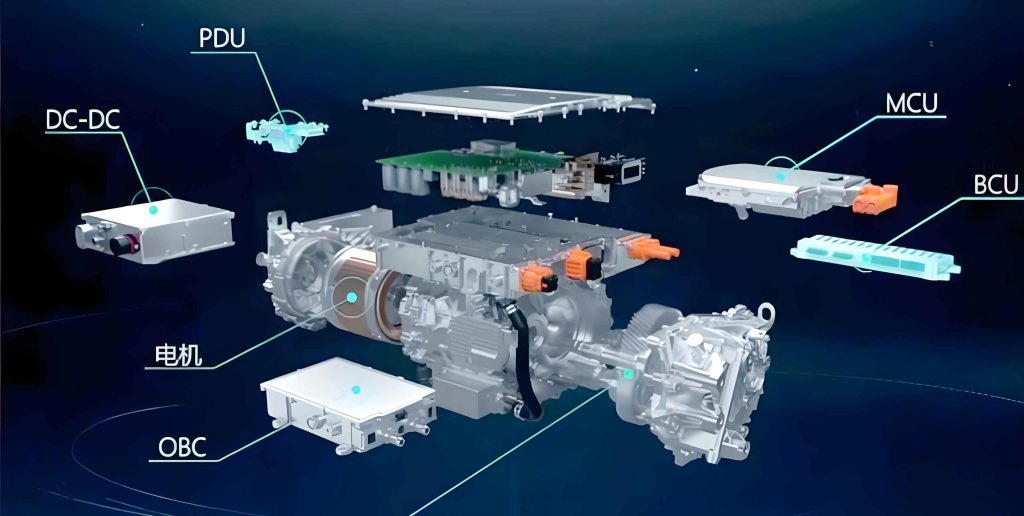
Integration is a hallmark of modern electric drive systems. EMR4 retains the three-in-one architecture—combining motor, inverter, and reducer—but with a higher degree of integration. This compact design reduces volume and weight, enabling easier vehicle packaging. The modularity of this electric drive system allows for scalability across vehicle classes, from A-segment to C-segment cars. We have engineered EMR4 with a standardized interface, so OEMs can install different power variants without altering mounting points or connections. This flexibility is crucial in a market like China, where EV segments are polarizing, with strong demand at both ends but slower growth in the mid-range. EMR4’s adaptability positions it to capture opportunities across this spectrum.
The power density of an electric drive system is a key performance indicator, defined as: $$ \text{Power Density} = \frac{P}{V} $$ where $P$ is power in kW and $V$ is volume in liters. For EMR4, we achieved a significant boost in power density through spatial optimization and advanced cooling techniques. This translates to more power in a smaller footprint, a vital attribute for EVs with limited under-hood space. Additionally, the electric drive system supports both 400 V and 800 V platforms. The 800 V variant utilizes silicon carbide (SiC) power devices, which offer faster charging and higher efficiency. The benefits of SiC can be quantified through reduced switching losses: $$ P_{\text{loss}} = f_{\text{sw}} \times E_{\text{sw}} $$ where $f_{\text{sw}}$ is switching frequency and $E_{\text{sw}}$ is switching energy. SiC devices lower $E_{\text{sw}}$, enhancing overall system efficiency by up to 5-10% compared to silicon-based solutions.
Our strategic focus on 800 V technology began years ago, anticipating market trends. We formed partnerships to secure SiC supply and have already secured major orders for 800 V systems, with production slated for 2023. The following table outlines the advantages of 400 V versus 800 V platforms in an electric drive system:
| Voltage Platform | Charging Speed | Efficiency | Component Requirements | Typical Application |
|---|---|---|---|---|
| 400 V | Standard (e.g., 50 kW) | High (e.g., 95%) | Silicon-based inverters | Mass-market EVs |
| 800 V | Fast (e.g., 350 kW) | Very High (e.g., 97% with SiC) | SiC power devices | Premium and performance EVs |
Choosing China for the global debut of EMR4 was a deliberate decision. This market is a hotbed of innovation and diversity in electrification, making it the perfect stage to showcase our electric drive system. We are not just manufacturing EMR4 in China; we are deeply integrating local supply chains to ensure efficient production. Our design-for-manufacturing approach enables the assembly of different EMR4 variants on the same production line, reducing lead times and costs. The Tianjin factory will serve as a hub, delivering this electric drive system to OEMs worldwide. This localization strategy underscores our commitment to the region and enhances our responsiveness to market dynamics.
The electric drive system landscape is becoming increasingly competitive, with legacy players, new entrants, and even OEMs developing in-house solutions. However, we are confident that EMR4’s technical superiority and adaptability will secure its place. The success of EMR3, with over 200,000 units supplied for more than 20 models globally, sets a strong foundation. EMR4 builds on this with enhanced features, and we anticipate even greater adoption. For instance, the modular design allows OEMs to tailor the electric drive system to specific needs, whether for a compact city car or a luxury SUV. This is quantified through the scalability equation: $$ P_{\text{available}} = P_{\text{base}} \times k $$ where $P_{\text{base}}$ is the base power rating and $k$ is a scaling factor (e.g., 1.0 to 2.5) achieved via modular components.
Looking ahead, the evolution of electric drive systems will be driven by continuous improvement in materials, electronics, and software. We are investing in R&D to further boost efficiency, perhaps approaching near-ideal levels where losses are minimized. The theoretical maximum efficiency for an electric drive system can be modeled as: $$ \eta_{\text{max}} = 1 – \frac{T_{\text{loss}}}{T_{\text{input}}} $$ where $T_{\text{loss}}$ represents torque losses. With EMR4, we are inching closer to this limit. Moreover, digitalization plays a key role; our electric drive system incorporates smart sensors and predictive algorithms to optimize performance in real-time, enhancing durability and energy management.
In conclusion, EMR4 represents a significant milestone in electric drive system technology. It embodies our vision of a sustainable, efficient, and accessible electric future. As production ramps up in 2023, we expect this electric drive system to empower a new generation of EVs, reducing carbon footprints and driving mobility forward. The journey has just begun, and we are excited to lead the charge with innovations that redefine what an electric drive system can achieve. The fusion of engineering excellence and market insight ensures that EMR4 will not only meet but exceed the expectations of OEMs and consumers alike, solidifying our position at the forefront of the electrification revolution.