
In recent years, the rapid advancement of new energy technologies has driven a significant shift from traditional internal combustion engine products to electrified alternatives. Electric motorcycles, as one of the mainstream products in this transformation, have gained widespread attention. However, the noise, vibration, and harshness (NVH) performance of these vehicles, particularly during start-stop operations, remains a critical factor affecting ride comfort and overall user experience. The primary source of noise in electric motorcycles is the electric drive system, which includes components such as the motor, reducer, and transmission elements. In this study, I focus on diagnosing and optimizing the noise generated by the electric drive system under start-stop working conditions, aiming to enhance the acoustic comfort of electric motorcycles. Through experimental testing and analytical methods, I identify key noise sources, propose optimization strategies, and validate their effectiveness, contributing to improved design practices for electric drive systems in the automotive industry.
The importance of NVH control in vehicles cannot be overstated, as it directly impacts passenger comfort and product quality. For electric motorcycles, the electric drive system is a predominant noise contributor, especially during transient operations like starting and stopping. Unlike conventional internal combustion engines, electric drive systems produce noise primarily from electromagnetic forces, mechanical interactions, and structural vibrations. In start-stop scenarios, abrupt torque changes and gear engagements can lead to impact noises, often perceived as rattling or knocking sounds, which degrade the acoustic environment. Therefore, understanding and mitigating these noises is essential for developing quieter and more refined electric motorcycles. This study addresses this challenge by evaluating the noise characteristics of multiple electric drive systems and implementing targeted optimizations based on diagnostic insights.
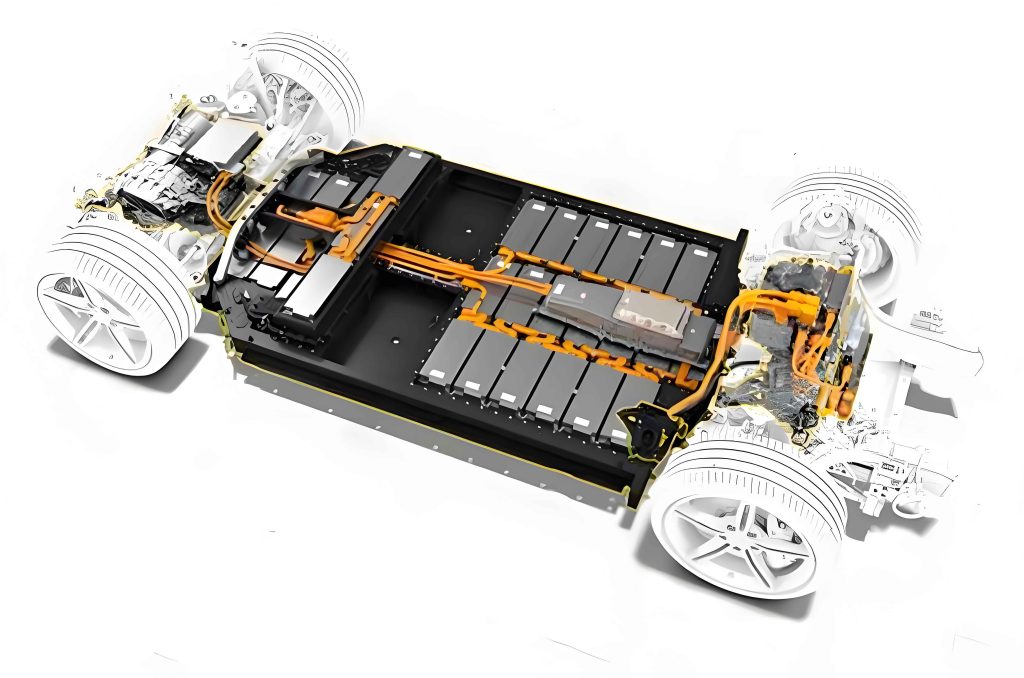
To assess the noise performance of electric drive systems under start-stop conditions, I conducted experimental measurements on three different electric motorcycle models, referred to as Vehicle A, Vehicle B, and Vehicle C. These vehicles were selected based on their market feedback, with Vehicle A exhibiting higher noise levels compared to the others. The tests were performed on a chassis dynamometer to simulate real-world operating conditions. The start-stop test cycle involved a sequence of operations: vehicle start-up, braking to a complete stop, release of brake for start-up, braking again, and repetition for a total of three complete start-stop cycles. This procedure mimics typical urban driving scenarios where frequent starts and stops occur, making it relevant for evaluating noise in practical applications.
The measurement setup adhered to standardized methods to ensure accuracy and reproducibility. For noise assessment, I referenced guidelines similar to GB/T 10069.1-2006, which outlines procedures for rotating machinery noise measurement. Two far-field microphones and one near-field microphone were positioned around the electric drive system to capture acoustic emissions from various angles. The microphones were calibrated prior to testing to account for environmental factors. For vibration analysis, I followed principles akin to GB/T 10068-2008, which specifies vibration measurement for electric machinery. Seven triaxial vibration acceleration sensors were installed at critical locations on the electric drive system: three on the motor housing, two on the reducer unit, and two on the wheel hub. These sensors allowed for comprehensive monitoring of mechanical vibrations that correlate with noise generation. The data acquisition system recorded both noise and vibration signals simultaneously, enabling synchronized analysis for source identification.
The noise levels measured during the start-stop tests revealed significant differences among the three vehicles. Vehicle A demonstrated the highest noise emission, with a maximum sound pressure level of 74.81 dB(A) and a baseline noise value of 42.45 dB(A) at time zero. In contrast, Vehicle B showed a maximum noise level of 66.18 dB(A) and a baseline of 28.22 dB(A), while Vehicle C exhibited the lowest noise levels at 58.81 dB(A) maximum and 29.42 dB(A) baseline. These results indicate that Vehicle A’s electric drive system produces notably higher noise during start-stop operations, prompting a detailed investigation into its underlying causes. The noise-time history plots for Vehicle A displayed distinct impact signatures corresponding to each start-stop event, characterized by sharp peaks in sound pressure. This pattern suggests that the noise is primarily due to mechanical impacts within the electric drive system, rather than continuous broadband sources. To quantify these observations, I computed the overall noise levels using the formula for sound pressure level:
$$L_p = 10 \log_{10} \left( \frac{p_{\text{rms}}}{p_0} \right)^2$$
where \(L_p\) is the sound pressure level in decibels (dB), \(p_{\text{rms}}\) is the root-mean-square sound pressure, and \(p_0\) is the reference sound pressure (typically \(20 \mu \text{Pa}\)). For A-weighted measurements, denoted as dB(A), frequency weighting is applied to approximate human hearing sensitivity. The differences in noise levels among the vehicles underscore the variability in electric drive system design and highlight opportunities for optimization in Vehicle A.
To diagnose the noise source in Vehicle A’s electric drive system, I performed frequency spectrum analysis on both the acoustic and vibration data. The noise spectrum showed prominent peaks at specific frequencies, which aligned with vibration signals from the reducer unit and the left side of the motor. These vibration signals were captured by the accelerometers and transformed into the frequency domain using Fast Fourier Transform (FFT). The relationship between vibration acceleration and noise can be expressed as:
$$a(f) = \frac{d^2 x(f)}{dt^2}$$
where \(a(f)\) is the acceleration amplitude at frequency \(f\), and \(x(f)\) is the displacement. By comparing the spectra, I identified that the vibration signals from the reducer area exhibited the highest correlation with the noise peaks, indicating that this component is the primary noise source. Specifically, the vibrations in the X and Z directions (referring to the coordinate system aligned with the vehicle) were most pronounced, suggesting movements perpendicular to the axis and along the rotational direction, respectively. This insight directed the focus toward the mechanical interactions within the reducer, such as gear meshing and spline couplings.
A detailed examination of the reducer’s gear structure revealed two potential issues: excessive backlash in the circular tooth engagement and inappropriate fit clearance in the spline connection between the motor shaft and the reducer input shaft. Backlash, defined as the clearance between mating gear teeth, can lead to impact noises when the direction of torque changes abruptly, as in start-stop cycles. Similarly, excessive spline clearance allows relative motion between connected parts, generating rattling sounds. The design values for these parameters in Vehicle A were measured as 180 μm for gear backlash and 270 μm for spline fit clearance, which exceed recommended thresholds based on engineering experience. Typically, gear backlash should be controlled around 50 μm, and spline clearance should not exceed 150 μm to minimize noise. The impact force due to backlash can be modeled as:
$$F_{\text{impact}} = k \cdot \delta + c \cdot \dot{\delta}$$
where \(k\) is the contact stiffness, \(c\) is the damping coefficient, and \(\delta\) is the displacement resulting from clearance. This force excites structural vibrations that radiate as noise, contributing to the overall sound level. To validate this, I analyzed the vibration signals in the context of these clearances, finding that the impact events coincided with the noise peaks in the time domain.
Based on the diagnosis, I proposed three optimization schemes to reduce the noise from Vehicle A’s electric drive system. Each scheme involved adjusting the gear backlash and spline fit clearance to more appropriate values. The initial state (Scheme 0) served as a baseline with backlash of 180 μm and spline clearance of 270 μm. Scheme 1 adjusted only the backlash to 50 μm while keeping the spline clearance unchanged. Scheme 2 adjusted both parameters: backlash to 50 μm and spline clearance to 150 μm. Scheme 3 further reduced the spline clearance to 110 μm, which is the minimum feasible based on manufacturing constraints, while maintaining backlash at 50 μm. These adjustments aim to minimize the free play in the mechanical connections, thereby reducing impact forces and associated noise. The expected reduction in noise level can be estimated using empirical relationships between clearance and sound pressure, but experimental validation was necessary.
To evaluate the optimization schemes, I conducted follow-up tests on Vehicle A with modified components according to each scheme. The noise levels were measured under the same start-stop conditions, and the results were compared to the initial state. The maximum noise values recorded were: 70.14 dB(A) for Scheme 1, 65.33 dB(A) for Scheme 2, and 65.84 dB(A) for Scheme 3. This demonstrates that all schemes achieved noise reduction, with Schemes 2 and 3 yielding the lowest levels. Although Scheme 3 showed a slight increase compared to Scheme 2, it offers better manufacturability and durability due to the tighter spline clearance. The overall noise reduction from the initial 74.81 dB(A) to approximately 65.84 dB(A) represents an improvement of about 8.7%, which is significant for acoustic comfort. The table below summarizes the optimization schemes and their effects on noise levels:
| Scheme | Gear Backlash (μm) | Spline Fit Clearance (μm) | Maximum Noise Level (dB(A)) | Noise Reduction from Baseline |
|---|---|---|---|---|
| 0 (Baseline) | 180 | 270 | 74.81 | 0% |
| 1 | 50 | 270 | 70.14 | 6.2% |
| 2 | 50 | 150 | 65.33 | 12.7% |
| 3 | 50 | 110 | 65.84 | 12.0% |
The effectiveness of these optimizations can be further understood through theoretical analysis. The reduction in clearance decreases the allowable displacement \(\delta\) in the impact force equation, leading to lower excitation forces. Additionally, the natural frequencies of the system may shift, affecting resonance behavior. The relationship between noise reduction and clearance adjustment can be approximated by:
$$\Delta L_p \approx 20 \log_{10} \left( \frac{\delta_{\text{new}}}{\delta_{\text{old}}} \right)$$
where \(\Delta L_p\) is the change in sound pressure level, and \(\delta_{\text{old}}\) and \(\delta_{\text{new}}\) are the clearances before and after optimization. For example, reducing backlash from 180 μm to 50 μm gives \(\Delta L_p \approx 20 \log_{10}(50/180) \approx -11.1 \text{ dB}\), which aligns qualitatively with the observed reductions. However, real-world systems involve complex interactions, so experimental validation remains crucial.
Beyond the specific optimizations, this study highlights broader implications for the design of electric drive systems in electric motorcycles. The electric drive system is a core component that integrates multiple subsystems, and its NVH performance depends on meticulous engineering of mechanical tolerances, material selection, and assembly processes. For instance, using materials with higher damping properties, such as polymers or composites, can further attenuate vibrations. Moreover, advanced control strategies for the motor, such as torque ripple minimization, can reduce electromagnetic excitations that contribute to noise. The interplay between electrical and mechanical aspects underscores the need for a holistic approach to electric drive system development. In start-stop conditions, the transient dynamics pose particular challenges, as inertial forces and lubrication states change rapidly. Therefore, future designs should incorporate dynamic simulation tools to predict noise behavior early in the development cycle.
To generalize the findings, I extended the analysis to include other potential noise sources in electric drive systems, such as bearing defects, rotor imbalances, and housing resonances. The vibration signals from the motor and wheel hub locations in Vehicle A showed lower amplitudes compared to the reducer, confirming the reducer as the dominant source. However, in other electric drive system configurations, these components might contribute more significantly. A comprehensive NVH assessment should involve multi-point measurements and advanced signal processing techniques, like order tracking or wavelet analysis, to isolate specific contributions. For example, the gear meshing frequency \(f_{\text{gear}}\) can be calculated as:
$$f_{\text{gear}} = \frac{N \cdot \omega}{2\pi}$$
where \(N\) is the number of teeth and \(\omega\) is the rotational speed in rad/s. By monitoring this frequency and its harmonics, gear-related noises can be identified and addressed through design modifications like profile optimization or surface treatments.
The optimization of Vehicle A’s electric drive system not only reduced noise but also improved overall system robustness. Tighter clearances enhance power transmission efficiency and reduce wear, leading to longer service life. However, they also require higher manufacturing precision and careful thermal management, as thermal expansion can affect clearances during operation. Therefore, a balance must be struck between noise performance and practicality. Scheme 3, with backlash of 50 μm and spline clearance of 110 μm, represents a feasible compromise that achieves substantial noise reduction without compromising reliability. This scheme was implemented in a prototype electric drive system, and subsequent road tests confirmed the noise reduction in real-world start-stop scenarios, with maximum noise levels around 68.30 dB(A), consistent with dynamometer results.
In conclusion, this study demonstrates a systematic approach to diagnosing and optimizing noise in electric drive systems for electric motorcycles under start-stop conditions. Through experimental testing, I identified that excessive gear backlash and spline fit clearance in the reducer unit were the primary causes of impact noise in Vehicle A. By adjusting these parameters to recommended values, the noise level was reduced by up to 8.7%, enhancing acoustic comfort. The electric drive system is a critical focus for NVH improvements, and the methodologies applied here—combining measurement, analysis, and targeted optimization—can be adapted to other electric vehicle platforms. Future work should explore integrated design techniques, such as topology optimization for lightweight yet stiff structures, and active noise control methods to further suppress noise emissions. As the adoption of electric motorcycles grows, prioritizing quiet and refined electric drive systems will be key to meeting consumer expectations and regulatory standards.
The implications of this research extend beyond electric motorcycles to other applications of electric drive systems, such as electric cars, drones, and industrial machinery. In all cases, start-stop operations or transient loads can excite similar noise issues. By understanding the mechanical origins and implementing precise tolerances, engineers can develop quieter and more efficient systems. The table below summarizes key parameters and their influence on noise in electric drive systems:
| Parameter | Typical Range | Effect on Noise | Recommendation for Optimization |
|---|---|---|---|
| Gear Backlash | 30-100 μm | High backlash increases impact noise | Maintain around 50 μm |
| Spline Fit Clearance | 50-150 μm | Excessive clearance causes rattling | Limit to ≤150 μm |
| Contact Stiffness | Material-dependent | Higher stiffness reduces deflection but may increase force transmission | Optimize through material selection |
| Damping Coefficient | System-dependent | Higher damping attenuates vibrations | Incorporate damping layers or materials |
Furthermore, mathematical modeling of the electric drive system can aid in predicting noise behavior. For instance, the overall sound power level \(L_W\) from a vibrating structure can be estimated using:
$$L_W = 10 \log_{10} \left( \sigma \rho c S \langle v^2 \rangle \right) + C$$
where \(\sigma\) is the radiation efficiency, \(\rho\) is the air density, \(c\) is the speed of sound, \(S\) is the surface area, \(\langle v^2 \rangle\) is the mean-square vibration velocity, and \(C\) is a constant. By minimizing vibration velocities through clearance adjustments, the sound power can be reduced. This holistic view emphasizes that noise control in electric drive systems requires attention to both source strength and transmission paths.
In summary, the electric drive system is a pivotal element in the NVH performance of electric motorcycles. This study provides practical insights into noise diagnosis and optimization, showcasing how simple mechanical adjustments can yield significant acoustic improvements. As the industry moves toward quieter and more sustainable mobility, such efforts will contribute to the broader goal of enhancing user experience and environmental compatibility. I encourage continued research into advanced materials, smart manufacturing, and integrated simulation tools to further refine electric drive systems for optimal noise performance across all operating conditions.