
In my experience as an educator in automotive technology, the integration of new media teaching modes has revolutionized how we approach courses like automotive engine control. This shift is not merely a trend but a necessary adaptation to the digital age, where students are increasingly reliant on interactive and accessible learning resources. I have observed that traditional methods often fall short in engaging learners, especially in technical subjects where abstract concepts like the motor control unit demand hands-on visualization and real-time interaction. Therefore, I aim to explore how new media—encompassing online platforms, virtual simulations, and multimedia resources—can enhance the teaching and learning of automotive engine control systems, with a particular focus on the motor control unit. This unit is central to modern engine management, governing functions such as fuel injection, ignition timing, and emission control. By leveraging new media, I believe we can bridge the gap between theoretical knowledge and practical application, fostering a deeper understanding among students.
New media teaching mode refers to an educational framework built on modern information technology, using the internet as a carrier to merge traditional and emerging media. From my perspective, this mode exhibits three core characteristics that align perfectly with the demands of automotive education. First, it offers strong interactivity, breaking spatial and temporal limitations. In my classes, students can participate in discussions and activities anytime, anywhere, through online forums or live sessions, which is crucial for mastering complex topics like the motor control unit. Second, it boasts openness and sharing spirit; the open network environment allows students to access a wealth of resources, including case studies and expert insights, thereby enhancing their comprehensive skills. Third, it is flexible and adaptable. Given the rich knowledge content on new media platforms, I often tailor my teaching methods based on real-time feedback and course progression. For instance, when explaining how the motor control unit processes sensor data, I might switch from a video tutorial to an interactive simulation to cater to different learning paces.
The advantages of new media teaching mode are manifold, as I have witnessed in my automotive engine control courses. It provides flexibility and openness, enabling students to learn at their own pace while offering me a vast repository of materials—from diagrams of the motor control unit to real-world故障案例. This richness aids in designing engaging lessons that go beyond textbooks. Moreover, it fosters students’ autonomous innovation capabilities. By using new media tools, I encourage learners to explore engine control concepts independently, such as through virtual labs where they can tweak parameters in a motor control unit and observe outcomes. This active participation boosts their problem-solving skills and aligns with modern educational理念, which emphasize competency over rote learning. Techniques like micro-lectures, flipped classrooms, and blended learning have become staples in my teaching, heightening student enthusiasm and broadening their horizons on topics like electronic fuel injection systems governed by the motor control unit.
In applying new media teaching mode to automotive engine control courses, I adhere to several principles to ensure effectiveness. First, I prioritize student-centered approaches. Unlike traditional lectures where I dominate the discourse, new media allows for peer-to-peer learning via online platforms, nurturing self-directed learning and teamwork—essential for understanding intricate systems like the motor control unit. Second, I emphasize the integration of theory and practice. Automotive engine control involves numerous abstract principles; for example, the motor control unit relies on algorithms for optimal performance. To make this tangible, I guide students to use online resources to solve practical problems, such as simulating engine tuning scenarios. Third, I stress foundational experiments. Given the abstract nature of engine control, hands-on labs are vital. I incorporate basic experiments that reinforce concepts, ensuring students grasp how the motor control unit interacts with sensors and actuators.
To implement these principles, I employ specific strategies in my curriculum. One key tactic is leveraging new media resources for lesson design. I often scour platforms like YouTube or academic databases for videos and images related to the motor control unit, then integrate them into presentations. For instance, I might use an animated clip to show how the motor control unit manages ignition sequences, making the process visually accessible. Additionally, I utilize social media tools like WeChat groups or QQ forums to share bite-sized知识points on engine control, fostering continuous learning. Another strategy involves adopting micro-lessons, flipped classrooms, and blended methods. For complex topics like the motor control unit’s programming, I create short videos that students watch beforehand, freeing class time for interactive discussions and hands-on activities. This approach not only clarifies theoretical aspects but also enhances practical skills, as students engage in group projects to diagnose engine issues involving the motor control unit.
Furthermore, I innovate assessment methods to align with new media. Traditional exams often fail to capture holistic understanding, so I use online quizzes, peer reviews, and project-based evaluations. For example, I might assign a task where students design a simple control algorithm for a motor control unit and present it via a video submission. This not only tests their knowledge but also encourages creativity and collaboration. Through these measures, I have noted significant improvements in student engagement and comprehension, particularly regarding the motor control unit’s role in engine systems.
To summarize the technical aspects of automotive engine control, I often use tables and formulas to consolidate key concepts. For instance, the motor control unit relies on various input signals from sensors to compute output commands for actuators. A table can illustrate this data flow clearly:
| Sensor Type | Input to Motor Control Unit | Typical Parameter |
|---|---|---|
| Throttle Position Sensor | Voltage signal (0-5V) | Angle in degrees |
| Oxygen Sensor | Voltage signal (0.1-0.9V) | Air-fuel ratio |
| Crankshaft Position Sensor | Pulse frequency | RPM (revolutions per minute) |
This table helps students visualize how the motor control unit processes diverse inputs to optimize engine performance. Similarly, mathematical formulas are crucial for understanding control algorithms. The motor control unit often uses PID (Proportional-Integral-Derivative) control to regulate engine variables. A basic PID formula can be expressed as:
$$u(t) = K_p e(t) + K_i \int_0^t e(\tau) d\tau + K_d \frac{de(t)}{dt}$$
where \( u(t) \) is the control output from the motor control unit, \( e(t) \) is the error signal (e.g., difference between desired and actual engine speed), and \( K_p \), \( K_i \), \( K_d \) are tuning constants. By breaking down such equations, I help students appreciate the computational logic behind the motor control unit’s decisions.
Another essential aspect is the engine’s torque calculation, which the motor control unit monitors for smooth operation. The torque \( T \) can be modeled as:
$$T = \eta \cdot V_d \cdot p_m \cdot \frac{1}{2\pi}$$
where \( \eta \) is mechanical efficiency, \( V_d \) is displacement volume, and \( p_m \) is mean effective pressure. This formula underscores how the motor control unit adjusts fuel injection and ignition timing to achieve desired torque. To further aid learning, I sometimes present comparative tables between traditional and new media teaching methods:
| Aspect | Traditional Teaching | New Media Teaching |
|---|---|---|
| Interaction Level | Low (mostly one-way lectures) | High (real-time feedback via platforms) |
| Resource Accessibility | Limited to textbooks and labs | Vast online libraries, simulations |
| Focus on Motor Control Unit | Abstract explanations | Visual aids, interactive modules |
Such tables enable students to see the benefits of new media in concretizing complex topics like the motor control unit. In my lessons, I also delve into the architecture of the motor control unit, which typically includes microprocessors, memory, and input/output interfaces. A simplified block diagram can be represented with formulas; for example, the processing speed of the motor control unit might be governed by:
$$f_{clock} = \frac{1}{T_{cycle}}$$
where \( f_{clock} \) is the clock frequency and \( T_{cycle} \) is the cycle time. This relates to how quickly the motor control unit can respond to sensor changes, a critical factor in engine safety and efficiency.
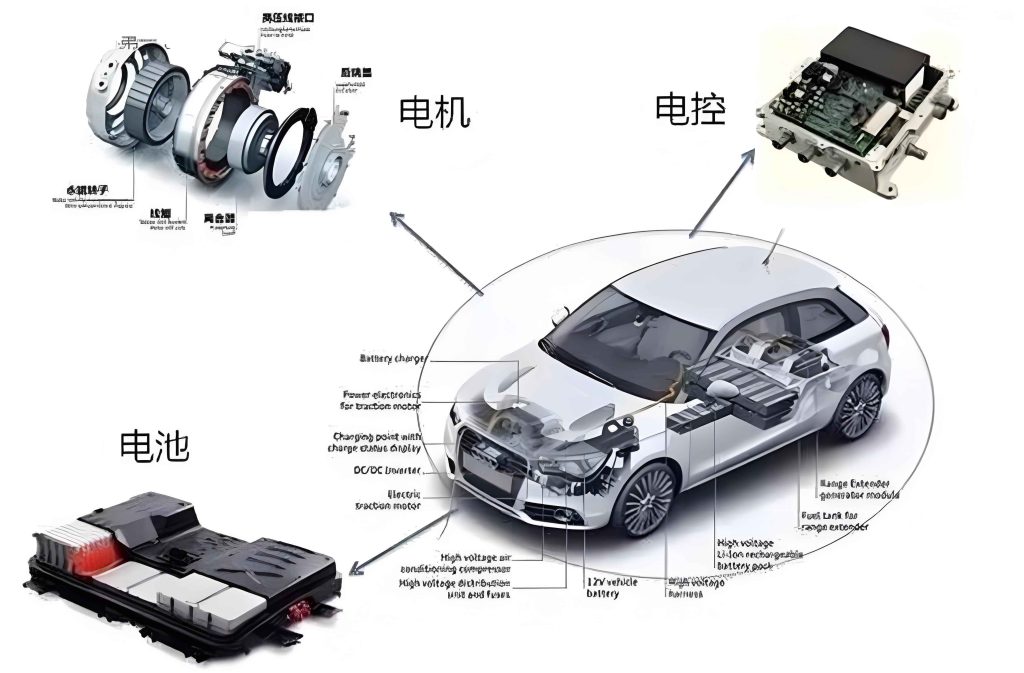
As shown in the image above, the motor control unit is a compact yet powerful device that forms the brain of modern engine systems. Integrating such visuals into my teaching via new media platforms has proven invaluable. Students can zoom in on components, discuss layouts in online forums, and even access 3D models to understand wiring connections. This hands-on visual approach demystifies the motor control unit, making it less daunting for learners. In my experience, after incorporating such resources, students show higher retention rates when quizzed on the motor control unit’s functions, such as its role in managing fuel injector pulse width based on engine load.
To elaborate on application strategies, I often design interactive scenarios where students simulate故障诊断 for a motor control unit. For instance, using virtual software, they might encounter an engine misfire and must analyze data logs from the motor control unit to pinpoint causes. This exercise reinforces theoretical knowledge through practice. I also encourage collaborative projects, such as building a simple motor control unit prototype with Arduino kits. Here, students apply formulas like Ohm’s law (\( V = IR \)) to calculate circuit parameters, linking physics to engine control. The motor control unit’s software logic can be explored through pseudo-code, which I present in tables for clarity:
| Step | Motor Control Unit Action | Mathematical Basis |
|---|---|---|
| 1. Read sensor data | Acquire throttle position \( \theta \) | \( \theta = k \cdot V_{in} \) where \( k \) is a calibration constant |
| 2. Compute fuel requirement | Calculate injection duration \( t_{inj} \) | \( t_{inj} = C \cdot \frac{m_{air}}{\rho_{fuel}} \) with \( C \) as tuning factor |
| 3. Output control signal | Send pulse to injector | Based on PID output \( u(t) \) |
This step-by-step breakdown helps students see the motor control unit as a dynamic system rather than a black box. Moreover, I frequently use online polls or quizzes to gauge understanding of the motor control unit’s algorithms, adjusting my teaching pace accordingly. For example, after a lesson on emission control, I might post a multiple-choice question about how the motor control unit adjusts air-fuel ratio using feedback from the oxygen sensor, with options derived from the formula:
$$ \lambda = \frac{AFR}{AFR_{stoich}} $$
where \( \lambda \) is the excess air ratio, \( AFR \) is the actual air-fuel ratio, and \( AFR_{stoich} \) is the stoichiometric value. Such interactive elements keep students engaged and provide immediate feedback, which is a hallmark of new media teaching.
The effectiveness of this approach is evident in student outcomes. In my surveys, most learners express appreciation for new media methods, citing enhanced clarity on topics like the motor control unit. They report better learning efficiency and quality, as they can revisit video tutorials or simulations at their own pace. For instance, when studying the motor control unit’s interaction with transmission systems, students often use online forums to share insights, fostering a community of practice. To further boost engagement, I organize virtual competitions where teams design control strategies for a motor control unit in a simulated race car. This not only sparks interest but also cultivates teamwork and innovation. However, challenges remain, such as ensuring all students participate actively; I address this by offering differentiated tasks, like simpler coding exercises for beginners or advanced tuning challenges for experts, all centered on the motor control unit.
In terms of curricular adjustments, I continuously update course materials to reflect technological advancements in motor control units. For example, with the rise of electric vehicles, I incorporate lessons on how the motor control unit manages battery and motor interactions, using formulas for power efficiency:
$$ P_{out} = \eta_{MCU} \cdot P_{in} $$
where \( P_{out} \) is the output power from the motor control unit, \( \eta_{MCU} \) is its efficiency, and \( P_{in} \) is input power from the battery. This keeps the content relevant and practical. Additionally, I leverage big data analytics from online learning platforms to track student progress on motor control unit topics, identifying areas needing reinforcement.
To conclude, the integration of new media teaching mode in automotive engine control courses has transformed my educational practice. By emphasizing interactivity, openness, and flexibility, I have seen marked improvements in student comprehension and skills, particularly regarding the motor control unit. The use of tables and formulas, as illustrated above, provides structured summaries that aid retention. Looking ahead, I plan to explore emerging technologies like augmented reality for immersive motor control unit training, ensuring that my teaching remains at the forefront of automotive education. Ultimately, this mode not only enhances learning outcomes but also prepares students for real-world challenges where the motor control unit plays a pivotal role in engine performance and sustainability.