
In recent years, as environmental and energy concerns have gained prominence, the automotive industry has faced increasing demands for sustainability. New energy vehicles (NEVs) have emerged as a pivotal solution, leveraging clean energy sources to reduce dependence on petroleum and lower CO2 emissions. From my perspective, the advancement of NEVs hinges critically on the application and optimization of electric control technologies. These technologies are evolving toward automation and informatization, yet there remains significant room for improvement. In this article, I will explore the current state of NEV development, delve into the specific applications of electric control technologies—with a focus on the motor control unit—and propose strategies for future progress, all while incorporating tables and formulas to summarize key concepts.
The proliferation of NEVs, including pure electric vehicles, hybrid electric vehicles, and fuel cell vehicles, has been remarkable. For instance, hybrid city buses exemplify the integration of advanced powertrains. Below, I present a comparison of technical parameters for various hybrid city buses, highlighting the role of electric control systems in optimizing performance.
| Manufacturer | Model | Fuel Type | Maximum Speed (km/h) | Motor Type | Battery Type |
|---|---|---|---|---|---|
| FAW Jiefang | CA6930URHEV23 | Natural Gas | 69 | Permanent Magnet Synchronous Motor | Lithium Iron Phosphate |
| Huanghai | DD6109CHEV6 | Diesel | 69 | Permanent Magnet Synchronous Motor | Lithium Manganese Oxide |
| Yaxing | JS6108GHEV17 | Diesel | 69 | Permanent Magnet Synchronous Motor | Lithium Iron Phosphate |
| Ankai | HFF6100G03CHEV23 | Natural Gas | 69 | Permanent Magnet Synchronous Motor | Lithium Manganese Oxide |
| Zhongtong | LCK6107PHEVG21 | Diesel | 69 | Permanent Magnet Synchronous Motor | Lithium Manganese Oxide |
These vehicles rely on sophisticated electric control systems to manage energy flow and ensure efficiency. In my analysis, the core of NEV electric control lies in several key areas: the battery management system, chassis system control, and transmission system control. Each of these domains involves intricate interactions with the motor control unit, which serves as a central processor for regulating motor operations. I will now detail these applications, emphasizing how the motor control unit integrates with other components to enhance vehicle performance.
Battery Management System (BMS)
The battery management system is a fundamental component of NEV electric control technology. It monitors and manages battery states, including voltage, current, and temperature of individual cells, to extend battery life and ensure safety. From my experience, a BMS typically comprises several modules: voltage acquisition, temperature acquisition, a main controller, and an均衡控制模块. The motor control unit often interfaces with the BMS to coordinate power delivery based on battery conditions.
First, the voltage acquisition module collects data from each cell using voltage sensors. This data is transmitted to a data acquisition chip and then to the main controller for analysis. The voltage of a cell can be modeled using Ohm’s law: $$V = I \cdot R + E$$ where \(V\) is the terminal voltage, \(I\) is the current, \(R\) is the internal resistance, and \(E\) is the electromotive force. This helps in detecting anomalies like overvoltage or undervoltage.
Second, the temperature acquisition module monitors internal temperature variations via temperature sensors. Battery performance degrades at extreme temperatures, so real-time monitoring is crucial. The relationship between temperature and battery efficiency can be expressed as: $$\eta(T) = \eta_0 \cdot e^{-k(T – T_0)}$$ where \(\eta\) is efficiency, \(T\) is temperature, \(\eta_0\) is reference efficiency at temperature \(T_0\), and \(k\) is a constant. The motor control unit uses this data to adjust cooling systems and prevent overheating.
Third, the main controller, often a high-performance microprocessor, oversees the entire BMS. It processes data from all modules and executes control algorithms. For example, it calculates state of charge (SOC) using integral methods: $$SOC(t) = SOC_0 – \frac{1}{C_n} \int_0^t I(\tau) d\tau$$ where \(SOC_0\) is initial SOC, \(C_n\) is nominal capacity, and \(I\) is current. The motor control unit relies on SOC estimates to optimize torque output.
Fourth, the均衡控制模块 addresses imbalances among cells by redistributing charge. This can be modeled with a balancing current equation: $$I_b = \frac{V_{\text{max}} – V_{\text{min}}}{R_b}$$ where \(I_b\) is balancing current, \(V_{\text{max}}\) and \(V_{\text{min}}\) are maximum and minimum cell voltages, and \(R_b\) is balancing resistance. The motor control unit collaborates with the BMS to ensure uniform cell usage, thereby enhancing overall battery health.
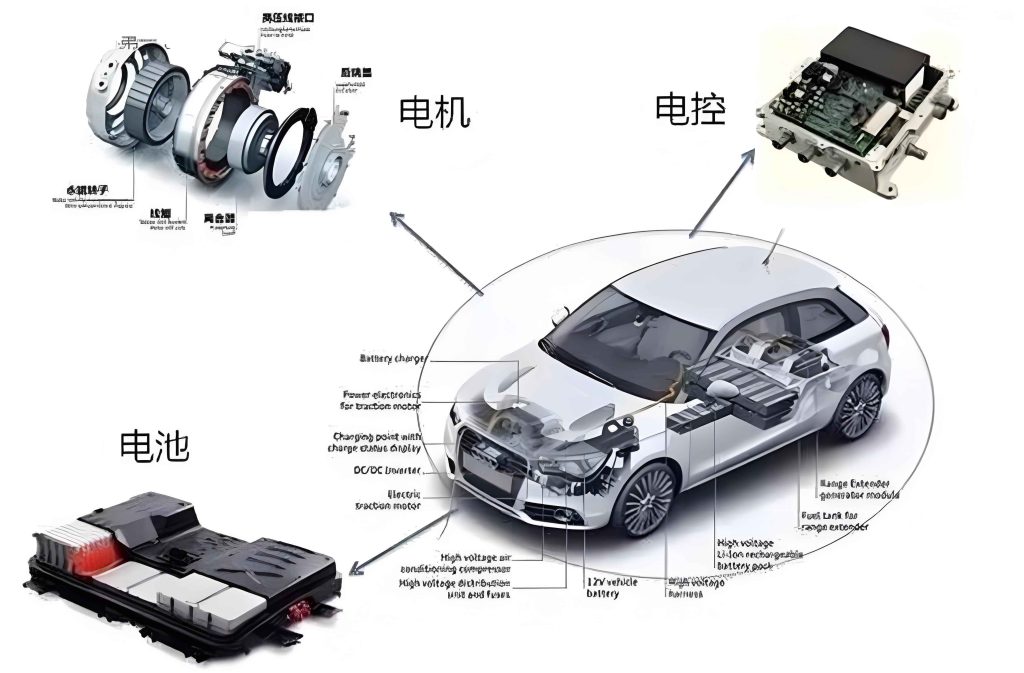
This image illustrates the integration of a motor control unit within an electric vehicle system. As seen, the motor control unit is pivotal in managing power flow between the battery and motor, highlighting its role in BMS operations. In my view, advancements in BMS technology are closely tied to improvements in the motor control unit, which enables precise control over energy distribution.
Chassis System Control Technology
The chassis system in NEVs incorporates various control technologies to enhance stability, safety, and comfort. I will break this down into制动控制系统,转向控制系统, and行驶控制系统, each involving the motor control unit for seamless operation.
Brake Control System
This system includes anti-lock braking system (ABS), electronic brakeforce distribution (EBD), and traction control system (TCS). The motor control unit plays a key role in modulating brake force and motor torque to prevent wheel lock-up or slip. For ABS, the slip ratio is critical: $$s = \frac{v – \omega r}{v} \times 100\%$$ where \(v\) is vehicle speed, \(\omega\) is wheel angular velocity, and \(r\) is wheel radius. The motor control unit adjusts braking pressure to maintain optimal slip, typically around 10-20%.
EBD optimizes brake force distribution based on load conditions. The force on each wheel can be calculated as: $$F_i = \mu_i \cdot N_i$$ where \(F_i\) is brake force, \(\mu_i\) is friction coefficient, and \(N_i\) is normal load. The motor control unit processes sensor data to allocate force dynamically.
TCS, or驱动防滑系统, prevents wheel spin during acceleration. It uses a control law: $$T_m = K_p \cdot (s_{\text{target}} – s) + K_i \int (s_{\text{target}} – s) dt$$ where \(T_m\) is motor torque, \(K_p\) and \(K_i\) are PID gains, and \(s_{\text{target}}\) is target slip ratio. Here, the motor control unit directly regulates torque output to maintain traction.
Steering Control System
Electric power steering (EPS) and electronically controlled four-wheel steering are common in NEVs. The motor control unit in EPS analyzes torque sensor inputs to determine assistive torque: $$T_a = f(\theta, v)$$ where \(T_a\) is assist torque, \(\theta\) is steering angle, and \(v\) is vehicle speed. This reduces driver effort and improves responsiveness.
For four-wheel steering, the rear wheel angle is controlled by a servo motor based on front wheel data. The relationship can be modeled as: $$\delta_r = k_1 \delta_f + k_2 \dot{\psi}$$ where \(\delta_r\) is rear wheel angle, \(\delta_f\) is front wheel angle, \(\dot{\psi}\) is yaw rate, and \(k_1, k_2\) are gains. The motor control unit coordinates these adjustments to enhance maneuverability.
Driving Control System
This encompasses adaptive suspension, cruise control, and tire pressure monitoring. The motor control unit interacts with these systems to optimize ride quality and safety. Adaptive suspension adjusts damping coefficients using: $$c = c_0 + \Delta c \cdot \sin(\omega t)$$ where \(c\) is damping coefficient, \(c_0\) is baseline damping, and \(\Delta c\) is adjustment based on road conditions. The motor control unit may supply data on vehicle dynamics to fine-tune suspensions.
Cruise control maintains constant speed by regulating throttle opening. The control equation is: $$\theta_t = K \cdot (v_{\text{set}} – v)$$ where \(\theta_t\) is throttle angle, \(v_{\text{set}}\) is set speed, and \(K\) is a gain. In NEVs, the motor control unit often handles this by adjusting motor power.
Tire pressure monitoring systems alert drivers to anomalies. Pressure changes affect rolling resistance: $$F_r = C_r \cdot P \cdot A$$ where \(F_r\) is rolling resistance, \(C_r\) is coefficient, \(P\) is pressure, and \(A\) is contact area. The motor control unit can use this data to adapt energy consumption.
Throughout these chassis systems, the motor control unit is indispensable. It processes inputs from various sensors and executes control algorithms to ensure cohesive operation. I believe that further integration of the motor control unit with chassis controls will lead to more autonomous and efficient vehicles.
Transmission System Control Technology
In NEVs, the transmission system control focuses on managing engine and motor operations for hybrid configurations. Key technologies include electronically controlled ignition and fuel injection systems, where the motor control unit coordinates with engine control units for optimal performance.
Electronically controlled ignition systems adjust ignition timing based on engine parameters. The advance angle can be computed as: $$\theta_{\text{adv}} = f(N, \dot{m}_a)$$ where \(N\) is engine speed and \(\dot{m}_a\) is air mass flow rate. The motor control unit may share data to synchronize ignition with motor torque in hybrids.
Electronically controlled fuel injection systems determine fuel delivery using sensor data. The fuel mass is given by: $$m_f = \frac{\dot{m}_a}{AFR}$$ where \(AFR\) is air-fuel ratio. In hybrids, the motor control unit helps decide when to switch between electric and engine modes, optimizing fuel efficiency.
For pure electric vehicles, the transmission is simpler, involving direct motor control. The motor control unit governs torque and speed using equations like: $$T_e = k_t \cdot I_q$$ where \(T_e\) is electromagnetic torque, \(k_t\) is torque constant, and \(I_q\) is quadrature current. This precise control is vital for smooth acceleration and regenerative braking.
Below, I summarize the key formulas discussed so far in a table for clarity.
| System | Formula | Description |
|---|---|---|
| Battery Voltage | $$V = I \cdot R + E$$ | Terminal voltage model for a cell |
| Battery Efficiency | $$\eta(T) = \eta_0 \cdot e^{-k(T – T_0)}$$ | Temperature-dependent efficiency |
| State of Charge | $$SOC(t) = SOC_0 – \frac{1}{C_n} \int_0^t I(\tau) d\tau$$ | SOC calculation using current integral |
| ABS Slip Ratio | $$s = \frac{v – \omega r}{v} \times 100\%$$ | Slip ratio for anti-lock braking |
| Motor Torque | $$T_e = k_t \cdot I_q$$ | Electromagnetic torque in motors |
These formulas underscore the mathematical foundations of electric control technologies. In practice, the motor control unit implements these models in real-time to achieve desired vehicle behaviors. As I see it, the evolution of NEVs will increasingly depend on sophisticated algorithms housed within the motor control unit.
Development Strategies for NEV Electric Control Technology
To propel NEV electric control technology forward, I propose several strategies that emphasize innovation and integration. These approaches aim to enhance the capabilities of the motor control unit and related systems.
First, leverage intelligent technologies for developing electric control water pump systems. Cooling systems are vital for NEVs, especially under high temperatures. By integrating automation and AI, we can create independent pump control mechanisms. For instance, the pump speed can be regulated using: $$P_{\text{pump}} = \alpha \cdot \Delta T + \beta$$ where \(P_{\text{pump}}\) is pump power, \(\Delta T\) is temperature difference, and \(\alpha, \beta\) are coefficients. The motor control unit can oversee this to optimize cooling efficiency, thereby protecting battery and motor components.
Second, utilize cloud platforms to strengthen the development and application of NEV electric control systems. Cloud computing enables massive data processing and machine learning for smart control. For example, energy management algorithms can be trained on historical data to predict driving patterns: $$E_{\text{pred}} = \sum_{i=1}^n w_i \cdot x_i$$ where \(E_{\text{pred}}\) is predicted energy consumption, \(w_i\) are weights, and \(x_i\) are features like speed and terrain. The motor control unit can upload data to the cloud for analysis and receive optimized control parameters in return. This facilitates remote monitoring, maintenance, and personalized services, all hinging on the motor control unit’s connectivity.
Third, research and develop water-wading sensors for NEVs. Driving through water poses risks to electric systems. An emergency monitoring module can be designed to alert users: $$A = \begin{cases} 1 & \text{if } h > h_{\text{threshold}} \\ 0 & \text{otherwise} \end{cases}$$ where \(A\) is alarm signal, \(h\) is water depth, and \(h_{\text{threshold}}\) is safe limit. The motor control unit can trigger protective measures, such as reducing power output, to prevent short circuits.
Fourth, enhance the integration of electric control technologies and components. The trend is toward “3+3+X platforms” that combine electric drive, charging, and distribution systems. For instance, integrating the motor, motor control unit, and reducer into a compact unit improves efficiency. The power output can be expressed as: $$P_{\text{out}} = \eta_{\text{int}} \cdot P_{\text{in}}$$ where \(\eta_{\text{int}}\) is integration efficiency. By self-developing these systems, automakers can achieve better performance and cost savings. The motor control unit is central to this integration, coordinating multiple functions within a unified framework.
In my opinion, these strategies will drive the motor control unit toward greater intelligence and reliability. As NEVs evolve, the motor control unit will become even more pivotal, handling complex tasks from energy management to autonomous driving. I envision a future where the motor control unit serves as the brain of the vehicle, seamlessly interfacing with all electric control systems.
Conclusion
In summary, the application and development of electric control technologies are crucial for the advancement of new energy vehicles. Through detailed exploration of battery management systems, chassis control, and transmission control, I have highlighted the integral role of the motor control unit in ensuring vehicle performance and safety. By proposing strategies like intelligent cooling, cloud-based systems, water-wading sensors, and component integration, we can foster the growth of these technologies. The motor control unit, as a key enabler, will continue to evolve, supporting the sustainable development of NEVs. I am confident that with ongoing innovation, electric control technologies will propel the automotive industry toward a cleaner, more efficient future.
To further illustrate the interdependencies, I provide a final table outlining the core functions of the motor control unit across different systems.
| System | Function of Motor Control Unit | Impact on Vehicle Performance |
|---|---|---|
| Battery Management | Regulates power flow based on SOC and temperature data | Enhances battery life and safety |
| Brake Control | Modulates motor torque for ABS and TCS operations | Improves braking stability and traction |
| Steering Control | Computes assistive torque for EPS and controls rear steering angles | Reduces driver effort and enhances maneuverability |
| Driving Control | Adjusts motor power for cruise control and suspension tuning | Ensures comfortable and efficient rides |
| Transmission Control | Coordinates motor and engine operations in hybrids | Optimizes fuel efficiency and power output |
This comprehensive analysis underscores the centrality of the motor control unit in modern NEVs. As research progresses, I anticipate breakthroughs that will further elevate the capabilities of the motor control unit, making electric vehicles more accessible and reliable for global adoption.