
As the automotive industry accelerates toward electrification and connectivity, modern vehicle electronic control systems are becoming increasingly complex, demanding higher levels of knowledge and professional skills from automotive repair technicians. Technical institutes, as vital hubs for cultivating high-level skilled talent, must adapt to industrial development needs and innovate talent training models. Theory-practice integrated teaching emphasizes the organic combination of theory and practice, highlighting work-integrated learning, and provides a framework for training high-quality skilled professionals in the field of automotive electronic control systems. However, influenced by traditional teaching concepts, technical institute instruction in automotive electronic control still tends to prioritize theory over practice, with training conditions often lagging behind actual industry environments, leading to room for improvement in talent cultivation quality. In this article, I explore theory-practice integrated teaching in automotive electronic control programs at technical institutes, aiming to foster more high-quality skilled professionals in this domain.
The significance of theory-practice integrated teaching in automotive electronic control programs is multifaceted. Firstly, it enhances students’ ability to integrate professional skills with theoretical knowledge. Automotive electronic control systems involve multidisciplinary knowledge from fields such as electrical engineering, electronics, and mechanics, possessing strong comprehensive practical characteristics. Through project-driven and task-oriented approaches, integrated teaching applies theoretical knowledge to practice, enabling students to solve problems in specific tasks and deepen their understanding of theory. By “learning through doing and practicing while learning,” students build a robust knowledge and skill system, simultaneously elevating their professional skills and theoretical literacy. For instance, in designing a “smart car competition” project, students work in teams to select sensors, control drive motors, and plan driving paths, thereby designing and building a vehicle. During the planning phase, they consult extensive materials on electronic control theory and use simulation tests to choose core components; during assembly and debugging, they apply learned knowledge to address complex issues like system matching and signal processing. This process often revolves around the motor control unit, a critical component in modern vehicles, which regulates engine or electric motor performance. Understanding its principles, such as through torque equations, is essential: $$T = k_t \cdot I$$ where \(T\) is torque, \(k_t\) is the motor torque constant, and \(I\) is current. Similarly, voltage equations for a DC motor can be expressed as: $$V = I R + k_e \omega$$ where \(V\) is voltage, \(R\) is resistance, \(k_e\) is the back-EMF constant, and \(\omega\) is angular velocity. These formulas highlight the interplay between theory and practice in mastering the motor control unit.
Secondly, integrated teaching adapts to the intelligent development needs of the automotive industry. As the industry shifts toward electrification and connectivity, it places higher demands on the knowledge updates and practical innovation abilities of automotive professionals. Technical institutes must align with these trends by incorporating new technologies and processes from areas like intelligent networking and new energy vehicles into teaching activities, cultivating skilled talents that meet actual production requirements. Theory-practice integrated teaching requires deep school-enterprise cooperation, developing courses based on industry and enterprise needs, guiding students to master cutting-edge technologies in work scenarios, and enhancing operational skills through real projects. In teaching, institutes can invite industry experts to participate in instruction, transforming单一 classroom lectures into on-site and case-based teaching, expanding content from routine maintenance to整车 control and remote diagnosis. This allows students to improve intelligent maintenance capabilities in realistic environments, boosting their comprehensive vocational proficiency in identifying and creatively solving疑难 issues. A key aspect here is the motor control unit, which is integral to electric vehicle powertrains and advanced driver-assistance systems (ADAS). For example, in新能源汽车, the motor control unit manages energy efficiency and performance, with control strategies often involving PID algorithms: $$u(t) = K_p e(t) + K_i \int_0^t e(\tau) d\tau + K_d \frac{de(t)}{dt}$$ where \(u(t)\) is the control output, \(e(t)\) is the error signal, and \(K_p\), \(K_i\), \(K_d\) are proportional, integral, and derivative gains. By integrating such concepts into projects, students gain hands-on experience with the motor control unit, preparing them for industry demands.
Thirdly, integrated teaching strengthens students’ employment competitiveness and career development potential. Currently, intelligent networking and new energy vehicles have become key trends in the automotive industry and important directions for automotive professional employment. Technical institutes must actively connect with industrial and innovation chains to cultivate comprehensive skilled talents that meet industry needs. Theory-practice integrated teaching closely aligns with用人 requirements in areas like intelligent automotive repair and new energy vehicles, guiding students to develop key abilities such as intelligent fault diagnosis and energy management. Through learning by doing and reflecting on practice, students become multi-skilled technical骨干. For example, offering courses on intelligent connected vehicle technology and new energy vehicle electronic control systems, incorporating virtual simulation, VR/AR, and other intelligent teaching methods, and building smart, digital teaching platforms allow students to design整车 control strategies and participate in activities like power battery management system design on these platforms. To ensure students’ professional abilities meet industry standards, schools and enterprises can collaborate to expand internship and employment opportunities through order-based training or modern apprenticeship systems, improving students’ intelligent automotive repair levels and enabling精准 employment. Central to this is the motor control unit, as proficiency in its calibration and troubleshooting is highly valued by employers. The following table summarizes the benefits of integrated teaching for skill development:
| Aspect | Traditional Teaching | Theory-Practice Integrated Teaching |
|---|---|---|
| Theory-Practice Integration | Separated; theory taught in isolation | Combined; theory applied in real tasks |
| Focus on Motor Control Unit | Limited to textbook descriptions | Hands-on programming and debugging |
| Industry Relevance | Often outdated | Updated with current technologies |
| Student Engagement | Passive learning | Active participation in projects |
| Employment Preparedness | Lower; skills may not match jobs | Higher; aligned with industry needs |
Despite these benefits, several issues persist in theory-practice integrated teaching for automotive electronic control programs at technical institutes. Firstly, teaching resources are often disconnected from actual work environments. Currently, some institutes rely on training equipment like teaching boards and dissected vehicles, which differ significantly from整车 electronic control systems in the intelligent networking era. Due to funding constraints, electronic control training rooms may lack core devices such as整车 control systems and high-voltage safety equipment, limiting students’ exposure to complete vehicle systems and reducing practical opportunities. This hampers their adaptation to intelligent repair positions. Additionally, training projects are often confined to单一 components or systems, lacking comprehensiveness; students miss out on global training in areas like整车 control strategy development and system integration optimization, hindering the锻炼 of engineering实践 abilities. Moreover, simulated training environments may not closely replicate real repair shops, with insufficient workstations and inadequate execution of standard operating procedures, making it difficult for students to adapt to frontline work rhythms. This disconnection between teaching and production realities leads to a “skill hollowing” phenomenon post-employment, where learned skills do not align with employer needs. A critical gap is in handling the motor control unit, as students may only encounter simplified models rather than actual units from modern vehicles.
Secondly, teaching content updates lag behind industry technological developments. In recent years, intelligent electric vehicles represented by brands like Tesla have gained widespread adoption, with breakthroughs in前沿 technologies such as L2+ autonomous driving and V2X vehicle-road coordination. However, current automotive electronic control curricula in some technical institutes still focus on traditional fuel vehicles, with minimal coverage of new energy vehicles and intelligent driving. Even when such courses are offered, content often remains at a conceptual level without practical training, failing to keep pace with industry progress. As a result, students’ acquired knowledge and skills struggle to meet the demands for automotive repair engineers in the intelligent networking era. Furthermore, course materials are not updated promptly; automotive electronic technology evolves rapidly, with new sensors and actuators widely used in最新 models, but textbooks may remain unchanged for years. This滞后性 disconnects institute talent cultivation from industry developments, impacting students’ vocational competitiveness. For instance, advancements in the motor control unit, such as integration with AI for predictive maintenance, are often omitted, leaving students unprepared for modern challenges. The table below highlights common content gaps:
| Technology Area | Industry Trend | Typical Curriculum Lag |
|---|---|---|
| Electric Vehicle Powertrains | High-voltage systems and battery management | Still emphasis on internal combustion engines |
| Motor Control Unit | Advanced algorithms for efficiency | Basic原理 only; no hands-on programming |
| Autonomous Driving | Sensor fusion and decision-making | Limited to overview lectures |
| Connectivity | 5G-V2X and over-the-air updates | Rarely covered |
Thirdly, teachers’ “dual-qualified” ability structures are imbalanced. Technical institutes require teachers to possess both theoretical teaching and practical指导 abilities, but currently, some automotive repair instructors exhibit uneven development, with theoretical prowess often overshadowing practical skills. Some teachers are well-versed in automotive electronic control theory but lack实战 experience in areas like整车 electronic control system development and fault diagnosis. In theory-practice integrated teaching, this can lead to “armchair theorizing,” where teachers struggle to guide students in holistic thinking, resulting in less targeted and effective practical instruction. Additionally, some teachers have an insufficient grasp of frontline technical needs in enterprises, with limited understanding of key technologies in intelligent networking and new energy vehicles, making it difficult to conduct实践 teaching that aligns with industrial development demands. This disconnect between teaching content and industry needs causes students to “learn without application and apply without learning.” The imperfect construction of “dual-qualified” teaching teams constrains reforms in theory-practice integrated teaching for automotive electronic control systems, affecting talent cultivation quality. Specifically, expertise in the motor control unit may be theoretical rather than based on real-world troubleshooting, limiting students’ exposure to practical scenarios. The imbalance can be represented by a simple ratio: if \(T_t\) represents theoretical knowledge and \(T_p\) represents practical skills, an ideal teacher balance might be \(T_t : T_p = 1:1\), but in reality, it often skews to \(T_t : T_p = 2:1\) or worse.
To address these challenges, optimization strategies for theory-practice integrated teaching in automotive electronic control programs are essential. Firstly, teaching environments must be optimized to promote the integration of theory and practice. Technical institutes should enhance training base construction in line with the requirements for automotive repair talents in the intelligent networking era, laying a foundation for integrated teaching. Investments in training equipment for intelligent connected vehicles and new energy vehicles should be increased, adding devices like整车 control systems and power battery management systems. Training arrangements for intelligent diagnosis and energy distribution can then be implemented, guiding students to master领先 technologies in realistic settings. Focusing on core vocational abilities in automotive electronic control, institutes can develop simulation training platforms that combine theoretical teaching with skill assessment, including modules for整车 wiring design and fault diagnosis. These platforms allow students to practice repeatedly in virtual environments, continuously improving their professional skills and analytical诊断 abilities. Furthermore, standardizing and informatizing automotive electronic control training workshops is crucial; workstation layouts should be革新, tools and器材配备完善, and training environments constructed based on enterprise workshops. Introducing industry通用 systems like ERP and PDM into training enhances students’ information technology application skills. By optimizing teaching environments, students can master industry通用 technical规范 in practice, strengthening their professional本领. For example, one institute invested in building an intelligent connected vehicle training center equipped with advanced systems like Bosch整车 control systems and dSPACE hardware-in-the-loop testing systems, designing projects for自动驾驶 algorithm implementation and intelligent cockpit human-machine interaction. Students work in groups on comprehensive training like automatic parking control and mobile App remote control, mastering key autonomous driving technologies through反复 training in theoretical analysis and hands-on practice. The institute also introduced software like CATIA and Altium Designer, guiding students in整车 wiring design and PCB design, and established a cloud platform for remote training. Students use the platform for simulations of autonomous driving functions and故障诊断预演, reinforcing their professional实践 abilities. Such intelligent teaching environments align well with the fast-paced technological迭代 in automotive electronic control, where knowledge update cycles are shortening, providing a solid basis for theory-practice integrated teaching reforms. A key component in these environments is the motor control unit, as students engage with actual units or high-fidelity simulators to understand their operation, such as through dynamic models: $$J \frac{d\omega}{dt} = T – T_L – B\omega$$ where \(J\) is inertia, \(T\) is motor torque, \(T_L\) is load torque, and \(B\) is damping coefficient. This hands-on exposure is vital for competency development.
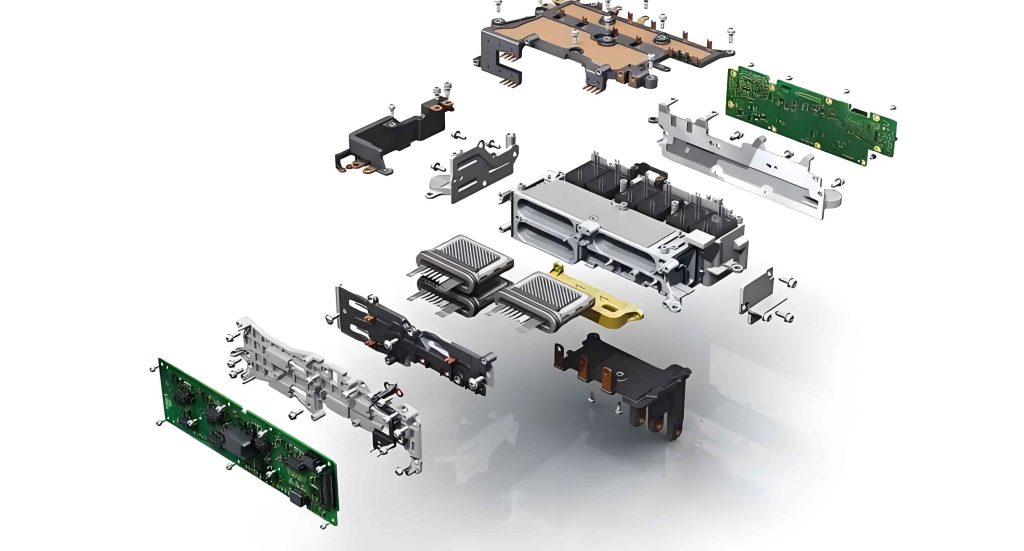
Secondly, teaching content systems must be updated to突出 ability cultivation objectives. Technical institute automotive electronic control programs should紧跟前沿 in intelligent networking and new energy vehicle technologies, optimizing content to highlight the cultivation of复合型 technical skills. First, courses should be set based on岗位 ability requirements. For the intelligent connected vehicle domain, develop特色 courses like advanced driver-assistance systems (ADAS) and autonomous driving perception-decision-control; for new energy vehicles, develop courses on power battery management systems and motor electronic control systems. Establish a “platform + module” course system, consolidating students’专业基础 while adding前沿 course modules in智能化 and网联化 technologies. Second, school-enterprise cooperation should be leveraged to develop project-based courses, introducing real enterprise projects. Teachers can collaborate with industry experts to create comprehensive training projects like intelligent fault diagnosis and new energy vehicle battery pack design optimization. Project content directly来源于企业生产一线, synchronizing with vocational standards. Student participation in actual projects ensures their professional abilities align with industry needs. Third, teaching content should emphasize前沿性 and拓展性,及时 incorporating new technologies like 5G-V2X and AI into courses to broaden students’专业视野. Encouraging students to engage in research projects allows them to grasp前沿动态 and开阔视野 through scientific实践. Optimizing content ensures students keep pace with时代发展, cultivating复合型 technical skills through deep integration with industry and enterprises. For instance, a vocational college partnered with an automotive manufacturer to develop core courses on new energy vehicle high-voltage safety and protection and power battery management technology. A joint course development team, comprising enterprise engineers and faculty, can design modules that include hands-on work with the motor control unit, such as calibrating it for different driving cycles using efficiency formulas: $$\eta = \frac{P_{out}}{P_{in}} \times 100\%$$ where \(\eta\) is efficiency, \(P_{out}\) is output power, and \(P_{in}\) is input power. The table below outlines a sample updated curriculum structure:
| Course Module | Key Topics | Integration with Motor Control Unit |
|---|---|---|
| Fundamentals of Automotive Electronics | Circuit analysis, sensors, actuators | Introduction to MCU architecture |
| Electric Vehicle Powertrains | Battery systems, motor drives | Deep dive into MCU programming |
| Intelligent Vehicle Systems | ADAS, connectivity, autonomy | MCU role in sensor fusion |
| Practical Projects | Real-world repair and design tasks | Hands-on MCU debugging and optimization |
Thirdly, teacher professional development must be promoted to enhance the teaching水平 of “dual-qualified” instructors. Teachers are key forces in driving theory-practice integrated teaching reforms; building a team with solid theoretical foundations and rich practical experience is essential to全面提升教学水平. First, teacher training should be strengthened by regularly selecting专业 teachers for placements at renowned automotive companies domestically and abroad, involving them in projects like new vehicle research and development and quality management to boost practical teaching abilities. Encouraging teachers to obtain vocational qualifications in areas like intelligent networking and new energy vehicles, and using competitions to promote learning, can be effective. Technical institutes should搭建教师成长 platforms, organizing teaching能力 competitions and lesson presentation activities to facilitate经验交流. Second, “industry-education-research” collaborative education should be advanced by hiring industry experts as兼职 teachers and establishing professional teaching guidance committees to参与 talent training plan formulation and internship指导. Teachers can collaborate with enterprise engineers on applied technology攻关, continuously improving产教融合 and科教融合 levels. Third, teaching innovation should be encouraged, with teachers adopting method reforms like case-based teaching and flipped classrooms into专业 courses. Supporting teachers in信息化教学实践, developing virtual simulation training projects, creating smart classrooms, and exploring blended online-offline teaching are crucial. For example, one technical institute implemented a “master teachers and craftsmen cultivation project,” annually sending about 10骨干 teachers to知名车企 for placements, where they participated in projects like electronic control system matching for vehicle models and battery pack design. Teachers accumulated实战 experience on the front lines, honing problem-solving skills. The institute also led in establishing a “new energy vehicle technology协同创新 center,” partnering with enterprises on research into key fuel cell vehicle technologies, yielding fruitful industry-education-research outcomes. Through diversified cultivation, batches of “dual-qualified” teachers rapidly grew, becoming中坚力量 in teaching innovation. Their expertise in the motor control unit, for instance, expanded from theory to include practical skills like using diagnostic tools to monitor MCU parameters, expressed as: $$V_{ref} = \frac{R_2}{R_1 + R_2} V_{in}$$ for sensor calibration in control circuits. This balanced development ensures effective guidance for students.
In conclusion, the rise of intelligent networking and new energy vehicles presents new opportunities and challenges for talent cultivation in automotive electronic control programs at technical institutes. To顺应 the transformation and upgrading trends of the automotive industry, it is imperative to orient toward training high-quality复合型 technical skills talents and comprehensively advance theory-practice integrated teaching reforms.加大实训基地建设力度, optimizing intelligent teaching environments, provides students with platforms for理实交融 and知行合一. By全方位推进教学改革 and打造独具特色的人才培养体系, technical institutes can leverage their人才优势 in the intelligent networking era to serve automotive强国建设. Faced with emerging new technologies and业态 in the industry, educators must勇于探索 and敢于创新, demonstrating the时代价值 of technical institutes in “提质培优 and增值赋能,” thereby supplying a continuous talent reserve and intellectual support for the high-quality development of the automotive industry. Central to this endeavor is the motor control unit, as its mastery symbolizes the integration of theory and practice, preparing students for evolving roles. Through sustained efforts in curriculum design, teacher development, and environment enhancement, we can ensure that graduates are proficient in handling complex systems, including the motor control unit, contributing to innovation and efficiency in the automotive sector. The journey requires commitment, but the rewards—in terms of skilled professionals and industry advancement—are substantial, paving the way for a future where education and technology drive progress hand in hand.