
In my assessment, the solid state battery is one of the most consequential electrochemical technologies for the next generation of energy storage. I view the solid state battery not merely as a replacement for a liquid electrolyte cell, but as a coupled chemo-mechanical system in which ion transport, interfacial reactions, stress evolution, fracture, thermal gradients, and electronic leakage interact across multiple length and time scales. My purpose here is to synthesize modeling and simulation progress for the solid state battery, concentrating on molecular dynamics, key materials and interfaces, electrochemical performance, mechanical degradation, and multiphysics coupling. I use a first-person perspective because modeling is never a neutral activity: the assumptions I choose, the scales I resolve, and the couplings I retain determine what a solid state battery model can reveal. I will repeatedly return to the solid state battery as the central object, because its promise of high specific energy and improved safety depends on controlling phenomena that are difficult to isolate experimentally.
A solid state battery replaces the porous liquid-filled separator with a solid electrolyte. This single architectural change alters nearly every transport and failure pathway. In a conventional lithium-ion cell, liquid wetting maintains large effective contact areas, and ionic transport in the electrolyte is relatively fast. In a solid state battery, contact is discrete, stress-sensitive, and vulnerable to void formation and contact loss. The solid electrolyte must conduct lithium ions rapidly while blocking electrons, resisting reduction and oxidation, accommodating volume changes, and suppressing lithium filament penetration. I therefore treat the solid state battery as a multiphysics problem rather than as a single electrochemical problem. The modeling literature mirrors this complexity: atomistic calculations explain migration barriers and interfacial stability, microstructure models describe composite electrodes and grain boundaries, continuum electrochemical models describe cell-level polarization, and coupled mechanical models explain fracture and dendrite growth.
I begin with a model hierarchy because no single model can resolve every relevant scale in a solid state battery. The hierarchy ranges from quantum and molecular descriptions to homogeneous cell-level equations. A useful solid state battery strategy is to pass parameters upward: atomistic calculations provide diffusion coefficients, elastic constants, and interfacial energies; microstructure simulations provide effective conductivity, tortuosity, and contact area; cell-level models use these effective properties to predict voltage, capacity, temperature, and stress. Conversely, cell-level observations can guide where atomistic and microstructural models should focus. This bidirectional workflow is, in my view, the most practical route toward predictive solid state battery design.
| Model family | Core idea | Primary variables | Strengths | Limitations | Typical solid state battery use |
|---|---|---|---|---|---|
| Electrochemical continuum model | Uses mass and charge conservation with reaction kinetics to describe ion transport and intercalation. | Concentration, potential, current density, overpotential. | Physical interpretability; links material parameters to voltage and capacity. | Many parameters; high computational cost when coupled to mechanics. | Electrode design, interface kinetics, cell-level polarization. |
| Equivalent circuit model | Represents cell response with resistors, capacitors, and sometimes constant-phase elements. | Voltage, current, state of charge, impedance elements. | Fast computation; convenient for real-time estimation and control. | Weak mechanistic transparency; difficult to predict degradation. | Battery management, state estimation, fast system-level simulation. |
| Thermo-electro-chemo-mechanical model | Couples electrochemistry, heat transfer, mass transport, and solid mechanics. | Concentration, potential, temperature, displacement, stress, damage. | Captures safety, fracture, contact loss, and multiphysics interactions. | Large computational demand; parameter identification is difficult. | Solid state battery stress analysis, thermal runaway, interface failure. |
| Data-driven and neural network model | Learns mappings from data without explicit governing equations. | Measured or simulated inputs and outputs. | Handles nonlinearity and complex operating conditions. | Requires large high-quality datasets; limited extrapolation. | Life prediction, state estimation, surrogate modeling of solid state battery simulations. |
At the continuum level, I describe the solid state battery using conservation laws. The flux of a charged species can be written with a Nernst-Planck form,
$$
\mathbf{J}_i = -D_i \nabla c_i – \frac{z_i F D_i}{RT} c_i \nabla \phi,
$$
where \(D_i\) is the diffusion coefficient, \(c_i\) is concentration, \(z_i\) is charge number, \(F\) is Faraday’s constant, \(R\) is the gas constant, \(T\) is temperature, and \(\phi\) is electric potential. Mass conservation gives
$$
\frac{\partial c_i}{\partial t} + \nabla \cdot \mathbf{J}_i = R_i,
$$
and charge conservation gives
$$
\nabla \cdot (\kappa \nabla \phi) = -F \sum_i z_i R_i,
$$
where \(\kappa\) is ionic or electronic conductivity and \(R_i\) is the reaction source term. Interfacial charge transfer is often represented by Butler-Volmer kinetics,
$$
i = i_0 \left[ \exp\left(\frac{\alpha_a F \eta}{RT}\right) – \exp\left(-\frac{\alpha_c F \eta}{RT}\right) \right],
$$
with exchange current density \(i_0\), anodic and cathodic transfer coefficients \(\alpha_a\) and \(\alpha_c\), and overpotential \(\eta\). For a solid state battery, the overpotential is not only electrochemical; it also contains mechanical contributions. A more complete electrochemical potential for a species under stress can be expressed as
$$
\tilde{\mu}_i = \mu_i^0 + RT \ln a_i + z_i F \phi + \Omega \sigma_h,
$$
where \(a_i\) is activity, \(\Omega\) is partial molar volume, and \(\sigma_h\) is hydrostatic stress. This coupling is central to the solid state battery because volume changes and stack pressure modify reaction driving forces, contact area, and degradation pathways.
I now turn to molecular-scale modeling. Molecular dynamics and density functional theory provide the atomistic foundation for solid state battery materials. I use molecular dynamics to track atomic trajectories, compute diffusion coefficients, and examine interfacial structure. The mean square displacement is a common observable,
$$
\mathrm{MSD}(t) = \langle |\mathbf{r}(t) – \mathbf{r}(0)|^2 \rangle,
$$
and the self-diffusion coefficient follows from the long-time limit,
$$
D = \lim_{t \to \infty} \frac{1}{6t} \mathrm{MSD}(t).
$$
Temperature dependence is often described by an Arrhenius relation,
$$
D(T) = D_0 \exp\left(-\frac{E_a}{k_B T}\right),
$$
or for ionic conductivity,
$$
\sigma(T) = \frac{\sigma_0}{T} \exp\left(-\frac{E_a}{k_B T}\right).
$$
These equations connect atomistic migration barriers to macroscopic transport in a solid state battery. I find this connection essential because the performance of a solid state battery is often limited not by bulk conductivity alone, but by grain boundaries, interfaces, voids, and contact loss.
| Atomistic or mesoscale method | Length scale | Time scale | Typical output | Role in solid state battery modeling |
|---|---|---|---|---|
| Density functional theory | Angstrom to nanometers | Picoseconds to nanoseconds | Formation energies, migration barriers, elastic constants, electronic structure. | Explains interfacial stability, reduction and oxidation limits, and ion migration pathways. |
| Ab initio molecular dynamics | Angstrom to few nanometers | Picoseconds | Temperature-dependent diffusion, structural evolution, bond dynamics. | Provides transport and structural data for solid electrolytes. |
| Classical molecular dynamics | Nanometers to tens of nanometers | Nanoseconds to microseconds | Diffusion coefficients, interfacial structure, elastic properties. | Studies grain boundaries, amorphous phases, and electrode-electrolyte contacts. |
| Kinetic Monte Carlo | Nanometers to micrometers | Microseconds to seconds | Ion hopping, phase evolution, defect-mediated transport. | Bridges atomistic barriers to mesoscale transport in solid state battery electrodes. |
| Machine learning interatomic potentials | Nanometers and beyond | Nanoseconds and longer | Fast surrogate energies and forces. | Accelerates screening of solid electrolytes and interfaces. |
I consider cathode modeling next. A high-capacity cathode in a solid state battery is usually a composite containing active material, solid electrolyte, conductive additive, and sometimes a coating. The composite nature means that ionic and electronic percolation, particle contact, and mechanical constraint all matter. Porous electrode theory remains useful because it provides effective equations for transport and reaction. A general mass balance in a porous composite can be written as
$$
\varepsilon \frac{\partial c}{\partial t} = \nabla \cdot (D_{\mathrm{eff}} \nabla c) + a_s j,
$$
where \(\varepsilon\) is porosity or volume fraction of the transport phase, \(D_{\mathrm{eff}}\) is effective diffusivity, \(a_s\) is specific surface area, and \(j\) is interfacial flux. Effective diffusivity often follows a Bruggeman-type relation,
$$
D_{\mathrm{eff}} = D_0 \varepsilon^\beta,
$$
where \(\beta\) depends on microstructure and tortuosity. In a solid state battery, \(\varepsilon\) and \(\beta\) are not fixed; they evolve with stack pressure, cycling, and damage. This is why I regard microstructure-resolved models as indispensable for the solid state battery.
An important cathode modeling issue is chemo-mechanical coupling. Active particles expand and contract during lithium insertion and extraction. The chemical strain can be written as
$$
\boldsymbol{\varepsilon}^{\mathrm{chem}} = \frac{\Omega}{3} \Delta c \, \mathbf{I},
$$
and the stress-strain relation becomes
$$
\boldsymbol{\sigma} = \mathbf{C} : (\boldsymbol{\varepsilon} – \boldsymbol{\varepsilon}^{\mathrm{chem}}),
$$
with equilibrium
$$
\nabla \cdot \boldsymbol{\sigma} = 0.
$$
These equations are simple, but their consequences for a solid state battery are profound. If the cathode particle expands against a stiff solid electrolyte, large compressive stresses develop. These stresses shift the open-circuit potential, alter reaction kinetics, and can drive fracture or interfacial delamination. I have seen in the literature that compliant solid electrolytes can accommodate volume changes and delay delamination, while rigid structures can suppress microcracking but may concentrate stress. The optimal design of a solid state battery therefore lies between these extremes.
| Cathode design variable | Physical effect | Modeling implication | Solid state battery consequence |
|---|---|---|---|
| Particle radius | Changes diffusion length and strain energy. | Affects concentration gradients and stress concentration. | Smaller particles reduce diffusion limitation but increase interfacial area. |
| Porosity | Controls ion transport pathways and mechanical compliance. | Changes effective diffusivity and modulus. | Low porosity improves contact but can reduce transport and increase stress. |
| Electrolyte volume fraction | Determines ionic percolation and load-bearing behavior. | Sets effective conductivity and stiffness. | There is a critical volume fraction below which performance collapses. |
| Interfacial coating | Suppresses side reactions and modifies charge transfer. | Adds contact resistance and mechanical interlayer. | Improves stability but can increase impedance if too thick. |
| Stack pressure | Closes voids and improves contact. | Couples mechanical deformation to transport. | Moderate pressure helps, but excessive pressure can drive fracture. |
Anode modeling in a solid state battery is dominated by lithium metal and silicon-based materials. Lithium metal offers very high capacity and low potential, but it creates severe interfacial instability. The solid state battery must suppress lithium filament growth, void formation, and contact loss. I classify lithium deposition morphologies into several modes because each has different consequences. Needle-like filaments can penetrate the electrolyte and cause short circuits. Mossy deposits create high surface area and consume lithium through interfacial reactions. Tree-like or branched deposits can grow in multiple directions and produce both capacity loss and short-circuit risk.
| Deposition morphology | Structural features | Primary risk | Modeling focus |
|---|---|---|---|
| Needle-like | Thin, elongated, directional growth. | Penetration through solid electrolyte and internal short circuit. | Stress-driven tip propagation and interfacial stability. |
| Mossy | High surface area, small diameter, porous deposit. | Dead lithium, electrolyte consumption, low Coulombic efficiency. | Surface reaction, SEI growth, and lithium inventory loss. |
| Tree-like | Branched, multidirectional growth. | Short circuits and capacity fade. | Phase-field and electrochemical growth models. |
Many lithium dendrite models in a solid state battery begin with interfacial instability. A linear stability analysis typically examines a planar interface perturbed by a small periodic displacement. The growth rate depends on current density, interfacial resistance, ionic conductivity, elastic modulus, surface energy, and partial molar volume. Although the exact expressions differ, the qualitative result is consistent: mechanical stiffness alone does not guarantee stability. Interfacial adhesion, stack pressure, defect geometry, and ion transport all matter. I therefore favor models that couple electrodeposition kinetics with finite-strain plasticity and fracture.
A useful electrochemical-mechanical framework for lithium deposition can be written by combining Butler-Volmer kinetics with a stress-dependent driving force,
$$
i = i_0 \left[ \exp\left(\frac{\alpha_a F (\eta + \eta_{\mathrm{mech}})}{RT}\right) – \exp\left(-\frac{\alpha_c F (\eta + \eta_{\mathrm{mech}})}{RT}\right) \right],
$$
where \(\eta_{\mathrm{mech}}\) represents the mechanical contribution to the local driving force. The mechanical contribution can be estimated from the normal stress at the interface,
$$
\eta_{\mathrm{mech}} = -\frac{\Omega \sigma_n}{F}.
$$
For plastic lithium, the stress state evolves according to a viscoplastic constitutive law. A generic form can be written as
$$
\dot{\boldsymbol{\varepsilon}}^p = \dot{\gamma} \frac{\partial \Phi}{\partial \boldsymbol{\sigma}},
$$
where \(\Phi\) is a yield function and \(\dot{\gamma}\) is a plastic multiplier. These equations allow a solid state battery model to capture the competition between deposition, creep, void closure, and filament growth.
Silicon-based anodes present a different challenge. Silicon undergoes very large volume changes during lithiation and delithiation. The chemical strain can reach tens of percent or more. In a solid state battery, this expansion is constrained by the solid electrolyte and surrounding composite, producing large stresses that can fracture particles and debond interfaces. A finite-strain chemo-mechanical model for silicon can be summarized by the multiplicative decomposition of the deformation gradient,
$$
\mathbf{F} = \mathbf{F}^e \mathbf{F}^{\mathrm{chem}} \mathbf{F}^p,
$$
where \(\mathbf{F}^e\) is elastic, \(\mathbf{F}^{\mathrm{chem}}\) is chemical, and \(\mathbf{F}^p\) is plastic. The Cauchy stress follows from an elastic energy density,
$$
\boldsymbol{\sigma} = \frac{1}{J^e} \frac{\partial W}{\partial \mathbf{F}^e} (\mathbf{F}^e)^T,
$$
with \(J^e = \det \mathbf{F}^e\). Phase-field damage models add a damage variable \(d\) and degrade stiffness,
$$
\mathbf{C}(d) = (1-d)^2 \mathbf{C}_0,
$$
where \(d=0\) is intact and \(d=1\) is fully broken. These models are directly relevant to the solid state battery because they predict where particle fracture and interfacial delamination begin.
I now focus on solid electrolytes, which are the distinguishing component of the solid state battery. Sulfide electrolytes, especially argyrodite phases, attract attention because of high ionic conductivity and relatively good mechanical ductility. A representative family is Li\(_6\)PS\(_5\)X with X = Cl, Br, or I. Mixed halide compositions can further tune conductivity. The following table summarizes reported ionic and electronic conductivities for several compositions, illustrating why halide and sulfur site disorder matter.
| Composition | Ionic conductivity (mS/cm) | Electronic conductivity (mS/cm) | Modeling insight for solid state battery |
|---|---|---|---|
| Li\(_{5.5}\)PS\(_{4.5}\)Cl\(_{1.5}\) | 3.9 | \(1.4 \times 10^{-5}\) | Halide substitution creates lithium vacancies and enhances transport. |
| Li\(_{5.75}\)PS\(_{4.75}\)Cl\(_{1.25}\) | 3.0 | \(2.6 \times 10^{-5}\) | Compositional disorder changes percolation and activation energy. |
| Li\(_6\)PS\(_5\)Br | 1.9 | \(4.4 \times 10^{-6}\) | Larger halide affects lattice volume and migration barrier. |
| Li\(_6\)PS\(_5\)Cl\(_{0.25}\)Br\(_{0.75}\) | 3.4 | \(1.1 \times 10^{-5}\) | Mixed halides can optimize site occupancy and vacancy concentration. |
| Li\(_6\)PS\(_5\)Cl\(_{0.5}\)Br\(_{0.5}\) | 3.9 | \(1.4 \times 10^{-5}\) | Intermediate mixing can maximize ionic conductivity. |
| Li\(_6\)PS\(_5\)Cl\(_{0.75}\)Br\(_{0.25}\) | 3.2 | \(3.7 \times 10^{-6}\) | Disorder is not always monotonic; local structure matters. |
| Li\(_6\)PS\(_5\)Cl | 2.4 | \(5.1 \times 10^{-6}\) | Baseline argyrodite structure for comparison. |
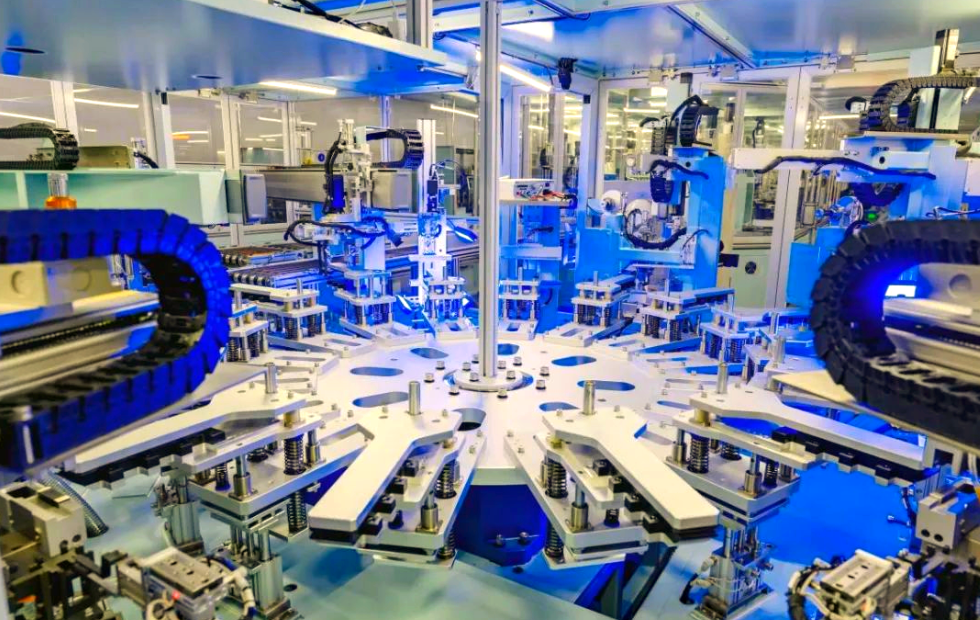
The architecture of a solid state battery cell can be represented as a sequence of solid layers and composite regions in which mechanical pressure, ionic flux, and electronic blocking must be managed simultaneously. The figure below is a useful schematic reminder that the solid state battery is a stacked, mechanically coupled system rather than a simple liquid-filled pouch.
Ion transport in a solid state battery electrolyte is often described as hopping between sites, but the real mechanism is more collective. In argyrodite and related superionic conductors, lithium ions can migrate through a network of cages, interstitial sites, and vacancies. The activation energy for hopping can be lowered by correlated motion, where one ion’s jump modifies the energy landscape for its neighbors. A simplified hopping rate follows from transition state theory,
$$
k_{\mathrm{hop}} = \nu_0 \exp\left(-\frac{\Delta G_m}{k_B T}\right),
$$
where \(\nu_0\) is an attempt frequency and \(\Delta G_m\) is the migration free energy. The macroscopic diffusion coefficient can then be approximated by
$$
D \approx \frac{1}{6} z a^2 k_{\mathrm{hop}},
$$
where \(z\) is the number of equivalent jump directions and \(a\) is the jump distance. This relation is a bridge between atomistic simulations and continuum models of a solid state battery. I use it to emphasize that improving a solid state battery requires controlling not only average conductivity but also the distribution of site energies, grain boundaries, and interfacial constrictions.
Interfaces are the most challenging part of a solid state battery. A solid-solid interface cannot spontaneously wet and heal like a liquid electrolyte. Contact area is finite, and it changes with pressure, cycling, and damage. The interfacial resistance can be written as
$$
R_{\mathrm{int}} = \frac{1}{A_{\mathrm{contact}} \sigma_{\mathrm{int}}},
$$
where \(A_{\mathrm{contact}}\) is true contact area and \(\sigma_{\mathrm{int}}\) is interfacial conductance. In a solid state battery, \(A_{\mathrm{contact}}\) is often much smaller than the geometric area. This amplifies local current density, accelerates degradation, and creates a feedback loop between electrochemistry and mechanics. I therefore model interface contact loss as a state variable rather than a fixed parameter.
Interphase formation is another critical issue. When a solid electrolyte is thermodynamically unstable against an electrode, a reaction layer can form. An ideal interphase should be ionically conductive and electronically insulating. If it is electronically conductive, it continues to grow. If it is ionically insulating, it increases resistance. The growth of an interphase can be described by a reaction-diffusion equation,
$$
\frac{\partial \xi}{\partial t} = k_r \exp\left(-\frac{E_a}{RT}\right) c_{\mathrm{Li}} (1-\xi),
$$
where \(\xi\) is the extent of reaction. Coupling this equation to stress and fracture is difficult, but necessary for a predictive solid state battery model.
Mechanical degradation in a solid state battery includes void formation, contact loss, particle fracture, electrolyte cracking, and dendrite penetration. Void formation occurs when lithium is stripped faster than it can be replenished by creep or diffusion. The void growth rate depends on current density, stack pressure, interfacial adhesion, and lithium creep. A simplified void growth condition can be written as
$$
J_{\mathrm{strip}} > J_{\mathrm{replenish}},
$$
where \(J_{\mathrm{strip}}\) is the interfacial flux and \(J_{\mathrm{replenish}}\) is the flux supplied by diffusion and creep. When this inequality holds, voids nucleate and grow. In a solid state battery, voids reduce contact area and increase local current density, which in turn promotes further void growth and filament formation.
Fracture in a solid state battery can be described by linear elastic fracture mechanics or phase-field damage. The energy release rate \(G\) is compared with a critical value \(G_c\),
$$
G \ge G_c = 2\gamma_s,
$$
where \(\gamma_s\) is surface energy. For a pressurized crack filled with lithium, the pressure \(p\) contributes to crack opening. A simplified condition for crack propagation is
$$
p \ge \sqrt{\frac{\pi E’ G_c}{2a}},
$$
where \(E’\) is the plane-strain modulus and \(a\) is crack length. This expression explains why pre-existing flaws and sharp defects are dangerous in a solid state battery: they lower the pressure required for propagation. It also explains why surface roughness and processing defects must be controlled.
| Degradation mode | Driving force | Key variables | Modeling approach | Impact on solid state battery |
|---|---|---|---|---|
| Void formation | Lithium stripping faster than creep or diffusion replenishment. | Current density, stack pressure, creep rate, contact area. | Electro-chemo-mechanical continuum models. | Increases impedance and promotes current focusing. |
| Contact loss | Volume change, void growth, interfacial debonding. | Interfacial energy, adhesion, modulus mismatch. | Cohesive zone and contact mechanics. | Reduces active area and capacity. |
| Particle fracture | Diffusion-induced stress and phase transformation. | Particle size, strain, fracture energy. | Phase-field damage and finite element analysis. | Loss of electronic contact and capacity fade. |
| Electrolyte cracking | Tensile stress, flaw size, stack pressure. | Fracture toughness, modulus, defect geometry. | Fracture mechanics and phase-field models. | Opens pathways for dendrite penetration. |
| Dendrite penetration | Electrodeposition at defects and grain boundaries. | Interfacial kinetics, conductivity, stress, plasticity. | Coupled electrochemical-mechanical phase-field models. | Short circuit and safety failure. |
| Interphase growth | Thermodynamic instability at electrode-electrolyte contact. | Reaction energy, electronic conductivity, ionic conductivity. | Reaction-diffusion and moving boundary models. | Impedance rise or continued electrolyte consumption. |
I now discuss cell-level electrochemical modeling. The classical pseudo-two-dimensional model is not directly applicable to a solid state battery because there is no liquid electrolyte filling a porous separator. Nevertheless, its structure is instructive: transport in the electrolyte, transport in active particles, and interfacial kinetics are solved together. For a solid state battery, I replace liquid-phase transport with solid electrolyte transport and add mechanical contact. A one-dimensional solid state battery model often includes
$$
\frac{\partial c_s}{\partial t} = \frac{1}{r^2} \frac{\partial}{\partial r} \left( r^2 D_s \frac{\partial c_s}{\partial r} \right),
$$
for spherical active particles,
$$
\frac{\partial c_e}{\partial t} = \nabla \cdot (D_e \nabla c_e) + \frac{a_s}{F} i_{\mathrm{int}},
$$
for the solid electrolyte, and
$$
\nabla \cdot (\kappa \nabla \phi) = a_s i_{\mathrm{int}},
$$
for charge conservation. The interfacial current \(i_{\mathrm{int}}\) is given by Butler-Volmer kinetics with a stress-dependent overpotential. These equations form the backbone of many solid state battery simulations.
Thermal coupling is also essential. A solid state battery can generate heat through ohmic losses, reaction polarization, and entropy changes. The energy balance can be written as
$$
\rho C_p \frac{\partial T}{\partial t} = \nabla \cdot (k \nabla T) + Q_{\mathrm{ohm}} + Q_{\mathrm{rxn}} + Q_{\mathrm{rev}},
$$
where \(Q_{\mathrm{ohm}}\) is Joule heating, \(Q_{\mathrm{rxn}}\) is irreversible reaction heat, and \(Q_{\mathrm{rev}}\) is reversible entropic heat. Temperature affects diffusion, conductivity, reaction rates, and mechanical properties. In a solid state battery, thermal gradients can also produce thermal stress,
$$
\boldsymbol{\sigma}^{\mathrm{th}} = \mathbf{C} : \boldsymbol{\alpha} (T – T_0),
$$
where \(\boldsymbol{\alpha}\) is the thermal expansion tensor. This thermal stress adds to chemical stress and can accelerate fracture or delamination.
| Physical field | Primary variable | Governing equation | Coupling to other fields | Solid state battery significance |
|---|---|---|---|---|
| Mass transport | Concentration \(c\) | \(\partial c/\partial t + \nabla \cdot \mathbf{J} = R\) | Potential, stress, temperature | Controls ion supply, concentration polarization, and phase evolution. |
| Charge transport | Potential \(\phi\) | \(\nabla \cdot (\kappa \nabla \phi) = -F \sum z_i R_i\) | Concentration, reaction rate | Determines ohmic loss and current distribution. |
| Mechanics | Displacement \(\mathbf{u}\), stress \(\boldsymbol{\sigma}\) | \(\nabla \cdot \boldsymbol{\sigma} = 0\) | Concentration, temperature, damage | Controls contact, fracture, void growth, and dendrite penetration. |
| Thermal | Temperature \(T\) | \(\rho C_p \partial T/\partial t = \nabla \cdot (k \nabla T) + Q\) | All transport and reaction parameters | Affects safety, rate capability, and thermal stress. |
| Damage | Damage variable \(d\) | Phase-field or cohesive law | Mechanics, transport, interfacial resistance | Represents cracks, contact loss, and degradation. |
Multiphysics coupling in a solid state battery is not optional. It is the central modeling challenge. I use a modular approach: first validate each single-physics model, then add couplings one by one. For example, I can start with an electrochemical model and compare it to rate-capability data. I then add thermal coupling and check temperature rise. I then add mechanical coupling and examine stress and contact evolution. Finally, I add damage and interfacial resistance. This workflow reduces the risk of hiding errors inside a large coupled model.
Electrochemical performance simulation of a solid state battery often focuses on rate capability, capacity utilization, and impedance. Design parameters include cathode thickness, electrolyte thickness, particle radius, porosity, stack pressure, and operating temperature. Increasing cathode thickness can increase areal capacity but also increases transport distance and stress. Decreasing electrolyte thickness reduces ohmic resistance but increases the risk of short circuits and may reduce mechanical integrity. These trade-offs are summarized below.
| Design parameter | Increase effect | Decrease effect | Modeling response | Solid state battery optimization target |
|---|---|---|---|---|
| Cathode thickness | Higher areal capacity but longer transport path and larger stress. | Lower capacity but better rate and lower stress. | Solve 1D or 2D transport with stress coupling. | Balance energy density and rate capability. |
| Electrolyte thickness | Higher resistance and lower short-circuit risk. | Lower resistance but higher leakage and mechanical risk. | Solve charge transport and fracture probability. | Minimize resistance while maintaining safety. |
| Particle radius | Longer diffusion path and higher strain energy. | Shorter diffusion path but more interfaces. | Solve spherical diffusion and stress concentration. | Reduce diffusion limitation without excessive interfacial area. |
| Porosity | Better transport but lower contact and modulus. | Better contact but poorer transport and higher stress. | Compute effective conductivity, diffusivity, and stiffness. | Maintain percolation and mechanical compliance. |
| Stack pressure | Closes voids and improves contact. | May increase void growth and contact loss. | Couple contact mechanics, creep, and interfacial resistance. | Find pressure window for stable cycling. |
| Temperature | Improves kinetics and transport. | Slows kinetics and transport. | Use Arrhenius parameterization. | Manage thermal gradients and safety. |
| Current density | Higher power but larger gradients and stress. | Lower power but more uniform utilization. | Solve nonlinear Butler-Volmer and transport equations. | Maximize power without degradation. |
I also emphasize that the solid state battery cannot be understood through bulk properties alone. Grain boundaries, cracks, and interfaces often control failure. For example, a high bulk shear modulus does not guarantee dendrite suppression. Lithium can penetrate through grain boundaries, pores, and pre-existing flaws. Interfacial adhesion and stack pressure can be more important than bulk stiffness. This insight has shifted my view of solid state battery design: the goal is not to make every component as stiff as possible, but to design a mechanically and electrochemically compatible stack.
Data-driven methods are becoming important for the solid state battery. Machine learning can screen solid electrolytes, predict elastic properties, and accelerate parameter estimation. A typical workflow uses atomistic or continuum simulations to generate a training set, then trains a surrogate model to map composition or microstructure to performance. The surrogate can be used for optimization. However, I remain cautious: a data-driven solid state battery model is only as good as its training distribution. Extrapolation to new chemistries or extreme conditions can fail. Hybrid models that combine physical conservation laws with machine-learned constitutive relations are more promising.
Let me summarize the modeling workflow I would use for a solid state battery. First, I define the length scale and question. If the question is about migration barriers, I use density functional theory or ab initio molecular dynamics. If the question is about grain boundary transport, I use classical molecular dynamics or kinetic Monte Carlo. If the question is about composite electrode performance, I use microstructure-resolved finite element or finite volume models. If the question is about cell-level rate capability, I use a reduced-order electrochemical model. If the question is about safety, I use a coupled thermo-electro-chemo-mechanical model. Finally, I validate against independent experiments whenever possible.
| Modeling question | Recommended scale | Key outputs | Validation strategy | Solid state battery application |
|---|---|---|---|---|
| What limits ionic conductivity? | Atomistic | Migration barriers, site occupancies, diffusion coefficients. | Impedance spectroscopy, nuclear magnetic resonance, diffraction. | Electrolyte composition and doping. |
| How do grain boundaries affect transport? | Mesoscale | Grain boundary conductivity, percolation pathways. | Microscopy, tomography, impedance. | Electrolyte processing and sintering. |
| How does contact area evolve? | Microstructure to cell | True contact area, local current density, stress. | Pressure-dependent impedance, operando imaging. | Stack pressure and interface design. |
| When do voids form? | Continuum coupled | Void growth rate, contact loss, impedance rise. | Operando microscopy, voltage relaxation. | Anode interface engineering. |
| When do dendrites penetrate? | Coupled phase-field and fracture | Critical current density, defect sensitivity, stress fields. | Critical current measurements, post-mortem analysis. | Electrolyte toughness and interfacial adhesion. |
| How does the cell age? | System-level data-driven and physical | Capacity fade, resistance growth, remaining life. | Cycle-life testing, differential voltage analysis. | Battery management and lifetime prediction. |
In my view, several common scientific and engineering problems remain unsolved for the solid state battery. First, failure mechanisms are still not fully resolved. Modeling can provide predictions when direct characterization is difficult, but the models need better parameterization. Second, characterization methods for sulfide-based solid state battery materials are limited by air sensitivity. This makes validation difficult. Third, low negative-to-positive capacity ratio operation demands high utilization and stability of both electrodes. Interfacial coatings and stable interlayers are needed. Fourth, scalable synthesis of air-stable sulfide electrolytes with high ionic conductivity remains a challenge. Fifth, thin and mechanically robust electrolyte membranes are needed. Sixth, manufacturing processes and equipment for solid state battery production must be developed and scaled.
| Research priority | Why it matters | Modeling contribution | Expected impact on solid state battery |
|---|---|---|---|
| Failure mechanism prediction | Experiments cannot always isolate coupled mechanisms. | Multiphysics models with damage and interfacial evolution. | Accelerates design of stable interfaces and electrolytes. |
| Advanced characterization | Air-sensitive materials limit direct observation. | Model-guided interpretation of spectra and imaging. | Improves parameter reliability for solid state battery models. |
| Low N/P ratio operation | High energy density requires thin lithium and high cathode utilization. | Couples anode, cathode, and interface models. | Improves capacity and cycle life. |
| Air-stable sulfide electrolytes | Moisture sensitivity hinders processing and manufacturing. | Atomistic screening of dopants and coatings. | Enables scalable solid state battery production. |
| Thin electrolyte membranes | Low resistance and high energy density require thin separators. | Mechanical and transport modeling of thin films. | Balances performance and safety. |
| Manufacturing process optimization | Cost and yield depend on scalable processes. | Process-structure-property simulations. | Accelerates commercialization of the solid state battery. |
I also want to highlight the role of artificial intelligence in solid state battery modeling. Machine learning can accelerate the discovery of new solid electrolytes, predict interfacial stability, and reduce the computational cost of molecular dynamics. However, I do not see machine learning as a replacement for physical models. Instead, I see it as a surrogate and screening tool. A physics-based solid state battery model can generate high-quality data, and a machine-learned model can then interpolate or optimize. The combination is more powerful than either alone.
Another important direction is the development of coupled chemical-mechanical continuum theories that can handle phase transformations and interphase growth. In a solid state battery, new phases can form at interfaces and within electrolytes. These phases have different molar volumes, elastic moduli, and ionic conductivities. Their growth can generate stress, crack the surrounding material, and change transport pathways. A general framework must include mass conservation, momentum conservation, energy conservation, and reaction kinetics. I write a simplified coupled system as follows:
$$
\frac{\partial c}{\partial t} = \nabla \cdot \left[ D \left( \nabla c + \frac{c \Omega}{RT} \nabla \sigma_h \right) \right] + R,
$$
$$
\nabla \cdot \boldsymbol{\sigma} = 0,
$$
$$
\boldsymbol{\sigma} = \mathbf{C} : (\boldsymbol{\varepsilon} – \boldsymbol{\varepsilon}^{\mathrm{chem}} – \boldsymbol{\varepsilon}^{\mathrm{th}} – \boldsymbol{\varepsilon}^p),
$$
$$
\rho C_p \frac{\partial T}{\partial t} = \nabla \cdot (k \nabla T) + Q.
$$
These equations are not new individually, but their simultaneous solution for a solid state battery is challenging. The coupling terms are nonlinear and history-dependent. Damage changes conductivity and diffusivity. Stress changes reaction kinetics. Temperature changes all parameters. Interface contact area changes with deformation. A predictive solid state battery model must handle these feedback loops.
I now consider three-dimensional modeling. One-dimensional models are efficient and useful for parameter studies, but they cannot capture particle arrangement, local current focusing, or heterogeneous contact. Two-dimensional and three-dimensional models can resolve these effects. Microstructure-resolved models use tomography or synthetic structures to represent active particles, solid electrolyte, pores, and cracks. They can compute effective transport properties and stress distributions. The challenge is computational cost. I expect that reduced-order models and machine-learned surrogates will make three-dimensional solid state battery simulations more practical.
For cell-level design, I would combine the following steps. First, I generate a representative microstructure of the composite cathode. Second, I compute effective ionic and electronic conductivity, tortuosity, and elastic properties. Third, I build a continuum cell model with those effective properties. Fourth, I couple the cell model to thermal and mechanical fields. Fifth, I calibrate and validate against electrochemical impedance, rate tests, and pressure-dependent measurements. Sixth, I use the model to explore design windows. This workflow is computationally demanding, but it is the most rigorous path I know for designing a solid state battery with high energy density and long life.
I also note that the solid state battery literature often reports conflicting trends because the materials and interfaces are not identical. For example, one study may find that increasing stack pressure improves performance, while another may find that it accelerates degradation. The difference often lies in the initial microstructure, surface roughness, and interfacial chemistry. This is why I insist on microstructure-aware modeling. A solid state battery model that ignores the true contact area can fit one dataset but fail to predict another. A model that includes contact area, stress, and interfacial resistance has a better chance of transferability.
Let me also discuss equivalent circuit models in the context of the solid state battery. They remain useful for real-time management because they are fast. However, their parameters are not directly tied to physical degradation. I prefer hybrid approaches: use a physics-based solid state battery model offline to generate training data, then fit a reduced-order equivalent circuit or neural network for online use. This gives both physical insight and computational speed. The online model can estimate state of charge, state of health, and power capability. The offline model can explain why the parameters change.
Safety modeling is another critical area. A solid state battery is often described as safer because it lacks flammable liquid electrolyte, but it is not intrinsically risk-free. High-energy density, lithium metal, and reactive sulfide electrolytes can still pose hazards. Thermal runaway can be triggered by internal short circuits, mechanical damage, or excessive temperature. Multiphysics modeling can identify hot spots, predict thermal propagation, and evaluate the effectiveness of safety features. I would couple electrochemical-thermal models with mechanical damage models to predict short-circuit initiation. I would also include electronic conductivity of the solid electrolyte, because even small electronic leakage can lead to self-discharge and localized heating.
In terms of numerical methods, finite element, finite volume, and finite difference methods are commonly used for solid state battery simulations. Finite element methods are well suited to mechanical coupling and complex geometries. Finite volume methods conserve mass and charge well and are useful for transport. Finite difference methods are simple and efficient for one-dimensional models. Kinetic Monte Carlo and molecular dynamics use different numerical frameworks. Multiscale coupling can be achieved through parameter passing, concurrent coupling, or sequential coupling. I find sequential coupling most practical for the solid state battery because it allows each scale to be validated independently.
I want to end with a forward-looking perspective. The solid state battery is not a single material problem; it is a system problem. The electrolyte, cathode, anode, interfaces, stack pressure, and manufacturing process must be co-designed. Modeling and simulation are the only practical way to explore this large design space. I expect the following developments to be most impactful. First, more accurate interatomic potentials for sulfide electrolytes and interfaces. Second, microstructure-resolved models that use real three-dimensional tomography data. Third, coupled chemo-mechanical models that include plasticity, fracture, and contact. Fourth, machine-learned surrogates that accelerate optimization. Fifth, standardized protocols for parameter measurement and model validation. Sixth, open datasets that allow models to be compared on common ground.
If I were to state a central thesis, it is this: the solid state battery will be commercialized not by a single breakthrough material, but by the integration of materials, interfaces, and mechanics. Modeling must therefore be integrative. Atomistic calculations alone cannot predict cell life. Cell-level models alone cannot explain dendrite penetration. Microstructure models alone cannot optimize stack pressure. Only coupled models can capture the feedback loops that govern the solid state battery. I am optimistic that continued progress in multiscale modeling, data science, and experimental validation will accelerate the solid state battery from laboratory prototypes to mass production. The solid state battery is difficult, but it is not intractable. With the right models, I believe we can design it with far fewer trial-and-error cycles and with a deeper understanding of why it works, why it fails, and how to make it last.