
I approach residential electric vehicle charging as a system problem rather than a simple hardware problem. The rapid growth of electric vehicle ownership has made charging access a decisive factor in whether clean mobility remains convenient, affordable, safe, and equitable. In my assessment, the most important lesson is that residential electric vehicle charging cannot be solved by allowing each household to act alone. The physical limits of a community power network, the safety risks of uncoordinated installation, and the ambiguity of responsibility among owners, property managers, service providers, and public authorities all point toward a more organized model. I therefore analyze the current situation of residential electric vehicle charging, the logic of the unified build and unified service model, its advantages, and its likely development trends. I use quantitative formulas and structured tables to make the argument transparent and repeatable.
My central argument is straightforward: residential electric vehicle charging should be planned, built, operated, and maintained as shared infrastructure. Uncoordinated private charging may appear faster at the beginning, but it often creates capacity bottlenecks, safety hazards, unfair access, and fragmented accountability. A unified model, supported by orderly charging, professional installation, digital monitoring, insurance, and community governance, can deliver much more electric vehicle charging capacity from the same network while improving reliability and user experience. This is why I regard the shift from scattered charging points to organized electric vehicle charging services as both a technical upgrade and an institutional innovation.
1. My Analytical Framework
I begin with a system boundary that includes the community transformer, the low-voltage distribution network, the charging equipment, the communication and control platform, the service operator, the property manager, the owners, and the public oversight platform. My framework evaluates residential electric vehicle charging across six dimensions: capacity, safety, equity, service quality, economics, and governance. These dimensions interact. For example, a capacity constraint can be partially relieved by orderly charging, but only if the governance model allows the operator to coordinate charging schedules and only if users trust the service.
| Dimension | Key Question | Primary Evidence | Decision Consequence |
|---|---|---|---|
| Capacity | How much electric vehicle charging load can the network support without compromising daily life? | Transformer rating, base load, spare capacity, simultaneity factor | Determines whether new charging points can be connected and how many |
| Safety | Are installation, operation, fault detection, and maintenance safe? | Protection settings, cable quality, inspection records, fault alarms | Determines risk controls and insurance requirements |
| Equity | Can all residents access electric vehicle charging fairly? | Parking allocation, queue rules, public versus private charge points | Determines social acceptance and dispute risk |
| Service quality | Is charging convenient, reliable, and transparent? | Uptime, response time, charging success rate, user feedback | Determines utilization and satisfaction |
| Economics | Is the investment sustainable for operators and users? | Capital cost, utilization, tariff, maintenance cost, payback period | Determines long-term viability |
| Governance | Who plans, permits, operates, monitors, and resolves disputes? | Contracts, responsibility matrix, data sharing, community rules | Determines accountability and conflict resolution |
I use a demand-first calculation to estimate the electric vehicle charging load in a community. If the number of electric vehicles in the community is N, their average daily driving distance is d, and their average electricity consumption is e per unit distance, then the daily charging energy demand is given by the following expression:
$$E_{daily} = N \cdot d \cdot e$$
This daily energy demand must be translated into a design load. If the effective charging window is T hours, the charging efficiency is eta, and the system diversity or simultaneity factor is f, the required electrical capacity for electric vehicle charging can be approximated as follows:
$$P_{design} = \frac{E_{daily} \cdot f}{T \cdot \eta}$$
The available capacity for electric vehicle charging is not the full transformer rating. I must subtract the existing base load and a reserve margin for reliability and future growth. If the transformer rated capacity is C, its acceptable loading factor is phi, the base residential load is L, and the reserved capacity is R, then the available electric vehicle charging capacity is as follows:
$$C_{avail} = C \cdot \phi – L – R$$
From this, I can estimate the maximum number of charge points that can operate simultaneously, or the maximum number of vehicles that can be served within a charging window, depending on whether the community adopts uncontrolled electric vehicle charging or orderly electric vehicle charging. Under simple uncontrolled charging, the supportable number of simultaneous charge points is as follows:
$$N_{sim} = \left\lfloor \frac{C_{avail}}{p_{avg}} \right\rfloor$$
Under orderly electric vehicle charging, time and power can be shifted. If the average energy required per charging session is E-bar and the effective charging window is T, a rough upper bound on the number of sessions served per day by a given available capacity is as follows:
$$N_{session} \approx \left\lfloor \frac{C_{avail} \cdot T}{\bar{E}} \right\rfloor$$
These formulas are intentionally simple, but they reveal a core insight: the number of electric vehicle charging points is not the same as the number of simultaneous charging events, and the number of simultaneous charging events is not the same as the number of vehicles that can be served over a day. Orderly electric vehicle charging changes the feasible set by controlling when and at what power each vehicle charges.
I also use a basic optimization representation for orderly electric vehicle charging. Suppose each vehicle i has a required energy amount E_i and a deadline by which it must be ready. The operator chooses charging power p_i(t) over time t subject to the community capacity limit. A generic formulation is as follows:
$$\max \sum_{i=1}^{N} u_i\left(E_i^{delivered}\right) – \lambda \sum_{t=1}^{T} \max\left(0, \sum_{i=1}^{N} p_i(t) – C_{avail}(t)\right)$$
$$0 \le p_i(t) \le p_i^{max}, \quad E_i^{delivered} = \sum_{t=1}^{T} \eta_i p_i(t) \Delta t, \quad E_i^{delivered} \le E_i^{need}$$
Here u_i is a user utility function, lambda is a penalty for exceeding the available capacity, and eta_i is the charging efficiency. In practice, I prefer to formulate the problem as a constrained maximization of delivered energy or a minimization of delay, because those objectives are easier to explain to residents and regulators. The important point is that orderly electric vehicle charging is not a vague promise; it is a measurable scheduling problem.
For safety and reliability, I use two additional constructs. The first is a risk score that combines probability and severity. If P is the probability of an incident and S is the severity, then the risk score is as follows:
$$R = P \cdot S$$
The second is availability, which I use to judge the service quality of electric vehicle charging infrastructure. If MTBF is the mean time between failures and MTTR is the mean time to repair, then availability is as follows:
$$A = \frac{MTBF}{MTBF + MTTR}$$
These formulas matter because residential electric vehicle charging is not only about adding plugs. It is about ensuring that the plugs are connected safely, controlled intelligently, maintained professionally, and governed accountably.
2. The Current State of Residential Electric Vehicle Charging
In my reading of the evidence, residential electric vehicle charging today is caught between rapid demand growth and legacy infrastructure. New communities may be designed with more capacity and more charging provisions, but older communities were built before electric vehicle charging loads were considered. Even in new communities, the presence of capacity does not automatically guarantee fair access or professional operation. The current state therefore has three dominant features: a power capacity bottleneck, cumulative safety hazards, and unclear responsibilities among multiple parties.
2.1 The Power Capacity Bottleneck
I see the power capacity bottleneck as the hardest constraint in residential electric vehicle charging. A community transformer and low-voltage network are designed around diversified residential loads. Electric vehicle charging is a new, concentrated, and potentially simultaneous load. If many residents install chargers without coordination, the aggregate load can exceed the transformer rating or overload specific feeders and branch circuits. The risk is not merely inconvenience. It includes voltage deviation, protection tripping, cable overheating, and in the worst case, electrical fire.
The fairness problem is equally important. If a community has a small amount of spare capacity and the first residents install private chargers, they may occupy the available capacity before others purchase electric vehicles. Later adopters then find that they cannot install electric vehicle charging equipment, even though they have the same need. This creates a first-mover advantage that is difficult to justify. In my view, a capacity allocation rule must be transparent, and the best way to preserve fairness is to plan electric vehicle charging at the community level rather than the household level.
| Setting | Typical Capacity Condition | Main Electric Vehicle Charging Challenge | My Preferred Response |
|---|---|---|---|
| Older community with limited transformer capacity | Base load close to design limit; little spare capacity | Uncontrolled private charging can overload the network | Community-level orderly charging with strict load control and phased deployment |
| Renovated community with partial spare capacity | Some spare capacity but uneven feeder distribution | Early private installations may block later users | Shared capacity pool, reservation rules, and public charge points |
| New community with designed charging provisions | Higher spare capacity and dedicated circuits | Risk of fragmented operation and weak maintenance | Unified service contract, digital monitoring, and common standards |
| Mixed-use community | Residential, commercial, and parking loads interact | Complex load profiles and unclear ownership of common areas | Integrated energy management and clear stakeholder agreements |
I have repeatedly observed that the bottleneck is often not the total annual energy but the peak power. A community may have enough energy over a day, yet a few simultaneous fast-charging events can create a peak that the network cannot tolerate. This is why I distinguish between energy capacity and power capacity. The daily energy formula tells me whether the community can serve the total demand; the peak power formula tells me whether it can serve that demand at the same time. Orderly electric vehicle charging addresses the peak by shifting flexible sessions away from the peak and by limiting the power of each session when necessary.
If I define the community load profile as L_total(t) = L_base(t) + L_EV(t), the capacity constraint is as follows:
$$L_{base}(t) + L_{EV}(t) \le C \cdot \phi \quad \forall t$$
This constraint is simple, but it has strong implications. It means that electric vehicle charging must be actively managed if the community load is close to the limit. The operator cannot simply add more chargers and hope that residents will charge at different times. Hoping is not a control strategy. A managed electric vehicle charging service must measure the load, predict the need, schedule the sessions, and enforce limits in real time.
2.2 Cumulative Safety Hazards
I regard safety as the second major challenge in residential electric vehicle charging. In a fragmented model, individual owners may hire different installers, use different materials, and apply different protection settings. The meter-side connection may be handled by the utility, but the customer-side wiring and the charging equipment are often the responsibility of the owner. Many owners do not have professional electrical knowledge. They may not know whether the cable size is adequate, whether the protection device is correctly selected, whether the earthing system is reliable, or whether the installation follows the manufacturer’s requirements. The result is a hidden risk that grows with every new private charger.
Safety hazards also accumulate over time. A charger that works well on the first day may degrade after years of exposure to moisture, dust, vibration, and thermal cycling. Without regular inspection, a loose connection or a damaged cable may go unnoticed. In a fragmented model, there may be no single party responsible for periodic testing, no centralized alarm system, and no common insurance arrangement. When an incident occurs, responsibility may be disputed, and compensation may be delayed. This is not only a technical problem; it is a governance problem.
| Risk Source | How It Appears | Potential Consequence | Control I Recommend |
|---|---|---|---|
| Improper cable selection | Undersized cable for the charger rating | Overheating, voltage drop, insulation damage | Standardized design review and verified bill of materials |
| Weak protection coordination | Breaker or residual current device not matched to the circuit | Failure to trip, nuisance tripping, fire risk | Central protection design and commissioning tests |
| Poor earthing | Inadequate grounding or bonding | Electric shock risk and equipment damage | Mandatory earthing inspection and periodic testing |
| Unprofessional installation | Loose terminals, poor routing, damaged insulation | Hot spots, short circuits, arc faults | Certified installers and post-installation inspection |
| No maintenance | No periodic inspection or fault diagnosis | Hidden degradation and sudden failure | Preventive maintenance and remote monitoring |
| No insurance | Liability unclear after property loss | Disputes and delayed compensation | Product liability and public liability coverage |
I use the risk score R = P · S to prioritize controls. A high-probability, low-severity event may require routine inspection, while a low-probability, high-severity event may require engineering redundancy and insurance. In residential electric vehicle charging, the most serious risks are low-probability but high-severity electrical fires or shock events. That is why I do not accept a purely market-driven approach in which every owner installs equipment independently. The consequences of a single failure can affect the whole building, so the safety of electric vehicle charging has a public dimension.
I also apply a simple reliability metric to electric vehicle charging services. If a charger is unavailable for a long time, users lose confidence and may revert to unsafe adapters or inconvenient alternatives. Availability A = MTBF / (MTBF + MTTR) should be monitored for each charger, each branch, and the whole community. A unified service operator can use remote diagnostics to reduce MTTR, and can use preventive maintenance to increase MTBF. In my view, availability is a better service indicator than the raw number of installed charge points.
2.3 Fragmented Responsibilities
The third current problem is fragmented responsibility. Residential electric vehicle charging involves owners, property managers, owners’ committees, utilities, charging operators, equipment vendors, insurers, and public authorities. When no party is clearly designated as the lead, the result is often multiple approvals, overlapping claims, and no one accountable for the end-to-end service. A resident may receive permission to install a charger but later find that no one is responsible for maintenance. A property manager may be asked to resolve a capacity dispute but may lack the technical information to do so. An operator may install equipment but may not control the upstream capacity.
I have found that fragmented responsibility creates a specific failure mode: the “no man’s land” between the meter and the parking space. The utility may be responsible up to the meter, the owner may be responsible after the meter, the property manager may be responsible for common areas, and the operator may be responsible only for its own equipment. When a fault occurs in the boundary area, it may be difficult to determine who should act. This is why I favor a unified service model with a single accountable operator and a clear responsibility matrix.
| Activity | Possible Responsible Party | Typical Gap | Unified Model Solution |
|---|---|---|---|
| Capacity assessment | Utility, property manager, or owner | No one has a complete view of the community load | Operator performs system-level assessment and shares results |
| Installation | Owner-hired contractor | Quality varies; no common standard | Operator uses certified teams and standard designs |
| Operation | Owner or equipment vendor | No centralized monitoring | Operator monitors all electric vehicle charging in real time |
| Maintenance | Owner, vendor, or property manager | Responsibility unclear after warranty | Operator provides scheduled and corrective maintenance |
| Insurance | Owner or property manager | Coverage may be incomplete | Operator purchases product and public liability insurance |
| Dispute resolution | Property manager or owners’ committee | No technical evidence | Platform data and service records support fair resolution |
My conclusion from the current state is that the problem is systemic. Capacity, safety, and responsibility cannot be solved one household at a time. They require a community-level electric vehicle charging service with professional planning, professional installation, professional operation, and professional accountability. This is the rationale for the unified build and unified service model.
3. The Unified Build and Unified Service Model
In my definition, the unified build and unified service model means that a professional electric vehicle charging operator takes responsibility for unified planning, unified construction, unified operation and maintenance, and unified service within a residential community. The operator does not merely sell chargers. It designs the community-level electric vehicle charging architecture, installs the shared backbone, connects private and public charge points, monitors the system, manages load, maintains equipment, and provides user support. The model is modular, so it can be deployed in phases according to parking layout and demand.
A typical basic unit in this model includes one integrated metering and load-control cabinet and six branch boxes. Each basic unit is designed to connect and manage up to 108 electric vehicle charging points. The cabinet communicates with the service platform over a wireless network, and the platform can receive load-management commands from an upper-level system and report data to a public oversight platform. The operator can install public charge points in shared parking areas and private charge points in dedicated spaces. After installation, the operator performs periodic inspection and maintenance, and purchases insurance for the electric vehicle charging service. This architecture is the physical and digital backbone of the model.
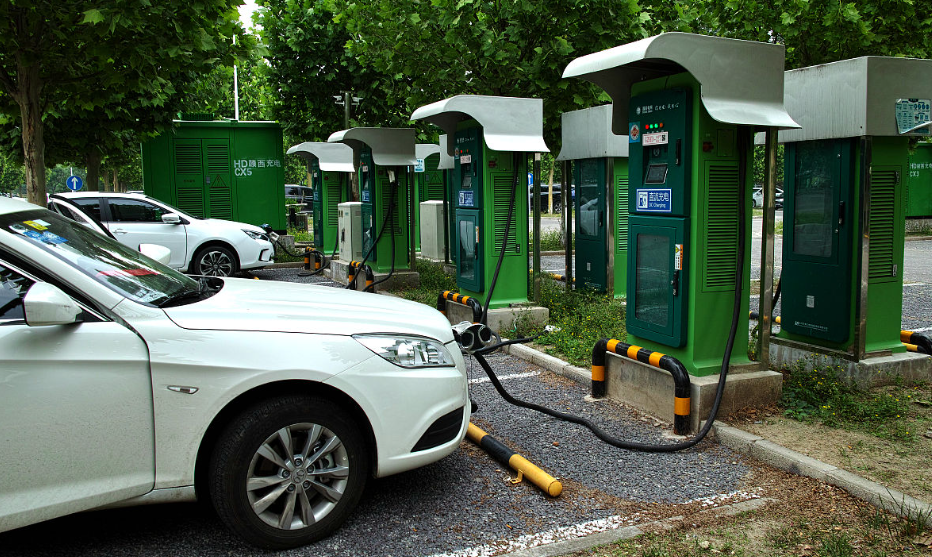
I represent the scaling of the model with a simple formula. If a community requires m basic units, the total number of manageable electric vehicle charging points is as follows:
$$N_{total} = m \cdot 108$$
If the community has N vehicles and each vehicle needs one dedicated or shared charge point, then the required number of basic units is at least as follows:
$$m_{req} = \left\lceil \frac{N}{108} \right\rceil$$
This modular approach is important because it allows the operator to match investment to actual demand. The community does not need to build every charge point at once. It can install the backbone and then add charge points as electric vehicle ownership grows. The platform can manage the existing charge points and reserve capacity for future expansion.
| Component | Function | Why It Matters for Electric Vehicle Charging |
|---|---|---|
| Integrated metering and load-control cabinet | Measures community charging load, receives control commands, enforces limits, and communicates with the platform | Provides the physical control point for safe and orderly electric vehicle charging |
| Branch boxes | Distribute power to groups of charge points and provide local protection | Improves modularity, fault isolation, and maintenance access |
| Charging points | Deliver energy to vehicles in public or private parking spaces | Provides the user-facing electric vehicle charging service |
| Communication network | Connects equipment, platform, and oversight system | Enables remote monitoring, scheduling, and data reporting |
| Service platform | Manages users, sessions, tariffs, alarms, load control, and reports | Turns distributed charge points into a managed electric vehicle charging service |
| Operation and maintenance team | Installs, inspects, repairs, and responds to incidents | Maintains safety and availability over the life of the system |
| Insurance arrangement | Covers product liability and public liability | Provides financial protection and builds user trust |
3.1 The Architectural Logic
I see the architectural logic of the unified model as a separation between shared backbone and flexible endpoints. The shared backbone includes the metering and load-control cabinet, branch boxes, communication, protection, and platform integration. The endpoints include public charge points and private charge points. This separation allows the community to standardize the risky and expensive parts of electric vehicle charging while allowing users to choose the service level that fits their needs. A resident with a dedicated parking space may choose a private charge point. A resident without a dedicated space may use a public charge point or participate in a shared private charge point arrangement.
The load-control cabinet is the key element. It gives the operator a single point from which to observe the total electric vehicle charging load and to enforce community-level limits. If the load approaches the available capacity, the cabinet can reduce the power of flexible sessions, pause lower-priority sessions, or disconnect a faulted branch. This is much safer and more effective than relying on individual chargers to behave well. In my view, the cabinet transforms electric vehicle charging from a collection of independent appliances into a coordinated service.
The platform layer provides visibility and control. I expect the platform to manage user registration, charging sessions, tariffs, reservations, alarms, maintenance tickets, and reports. It should also support data exchange with the public oversight platform. The data should include the number of charge points, their status, energy delivered, load profiles, faults, and maintenance records. This data is essential for accountability. Without data, a dispute about capacity or safety becomes a matter of opinion. With data, it becomes a matter of evidence.
3.2 Advantages of the Unified Model
I identify three major advantages of the unified model for residential electric vehicle charging: it breaks the capacity bottleneck, it strengthens safety, and it improves user experience. These advantages are not independent. Capacity control depends on safety monitoring, and user experience depends on reliable operation. Together, they create a service that is greater than the sum of individual chargers.
3.2.1 Breaking the Capacity Bottleneck
The core technical support for the unified model is intelligent orderly electric vehicle charging. The operator can dynamically adjust the output power of charge points according to the total community load. The goal is to maximize electric vehicle charging within the available capacity while protecting the residential base load. This means the community can significantly increase its electric vehicle charging service capacity without immediate transformer upgrading. Upgrading may still be needed in the long run, but orderly charging can defer capital expenditure and reduce disruption.
I model the scheduling of flexible electric vehicle charging as a constrained allocation problem. For each vehicle i, let E_i be the required energy, let t_i be the arrival time, let d_i be the departure deadline, and let p_i(t) be the charging power. The operator chooses p_i(t) to satisfy the energy requirement by the deadline while respecting the community capacity. A practical formulation is as follows:
$$\max \sum_{i=1}^{N} \frac{E_i^{delivered}}{E_i^{need}} \quad \text{subject to} \quad \sum_{i=1}^{N} p_i(t) \le C_{avail}(t), \quad 0 \le p_i(t) \le p_i^{max}$$
$$E_i^{delivered} = \sum_{t=t_i}^{d_i} \eta_i p_i(t) \Delta t \ge E_i^{need} \quad \text{for priority vehicles}$$
In practice, I would not use a single objective for all users. I would define priority classes: urgent trips, medical needs, users with low state of charge, and users who have opted for flexible charging. The operator can then maximize overall satisfaction while guaranteeing a minimum service level for priority users. This is the meaning of smart managed electric vehicle charging. The user plugs in and delegates the charging time to the operator. The operator allocates energy according to remaining capacity and urgency. By the next morning, all vehicles can be charged, while the community load remains within limits.
The state of charge of a vehicle evolves according to the following equation:
$$SOC_i(t + \Delta t) = SOC_i(t) + \frac{\eta_i p_i(t) \Delta t}{B_i}$$
Here B_i is the battery capacity. The energy required to reach the target state of charge is as follows:
$$E_i^{need} = B_i \left(SOC_i^{target} – SOC_i(t_i)\right)$$
These equations allow the operator to calculate how much energy each vehicle needs and how much time is available. The operator can then allocate power without exceeding the community limit. The result is a much higher utilization of existing capacity. I view this as the most important economic and technical advantage of unified electric vehicle charging.
| Criterion | Uncoordinated Private Charging | Unified Orderly Electric Vehicle Charging |
|---|---|---|
| Peak load control | Weak; charging starts when users plug in | Strong; charging is scheduled within capacity limits |
| Capacity utilization | Low and uneven; early users occupy spare capacity | High; spare capacity is shared across users |
| Fairness | First-mover advantage; later users may be blocked | Transparent allocation rules and shared access |
| Safety | Depends on individual installers and owners | Professional installation, monitoring, and maintenance |
| Reliability | Fragmented repairs and unclear responsibility | Single operator with service-level accountability |
| User experience | User must manage charging manually | Plug-in and delegate; optional priority charging |
| Data and oversight | Limited data; difficult to audit | Platform data and public reporting |
3.2.2 Strengthening Safety
I see safety as the second major advantage. The unified model improves safety in three ways. First, it uses professional and standardized installation and periodic maintenance. This reduces the risk of poor workmanship, undersized cables, weak protection, and inadequate earthing. Second, the integrated metering and load-control cabinet has an automatic overall disconnect function. If it detects overload or a safety hazard in a vehicle charging session, it can interrupt charging processes to prevent escalation. Third, the operator purchases product liability insurance and public liability insurance for the entire electric vehicle charging project. This provides financial protection and encourages careful risk management.
I express the safety benefit as a reduction in expected loss. If the baseline risk without unified control is R_0 = P_0 · S_0 and the risk with unified control is R_1 = P_1 · S_1, then the expected safety improvement is as follows:
$$\Delta R = P_0 S_0 – P_1 S_1$$
The unified model reduces P through better installation and monitoring, and it reduces the financial impact of S through insurance and rapid response. The goal is not to claim zero risk. The goal is to make risk visible, controlled, and financially covered. In my assessment, this is a more honest and more effective safety strategy than assuming that individual owners will manage complex electrical risks on their own.
I also use availability as a safety-related service metric. A charger that repeatedly fails may be bypassed by users, leading to unsafe improvisation. A high-availability electric vehicle charging service reduces the incentive for unsafe behavior. The operator should therefore monitor availability per charge point and per branch, and should set response targets for faults. I would treat a fault that affects multiple users as a higher priority than a fault that affects a single private charge point.
3.2.3 Improving User Experience
The third advantage is user experience. The unified model offers multiple service options. A resident with a fixed parking space can choose a private charge point for dedicated electric vehicle charging. A resident without a fixed space can use public charge points or participate in a shared private charge point arrangement. The operator provides standardized service, 24-hour customer support, transparent pricing, and digital records. The public oversight platform can receive unified data on registration and operation, which helps authorities understand the performance of electric vehicle charging services and urge operators to improve quality.
I believe that user experience should be measured, not assumed. The operator should track charging success rate, average wait time, fault response time, complaint resolution time, and user satisfaction. These metrics can be combined into a service quality index. If the index falls below a threshold, the operator should be required to take corrective action. This creates a feedback loop between users, operator, and regulator.
| Indicator | Definition | Target Direction | Why It Matters |
|---|---|---|---|
| Charging success rate | Successful sessions divided by attempted sessions | Higher | Reflects equipment reliability and user friction |
| Average wait time | Time between arrival and start of charging | Lower | Reflects capacity and scheduling performance |
| Fault response time | Time from alarm to operator response | Lower | Reflects maintenance readiness |
| Mean time to repair | Average time to restore service after failure | Lower | Directly affects availability |
| Availability | MTBF divided by MTBF plus MTTR | Higher | Measures overall service reliability |
| Complaint resolution time | Time to close a user complaint | Lower | Reflects accountability and user trust |
| Shared charger utilization | Energy delivered divided by available capacity | Balanced | Indicates whether shared electric vehicle charging is well used |
3.3 Economics of Unified Electric Vehicle Charging
I do not treat the unified model as a purely public good. It must be economically sustainable. The operator invests in the backbone, charge points, platform, maintenance, and insurance. It earns revenue from charging fees, service fees, subscription packages, advertising, and possibly grid services such as demand response and vehicle-to-grid discharge. The community benefits from safer and more accessible electric vehicle charging, while the operator benefits from scale and recurring revenue.
I evaluate the investment with net present value and levelized cost. If C_0 is the initial capital cost, CF_t is the net cash flow in year t, and r is the discount rate, then the net present value is as follows:
$$NPV = -C_0 + \sum_{t=1}^{T} \frac{CF_t}{(1+r)^t}$$
The levelized cost of electric vehicle charging service can be expressed as follows:
$$LCOC = \frac{C_0 + \sum_{t=1}^{T} \frac{O_t}{(1+r)^t}}{\sum_{t=1}^{T} \frac{E_t}{(1+r)^t}}$$
Here O_t is the operating and maintenance cost in year t, and E_t is the energy delivered in year t. A positive NPV and a competitive LCOC indicate that the electric vehicle charging service is financially viable. I would also calculate the payback period and the sensitivity to utilization, tariff, and maintenance cost. Utilization is the most important variable. A charge point that is rarely used may still provide equity and resilience benefits, but it will not pay for itself without cross-subsidy or public support.
| Category | Examples | Effect on Business Case |
|---|---|---|
| Capital cost | Cabinet, branch boxes, cables, charge points, civil works, platform integration | Increases initial investment; modular deployment reduces early commitment |
| Operating cost | Inspection, repair, customer service, insurance, data connectivity | Recurring cost; preventive maintenance reduces long-term failures |
| Charging revenue | Energy fee, service fee, parking-linked charging package | Main revenue source; depends on utilization and tariff design |
| Shared private charger revenue | Owner shares private charge point when idle | Improves utilization and provides income to owner |
| Grid service revenue | Demand response, peak shaving, future vehicle-to-grid discharge | Adds value as aggregation scale grows |
| Avoided cost | Deferred transformer upgrade, reduced safety incidents, lower dispute cost | Improves community-level value even if not captured by operator |
In my view, the economics of electric vehicle charging should be evaluated at the community level, not only at the individual charger level. A shared backbone may be underutilized in the first year, but it creates the capacity to serve future electric vehicle adoption. The operator can phase the charge points and use public charge points to generate early revenue. The community can use transparent rules to allocate shared capacity and to prevent early users from monopolizing the benefits.
4. Development Trends in Residential Electric Vehicle Charging
I expect residential electric vehicle charging to evolve along three main trends: policy and standardization, technology upgrading from orderly charging to vehicle-to-grid interaction, and governance innovation. These trends reinforce each other. Policy creates the framework, technology provides the tools, and governance determines whether the tools are used fairly and effectively.
4.1 Policy and Standardization
I see policy as a powerful driver of unified electric vehicle charging. National and local action frameworks are increasingly recognizing that residential charging is a bottleneck and that scattered private installation is not sufficient. Policies that promote unified build and unified service, set pilot targets, and require communities with unified service to stop accepting independent private applications can accelerate the transition. Standards for orderly charging equipment and grid interaction provide the technical basis for interoperability and safety. Without standards, every operator would use a different control protocol, making grid coordination difficult. With standards, the community electric vehicle charging system can become part of a larger energy management system.
In my assessment, policy should focus on four pillars: planning, standards, data, and incentives. Planning ensures that electric vehicle charging capacity is considered in community renovation and new construction. Standards ensure that equipment, installation, and communication are safe and interoperable. Data ensures that regulators can monitor performance and resolve disputes. Incentives ensure that operators and communities can bear the upfront cost of the shared backbone. I summarize these pillars in the following table.
| Pillar | Policy Instrument | Expected Effect on Electric Vehicle Charging |
|---|---|---|
| Planning | Capacity assessment requirements, charging provisions in new and renovated communities | Prevents new bottlenecks and reduces retrofit cost |
| Standards | Equipment standards, installation codes, communication protocols, safety inspection rules | Ensures interoperability, safety, and fair competition |
| Data | Registration, reporting, platform integration, public performance dashboards | Improves accountability and evidence-based oversight |
| Incentives | Grants, tax measures, low-cost financing, demand response payments | Accelerates shared infrastructure and orderly charging |
I also expect policy to clarify the boundary between individual rights and shared infrastructure. A resident should have the right to access electric vehicle charging, but that right should not allow one household to monopolize a scarce community capacity. The fair approach is to define access through a community-level plan and a transparent allocation rule. The unified model makes this possible because the operator can reserve capacity, manage queues, and provide shared charge points.
4.2 Technology Upgrade: From Orderly Charging to Vehicle-to-Grid
I view orderly electric vehicle charging as the first technology step and vehicle-to-grid interaction as the next. Orderly charging is a one-way energy management scheme. It adjusts charging time and power according to the available capacity. It is economical and practical, and it can be deployed with existing vehicles and equipment. Vehicle-to-grid interaction adds the ability for electric vehicles to discharge energy back to the building or the grid. This requires bidirectional chargers, supportive vehicle models, communication protocols, and market rules. It also requires a high level of user trust and a clear warranty arrangement for battery degradation.
I express the aggregate discharge capability of a vehicle fleet as follows:
$$P_{V2G}(t) = \sum_{i=1}^{N(t)} \eta_i^{dis} p_i^{dis}(t) I_i(t)$$
Here N(t) is the number of vehicles connected at time t, p_i^{dis}(t) is the discharge power of vehicle i, eta_i^{dis} is the discharge efficiency, and I_i(t) is an indicator that is one when the vehicle is available for discharge and zero otherwise. The maximum energy that can be safely discharged is limited by the battery state of charge and the user’s minimum state of charge:
$$E_{V2G}^{max} = \sum_{i=1}^{N} \left(SOC_i^{max} – SOC_i^{min}\right) B_i \eta_i$$
These formulas show why residential communities are a natural site for vehicle-to-grid interaction. Electric vehicles are parked for long periods at home, so they can provide flexible storage. When the number of electric vehicles reaches a certain scale, the aggregated battery capacity becomes a significant distributed energy resource. It can support the local community during peak load and can provide services to the wider grid. In a unified electric vehicle charging model, the operator can aggregate these resources and coordinate them with the building load and the public grid.
I estimate the peak-shaving potential of a community fleet with the following expression:
$$\Delta P_{peak} = N_{EV} \cdot p_{conn} \cdot \alpha \cdot \beta \cdot \gamma$$
Here p_conn is the average connection power per vehicle, alpha is the availability factor, beta is the participation factor, and gamma is the discharge duration factor. This formula is a planning approximation, not a dispatch instruction. It helps me compare the potential of different communities and prioritize those with high electric vehicle ownership and long parking times.
| Stage | Core Capability | Main Benefit | Key Enabler |
|---|---|---|---|
| Uncontrolled charging | Immediate charging when plugged in | Simple and low initial cost | Basic charge point and protection |
| Orderly charging | Schedule charging within capacity limits | Increases capacity utilization and avoids overload | Load-control cabinet, platform, user participation |
| Smart managed charging | Optimize by urgency, tariff, and user preference | Improves user experience and reduces cost | Data analytics, mobile service, dynamic pricing |
| Vehicle-to-grid interaction | Bidirectional energy flow and grid services | Adds storage value and peak shaving | Bidirectional chargers, standards, market rules, battery warranty |
| Virtual power plant integration | Aggregate many communities and electric vehicles | Provides system-level flexibility and resilience | Secure communication, aggregation platform, regulatory approval |
I am cautious about jumping too quickly to vehicle-to-grid interaction. Orderly electric vehicle charging should be the foundation. A community that cannot manage one-way charging safely and fairly is not ready for bidirectional energy flow. The sequence matters. First, standardize installation and metering. Second, deploy load control and orderly charging. Third, add smart managed charging and user choice. Fourth, pilot vehicle-to-grid interaction with willing users and appropriate warranties. Fifth, integrate aggregated electric vehicle charging into a virtual power plant. This sequence reduces technical risk and builds user confidence.
4.3 Governance Innovation
I believe the long-term success of residential electric vehicle charging depends on governance innovation. The unified model requires cooperation among public authorities, the operator, the property manager, the owners’ committee, and residents. Public authorities set standards and oversee performance. The operator invests and operates. The community organization coordinates communication and resolves disputes. Residents follow community rules and participate in shared charging arrangements. This is a multi-party governance model, not a simple outsourcing contract.
I use a responsibility matrix to clarify roles. The matrix should specify who plans, who approves, who installs, who operates, who maintains, who monitors, who insures, and who resolves disputes. Without such a matrix, the unified model can still fail because responsibilities remain ambiguous. With a matrix, the operator can be held accountable for service performance, while the community can be held accountable for access rules and resident communication.
| Activity | Public Authority | Service Operator | Property Manager | Owners’ Committee | Resident |
|---|---|---|---|---|---|
| Set safety and data rules | Lead | Support | Support | Inform | Comply |
| Assess community capacity | Review | Lead | Support | Inform | Provide input |
| Approve installation plan | Review | Prepare | Coordinate | Consult | Participate |
| Install shared backbone | Inspect | Lead | Support | Inform | Allow access |
| Operate and monitor | Oversee | Lead | Support | Monitor | Use service |
| Maintain equipment | Audit | Lead | Coordinate access | Inform | Report faults |
| Resolve disputes | Guide | Provide data | Facilitate | Lead community process | Follow rules |
| Insure risks | Set minimum requirements | Lead | Verify | Inform | Comply |
I also expect community rules to become more formal. A residents’ agreement or charging charter can define access to shared charge points, queue priority, guest charging, private charger sharing, noise and parking rules, and dispute resolution. These rules should be simple enough for residents to understand and specific enough for the operator to enforce. The technology platform can support the rules by recording sessions, calculating fees, and generating reports. Governance and technology should reinforce each other.
5. An Implementation Roadmap I Recommend
I recommend a phased implementation roadmap for residential electric vehicle charging. The roadmap should begin with a capacity and safety assessment, then move to pilot deployment, then scale up, and finally integrate with grid services. Each phase should have clear deliverables and decision gates. I do not favor a big-bang deployment in every community, because parking layouts, transformer conditions, and resident needs vary. A modular, data-driven approach is more robust.
| Phase | Main Activities | Deliverables | Decision Gate |
|---|---|---|---|
| Phase 1: Assessment | Measure base load, transformer capacity, parking layout, existing chargers, and resident demand | Capacity report, safety report, preliminary design, business case | Proceed only if capacity and safety conditions are acceptable |
| Phase 2: Pilot | Install one basic unit, connect public and private charge points, deploy platform, test orderly charging | Pilot system, operating procedures, user feedback, performance data | Proceed if availability, safety, and user satisfaction meet targets |
| Phase 3: Scale-up | Add basic units, expand shared charging, onboard residents, refine tariffs and access rules | Community-wide electric vehicle charging service | Proceed if utilization and financial performance are sustainable |
| Phase 4: Grid integration | Participate in demand response, test smart managed charging, pilot vehicle-to-grid interaction | Aggregated flexibility, grid service reports, expanded value streams | Proceed if standards, warranties, and market rules are mature |
I would use a readiness index to decide whether a community is ready for unified electric vehicle charging. The index can combine technical, safety, governance, and economic factors. If the weights are w_1 to w_6 and the normalized scores are A_1 to A_6, the readiness index is as follows:
$$R_{site} = \sum_{j=1}^{6} w_j A_j, \quad \sum_{j=1}^{6} w_j = 1$$
I would define the factors as capacity margin, wiring condition, parking controllability, governance readiness, resident demand, and operator capability. A community with a low readiness score should first address its basic constraints. For example, if the wiring condition is poor, it may need electrical renovation before adding electric vehicle charging. If governance readiness is low, it may need a resident consultation and a clear access agreement before deployment.
| Factor | What I Measure | Low Score Indicates | Recommended Action |
|---|---|---|---|
| Capacity margin | Available capacity after base load and reserve | High risk of overload | Orderly charging, phased deployment, or capacity upgrade |
| Wiring condition | Age, insulation, earthing, protection coordination | Safety risk before charging is added | Electrical renovation and inspection |
| Parking controllability | Ability to allocate and monitor parking spaces | Difficulty managing access and sharing | Parking rules, markings, and access control |
| Governance readiness | Agreement among operator, property, and residents | Disputes and delays | Consultation, responsibility matrix, charging charter |
| Resident demand | Current and projected electric vehicle ownership | Underutilized investment | Modular design and staged expansion |
| Operator capability | Technical capacity, service record, insurance, platform | Poor service and safety performance | Qualification review and performance contract |
I also recommend a risk-control plan with clear thresholds. For example, the operator should set an alarm threshold at a percentage of available capacity, a warning threshold at a higher percentage, and a hard limit at the design capacity. If the load exceeds the warning threshold, flexible sessions should be reduced. If the load approaches the hard limit, non-priority sessions should be paused. The thresholds should be reviewed after the pilot and adjusted based on actual load profiles. This is a practical way to translate the capacity formula into operating rules.
| Load Condition | Threshold Example | Control Action | User Communication |
|---|---|---|---|
| Normal | Below 70 percent of available capacity | Allow charging at requested power | No action needed |
| Watch | 70 to 85 percent | Monitor and prepare flexible sessions | Status message in application |
| Warning | 85 to 95 percent | Reduce power of flexible sessions | Notify affected users of adjusted schedule |
| Critical | Above 95 percent | Pause non-priority sessions and protect base load | Explain priority and expected completion time |
| Fault | Safety alarm or branch fault | Disconnect affected branch and dispatch maintenance | Immediate alert and estimated restoration time |
I would also require a transparent cost and tariff structure. Users should know the energy price, service fee, idle fee, and any priority charging premium. The operator should avoid hidden charges that undermine trust. If shared private charging is allowed, the owner and the user should see a clear settlement record. If demand response or vehicle-to-grid services generate revenue, the revenue-sharing rule should be defined in advance. Transparency is not a luxury in electric vehicle charging; it is a condition for long-term participation.
6. Risks, Mitigations, and My Quality Conditions
I do not assume that the unified model automatically succeeds. It can fail if the operator is weak, if the community is not consulted, if the technology is not interoperable, or if the economics are unrealistic. I therefore specify quality conditions and mitigations. These conditions are my test for whether a residential electric vehicle charging project is credible.
| Risk | Why It Matters | Mitigation I Recommend |
|---|---|---|
| Operator monopoly or poor service | Users may have no alternative and service quality may decline | Performance contract, public reporting, periodic review, service-level targets |
| Unclear capacity allocation | Residents may dispute access and priority | Transparent allocation rules, reserved capacity, public charge points, data records |
| Cybersecurity and data privacy | Charging data can reveal user behavior and grid information | Secure communication, role-based access, data minimization, audit logs |
| Interoperability failure | Equipment from different vendors may not work together | Adopt open standards, test before deployment, require certification |
| Underutilization | Investment may not be recovered | Phased deployment, shared private charging, public charging, grid services |
| Battery warranty conflict for vehicle-to-grid | Users may fear battery degradation | Pilot with willing users, define warranty terms, limit discharge cycles |
| Safety incident | One incident can undermine confidence | Professional installation, monitoring, automatic disconnect, insurance, rapid response |
My quality conditions are as follows. First, the electric vehicle charging design must be based on a measured load profile, not a rough guess. Second, the installation must be performed by qualified professionals and inspected before energization. Third, the system must have real-time monitoring and automatic protection. Fourth, the operator must have a maintenance team and a spare-parts plan. Fifth, the community must have a written access and dispute-resolution rule. Sixth, the project must have insurance and a clear liability allocation. Seventh, the platform must report data to the public oversight system and protect user privacy. If any of these conditions is missing, I would not regard the project as mature.
7. My Conclusions
I conclude that residential electric vehicle charging is entering a new phase. The early phase was about proving that electric vehicles could be charged at home. The current phase is about making electric vehicle charging safe, fair, reliable, and scalable in shared residential environments. The evidence I have reviewed points strongly toward the unified build and unified service model. This model does not simply replace scattered chargers with a single operator. It reconstructs the responsibility chain, creates a commercial and operational closed loop, and activates shared resources that individual households cannot manage on their own.
My reasoning can be summarized in four propositions. First, capacity is a shared constraint, so electric vehicle charging must be planned at the community level. Second, safety is a shared risk, so installation, monitoring, maintenance, and insurance must be professionalized. Third, fairness is a shared value, so access rules and capacity allocation must be transparent. Fourth, value is a shared opportunity, so orderly charging and future vehicle-to-grid interaction should be developed as part of the wider energy system. These propositions follow from the formulas and tables I have presented, and they are consistent with the practical direction of residential electric vehicle charging.
I also conclude that the most important word in the unified model is service, not construction. Building a cabinet and installing charge points is necessary, but it is not sufficient. The service includes user support, scheduling, maintenance, data reporting, insurance, dispute resolution, and continuous improvement. A community can install many electric vehicle charging points and still fail if the service is poor. Conversely, a community with modest capacity can deliver excellent electric vehicle charging if the service is well designed and well governed. This is why I emphasize service quality and governance as much as hardware.
Looking forward, I expect the residential electric vehicle charging system to become part of a broader energy management architecture. Orderly charging will be the baseline. Smart managed charging will become common. Vehicle-to-grid interaction will be piloted and then scaled where conditions are favorable. Aggregated electric vehicle charging resources will participate in virtual power plant services and support the stability of the power system. At the same time, I expect stronger standards for data, cybersecurity, interoperability, and battery warranty. The transition will not be uniform, but the direction is clear.
In my final assessment, the unified build and unified service model is a practical pathway for residential electric vehicle charging. It allows communities to overcome capacity limits without immediate and expensive upgrading, reduces safety risks through professional control, improves user experience through shared and private options, and creates a foundation for future grid interaction. The model succeeds when it is supported by transparent governance, sound economics, and reliable technology. For these reasons, I regard organized, service-oriented residential electric vehicle charging as a necessary condition for the continued growth of electric mobility and for the resilience of the future power system.