
In my extensive experience within the EV repair industry, I have observed that the rapid growth of electric vehicles (EVs) hinges critically on the performance and safety of their high-voltage battery systems. As global emphasis on environmental sustainability intensifies, EVs are becoming the primary alternative to traditional internal combustion engines. The thermal management system of the high-voltage battery is a cornerstone of EV operation, directly influencing range, power output, and overall safety. During charging and discharging cycles, these batteries generate significant heat, which, if not managed effectively, can lead to performance degradation, reduced lifespan, and even hazardous incidents like thermal runaway. Thus, mastering the repair and maintenance of these systems is essential for advancing electrical car repair practices and ensuring reliable EV performance.
The complexity of high-voltage battery thermal management systems has escalated with technological advancements, presenting unique challenges in EV repair. These systems typically comprise cooling mechanisms (such as liquid or air-based systems), heating elements (like electric heaters), temperature sensors, and sophisticated control units. For instance, in liquid cooling systems, a coolant circulates through modules to absorb heat, which is then dissipated via radiators. The control system relies on sensor inputs to regulate temperature within optimal bounds, often defined by mathematical models. One fundamental equation governing heat dissipation in these systems is the thermal balance equation: $$ \frac{dT}{dt} = \frac{Q_{gen} – Q_{diss}}{C_p} $$ where \( T \) is the battery temperature, \( t \) is time, \( Q_{gen} \) represents the heat generated during operation, \( Q_{diss} \) is the heat dissipated by the cooling system, and \( C_p \) denotes the thermal capacity of the battery. This equation highlights the need for precise control to prevent overheating, a common issue in electrical car repair scenarios.
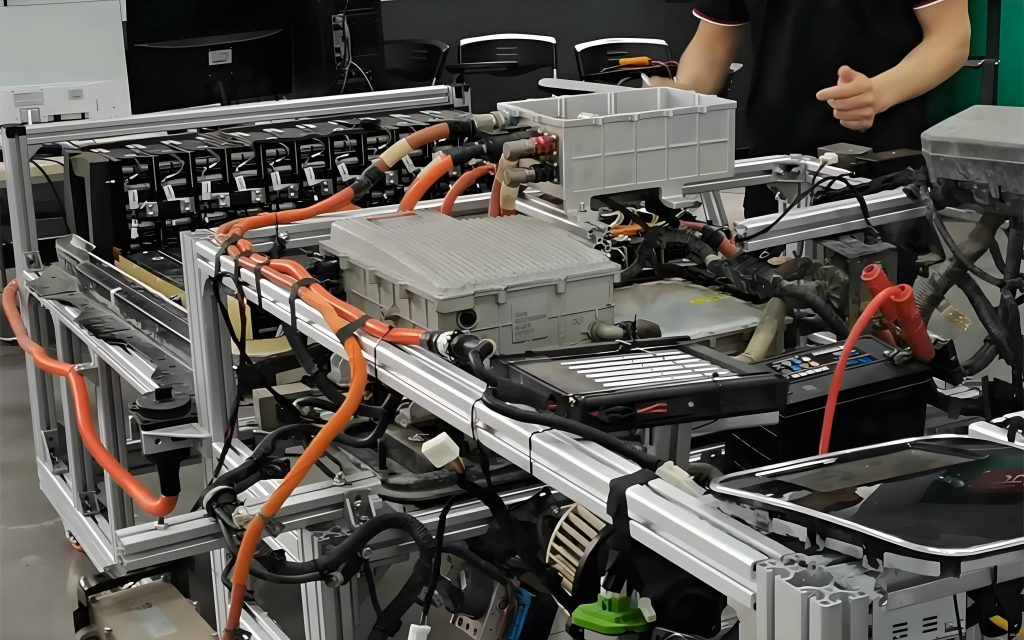
Understanding the components and their interdependencies is crucial for effective EV repair. The table below summarizes key elements of a typical high-voltage battery thermal management system and their functions, which I often reference in diagnostics:
| Component | Function | Common Issues in EV Repair |
|---|---|---|
| Cooling System (Liquid/Air) | Dissipates heat via coolant or air flow | Leaks, pump failures, clogged radiators |
| Heating System (e.g., Electric Heater) | Raises battery temperature in cold conditions | Heater element burnout, control circuit faults |
| Temperature Sensors | Monitors real-time battery temperature | Calibration errors, signal interference |
| Control Unit | Processes data and regulates systems | Software bugs, algorithm mismatches |
The importance of these systems cannot be overstated in the context of EV repair. For example, maintaining an optimal temperature range (e.g., 20°C to 40°C) enhances battery efficiency and longevity. In high-temperature environments, excessive heat accelerates chemical reactions, leading to capacity fade, which can be modeled using the Arrhenius equation: $$ k = A e^{-E_a / (RT)} $$ where \( k \) is the reaction rate constant, \( A \) is the pre-exponential factor, \( E_a \) is the activation energy, \( R \) is the gas constant, and \( T \) is the absolute temperature. This relationship underscores why thermal management is vital to prevent performance drops—a frequent concern in electrical car repair cases I handle. Conversely, in low temperatures, increased internal resistance impairs discharge capabilities, often described by: $$ R_{int} = R_0 + \alpha (T – T_0) $$ where \( R_{int} \) is the internal resistance, \( R_0 \) is the baseline resistance, \( \alpha \) is the temperature coefficient, and \( T_0 \) is the reference temperature. Such formulas guide my approach to diagnosing issues in EV repair, ensuring batteries operate within safe limits to avoid thermal runaway—a catastrophic failure mode where heat generation spirals out of control.
However, the sophistication of these systems introduces significant hurdles in EV repair. One major challenge is the complexity of fault diagnosis. As an EV repair specialist, I often encounter cases where multiple subsystems interact, making it difficult to pinpoint the root cause. For instance, a fault could stem from a faulty coolant pump, a misreading sensor, or an error in the control algorithm. To illustrate, the table below categorizes common diagnostic scenarios I face in electrical car repair, along with potential solutions:
| Fault Type | Symptoms | Diagnostic Methods in EV Repair |
|---|---|---|
| Cooling System Failure | Overheating, reduced performance | Data stream analysis, pressure tests |
| Sensor Malfunction | Inaccurate temperature readings | Multimeter checks, calibration via OBD-II |
| Control Algorithm Error | Erratic system behavior | Software scanning, update verification |
| Heating System Issue | Poor cold-start performance | Resistance measurements, component inspection |
Another persistent issue in EV repair involves the materials used in thermal management. High-conductivity insulation materials and phase-change substances are prone to damage during maintenance, and their replacement requires specialized tools and techniques. For example, the thermal conductivity \( k \) of these materials often follows Fourier’s law: $$ q = -k \nabla T $$ where \( q \) is the heat flux, and \( \nabla T \) is the temperature gradient. When materials degrade, their \( k \) value drops, leading to inefficient heat dissipation. In my practice, I have seen that sourcing these materials can be time-consuming and costly, exacerbating downtime in electrical car repair jobs. Moreover, components like heat exchangers are tightly packed, increasing the risk of collateral damage during disassembly—a frequent complaint among technicians in the EV repair field.
Software and control algorithm adaptations pose additional difficulties in EV repair. As manufacturers release updates to optimize performance, compatibility issues arise, requiring technicians to stay abreast of changes. The control logic often relies on PID (Proportional-Integral-Derivative) algorithms, expressed as: $$ u(t) = K_p e(t) + K_i \int_0^t e(\tau) d\tau + K_d \frac{de(t)}{dt} $$ where \( u(t) \) is the control output, \( e(t) \) is the error signal, and \( K_p \), \( K_i \), and \( K_d \) are tuning parameters. Inaccurate updates can disrupt this balance, leading to system failures. I have encountered numerous instances in electrical car repair where failed software upgrades necessitated reflashing, highlighting the need for robust update mechanisms.
Furthermore, the shortage of skilled professionals in EV repair compounds these challenges. The multidisciplinary nature of these systems—spanning electronics, thermodynamics, and software engineering—demands comprehensive training. In my interactions with repair shops, I have noted that existing programs often focus on conventional vehicles, leaving gaps in high-voltage system expertise. This skills deficit can delay repairs and increase costs, underscoring the urgency for standardized training in electrical car repair.
To address these hurdles, innovation is paramount in the EV repair sector. The application of intelligent diagnostics, such as AI-driven fault prediction, has revolutionized my approach. By analyzing historical data, machine learning models can forecast failures before they occur. For instance, a neural network might use input features like temperature variance \( \Delta T \) and current load \( I \) to predict risk, modeled as: $$ P(failure) = f(\Delta T, I, \text{other parameters}) $$ where \( f \) is a learned function. This proactive method reduces downtime and enhances safety in EV repair. Additionally, remote monitoring tools enable real-time data transmission, allowing me to diagnose issues without physical access—a boon for efficiency in electrical car repair.
Developing new repair materials and tools is another innovative direction. For example, quick-curing thermal adhesives with enhanced conductivity can simplify component replacement. The effectiveness of such materials can be quantified by their thermal diffusivity \( \alpha \), given by: $$ \alpha = \frac{k}{\rho c_p} $$ where \( \rho \) is density, and \( c_p \) is specific heat capacity. Higher \( \alpha \) values indicate better performance, which I have verified in field tests. Similarly, specialized tools designed for compact spaces minimize damage during EV repair, as summarized in the table below:
| Innovation | Application | Benefit in Electrical Car Repair |
|---|---|---|
| Fast-Cure Thermal Adhesives | Sealing and insulating battery modules | Reduces repair time, improves heat transfer |
| Modular Insulation Sheets | Replacing damaged insulation | Easy installation, cost-effective |
| Compact Diagnostic Probes | Accessing tight spaces for sensor checks | Enhances accuracy, prevents component damage |
| Remote Update Devices | Software upgrades and calibration | Minimizes on-site visits, ensures compatibility |
Optimizing software upgrades and remote services is also critical in modern EV repair. Cloud-based platforms facilitate seamless updates, reducing the incidence of version conflicts. In my practice, I have used such systems to push patches that recalibrate control algorithms, often involving iterative optimization like gradient descent: $$ \theta_{new} = \theta_{old} – \eta \nabla J(\theta) $$ where \( \theta \) represents algorithm parameters, \( \eta \) is the learning rate, and \( J(\theta) \) is the cost function. This ensures systems adapt to new conditions, a key aspect of electrical car repair. Remote diagnostics further allow me to analyze data logs and provide guidance without dispatching technicians, cutting costs and improving response times.
Finally, fostering professional development through standardized training is essential for advancing EV repair capabilities. Collaborative efforts between educational institutions and industry can bridge the skills gap. For instance, curricula incorporating hands-on sessions with thermal management systems prepare newcomers for real-world challenges. Certification programs based on competency assessments, often involving practical tests on equations like the heat transfer models, elevate the quality of electrical car repair services. I have witnessed how such initiatives build confidence and expertise, ultimately supporting the sustainable growth of the EV sector.
In conclusion, the evolution of high-voltage battery thermal management systems is inextricably linked to the progress of electric vehicles. Through my involvement in EV repair, I have seen how addressing diagnostic complexities, material limitations, software issues, and training deficits can drive innovation. The integration of smart technologies, advanced materials, and remote solutions not only enhances repair efficiency but also ensures the reliability and safety of EVs. As the industry moves forward, continued collaboration and research will be vital to overcoming emerging challenges in electrical car repair, paving the way for a greener automotive future.