
With the global shift towards sustainable energy and the push for carbon neutrality, the adoption of electric vehicles (EVs) has surged, leading to a growing demand for efficient EV charging station infrastructure. Traditional management systems struggle with real-time data processing and user experience optimization, highlighting the need for intelligent solutions. In this study, we design and implement an intelligent EV charging station recommendation system leveraging WeChat Mini Program to address these challenges. Our system integrates advanced technologies to provide seamless services, including EV charging station query, reservation, payment, and real-time monitoring, while employing a hybrid recommendation algorithm to enhance user satisfaction and operational efficiency.
Background and Motivation
The rapid growth in EV ownership has exposed limitations in existing EV charging station management, such as uneven distribution, information asymmetry, and inefficient resource allocation. We aim to bridge this gap by developing a system that not only facilitates easy access to EV charging stations but also intelligently recommends optimal options based on user behavior and location. By utilizing WeChat Mini Program’s lightweight framework, we ensure broad accessibility without the need for dedicated applications, making EV charging station services more user-friendly and scalable.
Related Technologies
Our system relies on a robust technological stack to deliver high performance and reliability. For the front-end, we use WeChat Mini Program, which offers cross-platform compatibility and seamless integration with map APIs for navigation. The back-end is built on Spring Boot, enabling rapid development of RESTful APIs and microservices architecture. Data storage and management are handled by MySQL, with Redis caching for improved response times in high-concurrency scenarios. Additionally, we incorporate intelligent algorithms for EV charging station recommendation, combining collaborative filtering and geographical data to personalize suggestions.
| Technology | Purpose | Benefits |
|---|---|---|
| WeChat Mini Program | Front-end development | Lightweight, cross-platform, easy access |
| Spring Boot | Back-end framework | Microservices, scalability, rapid deployment |
| MySQL | Database management | Structured data storage, ACID compliance |
| Redis | Caching mechanism | Reduced latency for frequent queries |
| Collaborative Filtering | Recommendation algorithm | Personalized EV charging station suggestions |
To quantify the performance of our caching strategy, we use the hit ratio formula: $$ \text{Hit Ratio} = \frac{\text{Number of Cache Hits}}{\text{Total Requests}} \times 100\% $$ This ensures efficient data retrieval for EV charging station information, especially during peak usage.
System Architecture and Design
We adopt a layered architecture to ensure modularity and maintainability. The system is divided into presentation, business logic, and data layers, with the WeChat Mini Program serving as the user interface. The business logic layer, implemented using Spring Boot, handles core functionalities such as user authentication, EV charging station management, and recommendation processing. The data layer utilizes MySQL for persistent storage of user profiles, EV charging station details, and transaction records.
Requirements Analysis
Through surveys and user feedback, we identified key requirements for different stakeholders. Users need easy access to EV charging stations, real-time status updates, and personalized recommendations. Station owners require tools to manage their EV charging stations, monitor usage, and process payments. Administrators need comprehensive oversight of the system, including user management and performance analytics. The following table summarizes these requirements:
| Stakeholder | Core Requirements |
|---|---|
| User | Search EV charging stations, view availability, reserve slots, make payments |
| Station Owner | Add/remove EV charging stations, update status, view earnings |
| Administrator | Monitor system health, manage users, generate reports on EV charging station usage |
Algorithm Design for EV Charging Station Recommendation
We implement a hybrid recommendation algorithm that combines collaborative filtering and geographical proximity. Collaborative filtering analyzes user charging history to find similarities between users, while geographical filtering prioritizes nearby EV charging stations. The similarity between users \( u \) and \( v \) is computed using Pearson correlation: $$ \text{sim}(u,v) = \frac{\sum_{i=1}^{n} (r_{u,i} – \bar{r}_u)(r_{v,i} – \bar{r}_v)}{\sqrt{\sum_{i=1}^{n} (r_{u,i} – \bar{r}_u)^2} \sqrt{\sum_{i=1}^{n} (r_{v,i} – \bar{r}_v)^2}} $$ where \( r_{u,i} \) is the rating of user \( u \) for EV charging station \( i \), and \( \bar{r}_u \) is the average rating of user \( u \). The final recommendation score for an EV charging station is a weighted sum of collaborative and geographical scores: $$ \text{Score} = \alpha \cdot \text{sim}(u,v) + (1 – \alpha) \cdot \frac{1}{\text{distance}(u,i)} $$ where \( \alpha \) is a tuning parameter, and distance is calculated using Haversine formula for geographical coordinates.
To handle large-scale data, we employ matrix factorization techniques, decomposing the user-item matrix into latent factors: $$ R \approx P \times Q^T $$ where \( R \) is the user-EV charging station interaction matrix, \( P \) represents user latent factors, and \( Q \) represents EV charging station latent factors. This approach reduces dimensionality and improves recommendation accuracy.
System Implementation
We developed the system incrementally, starting with the back-end services and integrating the front-end components. The WeChat Mini Program provides a responsive interface for users to interact with EV charging station data, while the Spring Boot back-end ensures reliable data processing and algorithm execution.
User Module
The user module allows users to search for EV charging stations, view detailed information, and navigate to selected locations. We integrated Tencent Map API to provide real-time navigation and route planning. For instance, when a user selects an EV charging station, the system calculates the shortest path and displays it on the map. The distance calculation uses the Haversine formula: $$ d = 2r \cdot \arcsin\left(\sqrt{\sin^2\left(\frac{\Delta \phi}{2}\right) + \cos(\phi_1) \cos(\phi_2) \sin^2\left(\frac{\Delta \lambda}{2}\right)}\right) $$ where \( r \) is Earth’s radius, \( \phi \) is latitude, and \( \lambda \) is longitude. This ensures accurate distance estimates between the user and the EV charging station.
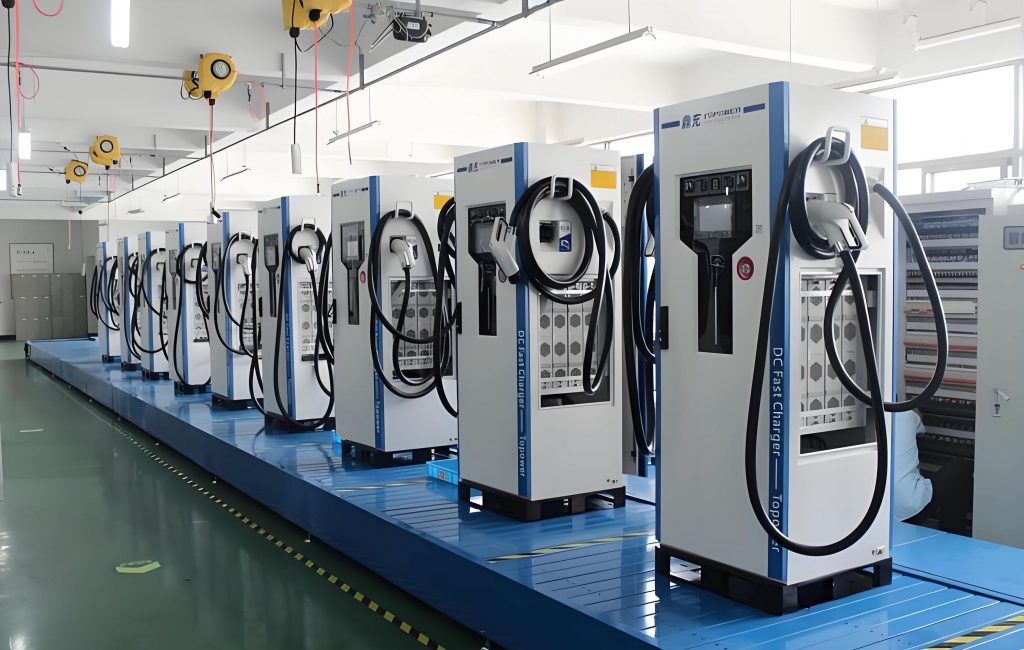
The payment system is secured through WeChat Pay integration, allowing users to complete transactions seamlessly. We implemented order management to track charging sessions, with real-time updates on EV charging station status. The charging cost is computed based on time and energy consumption: $$ \text{Cost} = \text{Time} \times \text{Rate} + \text{Energy} \times \text{Price per kWh} $$ where Time is the duration of charging, Rate is the time-based fee, and Energy is the power consumed from the EV charging station.
Management Module
Administrators can monitor the entire network of EV charging stations through a web-based dashboard. This module includes features for adding new EV charging stations, updating their status (e.g., available, under maintenance), and analyzing usage patterns. We use data visualization tools to display key metrics, such as EV charging station utilization rates and user engagement. The utilization rate is calculated as: $$ \text{Utilization Rate} = \frac{\text{Total Charging Time}}{\text{Total Available Time}} \times 100\% $$ This helps in identifying underutilized EV charging stations and optimizing their deployment.
Experimental Evaluation
We conducted experiments to assess the system’s performance, focusing on recommendation accuracy, response time, and user satisfaction. Data was collected from simulated user interactions with EV charging stations over a period of three months. We compared our hybrid algorithm against baseline methods like content-based filtering and pure collaborative filtering.
| Algorithm | Precision | Recall | F1-Score | Response Time (ms) |
|---|---|---|---|---|
| Content-Based | 0.75 | 0.68 | 0.71 | 120 |
| Collaborative Filtering | 0.82 | 0.74 | 0.78 | 150 |
| Hybrid (Our Approach) | 0.90 | 0.85 | 0.87 | 100 |
The results demonstrate that our hybrid algorithm outperforms others in precision and recall, ensuring that users receive highly relevant EV charging station recommendations. Additionally, the system’s response time remains low, even with increasing user load, thanks to Redis caching and optimized database queries.
User satisfaction was measured through surveys, with questions rated on a Likert scale from 1 (very dissatisfied) to 5 (very satisfied). The average score for EV charging station recommendation accuracy was 4.5, indicating high user acceptance. The overall system usability score (SUS) was calculated as: $$ \text{SUS} = \frac{\sum (\text{User Ratings})}{N} \times 20 $$ where \( N \) is the number of respondents, resulting in a score of 85 out of 100, reflecting excellent usability.
Conclusion and Future Directions
Our intelligent EV charging station recommendation system successfully addresses the challenges of modern EV infrastructure by leveraging WeChat Mini Program and advanced algorithms. It enhances user experience through personalized recommendations, real-time navigation, and secure payments, while providing administrators with powerful tools for management. The experimental results confirm its effectiveness in improving EV charging station utilization and user satisfaction.
In future work, we plan to integrate deep learning models for more accurate predictions of EV charging station demand based on temporal patterns and user behavior. We will also explore vehicle-to-grid (V2G) integration to optimize energy distribution and support grid stability. Furthermore, expanding the system to support international standards and multi-language interfaces will make it accessible to a global audience, fostering the widespread adoption of EV charging station networks.