
In the context of global environmental protection requirements and the transition of energy structures, new energy vehicles have emerged as a critical solution for energy conservation, emission reduction, and eco-friendly transportation. As the market for these vehicles expands, the complexity of their integrated technologies presents challenges, including potential faults during operation that can impact the driving experience. Therefore, enhancing the application of fault diagnosis and maintenance techniques is essential for ensuring vehicle safety and reliability. This article examines common fault types in new energy vehicles and explores advanced diagnostic and repair methodologies, with a focus on improving efficiency and effectiveness in EV repair and electrical car repair. By addressing these aspects, we aim to contribute to the sustainable development of the new energy vehicle industry.
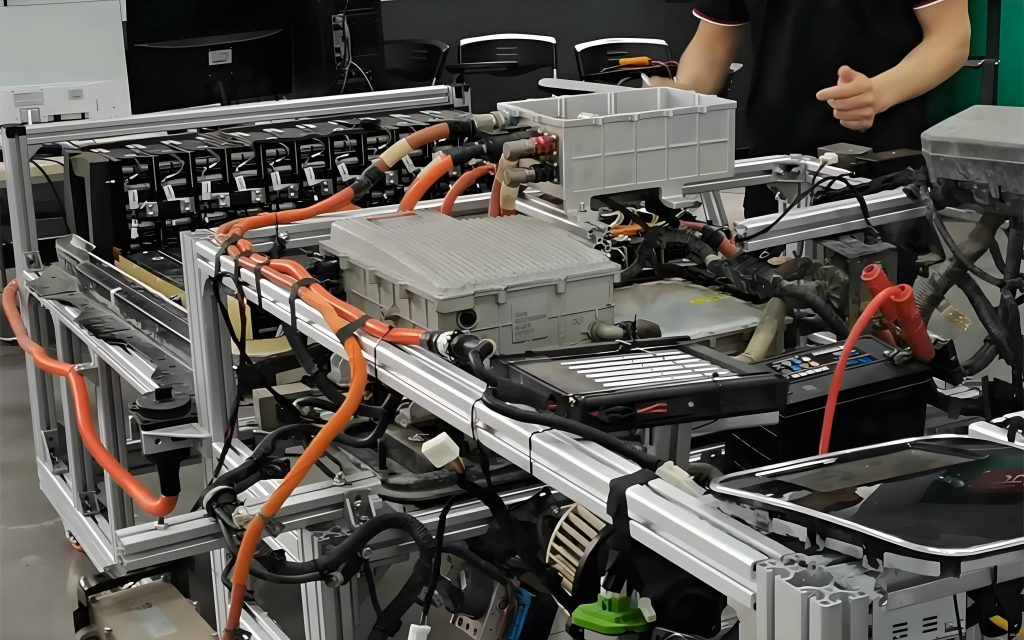
New energy vehicles, which include pure electric vehicles, hybrid electric vehicles, and fuel cell vehicles, utilize unconventional power sources or advanced onboard power systems. The electronic control systems in these vehicles involve intricate electrical components and control methods, making fault diagnosis and maintenance particularly complex. A thorough understanding of these processes is vital for enhancing safety, extending vehicle lifespan, and optimizing performance in electrical car repair scenarios. In this analysis, we delve into the specifics of fault types, diagnostic technologies, and repair strategies, emphasizing the role of data-driven approaches and standardized systems in modern EV repair practices.
Common Fault Types in New Energy Vehicles
New energy vehicles are prone to various faults due to their sophisticated systems. We categorize these into battery system faults, power transmission system faults, electronic control system faults, and electrical system faults. Each type has distinct characteristics and implications for vehicle operation, necessitating tailored approaches in EV repair and electrical car repair.
Battery System Faults
The battery system serves as the primary power source for new energy vehicles, directly influencing range and longevity. Common issues include battery aging, physical damage, and charging failures. Battery aging results from prolonged use and repeated charge-discharge cycles, leading to capacity degradation. Damage may occur due to external impacts or internal short circuits, while charging failures often stem from malfunctions in the charging system or battery management system. In EV repair, addressing these faults requires precise monitoring and replacement strategies to maintain optimal performance.
Power Transmission System Faults
This system, comprising the motor, transmission, and drive shaft, converts electrical energy into mechanical motion. Faults manifest as motor overheating, unusual noises, or unstable speeds, often caused by internal winding damage, bearing wear, or inadequate lubrication. For instance, motor overheating can be modeled using thermal equations, such as the heat dissipation formula: $$ P_{\text{loss}} = I^2 R $$ where \( P_{\text{loss}} \) represents power loss, \( I \) is current, and \( R \) is resistance. Effective electrical car repair involves diagnosing these issues through vibration analysis and temperature monitoring to prevent further damage.
Electronic Control System Faults
Electronic control systems, including battery management, motor drive, and thermal management, are critical for vehicle operation. Faults may arise from overheating, overload, or component aging, leading to startup delays or failures. Sensor malfunctions can result in inaccurate data acquisition, affecting overall control. Communication faults in networks like CAN or LIN buses may disrupt signal transmission, compromising safety. In EV repair, we employ diagnostic tools to identify these issues, such as using algorithms to detect anomalies in control signals.
Electrical System Faults
The electrical system encompasses high-voltage and low-voltage components, distribution units, grounding, and wiring. High-voltage faults, such as contactor failures, can interrupt current flow and prevent startup, while low-voltage issues often affect control units like lighting or entertainment systems. Grounding faults pose fire risks and require immediate attention in electrical car repair. We summarize common electrical faults in the table below to aid in diagnosis and repair.
| Fault Category | Common Symptoms | Potential Causes |
|---|---|---|
| Battery System | Reduced capacity, inability to charge | Aging, internal short circuits, BMS failure |
| Power Transmission | Overheating, unusual noises | Winding damage, bearing wear, lubrication issues |
| Electronic Control | Startup failures, data inaccuracies | Sensor faults, communication errors, overload |
| Electrical System | Intermittent power loss, fire hazards | Contactor faults, grounding issues, wiring defects |
Fault Diagnosis Techniques
Advanced diagnosis is crucial for identifying and resolving faults in new energy vehicles. We focus on two primary techniques: OBD-based diagnosis and data analysis-based diagnosis. Both approaches enhance the precision and speed of EV repair, enabling proactive maintenance and reducing downtime.
OBD-Based Fault Diagnosis
The On-Board Diagnostics (OBD) system is a standardized tool for vehicle monitoring, consisting of data interfaces, sensors, and control units. Sensors collect real-time data from key components like the battery and motor, while the control unit processes this information using predefined algorithms to detect anomalies. When a fault is identified, the system generates diagnostic trouble codes (DTCs) for repair technicians. The working principle can be expressed through a simple logic equation: $$ \text{Fault} = f(\text{Sensor Data}, \text{Thresholds}) $$ where the function \( f \) evaluates data against set parameters. In electrical car repair, OBD applications include monitoring battery temperature, voltage, and capacity retention. For example, if the maximum temperature during discharge exceeds safe limits, the system triggers an alert, guiding technicians in targeted EV repair actions.
Data Analysis-Based Fault Diagnosis
This technique leverages large datasets from vehicle operations to predict and diagnose faults. It involves data collection, preprocessing, feature extraction, and model-based analysis, which are integral to modern EV repair strategies.
Data Sources and Collection
Data is sourced from onboard sensors, telematics, and historical records, ensuring accuracy and completeness. In electrical car repair, we emphasize real-time data streaming for immediate fault detection, such as capturing battery voltage fluctuations or motor performance metrics.
Data Preprocessing and Feature Extraction
Preprocessing includes data cleaning, transformation, and reduction to eliminate noise and standardize formats. Feature extraction identifies key indicators of faults, using methods like time-domain analysis, frequency-domain analysis, and wavelet transforms. For instance, we might compute statistical features such as mean and variance: $$ \mu = \frac{1}{N} \sum_{i=1}^{N} x_i $$ $$ \sigma^2 = \frac{1}{N} \sum_{i=1}^{N} (x_i – \mu)^2 $$ where \( \mu \) is the mean, \( \sigma^2 \) is the variance, and \( x_i \) represents data points. This process reduces dimensionality and highlights patterns relevant to EV repair.
Fault Diagnosis Models and Algorithms
We employ various models, including rule-based, statistical, and machine learning approaches. Rule-based models rely on expert knowledge, while statistical models use methods like regression analysis. Machine learning models, such as support vector machines (SVM) or neural networks, automate fault classification. The decision function for SVM can be represented as: $$ f(x) = \text{sign}(\mathbf{w} \cdot \mathbf{x} + b) $$ where \( \mathbf{w} \) is the weight vector, \( \mathbf{x} \) is the input feature, and \( b \) is the bias. Neural networks, modeled with layers, use activation functions like: $$ a = \sigma(\mathbf{W} \mathbf{x} + \mathbf{b}) $$ where \( \sigma \) is the sigmoid function. These algorithms enhance diagnostic accuracy in electrical car repair by learning from labeled data.
Fault Warning and Diagnosis Output
Fault warning systems predict issues before they escalate, using thresholds and trend analysis. For example, if battery degradation trends indicate a future failure, the system alerts technicians for preemptive EV repair. Diagnosis outputs are presented via reports, graphs, or voice prompts, providing clear guidance on fault type, location, and severity. This streamlines the electrical car repair process and improves safety.
| Diagnosis Technique | Key Components | Applications in EV Repair |
|---|---|---|
| OBD-Based | Sensors, control unit, data interface | Real-time monitoring, DTC generation |
| Data Analysis-Based | Data preprocessing, feature extraction, models | Predictive maintenance, anomaly detection |
Maintenance Techniques
Maintenance for new energy vehicles requires specialized knowledge and tools, focusing on electrical and integrated systems. We discuss motor control system maintenance, powertrain maintenance, and intelligent control system maintenance, all critical for effective EV repair and electrical car repair.
Motor Control System Maintenance
This system involves components like permanent magnet synchronous motors (PMSM) and AC induction motors (ACIM). Common faults include winding shorts, rotor demagnetization, and inverter failures. In EV repair, we use instruments like insulation testers and oscilloscopes to check winding integrity and current balance. For rotor issues, spectral analysis detects eccentricity or bearing defects. Inverter maintenance involves testing gate drive circuits and capacitors, with post-repair validation through dynamic load tests. A key formula for power loss in inverters is: $$ P_{\text{inv}} = I_{\text{rms}}^2 R_{\text{on}} $$ where \( I_{\text{rms}} \) is the RMS current and \( R_{\text{on}} \) is the on-resistance. This approach ensures reliable electrical car repair by addressing root causes.
Powertrain Maintenance
The powertrain integrates the motor, gearbox, and differential, requiring combined mechanical and electrical expertise. Faults like gearbox noise or drive shaft vibrations are diagnosed using NVH (noise, vibration, harshness) analysis based on standards such as SAE J2929. Vibration sensors capture frequency signals to identify gear meshing issues. For cooling system faults, we measure flow rates and use thermal imaging to locate hotspots. In hybrid vehicles, CAN bus data analysis checks for clutch response delays. The table below summarizes maintenance actions for common powertrain faults in electrical car repair.
| Powertrain Component | Common Faults | Maintenance Actions |
|---|---|---|
| Motor | Overheating, bearing wear | Thermal imaging, lubrication, replacement |
| Gearbox | Noise, vibration | Vibration analysis, gear inspection |
| Cooling System | Overheating, flow issues | Flow measurement, radiator cleaning |
Intelligent Control System Maintenance
Intelligent systems, including the vehicle control unit (VCU), battery management system (BMS), and advanced driver-assistance systems (ADAS), require software and hardware coordination. VCU faults may involve CAN communication failures or torque allocation errors, addressed via parameter calibration using protocols like XCP. For BMS, we test voltage balance and state-of-charge (SOC) accuracy, with SOC often estimated using algorithms: $$ \text{SOC} = \text{SOC}_0 – \frac{1}{Q} \int I \, dt $$ where \( \text{SOC}_0 \) is the initial state, \( Q \) is capacity, and \( I \) is current. ADAS maintenance includes calibrating radar and cameras to meet functional safety standards like ISO 26262. This comprehensive approach to EV repair ensures system reliability and enhances electrical car repair outcomes.
Conclusion
The advancement of fault diagnosis and maintenance techniques is pivotal for the growth of the new energy vehicle sector. As technologies evolve, the integration of OBD-based and data-driven diagnostics offers multi-layered solutions for efficient EV repair. Maintenance methods for motor control, powertrain, and intelligent systems continue to improve, supported by standardized practices and safety protocols. Looking ahead, emerging technologies like 5G, edge computing, and digital twins will enable predictive maintenance and remote diagnostics, further refining electrical car repair processes. By optimizing algorithms, strengthening regulations, and fostering professional training, we can enhance vehicle reliability and safety, ultimately promoting green transportation. The ongoing development in EV repair and electrical car repair will play a crucial role in achieving sustainable mobility goals, ensuring that new energy vehicles remain a viable and safe option for future generations.