
As an engineer and researcher focused on the advancement of electric mobility, I consider the EV battery pack to be the technological and economic heart of the vehicle. Its design directly dictates performance, range, safety, and cost. Among the myriad design challenges, achieving lightweight construction stands out as a paramount objective with far-reaching implications. The pursuit of a lighter EV battery pack is not merely an exercise in material science; it is a systems-level optimization problem that sits at the intersection of mechanical integrity, thermal management, electrical safety, and manufacturing economics. In this analysis, I will detail the critical importance of this endeavor, dissect the prevailing challenges in current design paradigms, and propose a structured methodological framework for optimization, heavily leveraging computational techniques like topology and multi-objective optimization.
The imperative for lightweighting the EV battery pack stems from its substantial contribution to the vehicle’s total mass. A typical EV battery pack can account for 20% to 30% of the vehicle’s curb weight. This mass directly and profoundly influences nearly every aspect of vehicle dynamics and efficiency. The relationship between vehicle mass and its key performance indicators can be framed through fundamental physics. For instance, the force required for acceleration is given by Newton’s second law: $F = m \cdot a$. Reducing the mass ($m$) of the EV battery pack decreases the total force ($F$) needed from the powertrain for a given acceleration ($a$), or conversely, allows for greater acceleration with the same force. This translates to improved dynamic response and driving pleasure.
More critically, the impact on driving range is a primary concern for consumers. The energy consumption of an electric vehicle is heavily influenced by rolling resistance, aerodynamic drag, and inertial losses, all of which are mass-dependent. A simplified model for the energy required per unit distance ($E_d$) can incorporate mass:
$$E_d \approx \frac{1}{\eta} \left( C_{rr} \cdot m \cdot g \cdot \cos(\theta) + \frac{1}{2} \rho \cdot C_d \cdot A \cdot v^2 + m \cdot a + m \cdot g \cdot \sin(\theta) \right)$$
where $\eta$ is drivetrain efficiency, $C_{rr}$ is the coefficient of rolling resistance, $g$ is gravity, $\theta$ is road incline, $\rho$ is air density, $C_d$ is the drag coefficient, $A$ is frontal area, and $v$ is velocity. Reducing the mass ($m$) of the EV battery pack directly lowers the energy consumed against rolling resistance and inertial forces, thereby extending the usable range from the same amount of stored electrochemical energy. Furthermore, a lighter vehicle requires less energy for braking energy recovery cycles and places lower stress on suspension and braking components, enhancing longevity and safety.
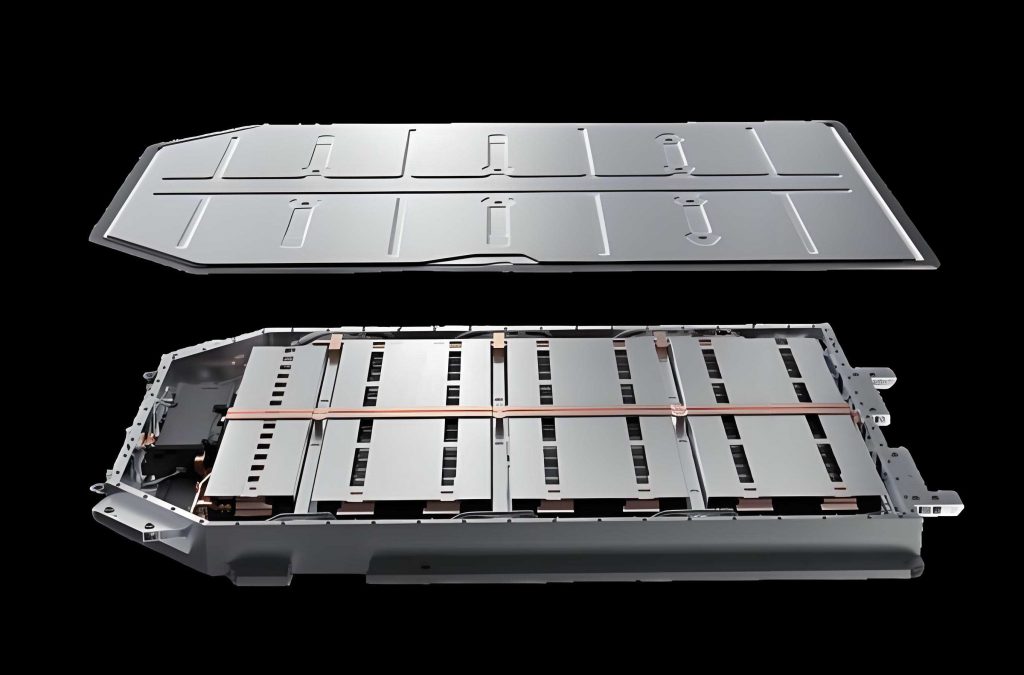
The table below summarizes the multifaceted benefits of a lightweight EV battery pack:
| Performance Metric | Mechanism of Improvement | Potential Benefit |
|---|---|---|
| Acceleration & Power-to-Weight Ratio | Reduced inertial mass improves response ($a = F/m$). | Decrease in 0-100 km/h acceleration time. |
| Energy Efficiency & Driving Range | Lower energy expenditure against rolling resistance and inertia. | Increase in WLTP range by 5-10% for a 10% mass reduction. |
| Handling & Agility | Lower unsprung and overall mass improves suspension response and reduces body roll. | Improved cornering stability and steering feedback. |
| Braking Performance | Lower kinetic energy ($E_k = \frac{1}{2}mv^2$) to dissipate. | Reduced braking distance, less brake wear. |
| Powertrain & Component Sizing | Lower peak power and torque demands allow for potentially smaller motors and power electronics. | System-level cost reduction and packaging benefits. |
Despite its clear importance, the path to an optimally lightweight EV battery pack is fraught with significant engineering challenges. The first major hurdle is low material utilization efficiency. The quest for lightweighting often leads designers toward advanced materials like high-strength aluminum alloys, magnesium alloys, or carbon fiber reinforced polymers (CFRP). While these materials offer excellent specific strength and stiffness, their manufacturing processes—such as precision machining, casting, or composite layup—often generate substantial scrap. For complex geometries of an EV battery pack enclosure, the buy-to-fly ratio (the ratio of material purchased to material used in the final part) can be disappointingly low. This inefficiency is economically punitive and contradicts the sustainability goals of electric mobility. We can define a simple Material Utilization Efficiency ($\eta_{mat}$) metric:
$$\eta_{mat} = \frac{M_{final}}{M_{raw}} \times 100\%$$
where $M_{final}$ is the mass of the finished component and $M_{raw}$ is the mass of the raw material input. In traditional design-for-manufacturing approaches for a complex EV battery pack tray, $\eta_{mat}$ can often be below 50%, meaning over half the material is wasted.
The second, more complex challenge is balancing multifunctional performance under complex loading conditions. An EV battery pack is not a passive container; it is a multifunctional system that must simultaneously:
- Provide mechanical protection against crash events, vibration, and shock (ISO, SAE standards).
- Ensure efficient thermal management to keep battery cells within their optimal temperature window (typically 15°C – 35°C).
- Maintain electrical isolation and structural integrity in the event of thermal runaway.
- Seal against water and dust ingress (IP67 or higher).
- Minimize cost and facilitate assembly/serviceability.
These requirements often conflict. For example, adding material for crash protection increases mass and may impede cooling airflow. Using a highly conductive material like aluminum for thermal management might compromise specific stiffness compared to CFRP. Optimizing for one load case (e.g., a static crush) might create vulnerabilities in another (e.g., high-frequency vibration). The table below illustrates these inherent conflicts:
| Design Objective | Typical Design Response | Potential Conflict With |
|---|---|---|
| Maximize Stiffness/Strength | Add ribs, increase wall thickness, use high-modulus materials. | Minimize Mass; Thermal Management (blocks airflow/paths). |
| Optimize Thermal Management | Add cooling channels, fins, thermal interface materials; use high-conductivity materials. | Minimize Mass; Minimize Cost; Structural Integrity (if channels weaken structure). |
| Ensure Crashworthiness | Design crush zones, use ductile materials, add reinforcement. | Minimize Mass; Packaging Volume. |
| Minimize Cost | Use standard materials (e.g., mild steel), simplify geometry, reduce part count. | Minimize Mass; Performance Targets (strength, thermal). |
To navigate these challenges, I advocate for a systematic, simulation-driven design optimization strategy that moves beyond iterative trial-and-error. The cornerstone of this strategy is the integration of Topology Optimization (TO) and Multi-Objective Optimization (MOO).
The first pillar of the strategy is Topology Optimization for Material Layout Efficiency. TO is a mathematical method that distributes a limited amount of material within a predefined design space to maximize structural performance. For an EV battery pack enclosure or internal support structure, we start by defining a conservative design space that encompasses all possible geometric configurations. The goal is to find the optimal layout of material (the “topology”) that meets performance constraints with minimal mass. A standard formulation for a stiffness-maximization problem (Minimize Compliance) under a mass constraint is:
$$
\begin{aligned}
& \underset{\rho}{\text{minimize}}
& & C(\boldsymbol{\rho}) = \mathbf{U}^T \mathbf{K} \mathbf{U} = \sum_{e=1}^{N} (E_e(\rho_e) \mathbf{u}_e^T \mathbf{k}_e^0 \mathbf{u}_e) \\
& \text{subject to}
& & \frac{V(\boldsymbol{\rho})}{V_0} = f \\
& & & \mathbf{K}(\boldsymbol{\rho}) \mathbf{U} = \mathbf{F} \\
& & & 0 < \rho_{min} \leq \rho_e \leq 1, \quad e = 1, \ldots, N
\end{aligned}
$$
Here, $C$ is compliance (inverse of stiffness), $\boldsymbol{\rho}$ is the vector of design variables (element densities), $\mathbf{K}$ is the global stiffness matrix, $\mathbf{U}$ and $\mathbf{F}$ are displacement and force vectors, $V/V_0$ is the volume fraction constraint $f$, and $E_e(\rho_e)$ is the material interpolation model (e.g., SIMP). By solving this problem, the algorithm generates a conceptual material distribution map that removes inefficient material from low-stress regions, often resulting in organic, truss-like structures perfectly tailored to the specific load paths of the EV battery pack. This process dramatically increases the material utilization efficiency ($\eta_{mat}$) defined earlier, as material is placed only where it is structurally necessary. The typical workflow is summarized below:
| Step | Action Description | Key Inputs/Considerations for EV Battery Pack |
|---|---|---|
| 1. Define Design Space | Create a 3D volume representing the maximum allowable geometry for the part (e.g., pack enclosure, module frame). | Packaging constraints from vehicle platform, cell module dimensions, clearance for connectors and cooling lines. |
| 2. Apply Loads & Boundary Conditions | Simulate real-world operational and abuse loads: inertia from acceleration/braking, crash pulses, vibration profiles, pressure from cell swelling. | Multiple load cases must be considered simultaneously (e.g., static crush, modal analysis, random vibration). |
| 3. Set Optimization Objective & Constraint | Define the goal (e.g., minimize compliance/maximize stiffness) and the constraint (e.g., target mass or volume fraction). | A common approach is to maximize stiffness for a given target mass reduction (e.g., 30% less material than a baseline design). |
| 4. Run Iterative Solver | Use algorithms (e.g., Method of Moving Asymptotes – MMA) to iteratively adjust material density distribution. | The solution generates a density field; a threshold (e.g., 0.3) is applied to obtain a binary material/no-material design. |
| 5. Interpret & Post-Process Results | Translate the optimized topology into a smooth, manufacturable CAD geometry. This is a critical step. | The organic shape must be converted into parametric features (ribs, beams, bosses) suitable for casting, extrusion, or additive manufacturing. |
While topology optimization excels at finding the best material layout for a single primary objective (like stiffness), the design of an EV battery pack is inherently a Multi-Objective Optimization (MOO) problem. This is the second pillar of the strategy. Here, we aim to find designs that optimally balance competing goals, such as minimizing mass ($f_1$), minimizing maximum stress ($f_2$), maximizing natural frequency ($f_3$), and minimizing thermal resistance ($f_4$). A general MOO problem can be stated as:
$$
\begin{aligned}
& \underset{\mathbf{x}}{\text{minimize}}
& & \mathbf{F}(\mathbf{x}) = [f_1(\mathbf{x}), f_2(\mathbf{x}), \ldots, f_k(\mathbf{x})]^T \\
& \text{subject to}
& & g_j(\mathbf{x}) \leq 0, \quad j = 1, \ldots, m \\
& & & h_p(\mathbf{x}) = 0, \quad p = 1, \ldots, q \\
& & & x_i^L \leq x_i \leq x_i^U, \quad i = 1, \ldots, n
\end{aligned}
$$
where $\mathbf{x}$ is the vector of design variables (e.g., wall thicknesses, rib heights, material choice indices), and $g_j$ and $h_p$ are inequality and equality constraints. The solution to a MOO problem is not a single point but a set of points known as the Pareto front. A design on the Pareto front is “non-dominated,” meaning no other feasible design is better in all objectives. For an EV battery pack, the Pareto front reveals the fundamental trade-offs: e.g., how much mass must increase to achieve a 10% reduction in maximum stress or a 5Hz increase in the first natural frequency.
In practice, a sequential approach is powerful: First, use topology optimization to generate a conceptually efficient structural layout for the EV battery pack enclosure. Second, parameterize the key features of this interpreted design (e.g., thicknesses of ribs and walls, curvature radii). Third, set up a multi-objective optimization using these parameters as variables to fine-tune the balance between mass, stress, frequency, and thermal performance. Algorithms like Non-dominated Sorting Genetic Algorithm (NSGA-II) or multi-objective particle swarm optimization are well-suited for this task. The choice of algorithm depends on the problem characteristics, as shown below:
| Algorithm Type | Key Principle | Advantages for EV Battery Pack Design | Potential Drawbacks |
|---|---|---|---|
| Evolutionary Algorithms (e.g., NSGA-II) | Uses concepts of natural selection (crossover, mutation) on a population of designs. | Well-suited for discontinuous, non-convex problems; finds a diverse set of Pareto solutions in one run. | Computationally expensive; requires many function evaluations (simulations). |
| Particle Swarm Optimization (PSO) | Simulates social behavior; particles (designs) move in the design space based on individual and group best. | Often simpler to implement; can be efficient for moderate numbers of variables. | May converge prematurely to a local Pareto front; tuning parameters is critical. |
| Surrogate-Model Based Methods | Builds fast approximate models (e.g., Kriging, Polynomial Chaos) from limited simulation data to guide optimization. | Dramatically reduces computational cost for expensive simulations like full crash or CFD thermal analysis. | Accuracy depends on the quality of the surrogate model; can be complex to set up. |
The integration of these two methodologies—topology optimization for conceptual, material-efficient layout and multi-objective optimization for performance trade-off balancing—provides a robust framework for the lightweight design of an EV battery pack. This approach systematically addresses the core challenges: it maximizes material utilization by placing material only where needed, and it explicitly navigates the complex trade-offs between conflicting performance requirements. The final outcome is not just a lighter EV battery pack, but a pack whose design is rationally derived, traceable to specific requirements, and potentially superior in its overall system-level performance. The continuous evolution of these computational tools, coupled with advancements in lightweight materials and additive manufacturing processes capable of producing the complex geometries suggested by topology optimization, promises even greater gains in the future. This holistic, optimization-driven design philosophy is essential for unlocking the full potential of electric vehicles, making them more efficient, sustainable, and competitive.