
As an automotive specialist with extensive experience in EV repair, I have witnessed the rapid evolution of new energy vehicles and their transformative impact on sustainable transportation. The power systems in these vehicles, which include electric motors, battery packs, and controllers, differ significantly from traditional internal combustion engines, necessitating advanced diagnostic and repair methodologies. In this comprehensive analysis, I will delve into the structure, common faults, diagnostic approaches, and repair techniques for these systems, emphasizing the critical role of electrical car repair in ensuring vehicle safety and performance. Given the complexity of these components, it is essential to adopt a systematic approach to fault diagnosis and repair, integrating both traditional and innovative methods to address issues efficiently. This discussion aims to provide a detailed guide for professionals and enthusiasts alike, highlighting the importance of continuous learning in the ever-evolving field of EV repair.
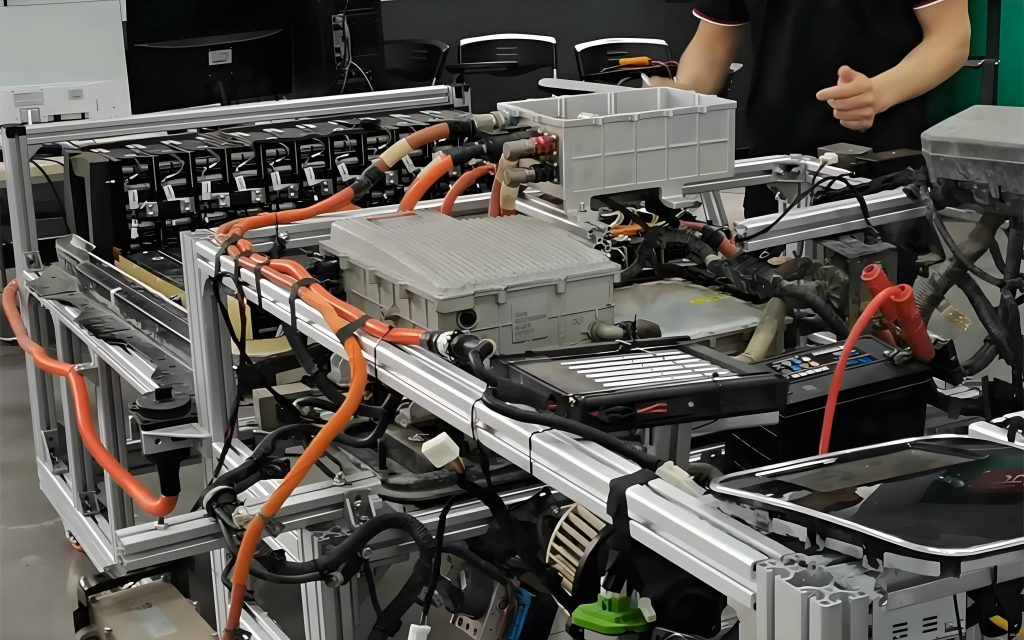
The proliferation of new energy vehicles has revolutionized the automotive industry, offering eco-friendly alternatives to fossil fuel-dependent transport. However, this shift introduces unique challenges in maintenance, particularly in power system fault diagnosis and repair. As someone deeply involved in electrical car repair, I recognize that understanding the intricacies of these systems is paramount. For instance, the drive motor, battery pack, and controller form the core of the power system, and their interdependencies require specialized knowledge for effective troubleshooting. In my practice, I have encountered numerous cases where improper handling led to exacerbated faults, underscoring the need for standardized procedures in EV repair. This article will explore these aspects in depth, incorporating practical insights and technical details to enhance the reader’s expertise in electrical car repair.
Structure and Working Principles of New Energy Vehicle Power Systems
New energy vehicle power systems are primarily categorized into pure electric and hybrid configurations, each with distinct components and operational mechanisms. In pure electric vehicles, the power system consists of a drive motor, power battery pack, and motor controller. The battery pack stores electrical energy, which is converted into mechanical energy by the drive motor to propel the vehicle. The motor controller regulates the motor’s operation based on driver inputs, such as acceleration and braking commands. During braking, the drive motor can function as a generator, converting kinetic energy back into electricity through regenerative braking, which recharges the battery pack. This process enhances energy efficiency and is a key focus in EV repair. Hybrid vehicles, on the other hand, integrate an internal combustion engine with an electric drive system. They can be series hybrids, where the engine charges the battery to power the electric motor, or parallel hybrids, where both the engine and motor can drive the wheels directly. Understanding these configurations is crucial for effective fault diagnosis in electrical car repair, as each type presents unique challenges. For example, in series hybrids, the engine’s role is indirect, requiring careful monitoring of the generator and battery interactions, while parallel hybrids demand synchronization between the engine and motor to optimize performance.
| Component | Pure Electric Vehicle | Hybrid Vehicle |
|---|---|---|
| Primary Power Source | Battery Pack | Battery and Internal Combustion Engine |
| Drive Mechanism | Electric Motor Only | Electric Motor and/or Engine |
| Energy Recovery | Regenerative Braking | Regenerative Braking and Engine Charging |
| Complexity in EV Repair | High (due to electrical systems) | Very High (integration of multiple systems) |
To quantify the efficiency of these systems, we can use formulas such as the overall efficiency of a pure electric vehicle, which can be expressed as: $$\eta_{\text{total}} = \eta_{\text{battery}} \times \eta_{\text{controller}} \times \eta_{\text{motor}}$$ where $\eta_{\text{battery}}$ represents the battery’s charge-discharge efficiency, typically ranging from 90% to 95%, $\eta_{\text{controller}}$ is the efficiency of the motor controller (often 95-98%), and $\eta_{\text{motor}}$ is the drive motor efficiency (usually 85-90%). This equation highlights the cumulative impact of component performance on overall vehicle efficiency, a critical consideration in electrical car repair. For hybrid vehicles, the energy management can be modeled using: $$E_{\text{total}} = E_{\text{engine}} + E_{\text{battery}} – E_{\text{losses}}$$ where $E_{\text{engine}}$ is the energy from the engine, $E_{\text{battery}}$ is the energy from the battery, and $E_{\text{losses}}$ accounts for systemic inefficiencies. Such models aid in diagnosing power distribution issues during EV repair.
Common Faults in New Energy Vehicle Power Systems
In my experience with EV repair, I have identified several recurrent faults in power systems that can compromise vehicle performance and safety. Drive motor faults often include winding short circuits or open circuits, which result from insulation degradation due to overheating, moisture, or mechanical stress. These faults lead to abnormal currents, increased noise, and vibrations, potentially causing motor failure. For instance, a short circuit can generate excessive heat, accelerating insulation breakdown and necessitating immediate intervention in electrical car repair. Another common issue is bearing wear, caused by prolonged friction and fatigue, which manifests as loud operational noises and can impair motor rotation if not addressed promptly. Power battery faults are equally prevalent, with capacity degradation being a major concern. Over time, repeated charge-discharge cycles and suboptimal usage patterns reduce battery capacity, diminishing the vehicle’s range. This degradation can be modeled using: $$C(t) = C_0 \cdot e^{-kt}$$ where $C(t)$ is the capacity at time $t$, $C_0$ is the initial capacity, and $k$ is the degradation constant dependent on factors like temperature and charge rates. Battery cell inconsistency is another critical fault, where variations in voltage, internal resistance, or capacity among cells lead to imbalanced performance. This inconsistency can cause individual cells to overcharge or over-discharge, exacerbaging aging and raising safety risks. Thermal management system failures, such as malfunctioning coolant pumps or fans, can cause battery temperatures to deviate from optimal ranges, further accelerating degradation and highlighting the importance of proactive monitoring in electrical car repair.
| Fault Type | Symptoms | Potential Consequences |
|---|---|---|
| Drive Motor Winding Fault | Abnormal noise, vibration, high current | Motor failure, reduced efficiency |
| Battery Capacity Degradation | Reduced range, slow charging | Decreased performance, increased downtime |
| Battery Cell Inconsistency | Voltage fluctuations, overheating | Safety hazards, reduced lifespan |
| Controller Power Module Failure | Motor stalling, erratic behavior | Complete system shutdown |
Motor controller faults often involve power module failures, where components like insulated-gate bipolar transistors (IGBTs) succumb to high currents and voltages, leading to uncontrolled motor operation or startup failures. Control circuit issues, such as damaged electronic components from electrostatic discharge or electromagnetic interference, can disrupt signal processing and impair controller functionality. In electrical car repair, diagnosing these faults requires a nuanced understanding of electronic systems, as even minor discrepancies can cascade into major failures. For example, a faulty sensor in the controller can misinterpret driver inputs, causing abrupt acceleration or braking, which underscores the need for comprehensive testing protocols in EV repair.
Fault Diagnosis Methods for Power Systems
Effective fault diagnosis in new energy vehicles relies on a combination of advanced tools and empirical techniques, which I frequently employ in my electrical car repair practice. Data stream analysis is a cornerstone method, involving the real-time monitoring of sensor and actuator data through diagnostic interfaces. By comparing parameters like current, voltage, and temperature against baseline values, I can identify anomalies indicative of underlying issues. For instance, in EV repair, analyzing the data stream from a motor controller might reveal irregular current spikes, suggesting winding faults or controller malfunctions. This approach allows for a deep dive into system dynamics, facilitating the detection of intermittent or complex faults that simpler methods might miss. Fault code diagnosis, another essential technique, leverages the built-in self-diagnostic capabilities of control units. When a fault is detected, the system generates specific codes stored in memory, which can be retrieved using diagnostic scanners. In electrical car repair, I often start with this method to quickly narrow down potential issues; however, it has limitations, as it may not capture faults outside the electronic domain or those that occur sporadically.
Visual inspection and experiential diagnosis remain invaluable in EV repair, particularly for identifying obvious physical defects. During inspections, I look for signs like corrosion, leaks, or physical damage to components such as battery casings or motor housings. For example, electrolyte leakage from a battery pack indicates seal failure, requiring immediate attention to prevent safety incidents. Experiential diagnosis draws on sensory cues—listening for unusual motor noises, feeling for abnormal heat on controller surfaces, or smelling burnt insulation—to pinpoint issues that automated systems might overlook. While this method depends heavily on the technician’s expertise, it complements technological tools by providing contextual insights. Specialized equipment diagnosis involves using devices like battery internal resistance testers or insulation resistance testers to obtain precise measurements. In electrical car repair, I use these tools to assess battery health or insulation integrity, as they provide quantitative data that supports informed decision-making. For instance, measuring internal resistance helps identify weak cells in a battery pack, guiding replacement strategies. The integration of these methods into a cohesive diagnostic framework enhances the efficiency and accuracy of EV repair, reducing downtime and improving reliability.
| Method | Tools Required | Advantages | Limitations |
|---|---|---|---|
| Data Stream Analysis | Diagnostic software, scanners | Comprehensive system insights | Requires expertise, time-consuming |
| Fault Code Diagnosis | OBD-II scanners, manufacturer tools | Quick initial assessment | Misses non-electronic faults |
| Visual Inspection | None (basic tools optional) | Immediate identification of physical issues | Subjective, limited to visible faults |
| Specialized Equipment | Multimeters, insulation testers | High precision, quantitative data | Costly, requires training |
To illustrate the application of these methods, consider a scenario in electrical car repair where a vehicle exhibits reduced acceleration. Using data stream analysis, I might observe that the motor current is lower than expected under load, indicating a potential battery issue. Fault codes could reveal specific errors related to the battery management system, while visual inspection might uncover corroded connectors. Finally, specialized equipment like a battery analyzer would measure cell voltages and internal resistances, confirming inconsistencies. This multi-faceted approach ensures thorough diagnosis, which is essential for effective EV repair. Additionally, statistical models can be applied to fault data; for example, the probability of a fault occurring within a given time frame can be estimated using: $$P(t) = 1 – e^{-\lambda t}$$ where $\lambda$ is the failure rate derived from historical data. Such models aid in predictive maintenance, a growing trend in electrical car repair.
Repair Techniques for Power System Components
Once faults are diagnosed, implementing appropriate repair techniques is critical to restoring vehicle functionality, a process I meticulously follow in my EV repair work. For drive motor faults, such as winding short circuits or open circuits, the repair involves disassembling the motor to access and inspect the windings. If a short circuit is detected, I replace the affected winding section or reinforce the insulation using high-temperature materials. In cases of open circuits, I reconnect broken wires through soldering or complete replacement, followed by rigorous testing of insulation resistance and electrical performance to ensure reliability. Bearing wear requires replacement with quality-assured components, using specialized tools for precise installation to avoid misalignment, which could lead to premature failure. In electrical car repair, I always verify motor balance and alignment post-repair to prevent vibrations that might exacerbate other system components.
Power battery repairs often focus on addressing cell inconsistencies and capacity degradation. When individual cells are faulty, I replace them with identical specifications to maintain pack uniformity, carefully following safety protocols to avoid short circuits during handling. Battery balancing is a key technique in electrical car repair, where I use均衡 devices to equalize cell voltages and capacities through controlled charging and discharging cycles. This process can be modeled using: $$V_{\text{balanced}} = \frac{\sum_{i=1}^{n} V_i}{n}$$ where $V_i$ represents the voltage of each cell, and $n$ is the number of cells. Balancing not only restores performance but also extends battery life, reducing the frequency of replacements. Thermal management system faults, such as failed coolant pumps or clogged散热器, require component replacement or flushing of cooling circuits. In EV repair, I ensure proper coolant levels and flow rates to maintain optimal operating temperatures, as overheating can accelerate battery degradation and pose safety risks.
| Fault | Repair Technique | Tools and Materials | Post-Repair Verification |
|---|---|---|---|
| Motor Winding Fault | Rewinding or replacement | Insulation materials, soldering iron | Insulation test, load testing |
| Battery Cell Inconsistency | Cell replacement, balancing | Battery analyzer, balancing device | Voltage and capacity checks |
| Controller Power Module Failure | Module replacement | ESD-safe tools, thermal paste | Functional testing, data stream analysis |
| Thermal System Failure | Component replacement, coolant refill | Coolant, pump tools | Temperature monitoring, leak tests |
Motor controller repairs typically involve replacing faulty power modules or control circuit components. In electrical car repair, I select modules that match the original specifications to ensure compatibility and performance. During installation, I pay close attention to thermal management, applying thermal paste and ensuring adequate heat sinking to dissipate excess heat, which is crucial for longevity. Control circuit repairs require soldering skills and the use of multimeters to test individual components like resistors or capacitors. For example, if a voltage regulator in the controller fails, I replace it and verify the output voltages using: $$V_{\text{out}} = V_{\text{ref}} \times (1 + \frac{R1}{R2})$$ where $V_{\text{ref}}$ is a reference voltage, and R1 and R2 are resistances in the circuit. This mathematical approach ensures accuracy in electrical car repair, minimizing the risk of recurrent faults. After repairs, I conduct comprehensive system tests, including simulated driving cycles, to validate performance under real-world conditions, a standard practice in high-quality EV repair.
Conclusion
In summary, the fault diagnosis and repair of new energy vehicle power systems demand a sophisticated blend of technical knowledge, practical skills, and advanced tools. As an advocate for excellence in EV repair, I emphasize the importance of understanding system structures, common faults, and diagnostic methods to address issues effectively. The integration of data stream analysis, fault code interpretation, visual inspections, and specialized equipment enables thorough troubleshooting, while repair techniques like motor rewinding, battery balancing, and controller module replacement restore system integrity. The evolving nature of electrical car repair necessitates ongoing education and adaptation to new technologies, such as AI-driven diagnostics or enhanced battery management systems. By embracing these advancements, technicians can improve repair accuracy, reduce costs, and contribute to the sustainability of electric mobility. Ultimately, a proactive approach to EV repair not only ensures vehicle reliability but also supports the broader adoption of new energy vehicles, paving the way for a greener automotive future.