
As an experienced automotive technician specializing in electrical car repair, I have encountered numerous cases involving electric vehicle (EV) power battery failures. With the rapid advancement of new energy vehicle technology, the efficiency and performance of these vehicles have significantly improved. However, as EVs become more widespread, the incidence of power battery faults has also increased, posing challenges for vehicle owners. In this article, I will share detailed insights into EV repair processes, focusing on power battery fault detection and maintenance. Through real-world examples and technical analyses, I aim to provide a comprehensive guide for professionals and enthusiasts in the field of electrical car repair. I will incorporate tables and formulas to summarize key points, ensuring clarity and depth in understanding these complex systems.
Power battery failures in EVs can stem from various factors, broadly categorized into physical damage and electrical performance issues. Physical damage includes external impacts or compression leading to internal short circuits, while electrical faults often involve capacity degradation or internal resistance abnormalities. In my practice of EV repair, I have found that a systematic approach to diagnosis is crucial. For instance, consider a common scenario where an EV exhibits reduced power and slow charging speeds. This not only affects the vehicle’s performance but also highlights the importance of regular maintenance in electrical car repair. To address such issues, I typically start with a thorough inspection of the battery system, using specialized tools and software to identify root causes.
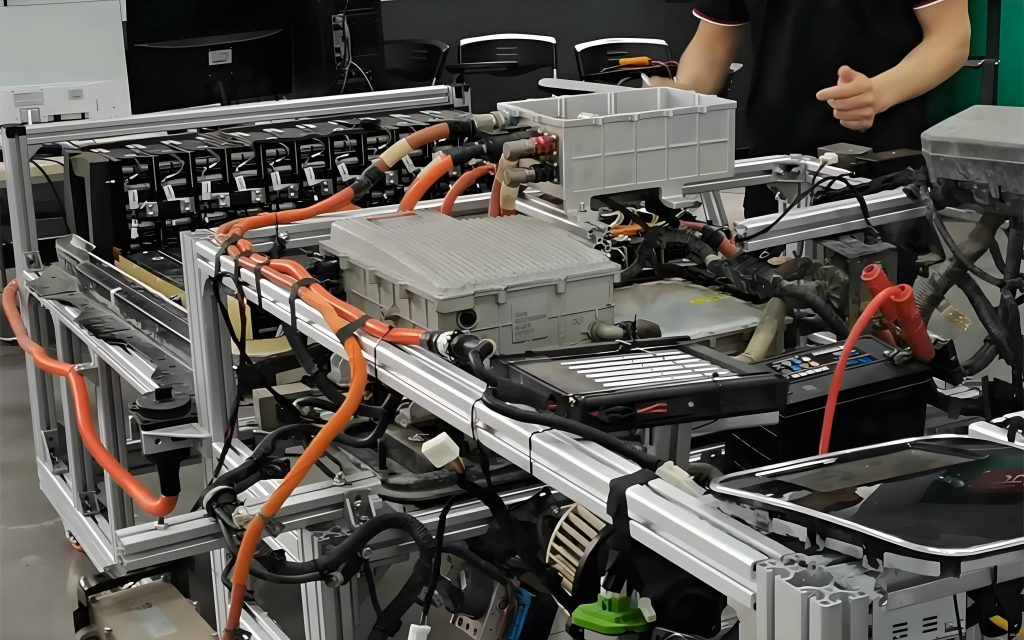
In one notable case of EV repair, I dealt with a vehicle that suddenly lost power during operation. The owner reported that the dashboard indicated low battery levels, and charging was unusually slow. As part of my electrical car repair routine, I began by shutting off the power and disconnecting the battery to ensure safety. This initial step is fundamental in any EV repair procedure to prevent electrical hazards. I then used a multimeter and battery analyzer to measure the internal resistance, which was significantly higher than the standard value. The internal resistance of a battery can be calculated using Ohm’s law: $$ R = \frac{V}{I} $$ where R is the internal resistance, V is the voltage drop, and I is the current. In this case, the elevated resistance pointed to potential issues within the battery cells or control systems.
To further diagnose the problem, I performed a series of tests, including visual inspections of the charging lines and connections. No signs of wear, corrosion, or loose contacts were found, which ruled out simple wiring faults. Next, I connected the vehicle to a diagnostic scanner to assess the Battery Management System (BMS). The BMS is critical in monitoring battery health, and any anomalies here can lead to performance issues. However, the software showed no error codes, suggesting that the fault might lie in the main controller’s internal components. This highlights the complexity of EV repair, where multiple subsystems must be evaluated systematically. In electrical car repair, such scenarios require a deep understanding of both hardware and software interactions.
Here is a table summarizing common power battery faults and their typical causes in EV repair:
| Fault Type | Common Causes | Detection Methods |
|---|---|---|
| Physical Damage | External impacts, compression, thermal runaway | Visual inspection, thermal imaging |
| Electrical Performance Issues | High internal resistance, capacity fade, internal short circuits | Resistance testing, capacity cycling, BMS analysis |
| Control System Failures | Main controller defects, sensor malfunctions | Software diagnostics, component testing |
Based on the diagnostic results, I analyzed that the main controller’s internal electronic components were damaged, leading to abnormal charging and discharging behaviors. This is a frequent issue in EV repair, where the controller regulates power flow and ensures battery safety. The failure likely resulted from prolonged exposure to high temperatures or voltage spikes, common in demanding driving conditions. To confirm this, I used a function generator and oscilloscope to simulate operating conditions and observed irregular output signals. The power dissipation in such components can be modeled using: $$ P = I^2 R $$ where P is power loss, I is current, and R is resistance. Excessive power dissipation can overheat components, causing permanent damage—a key consideration in electrical car repair.
For the repair phase, I developed a detailed plan. First, I removed the main controller and replaced it with a genuine OEM part to ensure compatibility. Then, I cleaned the battery group internally to eliminate dust and debris that could impair contact surfaces. This step is vital in EV repair to maintain optimal conductivity and prevent future issues. After reassembly, I conducted charge and discharge tests using a calibrated battery cycler. The tests confirmed that the vehicle could now start, drive, and charge normally, with no signs of the previous faults. This successful outcome underscores the importance of methodical approaches in electrical car repair, where each step builds on the previous one to achieve reliable results.
To illustrate the repair process, here is a table outlining the key steps in EV repair for power battery faults:
| Step | Action | Tools Used |
|---|---|---|
| 1 | Power down and battery disconnection | Insulated gloves, multimeter |
| 2 | Internal resistance measurement | Battery analyzer, ohmmeter |
| 3 | Visual and software inspection | Diagnostic scanner, thermal camera |
| 4 | Component replacement and cleaning | Screwdrivers, anti-static brush |
| 5 | Performance testing | Battery cycler, load tester |
In my experience with EV repair, I have learned that understanding the fundamental principles of battery operation is essential. For example, the state of charge (SOC) of a battery can be estimated using the formula: $$ \text{SOC} = \frac{Q_{\text{remaining}}}{Q_{\text{total}}} \times 100\% $$ where Q represents charge capacity. Similarly, the state of health (SOH) is crucial for predicting battery lifespan and is often derived from capacity measurements over time. In electrical car repair, monitoring these parameters helps in proactive maintenance, reducing the likelihood of sudden failures. Additionally, I recommend that vehicle owners adopt good practices, such as avoiding deep discharges and extreme temperatures, to extend battery life.
Another aspect of EV repair involves addressing thermal management issues. Batteries generate heat during operation, and inefficient cooling can lead to degradation. The heat generation rate can be approximated by: $$ \dot{Q} = I^2 R_{\text{internal}} + I V_{\text{polarization}} $$ where \dot{Q} is heat flow, and V_{\text{polarization}} accounts for overpotential losses. In one case, I encountered a vehicle with repeated battery faults due to a clogged cooling system. By cleaning the vents and replacing the coolant, I resolved the overheating problem, demonstrating how integrated systems affect EV performance. This highlights the interdisciplinary nature of electrical car repair, where mechanical and electrical knowledge must combine.
Furthermore, software updates play a significant role in modern EV repair. Manufacturers often release BMS firmware updates to optimize battery calibration and fault detection. During diagnostics, I always check for the latest software versions to ensure accurate readings. For instance, in a recent electrical car repair job, a software patch corrected a false alarm in the battery warning system, saving the owner unnecessary part replacements. This emphasizes that not all faults require physical interventions; sometimes, digital solutions are key in EV repair.
To summarize the economic impact, here is a table comparing costs and benefits of proactive versus reactive EV repair strategies:
| Strategy | Average Cost | Benefits |
|---|---|---|
| Proactive Maintenance | $200-$500 per year | Extended battery life, reduced downtime |
| Reactive Repair | $1000-$3000 per incident | Immediate fault resolution, but higher long-term costs |
In conclusion, my journey in EV repair has taught me that power battery faults, while challenging, are manageable with the right knowledge and tools. Electrical car repair demands a holistic approach, from basic electrical principles to advanced software diagnostics. By sharing these insights, I hope to contribute to the growing body of knowledge in this field. As EV technology evolves, continuous learning and adaptation will be essential for technicians. Remember, regular checks and adherence to manufacturer guidelines can prevent many common issues, making EV repair more efficient and sustainable for the future.
Finally, I encourage fellow professionals to engage in communities and training programs focused on EV repair. The integration of formulas, such as those for battery efficiency: $$ \eta = \frac{E_{\text{out}}}{E_{\text{in}}} \times 100\% $$ where \eta is efficiency and E represents energy, can deepen our analytical capabilities. Through collaborative efforts, we can advance the standards of electrical car repair and ensure safer, more reliable electric vehicles for everyone.