
We propose a novel Cell-to-Body (CTB) battery pack design integrated with an optimized concave triangular auxetic lattice structure to address the critical challenges of limited space and high energy-absorption requirements in electric vehicle (EV) battery pack protection systems. This study systematically develops the theoretical model, conducts multi-objective optimization, and validates the superior mechanical performance of the new design against a traditional honeycomb-core CTB pack under static and dynamic loading conditions.
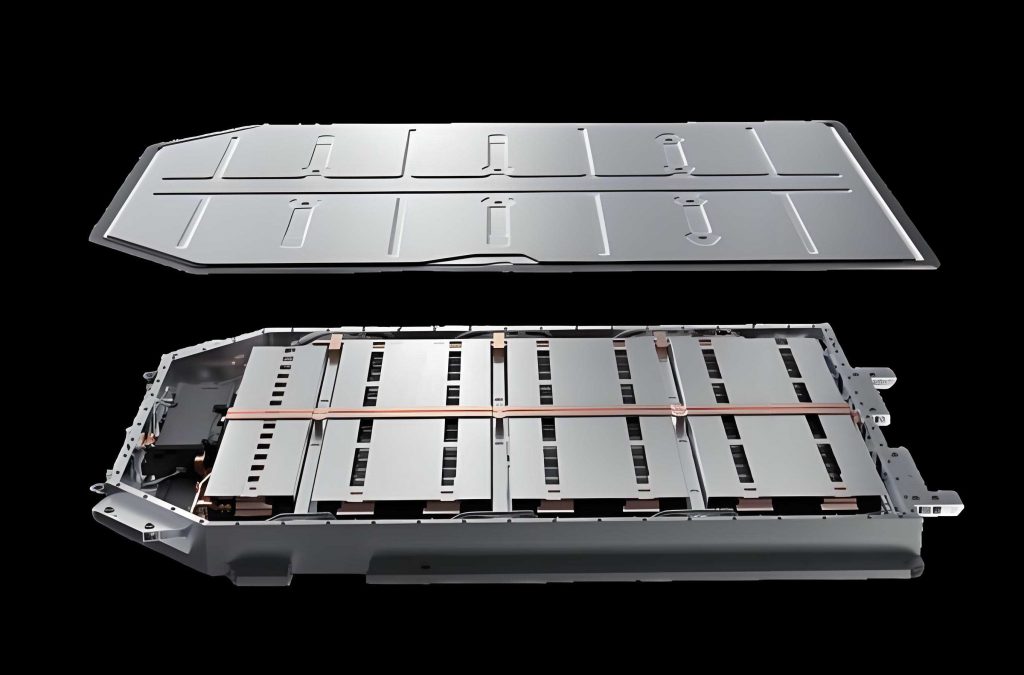
The global transition towards green and low-carbon development has positioned new energy vehicles as a pivotal force in economic transformation and environmental protection. Within this sector, the driving range remains a paramount performance indicator and a focal point of consumer concern, driving relentless technological innovation from manufacturers. However, advancements in battery chemistry, particularly for lithium iron phosphate (LFP) and ternary lithium batteries, are approaching their theoretical energy density limits. Consequently, enhancing the range without compromising vehicle light weighting presents a significant bottleneck. The Cell-to-Body (CTB) architecture emerges as a promising solution, integrating the upper enclosure of the EV battery pack with the vehicle’s underbody floor. This highly integrated “vehicle sandwich” structure significantly improves the vehicle’s structural rigidity, lightweight potential, and overall volumetric efficiency for increased range. Despite its advantages, the high level of integration in a CTB EV battery pack drastically reduces the available space for dedicated protective layers and buffer structures, posing new challenges for safety. Therefore, developing and integrating novel materials and structures with exceptional specific energy absorption is crucial to ensure the safety and integrity of the CTB EV battery pack under various operational and abusive conditions.
Auxetic metamaterials, characterized by a negative Poisson’s ratio (NPR) that causes them to contract laterally under axial compression, offer remarkable advantages for energy absorption and lightweight design. Their high porosity and unique deformation mechanism enable superior crashworthiness compared to conventional materials. Inspired by these properties, we focus on a concave triangular cellular structure, a classic 2D auxetic configuration. The primary objective of this work is to design, optimize, and validate a CTB EV battery pack that utilizes this auxetic lattice as its core, aiming to outperform traditional honeycomb-based designs in terms of load-bearing capacity and intrusion resistance during collisions.
Methodology and Structural Optimization
Our research framework consists of three main phases: 1) Establishing a baseline model and analyzing a traditional CTB EV battery pack; 2) Developing and optimizing the concave triangular unit cell; 3) Implementing the optimized lattice into a new CTB design and conducting comparative performance analysis.
1. Baseline Traditional CTB EV Battery Pack Model
We first developed a finite element (FE) model of a sedan body-in-white (BIW) integrated with a traditional CTB EV battery pack. The BIW model, simplified by removing non-structural details, measures 4475 mm × 1800 mm × 1770 mm. The CTB EV battery pack, with dimensions of 2100 mm × 1500 mm × 100 mm, comprises an upper cover (also serving as the floor panel), a lower tray, and a honeycomb sandwich core. The B-pillar was modeled in detail with outer, inner, and reinforcement layers. Shell elements (S4R) were used for most parts, while solid elements (C3D8R) were used for the battery pack lower tray. Connections were simulated using bolts (for B-pillar layers and pack-to-body joints) and welding (for body skeleton). Material properties are assigned as follows:
| Component | Material | Density (g/cm³) | Elastic Modulus (GPa) | Poisson’s Ratio |
|---|---|---|---|---|
| Body Skeleton | Docol 600DP | 7.85 | 222 | 0.28 |
| B-Pillar | Docol 600DP | 7.85 | 222 | 0.28 |
| Battery Pack Cover/Tray | B280/440DP | 7.85 | 207 | 0.30 |
| Honeycomb Core (Traditional) | 3003 Aluminum (Effective) | 1.08 | 27.68 | 0.33 |
This baseline model was subjected to static analyses (torsion and bending) and a dynamic side pole impact simulation to establish reference performance metrics for the traditional CTB EV battery pack.
2. Theoretical Modeling and Optimization of Concave Triangular Unit Cell
The core of our novel design is the concave triangular auxetic unit cell. Its geometry is defined by key parameters: long wall length \( L_l \) and thickness \( T_l \); short wall length \( L_s \) and thickness \( T_s \); horizontal wall length \( L_h \); cell height \( H \); out-of-plane thickness \( T \); angle between long walls \( \phi_l \); and angle between short walls \( \phi_s \). We define dimensionless parameters for optimization: the thickness ratio \( \alpha = T_l/L_l = T_s/L_s \), the length ratio \( \beta = L_h/L_l \), and the wall proportion coefficient \( K = L_s/L_l \).
Based on beam theory and homogenization methods, the relative density \( \rho_{RD,3D} \) (a key indicator of lightweight potential) and relative elastic modulus \( E_{RD,3D} \) (indicating specific stiffness) of the 3D lattice (extruded 2D cell) are derived as:
$$ \rho_{RD,3D} = \frac{\alpha\left[2+\beta^2+1+K^2 + \frac{K}{\beta}(\beta+K\sin\frac{\phi_s}{2})^2\right]}{2\left(\cos\frac{\phi_l}{2}-K\cos\frac{\phi_s}{2}\right)} $$
$$ E_{RD,3D} = \frac{\alpha^3 \left[\cos\frac{\phi_l}{2}\left(K^2-\sin^2\frac{\phi_l}{2}\right) – \frac{\sin^2\frac{\phi_l}{2}\left(\beta+\sin\frac{\phi_l}{2}\right)}{2}\left(1+\frac{1}{K^2}\right)\right]}{\left(\cos\frac{\phi_l}{2}-K\cos\frac{\phi_s}{2}\right)} $$
The in-plane Poisson’s ratio \( \nu_{3D} \) is given by:
$$ \nu_{3D} = -\frac{ \sin^2\frac{\phi_l}{2} + \frac{(1+K^2)\cos\frac{\phi_l}{2}\left(K^2-\sin^2\frac{\phi_l}{2}\right)}{-K^2\cos^2\frac{\phi_l}{2}+1} }{ \frac{(1+K^2)}{\beta}\sin\frac{\phi_l}{2} + \sin^2\frac{\phi_l}{2} } $$
To achieve an auxetic lattice with minimum mass and maximum stiffness, we formulated a multi-objective optimization problem:
$$
\begin{aligned}
\text{Maximize:} & \quad E_{RD,3D} \\
\text{Minimize:} & \quad \rho_{RD,3D} \\
\text{Subject to:} & \quad 0 < \alpha, \beta, \phi_l, \phi_s, K < [0.5, 0.3, 2.09, 2.09, 0.6] \\
& \quad \nu_{3D} < 0
\end{aligned}
$$
A Genetic Algorithm (GA) was employed to solve this problem. After 333 iterations, the optimal set of parameters was obtained. The effective material properties for the optimized auxetic core, assuming the same base 3003 aluminum as the honeycomb, were calculated.
| Optimized Parameter | Value |
|---|---|
| Relative Density \( \rho_{RD,3D} \) | 0.384 |
| Relative Elastic Modulus \( E_{RD,3D} \) | 0.517 |
| Poisson’s Ratio \( \nu_{3D} \) | -0.119 |
| Thickness Coefficient \( \alpha \) | 0.275 |
| Length Coefficient \( \beta \) | 0.194 |
| Long Wall Angle \( \phi_l \) (rad) | 0.239 |
| Short Wall Angle \( \phi_s \) (rad) | 2.049 |
| Wall Proportion \( K \) | 0.503 |
| Effective Core Density (g/cm³) | 1.037 |
| Effective Core Elastic Modulus (GPa) | 35.67 |
The optimized auxetic core demonstrates a 28.9% higher specific stiffness (35.67 GPa vs. 27.68 GPa at similar density) compared to the traditional honeycomb, confirming its superior mechanical potential for the EV battery pack application.
3. Novel Auxetic CTB EV Battery Pack Model
We constructed the novel CTB EV battery pack model by replacing the traditional honeycomb core material definition with the effective properties of the optimized concave triangular lattice. All other aspects of the FE model—geometry, connections, mesh, and loading/boundary conditions—remained identical to the baseline model to ensure a fair comparison. Performance was evaluated under identical static (torsion, bending) and dynamic (side pole impact) conditions.
Results and Comparative Performance Analysis
The performance of the traditional and novel auxetic CTB EV battery pack designs was compared across multiple load cases.
Static Torsion Condition
In the torsion test, the auxetic CTB EV battery pack showed a marginal increase in the maximum stress it carried (10.35 MPa vs. 10.29 MPa) and a slight reduction in its own maximum displacement (0.2388 mm vs. 0.2393 mm) compared to the traditional pack. More importantly, the overall body skeleton stress slightly decreased (38.07 MPa vs. 38.12 MPa). This indicates that the stiffer auxetic core effectively shares a greater portion of the torsional load, improving the integrated body-pack system’s performance.
Static Bending Condition
Under bending load, both CTB EV battery pack designs exhibited nearly identical performance, with a maximum stress of 13.98 MPa and a maximum displacement of 1.175 mm. This result is expected, as in pure bending, the primary load path is through the upper and lower skins of the sandwich structure; the core’s role is primarily to maintain the distance between these skins (shear transfer), and its specific stiffness has less influence on global bending deflection in this configuration.
Dynamic Side Pole Impact Condition
The side pole impact test is the most critical for evaluating the safety of an EV battery pack. The dynamic response was analyzed over 60 ms. Both packs showed a three-stage intrusion process: initial B-pillar deformation (0-20 ms), progressive intrusion into the pack space (20-40 ms), and maximum intrusion with some rebound (40-60 ms). The key metric is the maximum intrusion displacement of the battery pack lower tray in the vehicle’s y-direction (lateral direction).
The auxetic CTB EV battery pack demonstrated a clear advantage, reducing the maximum y-direction intrusion by 3.2% compared to the traditional design.
| Performance Metric | Traditional Honeycomb CTB Pack | Novel Auxetic CTB Pack | Improvement |
|---|---|---|---|
| Max. Y-Intrusion (Side Impact) | 4.70 mm | 4.55 mm | -3.2% |
| Core Density | 1.08 g/cm³ | 1.037 g/cm³ | -4.0% |
| Core Elastic Modulus | 27.68 GPa | 35.67 GPa | +28.9% |
| Pack Stress (Torsion) | 10.29 MPa | 10.35 MPa | Comparable |
| Pack Displacement (Torsion) | 0.2393 mm | 0.2388 mm | Slight Reduction |
The superior crashworthiness stems from the auxetic lattice’s deformation mechanism. Upon impact and compression, the concave triangular cells undergo lateral contraction (negative Poisson’s effect), promoting a densification mode that is more stable and efficient in energy absorption compared to the buckling-dominated deformation of traditional honeycombs. This allows the novel auxetic CTB EV battery pack to better resist intrusion, thereby creating a larger safe zone for the battery modules inside and reducing the risk of mechanical abuse leading to thermal runaway.
Conclusion
In this study, we have successfully designed and validated a novel CTB EV battery pack incorporating an optimized concave triangular auxetic lattice core. The comprehensive analysis leads to the following key conclusions:
- Performance Under Static Loads: In torsion, the novel auxetic CTB EV battery pack demonstrates a marginally higher load-bearing capacity within the pack itself and contributes to a slight reduction in overall body stress, indicating effective load-sharing due to its higher specific stiffness. In bending, both pack designs perform identically, as the core’s properties have minimal influence on global bending stiffness for this specific sandwich configuration.
- Superior Crash Protection: The most significant advantage is observed under dynamic side pole impact, a critical safety scenario. The novel auxetic CTB EV battery pack reduces the maximum lateral intrusion displacement by 3.2%. This improvement is attributed to the superior, stable energy absorption mechanism of the negative Poisson’s ratio lattice during compression.
- Design Methodology: The systematic approach—combining theoretical micromechanical modeling, multi-objective genetic algorithm optimization, and integrated vehicle-level finite element simulation—provides a robust framework for designing and evaluating advanced protective structures for EV battery packs.
The integration of auxetic lattice structures into the CTB architecture presents a promising pathway to enhance the safety and lightweight potential of electric vehicles. The optimized concave triangular core offers a favorable balance of low density, high specific stiffness, and excellent energy absorption, directly addressing the space-constrained protection challenges in modern integrated EV battery pack designs. Future work will involve experimental validation, investigation of multi-material and graded lattice designs, and optimization under a broader set of crash and impact scenarios.