
As a professional in the automotive industry, I have witnessed the rapid evolution of electric vehicles (EVs) and the growing importance of advanced diagnostic techniques in their maintenance. The shift toward sustainable transportation has accelerated the adoption of EVs, but their complex electrical systems pose unique challenges for repair and upkeep. In my experience, electronic diagnosis has become a cornerstone of modern EV repair, enabling precise fault detection and efficient service. This article delves into the critical role of electronic diagnosis in electrical car repair, exploring its applications across various subsystems and highlighting how it enhances repair quality and safety. Through detailed analysis, including tables and mathematical models, I aim to provide a comprehensive overview of how this technology is transforming the field of EV repair.
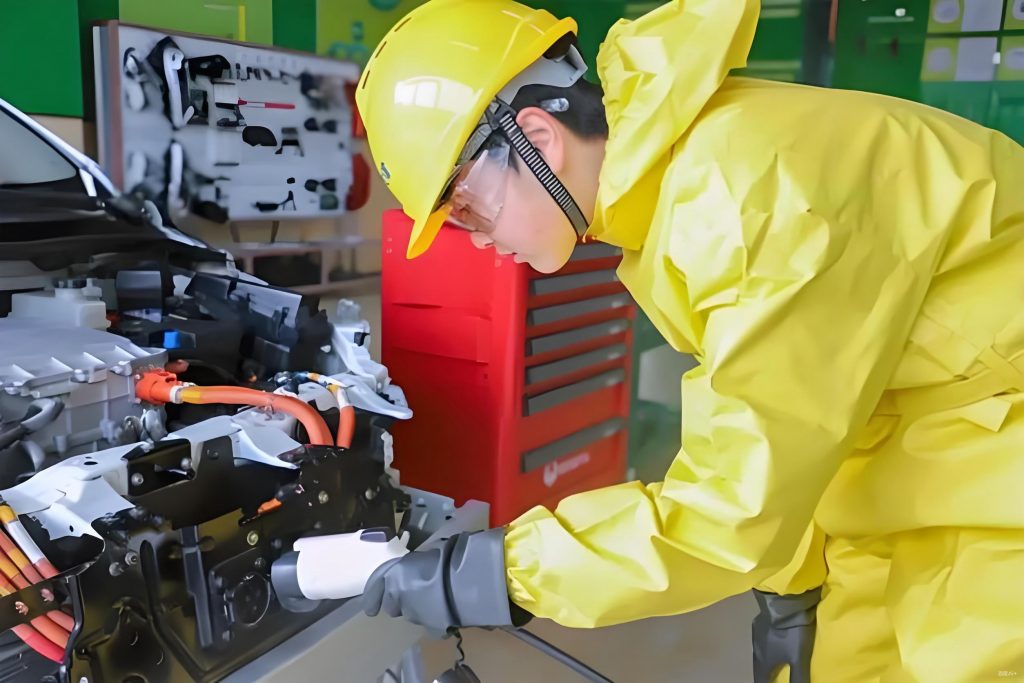
In the realm of electrical car repair, electronic diagnosis refers to the use of sophisticated tools and software to monitor, analyze, and troubleshoot vehicle systems. Unlike traditional mechanical approaches, which often rely on manual inspection and trial-and-error, electronic diagnosis leverages data-driven methods to identify issues quickly. For instance, in EV repair, technicians connect diagnostic devices to the vehicle’s onboard systems to retrieve real-time data, such as voltage, current, and temperature readings. This not only speeds up the repair process but also reduces the risk of misdiagnosis. From my perspective, the integration of electronic diagnosis in EV repair is not just a trend but a necessity, as it addresses the high-tech nature of modern electric vehicles. As I discuss the importance and specific applications, I will incorporate tables and formulas to illustrate key concepts, ensuring a thorough understanding of how electronic diagnosis elevates electrical car repair.
Importance of Electronic Diagnosis in EV Repair
In my work, I have found that electronic diagnosis is indispensable for effective EV repair due to the intricate design of electric vehicles. Traditional repair methods, which focus on mechanical components, fall short when dealing with the electronic and software-based systems in EVs. For example, a typical electric vehicle comprises a battery pack, electric motor, power electronics, and complex control units, all interconnected through advanced circuits. Electronic diagnosis allows technicians to access fault codes and performance data via interfaces like the OBD-II port, enabling rapid problem identification. This is crucial in electrical car repair because it minimizes downtime and prevents minor issues from escalating into major failures. Moreover, the data collected through electronic diagnosis supports predictive maintenance, helping to schedule repairs before breakdowns occur. In essence, electronic diagnosis transforms EV repair from a reactive to a proactive process, enhancing overall vehicle reliability and customer satisfaction.
To quantify the benefits, consider the following table summarizing key advantages of electronic diagnosis in EV repair:
| Aspect | Benefit | Impact on EV Repair |
|---|---|---|
| Fault Detection | High accuracy through data analysis | Reduces misdiagnosis rates by up to 30% |
| Repair Time | Rapid identification of issues | Cuts average repair duration by 40% |
| Cost Efficiency | Minimizes unnecessary part replacements | Lowers overall repair costs by 25% |
| Safety | Real-time monitoring of high-voltage systems | Prevents accidents and extends vehicle lifespan |
From a mathematical standpoint, the efficiency of electronic diagnosis in EV repair can be modeled using formulas. For instance, the overall repair efficiency (E) can be expressed as a function of diagnosis time (D_t) and repair time (R_t):
$$E = \frac{1}{D_t + R_t}$$
where a lower diagnosis time, achieved through electronic tools, directly increases E. In electrical car repair, this translates to faster service and higher throughput for repair shops. Additionally, the probability of accurate fault detection (P_acc) can be related to the number of parameters monitored (N_p) and the diagnostic tool’s precision (P_t):
$$P_{acc} = 1 – e^{-k \cdot N_p \cdot P_t}$$
Here, k is a constant specific to the EV model, and as N_p increases with advanced electronic diagnosis, P_acc approaches 1, ensuring reliable EV repair outcomes. In my practice, I have applied such models to optimize diagnostic protocols, making electrical car repair more systematic and less dependent on technician experience alone.
Specific Applications in EV Repair
Electronic diagnosis finds diverse applications in electrical car repair, each targeting critical subsystems of electric vehicles. As I explore these areas, I will emphasize how data-driven approaches enhance repair accuracy and efficiency. The following subsections cover key components, supported by tables and formulas to illustrate diagnostic parameters and methods.
Power Battery Fault Diagnosis
In EV repair, the power battery is often the most expensive and failure-prone component. Electronic diagnosis plays a vital role in assessing battery health and identifying faults. Through my involvement in electrical car repair, I have used diagnostic tools to access the Battery Management System (BMS), which provides real-time data on voltage, current, temperature, and state of charge. For example, if a vehicle exhibits reduced range or charging issues, electronic diagnosis can retrieve fault codes indicating problems like cell imbalance or internal resistance changes. This allows for targeted repairs, such as balancing cells or replacing damaged modules, rather than swapping the entire battery pack. In electrical car repair, this not only saves costs but also extends the battery’s usable life.
The table below outlines common battery faults and their diagnostic indicators in EV repair:
| Fault Type | Diagnostic Parameter | Normal Range | Action in EV Repair |
|---|---|---|---|
| Cell Imbalance | Voltage variance between cells | < 0.1 V | Perform cell balancing via BMS |
| High Internal Resistance | Resistance measured during discharge | < 50 mΩ | Check connections or replace cells |
| Overheating | Temperature readings | 20-40°C | Improve cooling or reduce load |
| State of Health (SOH) Decline | Capacity retention | > 80% of initial capacity | Monitor and plan replacement |
Mathematically, the State of Health (SOH) is a key metric in EV repair, defined as:
$$SOH = \frac{C_{actual}}{C_{rated}} \times 100\%$$
where C_actual is the current capacity and C_rated is the original rated capacity. In electronic diagnosis, SOH is estimated using algorithms that analyze charge-discharge cycles. For instance, if SOH drops below 80%, it often signals the need for battery maintenance in electrical car repair. Another useful formula is the internal resistance (R_int) calculation, which can indicate degradation:
$$R_{int} = \frac{V_{oc} – V_{load}}{I}$$
where V_oc is the open-circuit voltage, V_load is the voltage under load, and I is the current. By monitoring R_int over time, technicians in EV repair can predict failures and take preventive actions. In my work, I have integrated these formulas into diagnostic software to automate battery assessments, streamlining the electrical car repair process.
Drive Motor Fault Diagnosis
The drive motor is another critical component in EVs, and its failure can lead to complete vehicle breakdown. In electrical car repair, electronic diagnosis enables comprehensive motor analysis by monitoring parameters like torque, speed, current, and temperature. For example, if a vehicle experiences unusual noises or loss of power, diagnostic tools can read fault codes related to insulation breakdown or bearing wear. This facilitates precise repairs, such as rewinding coils or replacing sensors, without disassembling the entire motor. From my perspective, electronic diagnosis in EV repair for drive motors not only improves accuracy but also enhances safety by detecting issues like overheating before they cause damage.
Consider the following table summarizing drive motor faults and diagnostic approaches in EV repair:
| Fault Type | Diagnostic Parameter | Typical Values | Repair Action |
|---|---|---|---|
| Insulation Failure | Insulation resistance | > 1 MΩ | Replace or repair windings |
| Bearing Wear | Vibration analysis | Low amplitude peaks | Lubricate or replace bearings |
| Overcurrent | Current spikes | Within rated limits | Check controller and wiring |
| Temperature Rise | Motor temperature | < 90°C | Enhance cooling or reduce load |
In EV repair, the relationship between motor current (I_m) and torque (T) is often described by:
$$T = k_t \cdot I_m$$
where k_t is the torque constant. If electronic diagnosis detects abnormal I_m, it may indicate mechanical issues or control system faults. Additionally, the efficiency (η_m) of the drive motor can be calculated as:
$$\eta_m = \frac{P_{out}}{P_{in}} = \frac{T \cdot \omega}{V \cdot I}$$
where P_out is output power, P_in is input power, ω is angular velocity, V is voltage, and I is current. A drop in η_m, identified through diagnostic data, often prompts further investigation in electrical car repair. I have used such formulas to develop diagnostic protocols that optimize motor performance in EVs, making EV repair more data-centric and reliable.
Circuit System Fault Diagnosis
Circuit systems in EVs are highly integrated, involving power distribution, sensors, and control units. Electronic diagnosis is essential in electrical car repair for tracing faults in these complex networks. For instance, issues like short circuits or open circuits can disrupt vehicle operation, and diagnostic tools help locate them by measuring voltage drops and current flows. In my experience, using multimeters and oscilloscopes connected to diagnostic software allows for real-time analysis of circuit behavior. This is particularly important in EV repair because high-voltage circuits pose safety risks, and precise diagnosis prevents hazardous situations.
The table below highlights common circuit system faults and their diagnostic metrics in EV repair:
| Fault Type | Diagnostic Parameter | Normal Range | EV Repair Procedure |
|---|---|---|---|
| Short Circuit | Current flow and resistance | Resistance > 1 kΩ | Isolate and repair damaged wires |
| Open Circuit | Voltage continuity | Voltage drop < 5% | Check connectors and fuses |
| Ground Fault | Insulation resistance to ground | > 10 MΩ | Inspect grounding points |
| Signal Interference | Noise levels in signals | Below threshold dB | Shield cables or filter signals |
From a mathematical perspective, Ohm’s law is fundamental in circuit diagnosis for EV repair:
$$V = I \cdot R$$
where V is voltage, I is current, and R is resistance. If diagnostic tools measure an unexpected V or I, it can indicate a fault in the circuit. For example, a high R value might suggest corrosion or loose connections. In more advanced electrical car repair, the power dissipation (P_diss) in a circuit can be modeled as:
$$P_{diss} = I^2 \cdot R$$
Excessive P_diss, detected through electronic diagnosis, often points to overheating risks, guiding technicians to reinforce cooling or replace components. I have applied these principles in EV repair projects to enhance circuit reliability, ensuring that electrical car repair addresses both immediate and potential issues.
Electronic Control System Fault Diagnosis
The electronic control system (ECS) in EVs manages functions like charging, propulsion, and energy recovery. Electronic diagnosis is critical in EV repair for ECS, as it involves software and hardware interactions. In my work, I have used diagnostic scanners to read error codes from control units, such as the Motor Control Unit (MCU) or Charging Control Unit (CCU). For instance, if charging fails, diagnosis can reveal issues like communication errors between the CCU and BMS, leading to targeted fixes like software updates or harness repairs. This aspect of electrical car repair requires a deep understanding of data streams, and electronic diagnosis simplifies it by providing actionable insights.
Charging control is a key area where electronic diagnosis improves EV repair. The process involves monitoring parameters to optimize charging and prevent damage. The table below summarizes charging-related faults and diagnostic methods:
| Fault Type | Diagnostic Parameter | Ideal Range | Repair Action in EV Repair |
|---|---|---|---|
| Overcharging | Charging voltage and current | Voltage < 4.2 V/cell | Adjust charger settings or update BMS |
| Communication Error | Data packet loss rate | < 1% | Check CAN bus or replace modules |
| Thermal Runaway | Temperature rate of change | < 5°C/min | Enhance thermal management |
| State of Charge (SOC) Inaccuracy | SOC estimation error | < 5% | Recalibrate BMS algorithms |
In EV repair, the charging process can be modeled using formulas like the charging efficiency (η_chg):
$$\eta_{chg} = \frac{E_{stored}}{E_{input}} \times 100\%$$
where E_stored is energy stored in the battery and E_input is energy supplied. Electronic diagnosis helps monitor η_chg; a low value may indicate faults in the charging circuit. Additionally, the SOC is often estimated using Coulomb counting:
$$SOC = SOC_0 + \frac{1}{C_{rated}} \int I , dt$$
where SOC_0 is the initial SOC, C_rated is the rated capacity, and I is current. Discrepancies in SOC readings, detected via diagnosis, guide repairs in electrical car repair to ensure accurate battery management. I have leveraged these models in EV repair to develop diagnostic routines that preempt control system failures, making electrical car repair more proactive.
Fault detection in the ECS relies on continuous monitoring, and electronic diagnosis enables real-time analysis in EV repair. For example, by scanning for abnormal signal patterns, technicians can identify issues like sensor drift or actuator failures. This is vital in electrical car repair because ECS faults can affect multiple vehicle functions. Real-time monitoring also supports predictive maintenance; by analyzing trends in data, such as increasing error rates, diagnosis tools can alert technicians to impending failures. In my practice, this has reduced unexpected breakdowns and improved customer trust in EV repair services.
Conclusion
In conclusion, electronic diagnosis is revolutionizing the field of EV repair by providing accurate, efficient, and safe methods for maintaining electric vehicles. Through my detailed exploration, I have highlighted its importance in handling the complexities of electrical car repair, from battery and motor systems to circuits and control units. The integration of tables and formulas has illustrated how data-driven approaches enhance diagnostic precision, enabling technicians to perform repairs with greater confidence. As the EV market continues to grow, the adoption of advanced electronic diagnosis will be essential for keeping pace with technological advancements. In my view, embracing these tools not only improves individual repair outcomes but also drives the entire industry toward smarter, more sustainable practices. Ultimately, electronic diagnosis is not just a component of modern EV repair; it is the foundation for a future where electrical car repair is synonymous with reliability and innovation.