
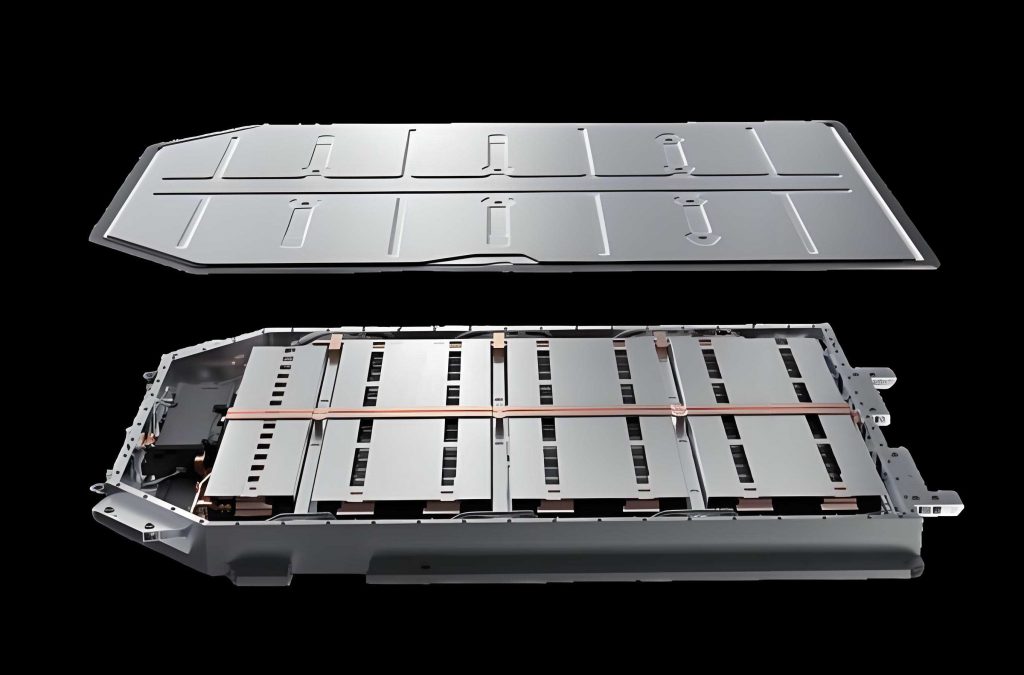
The housing material for electric vehicle (EV) battery packs is a critical component that directly impacts the safety, energy density, and overall performance of the battery system. While various materials like aluminum alloys and plastics are used, high-strength steel offers superior mechanical integrity, crash resistance, and thermal stability, making it a compelling choice for robust EV battery pack designs. However, the performance of these advanced high-strength steels can be severely degraded by the presence of large, brittle nitride inclusions, particularly aluminum nitride (AlN). These inclusions act as stress concentrators, initiating cracks and reducing ductility, which is unacceptable for the demanding safety standards of EV battery pack enclosures.
Conventional aluminum deoxidation leads to the formation of coarse AlN particles during solidification. Titanium treatment can modify these nitrides to titanium nitride (TiN), but TiN itself often exhibits a sharp, angular morphology that is also detrimental. This study investigates a novel Mg-Ti composite treatment as a method to refine and control nitride inclusions in high-strength steel intended for EV battery pack applications. Through a combination of high-temperature experiments and first-principles simulations, the mechanisms behind the significant refinement of nitrides are elucidated, providing a pathway to enhance the reliability of steel for EV battery pack structures.
Experimental Methodology
Three laboratory-scale heats of steel were prepared in a MoSi2 furnace under an argon atmosphere. The base composition was designed to simulate a high-strength grade suitable for forming into EV battery pack housings. The deoxidation and alloying sequence was carefully controlled:
- Heat 1 (Al-deoxidized): Served as the baseline, deoxidized solely with aluminum.
- Heat 2 (Ti-treated): Deoxidized with aluminum, followed by titanium addition to modify nitride formation.
- Heat 3 (Mg-Ti composite treated): Deoxidized with aluminum, followed by sequential additions of titanium and a Ni-Mg alloy.
The chemical compositions of the final ingots were analyzed, with key elements relevant to inclusion formation presented in Table 1.
| Heat | C | Si | Al | Mn | N | Ti | Mg | T.O |
|---|---|---|---|---|---|---|---|---|
| 1 (Al) | 0.23 | 0.21 | 0.48 | 0.81 | 0.0034 | – | – | 0.0018 |
| 2 (Ti) | 0.25 | 0.30 | 0.40 | 1.00 | 0.0025 | 0.04 | – | 0.0019 |
| 3 (Mg-Ti) | 0.25 | 0.30 | 0.40 | 1.00 | 0.0026 | 0.04 | 0.004 | 0.0014 |
Samples were taken from the ingots, polished, and examined using scanning electron microscopy (SEM) equipped with energy-dispersive X-ray spectroscopy (EDS). Inclusion characteristics—including morphology, composition, size distribution, and number density—were statistically analyzed over a large number of fields of view to ensure representativeness.
Results and Discussion
1. Characterization of Nitride Inclusions
The morphology and type of nitride inclusions varied dramatically with the deoxidation practice, directly influencing the potential performance of the steel in an EV battery pack.
Heat 1 (Al-deoxidized): The microstructure was dominated by AlN inclusions. Two typical morphologies were observed: individual cubic AlN particles and large, irregular clusters of AlN. These clusters and the sharp corners of the cubic particles are potent sites for stress concentration and crack initiation, which could compromise the integrity of an EV battery pack casing during a crash event.
Heat 2 (Ti-treated): Titanium addition successfully suppressed the formation of AlN. The predominant nitrides were discrete TiN particles. While the modification from AlN to TiN occurred, the TiN particles themselves maintained a polygonal or square shape with distinct, sharp edges. Their size remained relatively large, often exceeding 5 μm, meaning the fundamental issue of large, brittle inclusions persisted for this potential EV battery pack steel.
Heat 3 (Mg-Ti composite treated): This treatment resulted in a profound change. The typical inclusions were fine, complex particles consisting of a MgAl2O4 (spinel) core encapsulated by a TiN shell. The most significant outcome was the drastic reduction in inclusion size. Statistical analysis confirmed this, as shown in the summary of inclusion characteristics (Table 2) and the size distribution chart (Figure 1). The Mg-Ti treatment increased the number density of inclusions by an order of magnitude while reducing the average size to the 1-3 μm range. This refined and dispersed population of inclusions is highly desirable for maintaining the toughness and formability required for manufacturing complex EV battery pack components.
| Heat (Treatment) | Predominant Nitride Type | Average Size (μm) | Number Density (mm-2) | % of Inclusions 1-3 μm |
|---|---|---|---|---|
| 1 (Al) | AlN (Cubic/Clusters) | ~6.5 | ~25 | <20% |
| 2 (Ti) | TiN (Angular) | ~5.5 | ~35 | |
| 3 (Mg-Ti) | MgAl2O4-TiN (Core-Shell) | ~2.2 | ~80 | 85% |
The size distribution clearly highlights the refinement effect. In the Mg-Ti treated steel, over 85% of inclusions were in the benign 1-3 μm range, whereas in the Al- and Ti-only steels, more than 50% of inclusions were larger than 5 μm, posing a greater risk to the EV battery pack’s mechanical reliability.
2. Thermodynamic and Kinetic Analysis of Nitride Precipitation
The sequence of precipitation during solidification is key to understanding the refinement mechanism. The solubility products for TiN and AlN are given by:
$$ \log(K_{TiN}) = \log(w_{[Ti]} \cdot w_{[N]}) = -\frac{15312}{T} + 5.66 $$
$$ \log(K_{AlN}) = \log(w_{[Al]} \cdot w_{[N]}) = -\frac{15850.93}{T} + 6.96 $$
where $w_{[i]}$ is the mass percent of solute in the liquid steel and $T$ is the temperature in Kelvin.
Using the Clyne-Kurz model for microsegregation, the evolution of solute concentrations in the interdendritic liquid during solidification can be calculated:
$$ w_{[i]}^L = w_{[i],0} \left[ 1 – (1 – 2\Omega k_i) f_s \right]^{\frac{k_i – 1}{1 – 2\Omega k_i}} $$
where $w_{[i]}^L$ is the liquid concentration, $w_{[i],0}$ is the initial concentration, $k_i$ is the equilibrium partition coefficient, $f_s$ is the solid fraction, and $\Omega$ is a solute diffusion parameter.
For the composition of Heat 2 (Ti-treated), calculations show that TiN begins to precipitate at a solid fraction of approximately $f_s \approx 0.50$, while AlN precipitation does not start until $f_s \approx 0.58$. This confirms that TiN precipitates earlier, consuming the available nitrogen and suppressing AlN formation. However, the growth of these TiN particles in the liquid is governed by diffusion. The theoretical growth radius $r$ of a nitride $XY$ (where X=Ti or Al, Y=N) can be estimated by:
$$ r = \frac{M_{XY}}{50 M_{Fe}} \sqrt{\frac{\rho_{Fe}}{\rho_{XY}} D_N (w_{[N]}^L – w_{[N]}^e) t_f} $$
where $M$ are molar masses, $\rho$ are densities, $D_N$ is the diffusion coefficient of nitrogen, $(w_{[N]}^L – w_{[N]}^e)$ is the supersaturation, and $t_f$ is the local solidification time. Calculations for typical cooling rates show that while TiN sizes are slightly smaller than AlN sizes for the same conditions, both can grow to several micrometers without an effective nucleation site. This explains the coarse TiN observed in Heat 2, which is not optimal for EV battery pack steel.
3. The Role of MgAl2O4 as a Heterogeneous Nucleation Site
The introduction of magnesium in Heat 3 transforms primary Al2O3 clusters into numerous, finely dispersed MgAl2O4 spinel particles. These spinel particles serve as potent heterogeneous nucleation sites for TiN during solidification. The effectiveness of a substrate (MgAl2O4) in promoting the nucleation of a precipitate (TiN or AlN) depends largely on the crystallographic lattice mismatch. The two-dimensional lattice misfit $\delta$ is calculated using the Bramfitt equation:
$$ \delta_{(hkl)_n}^{(hkl)_s} = \sum_{i=1}^{3} \frac{|d_{[uvw]_s}^i \cos \theta – d_{[uvw]_n}^i|}{d_{[uvw]_n}^i} \times 100\% $$
where $(hkl)_s$ and $(hkl)_n$ are low-index planes of the substrate and nucleus, $d_{[uvw]}$ are the atomic spacings along low-index directions, and $\theta$ is the angle between these directions. A misfit below 6% indicates high potency for nucleation.
First-principles calculations were used to optimize the lattice parameters of the relevant phases (Table 3).
| Phase | Crystal System | Calculated Lattice Parameter (Å) |
|---|---|---|
| TiN | FCC | 4.2698 |
| MgAl2O4 | FCC | 8.1907 |
| AlN | Hexagonal | a=3.1135, c=5.0132 |
The calculated misfits for key interface combinations are summarized in Table 4.
| Substrate // Nucleus | Matching Directions | Misfit $\delta$ (%) | Remark |
|---|---|---|---|
| MgAl2O4(100) // TiN(100) | [100]s // [200]n | 4.08 | Excellent match, promotes nucleation |
| [110]s // [220]n | 6.31 | ||
| MgAl2O4(100) // AlN(0001) | [100]s // [2$\bar{1}$10]n | 16.00 | Poor match, unlikely to nucleate |
The critical result is the very low misfit of 4.08% between MgAl2O4 and TiN, confirming the high potency of spinel for TiN nucleation. In contrast, the misfit with AlN is significantly larger, explaining why MgAl2O4 is not an effective nucleant for AlN.
4. First-Principles Calculation of Interfacial Energy
To further validate the nucleation mechanism, the interfacial energy $E_{int}$ between MgAl2O4 and the nitrides was computed using first-principles methods based on density functional theory (DFT). The interfacial energy is derived from the adhesion work $W_{ad}$ and the surface energies $\sigma$ of the individual phases:
$$ W_{ad} = \frac{E_a + E_b – E_{a/b}}{A} $$
$$ E_{int} = \sigma_a + \sigma_b – W_{ad} $$
where $E_{a/b}$ is the total energy of the interface model, $E_a$ and $E_b$ are the energies of the isolated surfaces, and $A$ is the interface area. A lower $E_{int}$ indicates a more stable and readily formed interface.
Supercell models were constructed for the most favorable orientations based on misfit calculations: MgAl2O4(100)/TiN(100) and MgAl2O4(100)/AlN(0001). The DFT calculations yielded the following results:
$$ E_{int}^{(\text{MgAl2O4/TiN})} = 3.137 \, \text{J/m}^2 $$
$$ E_{int}^{(\text{MgAl2O4/AlN})} = 3.596 \, \text{J/m}^2 $$
The interfacial energy for the MgAl2O4/TiN system is approximately 0.46 J/m² lower than that for the MgAl2O4/AlN system. This lower energy barrier strongly supports the experimental observation that TiN preferentially and easily nucleates on MgAl2O4 particles rather than AlN, leading to the formation of the observed core-shell structures in the EV battery pack steel.
5. Synthesis of the Refinement Mechanism for EV Battery Pack Steel
The mechanism by which Mg-Ti composite treatment refines nitrides in high-strength EV battery pack steel can be summarized in a sequential process:
- Mg Modification: Upon addition, magnesium reacts with existing Al2O3 inclusions, transforming them into numerous, finely dispersed MgAl2O4 (spinel) particles. This is a crucial first step to create a high density of potential nucleation sites.
- Ti Addition and Supersaturation: Titanium is dissolved in the liquid steel. During solidification, microsegregation leads to the buildup of titanium and nitrogen in the interdendritic liquid.
- Heterogeneous Nucleation: When the solubility product of TiN is exceeded, TiN does not nucleate homogeneously (which would lead to fewer, larger particles). Instead, it finds the readily available MgAl2O4 particles. Due to the excellent crystallographic match (low lattice misfit of 4.08%) and low interfacial energy (3.137 J/m²), TiN nucleates heterogeneously on the surface of the spinel particles with a very low energy barrier.
- Formation of Composite Inclusions: The TiN grows epitaxially on the MgAl2O4 core, forming a fine, core-shell MgAl2O4-TiN composite inclusion. The size of this composite is constrained by the initial size of the spinel core and the limited amount of solutes available in the volume surrounding each fine particle.
- Suppression of AlN and Coarse TiN: The prior consumption of nitrogen by the formation of fine TiN on spinel prevents the supersaturation required for the later precipitation of AlN. It also eliminates the driving force for the growth of coarse, primary TiN particles.
This synergistic process results in a high number density of fine, well-dispersed inclusions, replacing the harmful coarse AlN or angular TiN. This microstructure is ideal for an EV battery pack steel, as it preserves ductility, toughness, and fatigue resistance—properties essential for withstanding road vibrations, minor impacts, and ensuring safety in a crash scenario.
Conclusion
The Mg-Ti composite treatment presents a highly effective metallurgical strategy for refining nitride inclusions in high-strength steels designed for critical applications like EV battery pack housings. The key findings and mechanisms are:
- Mg-Ti treatment transforms the inclusion population from coarse AlN or angular TiN (>5 μm) into fine MgAl2O4-TiN core-shell composites (1-3 μm), increasing their number density significantly.
- The refinement mechanism is based on the use of MgAl2O4 spinel, formed from Mg treatment, as a potent heterogeneous nucleation site for TiN.
- Crystallographic analysis confirms an excellent lattice match between MgAl2O4 and TiN, with a minimum two-dimensional misfit of 4.08%, well within the range for effective nucleation.
- First-principles calculations of interfacial energy provide atomistic-level confirmation, showing a lower energy barrier for the formation of the MgAl2O4/TiN interface (3.137 J/m²) compared to MgAl2O4/AlN (3.596 J/m²).
- This treatment not only refines inclusions but also suppresses the formation of brittle AlN, leading to a superior microstructure for enhancing the mechanical reliability and safety of EV battery pack components.
This work establishes a clear scientific foundation for the application of Mg-Ti composite deoxidation in producing high-performance steels for the next generation of safe and durable EV battery packs.