
As an experienced professional in the field of electric vehicle maintenance, I have observed the rapid growth of the electric car market and the critical role that power batteries play in these vehicles. Power batteries are the heart of electric cars, and their performance and safety are paramount. However, due to factors like technological limitations and environmental conditions, faults in these batteries are common. In this article, I will delve into the intricacies of EV repair, focusing on fault detection and repair techniques for power batteries, supported by real-world cases, tables, and formulas. My aim is to provide a comprehensive guide for technicians and enthusiasts involved in electrical car repair, emphasizing practical approaches to ensure battery reliability and longevity.
Electric vehicles (EVs) rely heavily on their power batteries for energy storage and delivery. These batteries, typically lithium-ion based, are complex systems that require meticulous monitoring and maintenance. Faults can arise from various sources, including internal short circuits, battery management system (BMS) failures, and thermal runaway events. Through my work in EV repair, I have encountered numerous cases where timely detection and repair prevented catastrophic failures. For instance, in one scenario, a vehicle experienced sudden power loss during operation, which was traced back to an internal short circuit in a single cell. This highlights the importance of robust detection methods in electrical car repair.
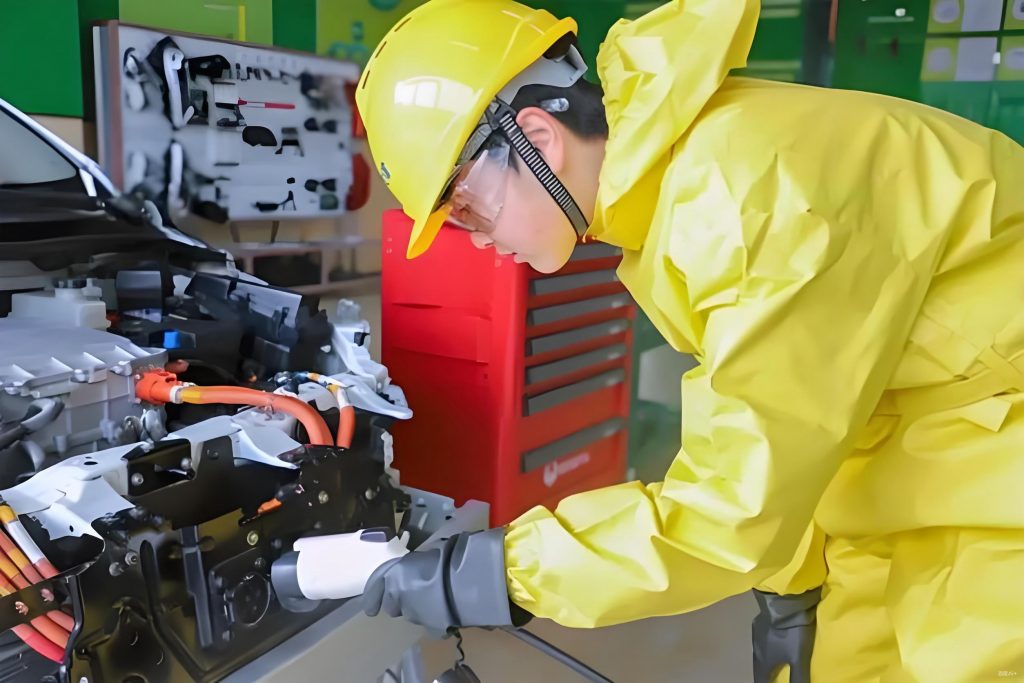
To begin, let’s explore the common fault types in electric vehicle batteries. Internal short circuits are a frequent issue in EV repair, often caused by manufacturing defects or physical damage. When a short circuit occurs, it can lead to voltage drops, increased internal resistance, and even thermal events. Detection typically involves using the BMS to monitor cell voltages and resistances. For example, the voltage of a faulty cell might drop significantly compared to others, as described by the equation for cell voltage under load: $$V_{cell} = V_{ocv} – I \cdot R_{internal}$$ where \(V_{cell}\) is the measured cell voltage, \(V_{ocv}\) is the open-circuit voltage, \(I\) is the current, and \(R_{internal}\) is the internal resistance. If \(R_{internal}\) increases due to a short, \(V_{cell}\) decreases, alerting technicians to a potential fault. In my experience, this is a key step in electrical car repair, as it allows for early intervention.
Another critical aspect of EV repair is dealing with battery management system faults. The BMS is responsible for balancing cells, monitoring temperatures, and ensuring safe operation. When it fails, vehicles may not charge or discharge properly. I recall a case where a BMS communication error caused erratic behavior; troubleshooting involved checking hardware connections and updating software. The BMS relies on algorithms to estimate state of charge (SOC) and state of health (SOH), which can be modeled using equations like the Kalman filter for SOC estimation: $$\hat{x}_{k|k-1} = F_k \hat{x}_{k-1|k-1} + B_k u_k$$ where \(\hat{x}\) is the state estimate, \(F\) is the state transition matrix, \(B\) is the control input matrix, and \(u\) is the input. Regular maintenance of the BMS is essential in electrical car repair to prevent such issues.
To systematize the fault detection process in EV repair, I often use tables to summarize key parameters and methods. For instance, the table below outlines common battery faults, their symptoms, and detection techniques:
| Fault Type | Symptoms | Detection Method | Typical Values |
|---|---|---|---|
| Internal Short Circuit | Voltage drop, increased resistance | BMS voltage monitoring, impedance spectroscopy | Voltage < 2.5V, Resistance > 50mΩ |
| BMS Failure | Charging/discharging issues, error codes | Hardware diagnostics, software logs | Communication errors, SOC inaccuracy |
| Thermal Runaway | Overheating, smoke, fire risk | Temperature sensors, thermal imaging | Temperature > 60°C, rapid rise rate |
In electrical car repair, prevention is as important as repair. For internal short circuits, I recommend using无损检测 techniques like ultrasonic testing to locate faults without disassembling the battery. The wave propagation in such methods can be described by the wave equation: $$\frac{\partial^2 u}{\partial t^2} = c^2 \nabla^2 u$$ where \(u\) is the displacement, \(c\) is the wave speed, and \(\nabla^2\) is the Laplacian operator. This helps in identifying micro-shorts early, reducing the risk of escalation. Additionally, implementing preventive strategies, such as regular battery inspections and user education on proper charging habits, can mitigate faults. In my EV repair practice, I have found that educating users on avoiding overcharging—modeled by the charge equation: $$Q = I \cdot t$$ where \(Q\) is charge, \(I\) is current, and \(t\) is time—can significantly extend battery life.
When it comes to repair strategies for electric vehicle batteries, replacing faulty cells is a common approach. However, this requires careful handling to maintain pack balance. The overall pack voltage \(V_{pack}\) for a series configuration is given by: $$V_{pack} = \sum_{i=1}^{n} V_{cell,i}$$ where \(n\) is the number of cells. If one cell is replaced, its voltage must match the others to avoid imbalances that could lead to further issues in EV repair. In one case, I used a cell balancer to equalize voltages after replacement, which involved calculating the energy difference: $$\Delta E = \frac{1}{2} C (V_{high}^2 – V_{low}^2)$$ where \(C\) is capacitance, and \(V_{high}\) and \(V_{low}\) are the voltages of high and low cells, respectively. This technical depth is crucial in electrical car repair for ensuring safety.
Moreover, thermal management is a vital component of EV repair. Batteries generate heat during operation, and poor dissipation can cause thermal runaway. The heat generation rate can be approximated by Joule heating: $$P = I^2 R$$ where \(P\) is power loss, \(I\) is current, and \(R\) is resistance. To prevent this, I often advise on cooling system maintenance, such as checking coolant levels in liquid-cooled batteries. The table below summarizes thermal fault parameters and mitigation steps in electrical car repair:
| Thermal Issue | Causes | Detection | Mitigation |
|---|---|---|---|
| Overheating | High current, ambient heat | Temperature sensors, BMS alerts | Improve cooling, reduce load |
| Thermal Runaway | Internal short, overcharge | Thermal cameras, smoke detectors | Isolate cells, emergency protocols |
In the realm of EV repair, battery management system optimization is a continuous process. I have worked on cases where software updates resolved persistent BMS faults. For example, the SOC estimation algorithm can be refined using adaptive filters, which adjust based on real-time data. The recursive least squares method is one such approach: $$\theta_{k} = \theta_{k-1} + K_k (y_k – \phi_k^T \theta_{k-1})$$ where \(\theta\) is the parameter vector, \(K\) is the gain, \(y\) is the measurement, and \(\phi\) is the regressor vector. This enhances the accuracy of battery monitoring, a cornerstone of reliable electrical car repair.
Looking ahead, the field of EV repair is evolving with advancements in battery technology. Solid-state batteries, for instance, promise higher safety and energy density, but they introduce new fault modes. As a practitioner, I stay updated on these trends to adapt repair techniques. For example, the internal resistance of solid-state batteries might be lower, modeled by: $$R_{internal} = \frac{\rho L}{A}$$ where \(\rho\) is resistivity, \(L\) is length, and \(A\) is cross-sectional area. This could change how we approach detection in electrical car repair.
In conclusion, electric vehicle battery fault detection and repair is a multifaceted discipline that requires a deep understanding of battery mechanics, electronics, and software systems. Through my experiences in EV repair, I have learned that proactive monitoring, combined with precise diagnostic tools, is key to maintaining battery health. Formulas and tables, as shown, provide a structured way to analyze and address faults. As the electric car industry grows, the demand for skilled electrical car repair technicians will only increase, driving innovation in fault detection and repair methodologies. By sharing these insights, I hope to contribute to a safer and more efficient future for electric mobility.