
As an engineer focused on electric vehicle (EV) thermal management systems, I have extensively studied the challenges posed by thermal hazards in range-extended electric vehicles (REEVs). These vehicles combine a battery-powered electric drivetrain with an internal combustion engine acting as a generator, creating unique thermal management scenarios. A critical issue is the heat damage from the exhaust system of the range extender, which can significantly affect the EV battery pack’s performance, safety, and longevity. In this article, I will analyze the impact of exhaust pipe heat radiation on the EV battery pack, drawing from simulation studies, experimental testing, and mitigation strategies. The goal is to provide a comprehensive understanding of how thermal hazards influence EV battery pack design and operation, emphasizing the importance of thermal protection for ensuring reliability and safety in REEVs.
The operation of a range-extended electric vehicle involves using an electric motor to drive the wheels, with a battery pack supplying energy. When the EV battery pack’s state of charge drops, a gasoline engine starts to generate electricity, charging the EV battery pack indirectly. This engine, or range extender, operates at optimal efficiency points, but its exhaust system reaches high temperatures, often between 100°C and 400°C during normal operation, and up to 800–1000°C during cold starts. In contrast, the EV battery pack, typically comprising lithium-ion cells, plastics, metals, and sealing materials, has a limited operating temperature range, generally from 15°C to 35°C for optimal performance, with component耐温 limits around 55°C to 125°C. The close proximity of the exhaust pipe to the EV battery pack in vehicle underbody layouts leads to significant heat radiation, posing risks of material degradation, thermal runaway, and reduced lifespan for the EV battery pack. This thermal hazard is a key concern in REEV design, requiring careful analysis and countermeasures to protect the EV battery pack from excessive heat exposure.
The impact of thermal hazards on the EV battery pack can be categorized into two main areas: threats to temperature safety and acceleration of high-temperature aging. First, heat radiation from the exhaust pipe can cause localized overheating of EV battery pack components, such as cell modules, busbars, connectors, and the enclosure. If temperatures exceed the material耐温 limits, it may lead to melting, short circuits, or even fires, compromising the safety of the EV battery pack. Second, prolonged exposure to elevated temperatures accelerates the aging process of lithium-ion cells within the EV battery pack. Higher operating temperatures reduce cycle life and capacity retention, affecting the long-term viability of the EV battery pack. To quantify these effects, I conducted thermal simulations and整车热害 tests, focusing on temperature distributions and lifecycle impacts. For instance, in a typical REEV layout, the exhaust pipe runs near one side of the EV battery pack, as illustrated below, highlighting the need for effective thermal barriers.
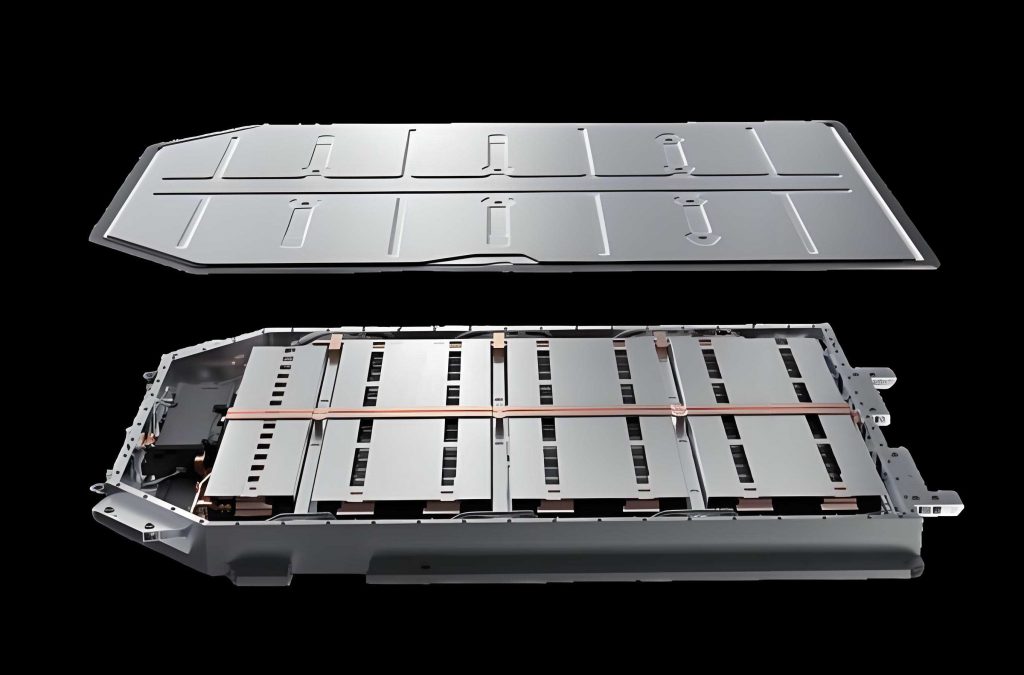
To assess the thermal hazard, I performed a computational fluid dynamics (CFD) simulation of the EV battery pack under heat radiation conditions. The simulation model included the EV battery pack’s geometry, material properties, and boundary conditions representing a worst-case scenario: ambient temperature of 38°C, no active cooling from the liquid cooling system, and radiative heat flux from the exhaust pipe applied to the adjacent side of the EV battery pack enclosure. The simulation time was set to 3600 seconds to capture steady-state temperature rises. The governing equations for heat transfer involve conduction, convection, and radiation. For conduction, Fourier’s law applies:
$$ \vec{q} = -k \nabla T $$
where \(\vec{q}\) is the heat flux vector, \(k\) is the thermal conductivity, and \(\nabla T\) is the temperature gradient. For radiation from the exhaust pipe, the Stefan-Boltzmann law is relevant:
$$ P = \epsilon \sigma A (T^4 – T_{\text{amb}}^4) $$
where \(P\) is the radiative power, \(\epsilon\) is the emissivity, \(\sigma\) is the Stefan-Boltzmann constant, \(A\) is the surface area, \(T\) is the exhaust temperature, and \(T_{\text{amb}}\) is the ambient temperature. The simulation results showed that the side of the EV battery pack near the exhaust pipe experienced a temperature increase from 38°C to approximately 46°C over 3600 seconds, with a temperature difference of up to 8°C across the cells within the EV battery pack. This indicates that thermal hazards can cause significant temperature rises and gradients in the EV battery pack, potentially pushing components beyond their耐温 limits. The table below summarizes the simulated temperature rises for key EV battery pack components:
| EV Battery Pack Component | Initial Temperature (°C) | Final Temperature (°C) | Temperature Rise (°C) |
|---|---|---|---|
| Cell Surface (Near Exhaust) | 38 | 46 | 8 |
| Enclosure Surface | 38 | 50 | 12 |
| Busbar Area | 38 | 48 | 10 |
To validate the simulation findings, I conducted整车热害 tests on a REEV in a chassis dynamometer laboratory. The test conditions simulated a severe driving scenario: vehicle speed of 50 km/h, a road gradient of 7.2% to emulate hill climbing, duration of 30 minutes (1800 seconds), and an ambient temperature of 38°C. Thermocouples were placed inside the EV battery pack to measure temperatures of various components, including cells,模组外壳, connectors, and the cooling liquid. The EV battery pack’s liquid cooling system was initially disabled to isolate the effects of exhaust heat radiation. The test monitored parameters such as cell temperatures, cooling liquid temperature, and vehicle power output. The results revealed that without thermal protection, the EV battery pack components exceeded their耐温 standards. For example, the模组外壳 temperature reached 69°C, surpassing its limit of 55°C, and the enclosure temperature hit 105°C, above its 80°C limit. This confirms the simulation predictions and underscores the thermal hazard risk to the EV battery pack. The table below compares the maximum temperatures of EV battery pack components with and without an exhaust隔热罩 during the test:
| EV Battery Pack Component | 耐温 Standard (°C) | Max Temperature Without Heat Shield (°C) | Max Temperature With Heat Shield (°C) |
|---|---|---|---|
| Enclosure | 80 | 105 | 65 |
| Busbar (GCU) | 105 | 89 | 76 |
| Connector (PDU) | 125 | 103 | 94 |
| Connector (GCU) | 125 | 105 | 82 |
| Module Housing | 55 | 69 | 51 |
The cooling liquid temperature in the EV battery pack also showed significant increases due to heat radiation from the exhaust pipe. When the liquid cooling system’s compressor was turned off after 2400 seconds in the test, the cooling liquid temperature rose from 20°C to 45°C within 1200 seconds. This rapid温升 is attributed to heat radiation heating the coolant reservoir located near the range extender. Since the cooling liquid circulates through the EV battery pack to regulate cell temperatures, this heating effect can indirectly raise cell temperatures, exacerbating the thermal hazard impact on the EV battery pack. The temperature profile can be modeled using a simple energy balance equation:
$$ m c_p \frac{dT}{dt} = \dot{Q}_{\text{in}} – \dot{Q}_{\text{out}} $$
where \(m\) is the mass of the coolant, \(c_p\) is the specific heat capacity, \(T\) is the temperature, \(t\) is time, \(\dot{Q}_{\text{in}}\) is the heat input from radiation, and \(\dot{Q}_{\text{out}}\) is the heat removed by cooling. For the EV battery pack, maintaining coolant temperature is crucial to prevent overheating of cells.
Beyond immediate temperature safety, thermal hazards accelerate the aging of the EV battery pack’s lithium-ion cells. High temperatures degrade cell chemistry, leading to capacity fade and reduced cycle life. I analyzed the cycle life of typical NCM (nickel-cobalt-manganese) lithium-ion cells used in EV battery packs under different temperatures. Testing was performed on 52 Ah cells with a voltage range of 2.50 V to 4.25 V, using a 1C charge-discharge cycle protocol. The results showed that at 25°C, the cycle life (to 80% capacity retention) was 2,522 cycles, while at 45°C, it dropped to 1,545 cycles—a reduction of about 38.7%. This demonstrates that elevated temperatures significantly shorten the lifespan of the EV battery pack. To generalize, I developed a cycle life prediction model based on empirical data fitting. The capacity loss after \(n\) cycles at temperature \(\theta\) (in Kelvin) can be expressed as:
$$ Q_{\text{loss}}(\theta, n) = e^{\left(2.696 – \frac{3840.3}{\theta} + 1.15183 \times \ln n\right)} $$
where \(Q_{\text{loss}}(\theta, n)\) is the capacity衰减率 (e.g., 0.2 for 20% loss), and \(\theta\) is the absolute temperature. From this model, the cycle life \(n\) for a given temperature can be derived. For instance, setting \(Q_{\text{loss}} = 0.2\) and \(\theta = 323\,\text{K}\) (50°C) yields a cycle life of approximately 700 cycles for a single cell. Considering cell-to-cell variations and temperature gradients in an EV battery pack, a derating factor of 0.8 is often applied, giving a pack-level cycle life of about 560 cycles. The table below summarizes the predicted cycle life for the EV battery pack at various temperatures:
| Temperature (°C) | Cycle Life (Single Cell) | Cycle Life (EV Battery Pack with Derating) |
|---|---|---|
| 25 | 2,522 | 2,018 |
| 35 | 1,800 | 1,440 |
| 45 | 1,545 | 1,236 |
| 50 | 700 | 560 |
The model indicates that for every 5°C increase in average operating temperature, the EV battery pack’s cycle life decreases by roughly 200 cycles. This highlights the importance of thermal management in preserving the longevity of the EV battery pack in REEVs. The heat radiation from the exhaust pipe can raise the EV battery pack’s temperature by 10–15°C or more, directly contributing to accelerated aging. Therefore, mitigating thermal hazards is essential not only for safety but also for economic reasons, as it extends the service life of the expensive EV battery pack.
To address thermal hazards, I implemented two primary countermeasures: optimizing the thermal management strategy and adding physical隔热罩 between the exhaust pipe and the EV battery pack. First, in the thermal management strategy, I ensured that during extreme conditions, the EV battery pack’s liquid cooling system operates proactively. This involves synchronously activating the coolant pump and the refrigeration compressor to cool the circulating liquid. By doing so, the coolant temperature is maintained within a safe range, preventing it from being heated by exhaust radiation and subsequently overheating the EV battery pack cells. The control logic can be based on temperature thresholds: when the coolant temperature exceeds 45°C, the compressor is engaged; when it drops below 20°C, the compressor is turned off. This active cooling helps stabilize the EV battery pack temperature, even under heat radiation stress. The energy consumption of this strategy can be estimated using the coefficient of performance (COP) of the refrigeration cycle:
$$ \text{COP} = \frac{\dot{Q}_{\text{cooling}}}{W} $$
where \(\dot{Q}_{\text{cooling}}\) is the cooling capacity and \(W\) is the electrical work input. For an EV battery pack, typical COP values range from 2 to 4, meaning efficient heat removal relative to energy use.
Second, I installed a heat shield made of double-layer aluminum foil with air gaps (convex包板) between the exhaust pipe and the EV battery pack. This隔热罩 leverages the insulating properties of air layers and the high reflectivity of aluminum to reduce radiative heat transfer. The effectiveness of the heat shield can be quantified by the reduction in heat flux. Using the radiative heat transfer equation, the heat flux with a shield can be approximated as:
$$ q”_{\text{with shield}} = \frac{\sigma (T^4_{\text{exhaust}} – T^4_{\text{pack}})}{\frac{1}{\epsilon_1} + \frac{1}{\epsilon_2} – 1 + \frac{1}{\epsilon_{\text{shield}}}} $$
where \(\epsilon_1\) and \(\epsilon_2\) are the emissivities of the exhaust and pack surfaces, and \(\epsilon_{\text{shield}}\) is the emissivity of the shield. For aluminum, \(\epsilon_{\text{shield}}\) is low (around 0.05), significantly cutting heat flux. In tests, adding the heat shield reduced temperatures on the EV battery pack side by up to 40°C, as shown in the earlier table. For instance, the enclosure temperature dropped from 105°C to 65°C, well within the耐温 limit. This demonstrates the shield’s crucial role in protecting the EV battery pack from direct heat radiation. Additionally, I supplemented the shield with隔热垫片 and隔热棉 at mounting points to minimize conductive heat transfer, further safeguarding the EV battery pack components.
The combined approach of active cooling and passive shielding proved effective in mitigating thermal hazards. After implementation, under the same test conditions (38°C ambient, 30-minute hill climb), the EV battery pack’s cell temperatures remained controlled, with a maximum of 40°C and a温差 of 5°C. This is within the optimal range of 15–35°C for the EV battery pack, ensuring both safety and longevity. The table below summarizes the temperature improvements for the EV battery pack with countermeasures:
| Parameter | Without Countermeasures | With Countermeasures |
|---|---|---|
| Max Cell Temperature (°C) | 46 | 40 |
| Cell Temperature Difference (°C) | 8 | 5 |
| Coolant Temperature Rise (°C) | 25 | 10 |
| Component Temperature Exceedance | Yes (e.g., module at 69°C) | No (all within limits) |
In conclusion, thermal hazards from the exhaust pipe in range-extended electric vehicles pose significant risks to the EV battery pack, including temperature safety violations and accelerated aging. Through simulation and experimental analysis, I have shown that heat radiation can raise EV battery pack component temperatures by 15°C or more, exceed耐温 standards, and reduce cycle life by up to 40%. The EV battery pack’s vulnerability underscores the need for robust thermal management. Effective countermeasures, such as同步开启 the liquid cooling system and installing aluminum heat shields, can mitigate these risks, keeping the EV battery pack within safe temperature ranges and extending its lifespan. Future work should focus on advanced materials for隔热罩 and adaptive thermal control algorithms to further optimize EV battery pack protection in diverse driving conditions. By addressing thermal hazards proactively, we can enhance the reliability and safety of EV battery packs in REEVs, supporting the broader adoption of electric mobility.
To further elaborate on the thermal dynamics, consider the heat conduction within the EV battery pack cells. The temperature distribution in a cell can be modeled using the heat equation:
$$ \rho c_p \frac{\partial T}{\partial t} = k \nabla^2 T + \dot{q}_{\text{gen}} $$
where \(\rho\) is density, \(c_p\) is specific heat, \(k\) is thermal conductivity, and \(\dot{q}_{\text{gen}}\) is internal heat generation from electrochemical reactions. For an EV battery pack, managing \(\dot{q}_{\text{gen}}\) through cooling is vital, but external heat from exhaust radiation adds to the challenge. The overall heat balance for the EV battery pack system can be expressed as:
$$ \sum \dot{Q}_{\text{in}} = \sum \dot{Q}_{\text{out}} + \frac{dU}{dt} $$
where \(\dot{Q}_{\text{in}}\) includes heat from radiation and internal generation, \(\dot{Q}_{\text{out}}\) includes convective and radiative losses to the environment, and \(dU/dt\) is the rate of change in internal energy. By minimizing \(\dot{Q}_{\text{in}}\) from exhaust radiation via shielding and enhancing \(\dot{Q}_{\text{out}}\) via active cooling, the EV battery pack’s thermal state can be stabilized.
In terms of design implications, the placement of the EV battery pack relative to the exhaust pipe is critical. Using CFD simulations, engineers can optimize the layout to maximize distance or incorporate natural airflow for cooling. For example, the distance \(d\) between the exhaust and EV battery pack affects radiative heat flux according to the inverse square law for point sources, but for extended surfaces, view factors are used:
$$ F_{1 \to 2} = \frac{1}{A_1} \int_{A_1} \int_{A_2} \frac{\cos \theta_1 \cos \theta_2}{\pi r^2} \, dA_2 \, dA_1 $$
where \(F_{1 \to 2}\) is the view factor from surface 1 (exhaust) to surface 2 (EV battery pack), \(A\) is area, \(\theta\) are angles, and \(r\) is the distance. Reducing \(F_{1 \to 2}\) through shielding or spacing lowers heat transfer to the EV battery pack.
Additionally, the choice of materials for the EV battery pack enclosure influences thermal performance. Materials with low thermal conductivity and high reflectivity can reduce heat absorption. For instance, using composites with insulating layers can protect the EV battery pack from external heat sources. The thermal resistance \(R\) of such a composite wall is given by:
$$ R = \sum \frac{\Delta x_i}{k_i} $$
where \(\Delta x_i\) is thickness and \(k_i\) is thermal conductivity of layer \(i\). Increasing \(R\) helps shield the EV battery pack interior.
From a lifecycle perspective, the economic impact of thermal hazards on the EV battery pack is substantial. Assuming an EV battery pack cost of $10,000 and a lifespan reduction from 2,000 cycles to 1,200 cycles due to heat, the cost per cycle increases, affecting total cost of ownership. Therefore, investing in thermal protection measures for the EV battery pack is cost-effective over the vehicle’s life. The formula for cost per cycle \(C_{\text{cycle}}\) is:
$$ C_{\text{cycle}} = \frac{C_{\text{pack}}}{N_{\text{cycles}}} $$
where \(C_{\text{pack}}\) is the EV battery pack cost and \(N_{\text{cycles}}\) is the cycle life. By extending \(N_{\text{cycles}}\) through thermal management, \(C_{\text{cycle}}\) decreases, benefiting consumers.
In summary, the EV battery pack in range-extended vehicles faces unique thermal hazards from exhaust heat radiation. Through comprehensive analysis involving simulations, testing, and mitigation strategies, I have demonstrated that proactive thermal management—combining active cooling and passive shielding—is essential to safeguard the EV battery pack. This ensures not only immediate safety but also long-term durability, supporting the sustainable evolution of electric transportation. The insights gained can guide future EV battery pack designs for REEVs, emphasizing thermal resilience as a key factor in performance and reliability.