
As an expert in electric vehicle (EV) repair, I have extensively studied the complexities of battery management systems (BMS) in modern electric cars. The rapid growth of the electric car repair industry demands advanced knowledge to address BMS failures, which are critical to vehicle safety and performance. In this article, I will explore common BMS fault types, diagnostic procedures, and repair strategies, emphasizing the importance of EV repair and electrical car repair in maintaining vehicle reliability. With the increasing adoption of electric vehicles, effective BMS fault diagnosis and repair are essential to prevent issues like thermal runaway, reduced range, and system failures. I will use tables and formulas to summarize key concepts, providing a comprehensive guide for professionals in the EV repair field.
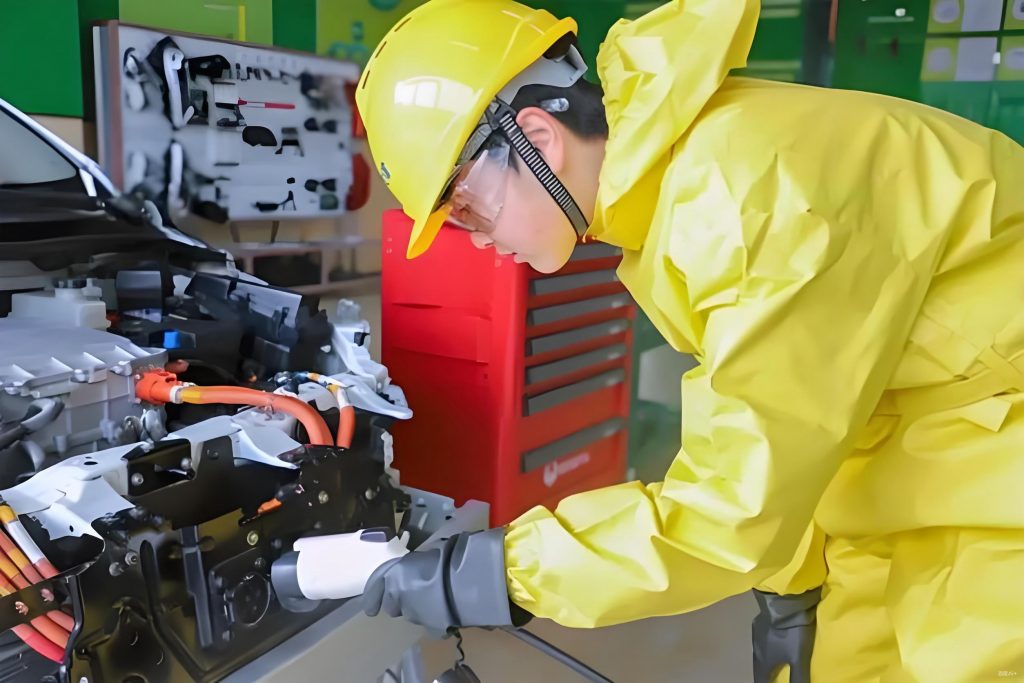
Common Fault Types in Battery Management Systems
In electric car repair, BMS faults are categorized into several types, each affecting system performance. Communication faults, for instance, involve disruptions in data exchange between components, such as CAN bus errors. Data acquisition faults relate to inaccurate sensor readings, while thermal management faults impact temperature control. Insulation faults pose safety risks, and control strategy failures lead to miscalculations in state of charge (SOC) or state of health (SOH). Understanding these faults is fundamental to EV repair, as they directly influence vehicle operation and longevity.
| Fault Type | Primary Causes | Typical Symptoms | Impact on EV Performance |
|---|---|---|---|
| Communication Fault | CAN bus physical damage, protocol mismatches | Data loss, SOC errors | Reduced coordination with vehicle controllers |
| Data Acquisition Fault | Sensor drift, electromagnetic interference | Inaccurate voltage/current readings | Imprecise SOC estimation |
| Thermal Management Fault | Cooling system failures, heater issues | Temperature gradients, overheating | Decreased battery life and safety risks |
| Insulation Fault | Moisture ingress, component degradation | Insulation resistance drop | High-voltage hazards |
| Control Strategy Failure | Algorithm errors, software bugs | SOC inaccuracies, protection malfunctions | Unreliable vehicle operation |
Communication faults in BMS often stem from physical layer issues, such as damaged wiring or connector oxidation. For example, a CAN bus differential signal amplitude below 2 V can indicate faults, with the voltage error modeled as $$ \Delta V = V_{\text{measured}} – V_{\text{actual}} $$, where deviations exceed 0.5% in EV repair scenarios. Data acquisition faults involve analog front-end (AFE) chip errors; the voltage sampling error can be expressed as $$ \epsilon_v = \frac{V_{\text{ref}} – 2.5}{2.5} \times 100\% $$, with reference voltage drift causing significant inaccuracies. In thermal management, the heat transfer rate $$ q = h \cdot A \cdot \Delta T $$ must be maintained, where h is the heat transfer coefficient, A is the area, and ΔT is the temperature difference. Failures here can lead to gradients exceeding 8°C, highlighting the need for precise electrical car repair. Insulation faults are quantified by the insulation resistance $$ R_{\text{ins}} = \frac{V_{\text{test}}}{I_{\text{leakage}}} $$, where values below 50 MΩ indicate severe issues. Control strategy failures often involve SOC estimation errors; the cumulative error over cycles can be described as $$ \text{SOC}_{\text{error}} = \sum_{i=1}^{n} \eta_i \cdot \Delta t \cdot I $$, where η is the coulombic efficiency, Δt is time, and I is current. Repeated exposure to such faults underscores the importance of regular EV repair and maintenance.
Fault Diagnosis Procedures for BMS
Diagnosing BMS faults in electric vehicles requires a systematic approach, starting with preliminary data collection and progressing to detailed hardware and software checks. As part of EV repair, technicians use tools like VDS diagnostic systems to analyze CAN bus messages, such as the 0x6B0 frame, for anomalies in voltage, temperature, and current parameters. Hardware inspection involves signal tracing with oscilloscopes and multimeters, while thermal management diagnostics employ infrared imaging and flow measurements. Insulation tests use specialized equipment to verify safety, and software calibration ensures accurate SOC and SOH estimates. This comprehensive process is vital for effective electrical car repair, minimizing downtime and enhancing vehicle reliability.
| Diagnosis Step | Tools and Methods | Key Parameters | Acceptance Criteria |
|---|---|---|---|
| Preliminary Diagnosis | VDS tool, CAN bus analyzer | Voltage deviation, temperature refresh rate | Deviation < 0.5%, refresh < 500 ms |
| Hardware Inspection | Oscilloscope, logic analyzer | Signal amplitude, resistance values | CAN amplitude ≥ 2 V, resistance 120 Ω ±5% |
| Thermal System Check | IR camera, PIV system | Temperature gradient, flow rate | Gradient ≤ 2°C, flow ≥ 2 L/min |
| Insulation Verification | Insulation tester, HV probes | Insulation resistance, HVIL voltage | R_ins ≥ 50 MΩ, HVIL ≥ 9 V |
| Software Calibration | UDS protocol, calibration software | SOC error, algorithm parameters | SOC error ≤ 2%, noise covariance adjusted |
In preliminary diagnosis for EV repair, data acquisition focuses on identifying discrepancies in real-time parameters. For instance, the SOC estimation error can be calculated using $$ \text{SOC}_{\text{dev}} = \left| \frac{\text{SOC}_{\text{estimated}} – \text{SOC}_{\text{actual}}}{\text{SOC}_{\text{actual}}} \right| \times 100\% $$, where deviations beyond 5% trigger further investigation. Hardware inspection involves verifying communication integrity; the CAN bus impedance Z is given by $$ Z = \sqrt{R^2 + (2\pi f L)^2} $$, where R is resistance, f is frequency, and L is inductance, with deviations indicating faults. Thermal management diagnostics assess cooling efficiency through the Reynolds number $$ Re = \frac{\rho v D}{\mu} $$, where ρ is density, v is velocity, D is diameter, and μ is viscosity; values below critical thresholds suggest flow issues in electrical car repair. Insulation testing uses the AC injection method, with the leakage current $$ I_{\text{leak}} = \frac{V_{\text{ac}}}{Z_{\text{total}}} $$, where Z_total includes insulation and stray capacitances. Software calibration involves updating Kalman filter parameters; the state update equation is $$ x_{k|k} = x_{k|k-1} + K_k (z_k – H x_{k|k-1}) $$, where K is the Kalman gain, z is measurement, and H is observation matrix, ensuring SOC accuracy within 1% standard deviation. This detailed approach is essential for reliable EV repair, addressing both immediate and potential faults in electric car systems.
Repair Strategies for BMS Faults
Repairing BMS faults in electric vehicles involves a combination of hardware replacements, system optimizations, and software updates. As a key aspect of EV repair, technicians must follow standardized procedures to replace faulty components like AFE chips or temperature sensors, while also performing battery balancing to restore capacity. Thermal system repairs may include redesigning cooling channels or replacing aged materials, and software upgrades enhance algorithm performance for better SOC estimation. These strategies not only resolve current issues but also prevent future failures, underscoring the proactive nature of electrical car repair in maintaining vehicle health and safety.
| Repair Strategy | Components Involved | Procedures | Expected Outcomes |
|---|---|---|---|
| Hardware Replacement | AFE chips, sensors, MCUs | Desoldering, testing, reassembly | Restored signal accuracy, reduced errors |
| Battery Balancing | DC/DC modules, MOSFET arrays | Active/passive balancing, capacity tests | SOC variation ≤ 3%, improved longevity |
| Thermal System Optimization | Cooling plates, fans, TIMs | CFD analysis, component replacement | Temperature gradient ≤ 2°C, stable operation |
| Software Upgrade | Firmware, algorithms, parameters | UDS flashing, calibration curves | SOC error ≤ 3%, enhanced communication |
In hardware replacement for EV repair, components like voltage sampling chips are evaluated against thresholds; for example, the error margin $$ \epsilon_{\text{hardware}} = \pm 10 \text{ mV} $$ dictates replacement needs. The replacement process adheres to standards like IPC-A-610H, with post-repair testing in environmental chambers to verify durability. Battery balancing uses active topologies with energy transfer modeled by $$ P_{\text{balance}} = I_{\text{balance}} \cdot V_{\text{cell}} $$, where I_balance is controlled between 100-500 mA to prevent thermal issues in electrical car repair. Passive balancing involves discharge through resistors, with the power dissipation $$ P_{\text{discharge}} = I^2 \cdot R $$, and resistance adjusted based on cell internal resistance $$ R_{\text{internal}} = \frac{\Delta V}{\Delta I} $$. Thermal system optimization includes recalculating heat transfer using $$ Q = m \cdot c_p \cdot \Delta T $$, where m is mass, c_p is specific heat, and ΔT is temperature change, ensuring efficient cooling. Software upgrades for SOC estimation employ extended Kalman filters, with the prediction step $$ x_{k|k-1} = F x_{k-1|k-1} + B u_k $$ and measurement update, reducing errors to within ±3%. Communication protocols are upgraded to ISO 15118, with baud rate adjustments for reliability. These repair strategies are integral to EV repair, providing long-term solutions for electric car maintenance and performance enhancement.
Conclusion
In summary, the diagnosis and repair of battery management systems are critical components of EV repair and electrical car repair. By systematically addressing common faults through advanced procedures and strategies, technicians can ensure the safety, efficiency, and longevity of electric vehicles. The integration of tables and formulas in this guide highlights the technical depth required in the field, while the emphasis on keywords like EV repair and electrical car repair reinforces their importance. As technology evolves, incorporating AI and edge computing, BMS fault management will become more predictive and efficient, further advancing the electric car repair industry. Ultimately, a proactive approach to BMS maintenance not only resolves immediate issues but also contributes to the sustainable growth of electric mobility.
The future of EV repair will likely see increased automation in diagnostics, with real-time monitoring systems reducing the need for manual interventions. For instance, machine learning algorithms could predict faults using historical data, enhancing the precision of electrical car repair. Moreover, standardization of repair protocols across manufacturers will streamline processes, making EV repair more accessible and reliable. As electric vehicles continue to dominate the automotive market, the role of skilled technicians in BMS repair will remain indispensable, driving innovation and safety in the electrical car repair ecosystem.