
In the context of global carbon neutrality goals and green development strategies, the automotive industry is undergoing an unprecedented wave of electrification. The iterative upgrading of market demands, especially for battery electric vehicles, has led to higher requirements for driving range and power performance. This directly drives the development of drive motors towards higher power density, making thermal management a critical bottleneck restricting technological breakthroughs. As a researcher focused on advancing battery electric vehicle technologies, I have observed that the thermal imbalance during motor operation triggers a chain reaction: on one hand, the insulation materials of stator windings age rapidly due to high temperatures, leading to continuous degradation of insulation performance between the stator and rotor, which can easily cause winding short-circuit faults and ultimately permanent motor failure; on the other hand, high temperatures can induce permanent magnet demagnetization, increased mechanical vibration, and abnormal noise. To effectively address these challenges, it is essential to delve into the heat generation mechanisms and heat transfer laws within the motor, systematically analyzing the impact of key parameters such as stator winding arrangement and rotor ventilation hole structure on heat conduction paths. This article explores collaborative optimization strategies for drive motor components and thermal management systems, providing innovative ideas and practical solutions for tackling temperature rise issues in battery electric vehicle drive motors.
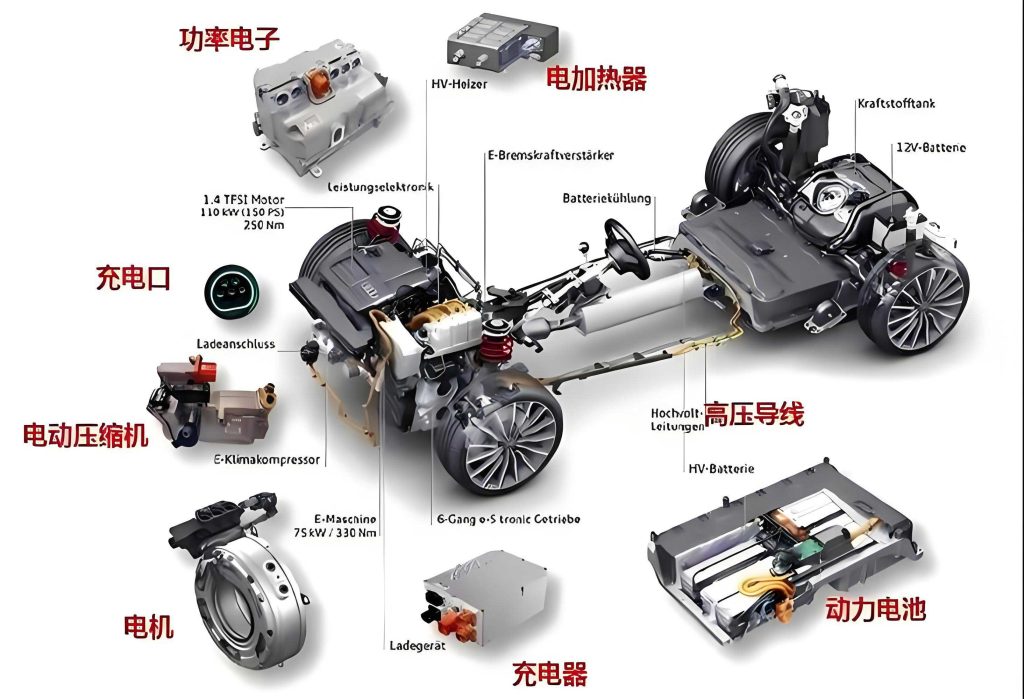
The proliferation of battery electric vehicles hinges on the efficiency and reliability of their drive systems. Drive motors in battery electric vehicles are responsible for converting electrical energy from the battery into mechanical energy to drive the wheels, with conversion efficiency relying on core components such as the stator, rotor, bearings, and end covers. The stator mainstream structures include round wire windings and flat wire windings. Round wire windings offer simple manufacturing processes and low cost, but gaps between wires result in low slot space utilization, affecting motor power density and efficiency. Flat wire windings have smaller gaps, enabling higher output power in the same volume, but under high-frequency alternating current, current tends to concentrate at the conductor edges, causing skin effect and additional losses. Moreover, manufacturing requires precise forming and insertion processes, demanding high equipment accuracy. For battery electric vehicles, optimizing these structures is paramount to achieving desired performance metrics.
Common rotor types include surface-mounted and interior-mounted designs. Surface-mounted designs attach magnets directly to the rotor core surface, facilitating easy manufacturing, but the magnets face the air gap directly, making them prone to being thrown out due to centrifugal force at high speeds. Interior-mounted designs embed magnets into slots within the rotor core, allowing for higher speed tolerance, but the complex structure, along with high requirements for lamination shape design and precision manufacturing, increases production costs. Bearings ensure smooth rotor rotation, with rolling bearings being the most widely used, requiring wear resistance and sealing under high-speed operation. End covers, located at both ends of the motor, fix bearings and form an enclosed space with the housing to prevent dust and moisture ingress. Mainstream designs use cast structures, often made of aluminum alloy, to balance lightweighting and heat dissipation performance. In battery electric vehicles, these components must be meticulously engineered to withstand rigorous operating conditions.
Current optimization technologies for core components of drive motors in battery electric vehicles include topology optimization, parametric optimization, and bionic design. Topology optimization involves delineating a design space for the component to be optimized, automatically screening necessary and removable material areas through algorithms based on set objectives and constraints. Parametric optimization is based on mature structural shapes, defining key dimensions as variable parameters, and analyzing the impact of parameters such as torque, efficiency, and vibration on performance through computer virtual experiments to find the optimal parameter combination. Bionic design is widely applied in motor structural design; for example, end cover support ribs mimic root or leaf vein distributions, ensuring material alignment with force transmission paths to achieve weight reduction without compromising stiffness. Rotor cooling channels reference porous structures like plant stems to enhance heat dissipation efficiency. For battery electric vehicles, these techniques contribute significantly to performance enhancement.
The thermal management system is a critical aspect of battery electric vehicle drive motor design. Air cooling technology is the most commonly used heat dissipation method, removing heat through flowing air, divided into natural air cooling and forced air cooling. Natural air cooling relies on air flow generated by motor rotation and vehicle movement, offering a simple structure. Forced air cooling enhances heat dissipation by installing independent fans on the motor to actively blow air. However, air’s heat dissipation capacity is limited, and faced with continuous high-load operation of the motor, air cooling systems often prove insufficient in heat dissipation efficiency. This limitation is particularly pronounced in high-performance battery electric vehicles where motors operate under strenuous conditions.
Liquid cooling technology designs cooling channels inside the motor, allowing coolant to circulate and absorb and carry away heat. Coolant has a much higher heat capacity than air, significantly improving heat dissipation efficiency. However, liquid cooling systems require high integration with the motor; cooling channels need precision machining (such as housing milling or drilling), and improper design of channel cross-sectional area and layout density can lead to local low flow velocity and heat dissipation dead zones. Moreover, liquid cooling circuits demand extremely high sealing; loose interfaces or aging seals can cause coolant leakage, leading to short circuits, insulation breakdown, and other serious faults within the motor. For battery electric vehicles, ensuring the reliability of liquid cooling systems is essential to prevent catastrophic failures.
Oil cooling technology involves direct冲刷 of winding ends or circulation between winding layers using cooling oil, leveraging oil’s high specific heat capacity and good fluidity to remove heat, adapting to the heat dissipation needs of dense structures like flat wire windings. However, oil cooling systems require additional components such as oil pumps and oil coolers, increasing system complexity and cost, and necessitate solutions for oil sealing and compatibility with internal motor insulation. In battery electric vehicles, the trade-offs between efficiency, cost, and complexity must be carefully evaluated when adopting oil cooling.
The coupling relationship between thermal management and component structure is profound. Stator winding arrangement directly determines heat conduction paths; between flat wire winding layers, the presence of insulation films increases heat conduction resistance, easily forming local hot spots. Therefore, designers need to design微小 cooling channels within flat wire windings or adopt direct cooling techniques allowing cooling oil to directly冲刷 winding ends, creating efficient heat escape paths. For battery electric vehicles, optimizing these paths is crucial to maintaining motor integrity under thermal stress.
During high-speed rotation, rotor core hysteresis, eddy current losses, and permanent magnet eddy current losses generate heat, with heat dissipation relying on its own structural design (without direct external cooling coverage). Designers need to stamp specific shapes and positions of ventilation holes on rotor silicon steel sheets to drive internal air flow forming self-pumping circulation. The size, shape, quantity, and distribution of ventilation holes are key structural parameters—too small size or too few holes result in weak airflow and poor heat dissipation, while too large size reduces rotor structural strength and increases rotational wind resistance. In battery electric vehicles, rotor design must balance mechanical integrity with thermal performance.
Additionally, copper wires require insulation coating (e.g., polyimide film). Thicker insulation layers increase thermal resistance, making heat conduction from copper wires to external cores more difficult; however, thin insulation layers increase the risk of insulation breakdown (especially in high-voltage motors). Thus, selecting thin insulation materials that meet temperature ratings and have high thermal conductivity becomes a design challenge for battery electric vehicles.
To achieve collaborative optimization of drive motor component structure and thermal management systems in battery electric vehicles, a structure-thermal management collaborative optimization model must be constructed. The steps are as follows. Step 1: Determine key design variables, including structural parameters (stator yoke thickness, rotor ventilation hole diameter and quantity, permanent magnet size, end cover support structure, etc.) and thermal management parameters (coolant channel cross-sectional shape and layout, coolant flow rate and inlet temperature, heat sink area, thermal insulation material thickness, etc.). Step 2: Define constraint conditions: geometric constraints (motor maximum outer diameter and length limited to vehicle chassis installation space), performance constraints (motor output torque and power meeting minimum requirements), reliability constraints (operating temperatures of various parts not exceeding material maximum allowable temperatures). Step 3: Establish a multi-objective optimization function, including lightweighting (f1: minimizing total motor mass), low temperature rise (f2: minimizing average temperature rise under rated conditions), and high reliability (f3: maximizing predicted lifespan of key components such as bearings). Construct a weighted sum total objective function, expressed as:
Minimize: $$F(x) = w_1 \times f_1(x) + w_2 \times f_2(x) + w_3 \times f_3(x)$$
where x is the set of all design variables; w1, w2, w3 are weight coefficients reflecting the importance of each objective, satisfying $$w_1 + w_2 + w_3 = 1$$.
Step 4: Select appropriate solving algorithms to find the optimal set of design variables minimizing the total objective function F(x). This article employs Genetic Algorithm (GA) and Particle Swarm Optimization (PSO) as solving algorithms. Through GA iterative optimization of structural parameters and PSO optimization of thermal management parameters, results are fused after each iteration to adjust design variables, conducting efficient searches in vast solution sets. Through multiple generations of “evolution” and “elimination,” the optimal design scheme is approached. For battery electric vehicles, this model provides a systematic approach to balancing competing objectives.
Key component collaborative optimization schemes and implementation include stator system optimization: machining spiral channels inside the housing aligned with stator slot backs to shorten heat transfer distances; designing spray cooling structures matching winding end shapes, allowing cooling oil to directly冲刷 winding ends, forming a three-dimensional heat dissipation network. Rotor system optimization: enhancing internal heat dissipation through structural design, axial ventilation holes adopting gradually narrowing cross-sectional designs, forming effects similar to微型 centrifugal fans during rotor rotation to drive air flow and remove heat from magnets and cores; setting微小隔热 gaps between permanent magnet slots and magnets to protect permanent magnets from external heat source impacts, coordinating stator-rotor thermal management conflicts. In battery electric vehicles, these optimizations are vital for sustained high-performance operation.
To validate the optimization scheme, ANSYS Finite Element Analysis software is used for simulation and experimental testing. First, electromagnetic field simulation is conducted to calculate various losses under rated and peak loads of the motor, applying these losses as heat sources to the model to solve the temperature distribution during stable motor operation. Then, superimposing thermal loads from temperature field simulation and mechanical loads such as centrifugal force generated by high-speed rotor rotation, stress and deformation of key components like rotor core and permanent magnets are analyzed. Core parameter settings for multi-physics simulation are summarized in Table 1.
| Simulation Category | Parameter Name | Set Value / Condition |
|---|---|---|
| Electromagnetic Field | Rated Phase Current (Peak) | 200 A |
| Rated Operating Speed | 5000 rpm | |
| Peak Power Operating Point | 300 A, 12000 rpm | |
| Temperature Field | Coolant Inlet Temperature | 65°C |
| Coolant Volume Flow Rate | 10 L/min | |
| Ambient Temperature | 25°C | |
| Structural Field | Rotor Maximum Operating Speed | 15000 rpm |
| Rated Output Torque | 300 N·m |
Experimental validation adopts bench testing methods: comparing experimentally measured temperature-time variation curves and steady-state temperature values at various points with simulation results. If they highly吻合, it proves the collaborative optimization model is accurate and reliable; if deviations are unacceptable, material properties, boundary conditions, or contact settings are rechecked, and the model is corrected for iteration. For battery electric vehicles, such validation ensures that optimization strategies translate effectively to real-world applications.
The drive motors in battery electric vehicles are subject to diverse operating conditions, necessitating robust thermal management. The heat generation within the motor can be modeled using fundamental equations. For instance, the total losses \( P_{total} \) in a drive motor include copper losses \( P_{cu} \), iron losses \( P_{fe} \), and additional losses \( P_{add} \). Copper losses are given by $$P_{cu} = I^2 R$$, where I is the current and R is the resistance. Iron losses, comprising hysteresis and eddy current losses, can be expressed as $$P_{fe} = k_h f B^2 + k_e f^2 B^2$$, where \( k_h \) and \( k_e \) are hysteresis and eddy current coefficients, f is frequency, and B is magnetic flux density. These losses contribute to the heat load that must be dissipated.
Thermal management efficiency can be evaluated using the heat transfer equation. For convective cooling, the heat transfer rate Q is given by $$Q = h A \Delta T$$, where h is the heat transfer coefficient, A is the surface area, and \(\Delta T\) is the temperature difference. In battery electric vehicle drive motors, enhancing h through improved coolant flow or surface design is critical. The overall thermal resistance network of the motor can be represented as a series-parallel combination, with total thermal resistance \( R_{th} \) affecting the temperature rise \(\Delta T\) via $$\Delta T = P_{total} R_{th}$$. Minimizing \( R_{th} \) through structural optimizations is key to controlling temperature.
Structural optimization often involves parameterizing geometric features. For example, the stator yoke thickness \( t_y \) influences both magnetic flux carrying capacity and heat conduction. A thicker yoke reduces magnetic saturation but increases mass. The optimization function for lightweighting can include terms like $$f_1(x) = \rho (V_{stator} + V_{rotor} + …)$$, where \(\rho\) is material density and V are volumes. For thermal performance, the temperature rise function \( f_2(x) \) might be derived from finite element analysis results, incorporating variables like coolant flow rate \( \dot{m} \) and channel geometry. Reliability \( f_3(x) \) could relate to stress levels, with fatigue life models such as $$N_f = C \sigma^{-m}$$, where N_f is cycles to failure, \(\sigma\) is stress, and C, m are material constants.
The collaborative optimization model integrates these aspects. Using genetic algorithms, design variables are encoded as chromosomes, and fitness is evaluated based on F(x). Selection, crossover, and mutation operations evolve solutions. Particle swarm optimization updates particle positions and velocities towards personal and global bests. The synergy between these algorithms accelerates convergence to Pareto-optimal solutions for battery electric vehicle drive motors.
In practice, for battery electric vehicles, the drive motor operates under varying loads. A duty cycle can be defined, and the optimization model extended to consider transient thermal behavior. The temperature rise over time can be modeled with differential equations: $$C \frac{dT}{dt} = P_{total} – Q_{cool}$$, where C is thermal capacitance and \( Q_{cool} \) is cooling rate. Integrating this into the optimization allows for dynamic performance assessment.
Material selection plays a crucial role. For instance, using high-thermal-conductivity insulation materials can reduce thermal resistance. The thermal conductivity \( k \) affects heat flow according to Fourier’s law: $$q = -k \nabla T$$. Advanced materials like ceramic-filled polymers or graphene-enhanced composites offer promising avenues for battery electric vehicle motor components.
Table 2 summarizes key design variables and their typical ranges for optimization in battery electric vehicle drive motors.
| Component | Design Variable | Typical Range | Influence on Objectives |
|---|---|---|---|
| Stator | Yoke Thickness (mm) | 10-30 | Mass, magnetic saturation, heat conduction |
| Winding Type | Round/Flat wire | Efficiency, power density, thermal resistance | |
| Cooling Channel Width (mm) | 2-10 | Flow resistance, heat transfer area | |
| Rotor | Ventilation Hole Diameter (mm) | 5-20 | Airflow, structural strength, heat dissipation |
| Magnet Thickness (mm) | 3-10 | Magnetic flux, demagnetization risk, cost | |
| Number of Ventilation Holes | 10-50 | Heat distribution, weight | |
| Thermal Management | Coolant Flow Rate (L/min) | 5-20 | Heat removal rate, pump power |
| Insulation Thickness (mm) | 0.1-0.5 | Electrical insulation, thermal resistance |
The optimization process often involves iterative simulations. For example, a response surface methodology can approximate the relationship between design variables and objectives. The response surface for temperature rise might be modeled as a quadratic function: $$T_{rise} = \beta_0 + \sum \beta_i x_i + \sum \beta_{ii} x_i^2 + \sum \sum \beta_{ij} x_i x_j$$, where \( \beta \) are coefficients obtained from design of experiments. This surrogate model speeds up optimization by reducing full simulation calls.
In battery electric vehicles, the drive motor is part of a larger system including power electronics and battery pack. Thermal interactions between these components can be considered. For instance, waste heat from the motor might be used for battery warming in cold climates, enhancing overall efficiency. Integrated thermal management systems for battery electric vehicles are an emerging research area.
Validation through prototyping is essential. After optimization, a prototype motor can be built and tested on a dynamometer. Measurements include temperature at multiple points using thermocouples, efficiency maps, and vibration spectra. Correlation with simulation results ensures model fidelity. For battery electric vehicles, such prototypes undergo rigorous driving cycle tests to emulate real-world conditions.
The future of battery electric vehicle drive motor optimization lies in advanced materials and manufacturing. Additive manufacturing (3D printing) allows for complex geometries unachievable with traditional methods, such as conformal cooling channels or lattice structures for lightweighting. Topology optimization combined with 3D printing can yield highly efficient designs tailored for battery electric vehicles.
Furthermore, artificial intelligence and machine learning can enhance optimization algorithms. Neural networks can predict thermal behavior based on historical data, reducing computational cost. Reinforcement learning can adapt cooling strategies in real-time based on operating conditions, improving efficiency and reliability of battery electric vehicle drive systems.
In conclusion, addressing thermal management challenges in battery electric vehicle drive motors requires a holistic approach integrating structural design and cooling strategies. The collaborative optimization model presented, leveraging multi-physics simulation and evolutionary algorithms, provides a framework for achieving balanced performance in terms of lightweighting, low temperature rise, and high reliability. As battery electric vehicles continue to evolve, ongoing research in materials, manufacturing, and intelligent control will further push the boundaries of drive motor technology, contributing to the sustainable future of transportation.