
The rapid development of the low-altitude economy has positioned electric vertical take-off and landing (eVTOL) aircraft as a transformative solution for urban mobility, offering zero emissions, low noise, and efficient point-to-point transportation. However, eVTOL platforms impose extreme performance demands on their power sources, far surpassing those of ground-based electric vehicles. These demands include ultra-high energy density for extended range, exceptional power density for vertical take-off and landing maneuvers, long cycle life under frequent deep discharges, and uncompromising safety under dynamic thermal and mechanical stresses. Conventional liquid electrolyte lithium-ion batteries (LE-LIBs) are approaching their theoretical limits and struggle to meet these combined requirements, particularly regarding energy density and safety under high-stress conditions. Consequently, solid-state batteries have emerged as a pivotal next-generation technology, leveraging solid electrolytes to potentially overcome these barriers. This article analyzes the operational profiles of eVTOLs and their battery requirements, reviews advancements in solid-state battery technologies—namely polymer, oxide, and sulfide-based systems—and explores the development of specialized battery management systems (BMS) that integrate electrical, thermal, and mechanical management for reliable eVTOL operation.
eVTOL configurations are broadly categorized into multi-rotor, vectored thrust, and lift-plus-cruise types, each with distinct implications for the power system. A typical eVTOL mission profile consists of several phases: vertical take-off, hover, climb, cruise, descent, and vertical landing. The power demand varies drastically across these phases. Vertical take-off and landing are the most power-intensive, requiring discharge rates often exceeding 4C to 5C to generate sufficient lift. Cruise phases demand sustained energy output, while descent may still require high power to control the aircraft safely, especially at low states of charge. This profile creates a unique challenge: the battery must deliver high peak power repeatedly while maintaining high energy density to minimize weight—a critical factor as additional battery mass increases overall energy consumption, creating a design penalty loop. The power-to-energy ratio and heat generation rate for eVTOLs are significantly higher than for electric cars. For instance, studies indicate that eVTOL battery systems may experience heat generation rates an order of magnitude greater than those in electric vehicles under similar energy output. Therefore, the key battery requirements for eVTOLs can be summarized as follows:
| Requirement | Target for eVTOL Application | Challenge for Conventional LE-LIB |
|---|---|---|
| Energy Density | >400 Wh/kg at the cell level (>300 Wh/kg at pack level) | Limited by graphite anode and electrolyte stability; typically 250-300 Wh/kg for high-nickel systems. |
| Power Density | Sustained discharge rates of 4C-5C, with peaks higher for take-off/landing. | High rates cause severe polarization, lithium plating, and rapid capacity fade. |
| Cycle Life | >20,000 cycles equivalent to frequent deep discharges for urban air mobility. | Degradation accelerates under high-power profiles; typical automotive life is insufficient. |
| Safety & Thermal Stability | Non-flammable, thermal runaway onset >300°C, operation from -30°C to 80°C. | Organic liquid electrolytes are flammable; thermal runaway risks increase with energy density. |
| Mechanical Robustness | Stable performance under vibration, shock, and variable stack pressure. | Liquid electrolytes adapt to volume changes; solid-state interfaces require constant pressure. |
The power demand \( P \) during a flight mission relative to the battery pack energy \( E_p \) can be expressed as a function of time \( t \):
$$
\frac{P(t)}{E_p} = f(\text{phase})
$$
where phases like take-off yield high ratios (>0.1 kW/Wh), while cruise yields lower ratios. The heat generation rate \( \dot{Q}_p \) is similarly critical:
$$
\dot{Q}_p = I^2 R_{internal} + \text{entropic terms}
$$
For eVTOLs, \( \dot{Q}_p / E_p \) can exceed 10 W/Wh during high-power segments, necessitating advanced thermal management.
Solid-state batteries replace the flammable organic liquid electrolyte with a solid ion conductor, which fundamentally enhances safety and enables the use of high-energy electrodes like lithium metal. The solid electrolyte acts as both ion transporter and physical separator, potentially allowing thinner designs and higher energy densities. The primary solid electrolyte families are polymer solid electrolytes (PSE), oxide solid electrolytes (OSE), and sulfide solid electrolytes (SSE). Each offers distinct trade-offs in ionic conductivity, mechanical properties, electrochemical stability, and processability, as summarized below:
| Electrolyte Type | Typical Ionic Conductivity (S/cm) at 25°C | Mechanical Properties | Key Advantages | Key Challenges for eVTOL |
|---|---|---|---|---|
| Polymer (PSE, e.g., PEO-based) | 10-6 – 10-3 (often requires >60°C) | Flexible, good interfacial contact | Easy processing, low cost, lightweight | Low room-temperature conductivity, limited voltage window |
| Oxide (OSE, e.g., LLZO) | 10-5 – 10-3 | High modulus, brittle | Excellent thermal/chemical stability, wide window | Poor interfacial contact, rigid, requires high sintering temps |
| Sulfide (SSE, e.g., LGPS, LPSC) | 10-3 – 10-2 (near liquid-like) | Soft, ductile | Highest ionic conductivity, good processability | Moisture sensitivity, interfacial reactions with cathodes |
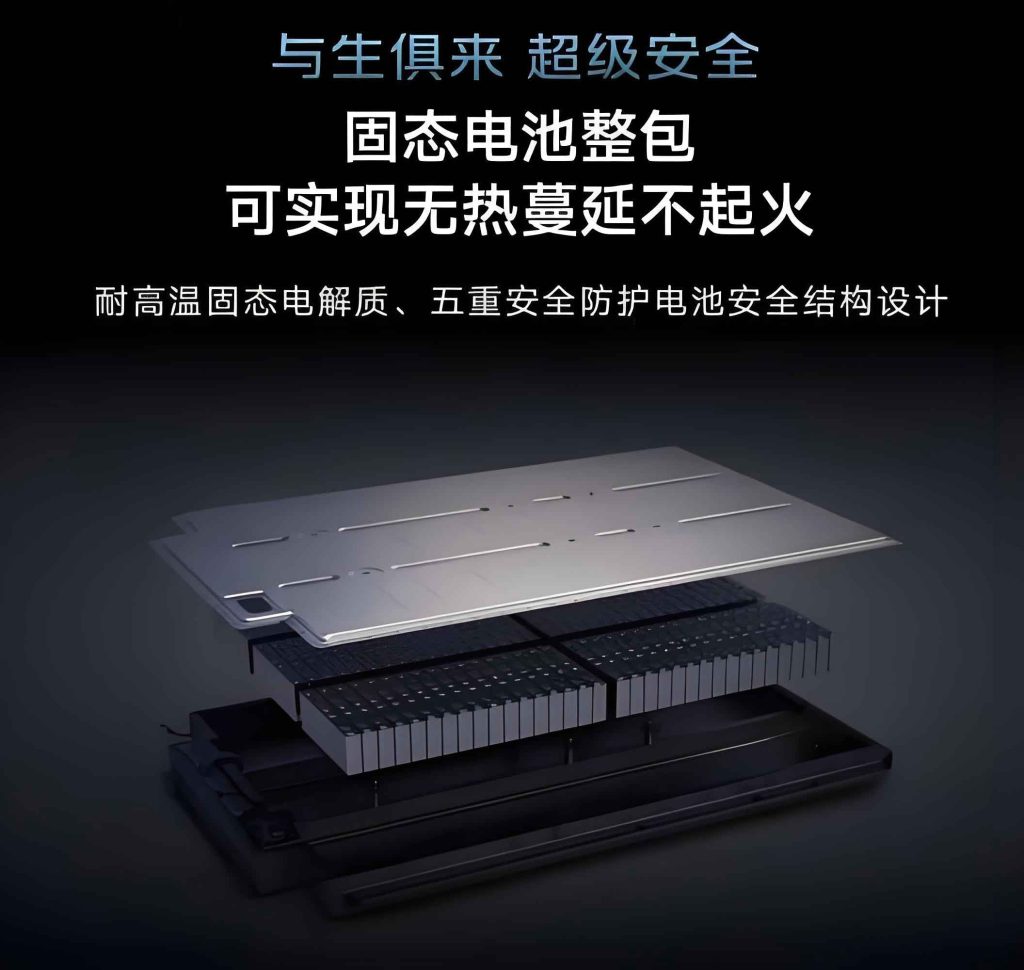
To achieve the energy density target of >400 Wh/kg, solid-state battery designs focus on employing lithium metal anodes, high-voltage cathodes (e.g., layered oxides like NCM811 or Li-rich materials), and ultra-thin solid electrolyte membranes. The energy density \( E_{cell} \) can be approximated as:
$$
E_{cell} = \frac{\sum (Q \cdot V)}{\text{mass of active materials + inactive components}}
$$
where \( Q \) is the capacity and \( V \) the operating voltage. By reducing electrolyte thickness to below 30 µm, the proportion of inactive material is minimized. For instance, composite polymer-ceramic electrolytes fabricated via tape-casting can achieve membranes as thin as 12 µm, enabling cell-level energy densities approaching 500 Wh/kg. Sulfide-based solid-state batteries, with their high conductivity, can utilize thicker electrodes without significant kinetic penalties, and bipolar stacking architectures further enhance pack-level energy density by reducing redundant current collectors. However, interfacial stability between the solid electrolyte and electrodes remains a critical hurdle. Coatings such as Li3VO4 on cathode particles or Li3InCl6 interlayers have been shown to suppress side reactions and extend cycle life, which is essential for eVTOL applications where batteries undergo thousands of deep discharge cycles.
High power density is paramount for eVTOLs, especially during take-off and landing where discharge rates can exceed 5C. The solid-state battery must exhibit low internal resistance and fast ion transport. The overall cell resistance \( R_{cell} \) comprises bulk electrolyte resistance \( R_{bulk} \), interfacial charge transfer resistance \( R_{ct} \), and diffusion-related impedances. For solid-state batteries, \( R_{ct} \) at the electrode-electrolyte interface is often dominant due to poor solid-solid contact. Enhancing ionic conductivity \( \sigma \) and lithium-ion transference number \( t_+ \) is crucial. The transference number, defined as:
$$
t_+ = \frac{\sigma_+}{\sigma_+ + \sigma_-}
$$
where \( \sigma_+ \) and \( \sigma_- \) are the cationic and anionic conductivities, respectively. A high \( t_+ \) (approaching 1) reduces concentration polarization at high currents, which is vital for maintaining voltage stability during high-power pulses. Recent advances in PSEs incorporating ionic liquids or ceramic fillers have achieved room-temperature conductivities over 10-3 S/cm and \( t_+ \) values above 0.6, enabling discharge rates up to 10C. Sulfide solid-state batteries, with their inherently high conductivity, have demonstrated stable operation at rates exceeding 20C in lab settings, far surpassing eVTOL requirements. Moreover, interface engineering—such as employing soft carbon-silicon nitride interlayers—can homogenize lithium deposition and prevent dendrite growth, ensuring long-term power capability even under aggressive cycling.
Reliability and safety under extreme conditions are non-negotiable for aviation. Solid-state batteries inherently reduce fire risks by eliminating flammable liquids, but they introduce new challenges related to interfacial degradation, dendrite propagation through solids, and mechanical failure from volume changes. The thermal runaway onset temperature for solid-state batteries is generally higher than for LE-LIBs; for example, some polymer-based systems show onset above 300°C versus ~200°C for liquids. However, the total heat release during failure can be greater due to exothermic reactions between electrodes and solid electrolytes. Thermal management must therefore balance between heating the battery to optimal operating temperatures (e.g., 60–80°C for some PSEs) and preventing overheating. The heat equation governing temperature rise \( \Delta T \) during operation is:
$$
\Delta T = \int \frac{\dot{Q}_p}{C_p \cdot m} dt
$$
where \( C_p \) is specific heat capacity and \( m \) is mass. For eVTOLs, active cooling systems like micro-grooved heat pipes combined with air cooling are being explored to dissipate heat while minimizing weight. Conversely, for cold starts, internal heating methods—such as embedding thin nickel foils in current collectors to generate joule heat—can rapidly warm solid-state batteries from subzero temperatures to operating conditions within minutes, ensuring immediate power availability.
A unique aspect of solid-state battery management is mechanical pressure control. Unlike LE-LIBs, where liquid electrolytes wet porous electrodes, solid-state batteries require external pressure to maintain intimate electrode-electrolyte contact and suppress lithium dendrite growth. The optimal stack pressure \( P_{stack} \) depends on the electrolyte type: sulfides may need 10–100 MPa, while polymers and oxides require lower pressures (<10 MPa). Insufficient pressure leads to contact loss and increased impedance, while excessive pressure causes particle fracture or lithium extrusion. The pressure \( P \) influences the interfacial impedance \( R_{interface} \) as:
$$
R_{interface} \propto \frac{1}{P^n}
$$
where \( n \) is an empirical constant. Dynamic pressure management is essential for eVTOLs due to in-flight vibrations and volume changes during cycling. Active systems using hydraulic fluids or phase-change actuators can adjust pressure in real-time, but they add complexity and mass. Thus, developing lightweight, integrated pressure management systems is a key research focus for solid-state battery packs in aviation.
The battery management system (BMS) for solid-state batteries in eVTOLs must evolve beyond traditional electrical and thermal management to include mechanical pressure regulation. This integrated BMS architecture encompasses three core domains: energy management, thermal management, and pressure management. Energy management involves accurate state estimation—state of charge (SOC), state of health (SOH), and power capability—under highly dynamic loads. Given the nonlinear aging and interfacial phenomena in solid-state batteries, conventional equivalent circuit models (ECM) may need modification. For example, a simplified ECM for a solid-state battery might include a resistance for bulk electrolyte \( R_b \), a constant phase element (CPE) for interfacial effects, and a Warburg element for diffusion, but the absence of liquid-phase concentration polarization simplifies some aspects. The voltage \( V(t) \) can be modeled as:
$$
V(t) = V_{oc}(SOC) – I(t) \cdot R_{series} – V_{polarization}(t)
$$
where \( V_{oc} \) is the open-circuit voltage and \( I \) is the current. Advanced estimation techniques like extended Kalman filters or machine learning algorithms are being adapted to account for solid-state-specific behaviors, such as pressure-dependent impedance. Power capability assessment must ensure that the battery can deliver the required power at all SOC levels, especially during descent when SOC is low. A two-step testing protocol that determines the minimum SOC for sustaining a constant power pulse is recommended for eVTOL mission profiling.
Thermal management systems for solid-state batteries must address both cooling and heating needs. While solid electrolytes are less prone to thermal runaway, some systems operate best at elevated temperatures. Cooling strategies can leverage the lower heat generation compared to LE-LIBs—by perhaps an order of magnitude—to employ lighter air-cooling or hybrid systems. For instance, forced air convection over finned surfaces or heat pipes can suffice, reducing system mass. Heating strategies, crucial for cold starts at high altitudes, may integrate internal resistive heaters or exploit self-heating via controlled current pulses. The temperature control law might use a proportional-integral-derivative (PID) controller based on real-time temperature feedback:
$$
u(t) = K_p e(t) + K_i \int e(t) dt + K_d \frac{de(t)}{dt}
$$
where \( u(t) \) is the cooling/heating output and \( e(t) \) is the temperature error. Multizone thermal management is essential to ensure uniformity across large battery packs, preventing hot spots that could degrade solid-state interfaces.
Pressure management is a novel BMS function unique to solid-state batteries. The BMS must monitor stack pressure via sensors and adjust it using actuators. A feedback control loop can maintain pressure within an optimal window, compensating for volume changes during cycling. The required pressure \( P_{req} \) may be expressed as a function of state variables:
$$
P_{req} = f(SOC, T, SOH)
$$
where \( T \) is temperature. Active pressure systems using pneumatic or piezoelectric actuators can modulate pressure dynamically, but their energy consumption and mass must be minimized for eVTOL applications. Passive systems like springs or elastic frames offer simplicity but lack adaptability. Research is ongoing into smart materials that change volume with SOC or temperature, enabling self-regulating pressure. Integrating pressure control with electrical and thermal management will yield a cohesive BMS that maximizes solid-state battery performance and lifespan in eVTOLs.
In conclusion, solid-state batteries represent a promising path to meet the stringent demands of eVTOL aircraft, offering potential breakthroughs in energy density, power output, and safety. The three main solid electrolyte families—polymer, oxide, and sulfide—each have distinct advantages and challenges that must be tailored for aviation environments. Achieving the target of >400 Wh/kg energy density and >4C–5C power density requires continued innovation in thin electrolyte membranes, interface engineering, and lithium metal anode integration. Moreover, the battery management system must expand into a multi-physical domain controller, encompassing not only electrical and thermal management but also active pressure regulation to maintain interfacial integrity. Future work should focus on scaling up solid-state battery cells to multi-ampere-hour capacities, validating performance under real eVTOL mission profiles, and developing lightweight, integrated BMS hardware. With these advancements, solid-state batteries can become the cornerstone of reliable, efficient, and safe urban air mobility, enabling the low-altitude economy vision. The journey from lab-scale breakthroughs to certified aviation-grade solid-state battery systems will require collaborative efforts across materials science, electrochemistry, and systems engineering, but the potential rewards for sustainable transportation are immense.