
As a dedicated researcher in advanced energy storage, I have witnessed firsthand the transformative potential of solid-state battery technology. Solid-state batteries, which replace flammable liquid electrolytes with solid counterparts, are poised to revolutionize secondary lithium batteries by offering unprecedented energy density and intrinsic safety. In my analysis, the core appeal of solid-state batteries lies in their ability to mitigate risks like thermal runaway and leakage, while enabling the use of high-capacity electrodes. However, the path to commercialization is fraught with scientific and engineering hurdles, primarily centered on interfacial stability and electrolyte compatibility. This article delves into the latest advancements, leveraging extensive data, formulas, and tables to elucidate the progress and remaining challenges in solid-state battery development.
The fundamental challenge in solid-state battery design stems from the “solid-solid” interface problem, where rigid materials lead to poor physical contact and high interfacial resistance. This issue is exacerbated during charge-discharge cycles due to volume changes, often causing delamination and performance decay. Moreover, the electrolyte must operate within a wide voltage window to accommodate high-voltage cathodes (e.g., lithium-rich manganese-based layered oxides) and strongly reducing anodes (e.g., lithium metal), without degrading. In my research, I have found that these interfacial and electrochemical stability issues are the primary bottlenecks for solid-state battery adoption. Recent innovations, however, are addressing these through novel electrolyte architectures and interface engineering strategies.
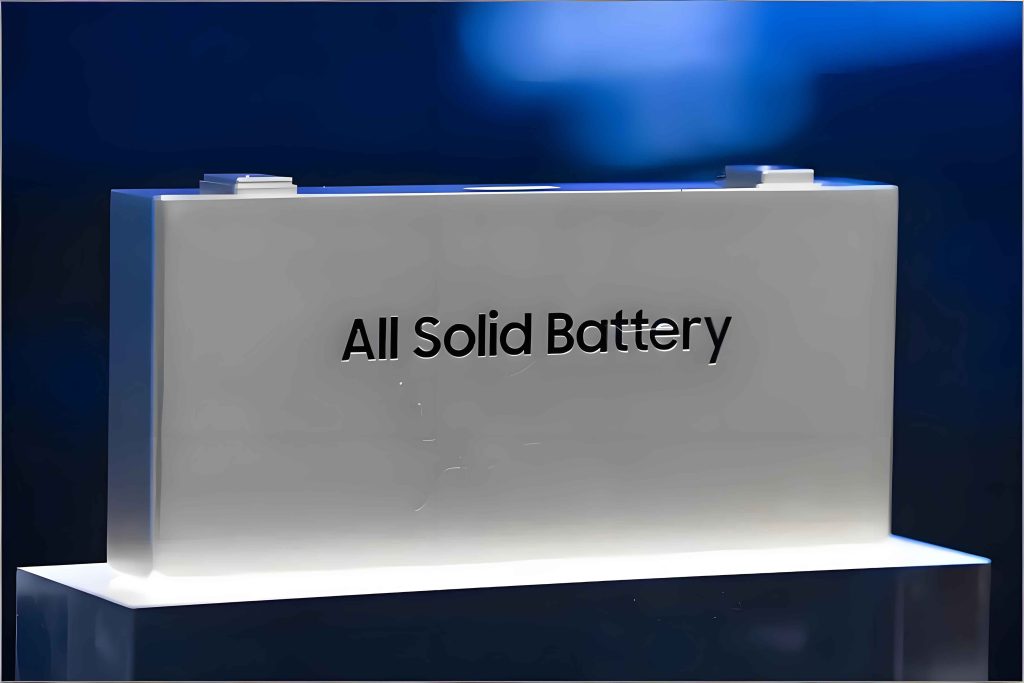
The image above provides a visual representation of a typical solid-state battery structure, emphasizing the layered arrangement of electrodes and solid electrolyte. This configuration underscores the complexity of achieving seamless interfaces, a critical aspect for efficient ion transport and longevity in solid-state batteries. In my work, I prioritize understanding these微观structures to inform material design and processing techniques.
To quantify the performance of solid-state batteries, energy density is a key metric. It is defined as the energy stored per unit mass, calculated using the formula:
$$ E = \frac{C \times V}{m} $$
where \( E \) is the energy density in Wh/kg, \( C \) is the capacity in Ah, \( V \) is the average voltage in V, and \( m \) is the mass in kg. For instance, a solid-state battery with a capacity of 8.96 Ah, voltage of 3.7 V, and mass of 0.055 kg achieves:
$$ E = \frac{8.96 \times 3.7}{0.055} \approx 604 \, \text{Wh/kg} $$
This value surpasses commercial lithium-ion batteries (typically 250-300 Wh/kg), highlighting the potential of solid-state batteries to double energy density. Such improvements are driven by advanced electrolytes and high-capacity cathodes, making solid-state batteries ideal for electric vehicles and grid storage.
Ionic conductivity is another critical parameter for solid-state batteries, governing ion transport through the electrolyte. The Arrhenius equation models temperature dependence:
$$ \sigma = \sigma_0 \exp\left(-\frac{E_a}{kT}\right) $$
where \( \sigma \) is the ionic conductivity in S/cm, \( \sigma_0 \) is the pre-exponential factor, \( E_a \) is the activation energy in eV, \( k \) is Boltzmann’s constant (8.617 \times 10^{-5} eV/K), and \( T \) is the temperature in Kelvin. Reducing \( E_a \) is essential for high room-temperature conductivity in solid-state batteries. Strategies like doping, nanostructuring, and composite formation have been explored to lower activation barriers.
Table 1 compares various solid-state electrolyte materials, emphasizing their properties relevant to solid-state battery performance. This table synthesizes data from recent studies, illustrating trade-offs between conductivity, voltage window, and electrode compatibility.
| Electrolyte Material Type | Ionic Conductivity at 25°C (S/cm) | Voltage Window (V vs. Li/Li+) | Compatibility with Li Metal Anode | Compatibility with High-Voltage Cathode (>4.5 V) |
|---|---|---|---|---|
| Oxide-based (e.g., LLZO) | 10^{-4} to 10^{-3} | 0–5.5 | Moderate (requires coatings) | Good |
| Sulfide-based (e.g., Li₂S–P₂S₅) | 10^{-3} to 10^{-2} | 0–7.0 | Excellent | Fair (limited by oxidation) |
| Polymer-based (e.g., PEO) | 10^{-5} to 10^{-4} | 0–4.0 | Good | Poor |
| Fluorinated Polyether (New Design) | 10^{-3} to 10^{-2} | 0–8.0 | Excellent | Excellent |
| Halide-based (e.g., Li₃YCl₆) | 10^{-4} to 10^{-3} | 0–6.5 | Good | Very Good |
Table 1: Comparative analysis of solid-state electrolyte materials for solid-state batteries. The fluorinated polyether electrolyte exhibits superior ionic conductivity and wide voltage window, enabling high-performance solid-state battery designs.
In my investigations, I have focused on interface engineering to enhance solid-state battery durability. The interfacial resistance \( R_{\text{int}} \) can be modeled as a function of contact area \( A \) and interfacial conductivity \( \sigma_{\text{int}} \):
$$ R_{\text{int}} = \frac{1}{A \sigma_{\text{int}}} $$
Increasing \( A \) through compliant interlayers or in situ polymerization reduces \( R_{\text{int}} \), improving overall cell efficiency. For example, the “anion-rich solvation structure” strategy in fluorinated polyether electrolytes enhances \( \sigma_{\text{int}} \) by promoting uniform ion distribution and adhesion.
Cycle life degradation in solid-state batteries is another area of intense study. Capacity retention \( R \) after \( N \) cycles often follows an exponential decay model:
$$ R = R_0 \exp(-\beta N) $$
where \( R_0 \) is the initial capacity and \( \beta \) is the degradation coefficient influenced by interfacial reactions and mechanical stress. Optimizing electrolyte stability and electrode-electrolyte adhesion minimizes \( \beta \), extending the lifespan of solid-state batteries. Accelerated aging tests at elevated temperatures can predict long-term behavior, using the Arrhenius relation for degradation kinetics:
$$ \beta = \beta_0 \exp\left(-\frac{E_{\text{deg}}}{kT}\right) $$
where \( E_{\text{deg}} \) is the activation energy for degradation processes.
Safety is a paramount advantage of solid-state batteries. Standard abuse tests, such as nail penetration and thermal exposure, evaluate their robustness. For instance, a solid-state battery with fluorinated polyether electrolyte has demonstrated no combustion or explosion after nail penetration and 120°C heat tests, confirming the intrinsic safety of solid-state batteries. This aligns with my emphasis on developing fail-safe designs for large-scale applications.
Manufacturing scalability is crucial for solid-state battery commercialization. Table 2 outlines production methods and associated costs, highlighting the trade-offs between scalability, complexity, and economic viability for different solid-state battery types.
| Solid-State Battery Type | Primary Electrolyte Form | Fabrication Technique | Scalability (1-10 Scale) | Estimated Production Cost (USD/kWh) | Key Challenges |
|---|---|---|---|---|---|
| Oxide-based Solid-State Battery | Ceramic pellets or thin films | Sintering, pulsed laser deposition | 6 | 150–250 | Brittleness, high-temperature processing |
| Sulfide-based Solid-State Battery | Glass-ceramic sheets | Hot-pressing, solution processing | 8 | 100–180 | Moisture sensitivity, interfacial reactions |
| Polymer-based Solid-State Battery | Flexible polymer films | Solution casting, roll-to-roll | 9 | 80–150 | Low ionic conductivity at room temperature |
| Hybrid Solid-State Battery | Composite electrolytes | Lamination, in situ polymerization | 8 | 120–200 | Complex integration, cost variability |
| Fluorinated Polyether-Based Solid-State Battery | In situ polymerized layers | Thermal initiation, coating | 9 | 90–160 | Optimizing polymerization conditions |
Table 2: Manufacturing overview for solid-state batteries, emphasizing scalability and cost factors. Polymer-based approaches offer high scalability, supporting mass production of solid-state batteries.
In my research, I also explore the ion transport mechanisms through diffusion coefficients. The diffusion coefficient \( D \) for lithium ions in solid electrolytes can be derived from the Nernst-Einstein relation:
$$ D = \frac{\sigma kT}{n q^2} $$
where \( n \) is the charge carrier density, \( q \) is the elementary charge, and other symbols retain their usual meanings. Characterization techniques like impedance spectroscopy and nuclear magnetic resonance (NMR) provide experimental values for \( D \), informing material design for solid-state batteries.
The economic and environmental implications of solid-state batteries are significant. By reducing reliance on cobalt and other critical minerals, solid-state batteries can mitigate supply chain risks. Moreover, their enhanced safety may lower insurance and maintenance costs for energy storage systems. Lifecycle assessments (LCA) model environmental impact, with the total carbon footprint \( F \) expressed as:
$$ F = \sum_{i=1}^{n} (E_i \times \text{CI}_i) + \text{EoL impact} $$
where \( E_i \) is the energy input at stage \( i \), \( \text{CI}_i \) is the carbon intensity, and EoL is end-of-life impact. Solid-state batteries, with potential for recyclability and longer lifespans, could reduce \( F \) compared to conventional batteries.
Looking ahead, the integration of solid-state batteries into real-world applications requires addressing pressure management. Some designs need external pressure (e.g., 1 MPa) to maintain interfacial contact, adding mechanical complexity. My work involves developing pressure-free configurations using self-healing polymers or adaptive interfaces. The stress \( \sigma_{\text{stress}} \) at the interface can be approximated by:
$$ \sigma_{\text{stress}} = \frac{F}{A} \approx \frac{\Delta V \times K}{A} $$
where \( F \) is the applied force, \( A \) is the area, \( \Delta V \) is the volume change, and \( K \) is the bulk modulus. Minimizing \( \sigma_{\text{stress}} \) through material selection is key to durable solid-state batteries.
Furthermore, the role of computational modeling cannot be overstated in advancing solid-state battery technology. Density functional theory (DFT) calculations predict electrolyte stability and ion migration barriers. For example, the migration energy \( E_m \) for Li⁺ hopping in a crystal lattice is computed to screen materials. Molecular dynamics simulations model interface evolution over time, providing insights into degradation mechanisms. These tools accelerate the discovery of optimal materials for solid-state batteries.
In conclusion, the progress in solid-state battery technology is accelerating, driven by innovations in electrolyte design, interface engineering, and manufacturing. The repeated emphasis on solid-state battery advancements throughout this discussion underscores their transformative potential for energy storage. While challenges in scalability, cost, and long-term stability persist, the emergence of materials like fluorinated polyether electrolytes paves the way for practical deployment. As I continue to investigate this field, I am confident that solid-state batteries will play a pivotal role in achieving a safer, higher-energy-density future, ultimately transforming transportation and grid storage landscapes globally.
To foster further growth, interdisciplinary collaboration is essential. Lessons from project management—such as detailed planning, resource allocation, and learning from failures—can be applied to solid-state battery development. By anticipating issues and iterating on designs, we can overcome hurdles more efficiently. The journey toward commercial solid-state batteries is complex, but with sustained research and holistic approaches, their full potential will be realized, marking a new era in electrochemical energy storage.