
In today’s world, the gradual depletion of traditional energy resources and the increasing severity of environmental issues have made the electrification of power systems an inevitable trend in energy structure upgrading. As a researcher focused on advanced propulsion technologies, I believe that the intelligent electric drive system represents a pivotal innovation in this transition. Unlike traditional driving methods such as fossil fuel, hydraulic, or pneumatic drives, the electric drive system offers environmental friendliness, simplicity in power transmission structures, reduced losses, and rapid response times. Over decades of development and promotion, electric drive technology has become more widespread and profound, with the intelligent electric drive system emerging as a product of its diversified evolution. This system integrates core components like motors, transmission systems, and power electronic control systems into a compact “powertrain,” enabling miniaturization, lightweight design, and enhanced efficiency. In this article, I will delve into the composition, advantages, applications, and future directions of the intelligent electric drive system, with a particular emphasis on its development in China, while incorporating tables and formulas to summarize key points.
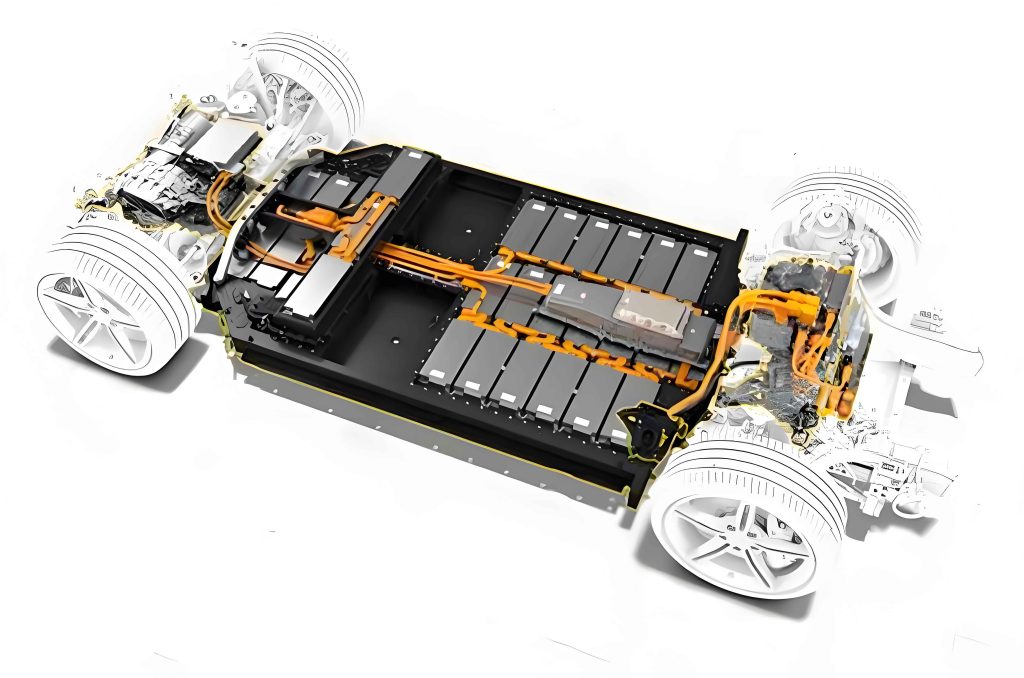
The intelligent electric drive system is fundamentally a highly integrated unit that combines an electric motor, a variable-speed transmission system, and a power conversion control system. This integration eliminates redundant structures, reduces energy losses, and allows for immediate maximum torque output upon startup. From my perspective, the technical advantages of such an electric drive system are manifold: high integration leads to cost reduction and improved reliability; intelligent control enables adaptive performance optimization; and high efficiency contributes to energy savings. For instance, the overall efficiency of an intelligent electric drive system can be expressed as: $$ \eta_{total} = \eta_{motor} \times \eta_{transmission} \times \eta_{controller} $$ where $\eta_{motor}$ is the motor efficiency, $\eta_{transmission}$ is the transmission efficiency, and $\eta_{controller}$ is the control system efficiency. Typically, modern electric drive systems achieve efficiencies above 90%, outperforming many traditional drives. The power density, a critical metric, is given by: $$ P_d = \frac{P_{output}}{V_{system}} $$ where $P_d$ is the power density in kW/L, $P_{output}$ is the output power, and $V_{system}$ is the system volume. Advanced electric drive systems can reach power densities of 2-4 kW/L, facilitating compact designs.
To better illustrate the components and benefits, I have summarized them in the following table:
| Component | Function | Key Advantages in Electric Drive System |
|---|---|---|
| Electric Motor | Converts electrical energy to mechanical energy | High torque at low speeds, regenerative braking capability |
| Transmission System | Adjusts speed and torque output | Multi-gear or CVT options for optimized efficiency |
| Power Electronics Controller | Manages power flow and motor control | Precise control algorithms, fault diagnostics |
| Integrated Housing | Encloses and protects components | Reduces weight and space, improves thermal management |
The intelligent electric drive system relies on sophisticated control strategies, such as field-oriented control (FOC) for motors, which can be modeled as: $$ \mathbf{V}_{dq} = R_s \mathbf{I}_{dq} + \frac{d}{dt} \mathbf{\Psi}_{dq} + \omega \mathbf{J} \mathbf{\Psi}_{dq} $$ where $\mathbf{V}_{dq}$ is the voltage vector, $R_s$ is stator resistance, $\mathbf{I}_{dq}$ is current vector, $\mathbf{\Psi}_{dq}$ is flux linkage, $\omega$ is electrical speed, and $\mathbf{J}$ is a skew-symmetric matrix. This allows for seamless integration and smart operation, making the electric drive system adaptable to various applications.
In terms of applications, the intelligent electric drive system has gained significant traction in three primary domains: intelligent transportation, robotics, and new energy equipment. Each of these areas leverages the unique benefits of the electric drive system to drive innovation and efficiency.
Starting with intelligent transportation, the shift towards electrification is most evident in electric vehicles (EVs) and electric ships. For EVs, the electric drive system is the heart of the powertrain, and market growth has been explosive. According to projections, by 2020, the new energy vehicle market in China aimed for sales of 2 million units, with the electric drive system market reaching approximately 29.5 billion yuan. However, as I analyze the landscape, foreign brands dominate the core technology, with domestic companies like BYD and BAIC New Energy leading in market share but still relying on imported components for high-end systems. The integration level of electric drive systems, such as “three-in-one” or “five-in-one” designs, remains a focus. The performance of an EV electric drive system can be evaluated using: $$ T_{max} = k_t \cdot I_{max} $$ where $T_{max}$ is the maximum torque, $k_t$ is the torque constant, and $I_{max}$ is the maximum current. Additionally, the range of an EV is influenced by the efficiency of the electric drive system: $$ Range = \frac{E_{battery}}{\eta_{system} \cdot P_{load}} $$ where $E_{battery}$ is battery energy, $\eta_{system}$ is overall system efficiency, and $P_{load}$ is average power demand. The following table summarizes key parameters in the EV electric drive system market:
| Parameter | Typical Value | Trend |
|---|---|---|
| Motor Power Range | 50-250 kW | Increasing towards higher power densities |
| System Efficiency | >90% | Improving with advanced materials and cooling |
| Integration Level | 2-in-1 to 5-in-1 | Growing for cost and space savings |
| Domestic Market Share (China) | ~75% for top 10 firms | Gradual increase but still reliant on imports |
In the maritime sector, electric drive systems for ships offer clear advantages in reducing emissions and noise. Traditional diesel-powered vessels are being replaced by electric propulsion, particularly for short-distance ferries and tourist boats. The global electric ship market was predicted to grow from $2.6 billion in 2013 to $7.3 billion by 2024. Companies like ABB, Siemens, and GE control around 90% of the market, showcasing the dominance of foreign players. The thrust generated by an electric propulsion system can be calculated as: $$ F = \eta_{prop} \cdot P_{electric} / v $$ where $F$ is thrust, $\eta_{prop}$ is propeller efficiency, $P_{electric}$ is electrical power, and $v$ is ship speed. In China, efforts are underway to catch up, with domestic companies developing systems like the “Galaxy Power EYS249-2” for LNG-powered ships, yet the overall capability in integrated electric drive systems remains nascent.
Moving to the robotics field, the intelligent electric drive system is a core component in both industrial and service robots. The global robotics market is expanding rapidly, driven by labor shortages and aging populations. China, as the largest application market, had industrial robot sales of 141,000 units in 2017, accounting for 40% of global demand by 2020. However, foreign brands such as the “Big Four” robot families hold over 70% of the market share, with high-end domains like welding and assembly dominated by imports. The electric drive system in robots typically involves servo motors and controllers, with precision being paramount. The torque-speed characteristic of a servo motor in an electric drive system is given by: $$ T = K \cdot ( \theta_{desired} – \theta_{actual} ) $$ where $T$ is torque, $K$ is a gain constant, and $\theta$ are angular positions. The following table outlines the robotics electric drive system market:
| Aspect | Details | Implications for Electric Drive System |
|---|---|---|
| Top Brands | Panasonic, Mitsubishi, Yaskawa (Japanese) | 45% market share; set high performance standards |
| European Brands | Siemens, Bosch, Schneider | 30% share in high-end applications |
| Domestic Chinese Share | <10% | Limited by reliance on imported key components |
| Key Components | Servo drives, reducers, controllers | High-precision gears and small motors often imported |
From my analysis, the challenges in robotics stem from core technology gaps. For example, the dynamic model of a robot joint with an electric drive system can be expressed as: $$ \tau = M(q) \ddot{q} + C(q, \dot{q}) \dot{q} + G(q) $$ where $\tau$ is joint torque, $M$ is inertia matrix, $C$ accounts for Coriolis forces, $G$ is gravity vector, and $q$ is joint angle. Achieving precise control requires advanced electric drive systems, but domestic production of such components is still evolving. Companies like Siasun and Estun are making strides, yet import dependency persists.
The third major application area is new energy equipment, particularly decentralized power generation systems like small-scale wind turbines. As policy support for distributed energy grows, the electric drive system plays a crucial role in converting and managing power. In China, off-grid areas with around 28,000 villages and 28 million people lack electricity, creating a demand for small wind or hybrid systems. The cumulative installed capacity of small wind turbines was projected to reach 2,955 MW by 2020 under conservative estimates, potentially rising to 10,038 MW with strong policy incentives. The power output of a small wind turbine with an electric drive system can be modeled as: $$ P_{wind} = \frac{1}{2} \rho A v^3 C_p \eta_{drive} $$ where $\rho$ is air density, $A$ is swept area, $v$ is wind speed, $C_p$ is power coefficient, and $\eta_{drive}$ is the efficiency of the electric drive system. The market for such systems is fragmented, with domestic Chinese manufacturers like Qingdao Anhua New Energy focusing on units from 150 W to 20 kW, while foreign companies like Bergey Windpower have longer experience. The table below summarizes this sector:
| Factor | Status in China | Global Context |
|---|---|---|
| Market Size | Growing but low penetration | Mature in regions like the US and Europe |
| Technology Level | Basic systems available | Advanced integration and smart grid compatibility |
| Key Players | Small-scale domestic firms | Companies like Jacobs and Acolian Energy |
| Potential Growth | High due to unmet rural demand | Stable with policy incentives |
In all these applications, the intelligent electric drive system demonstrates its versatility, but the development in China faces significant hurdles. As I reflect on the current state, China’s electric drive system industry started late, and despite forming a complete industrial chain, it remains in a catch-up phase. Core technologies and key components, such as high-performance motors, power semiconductors, and precision reducers, heavily rely on imports. This dependency stifles innovation and competitiveness. For instance, the cost breakdown of an electric drive system often shows that imported parts constitute over 50% of the total cost. To quantify this, the localization rate can be defined as: $$ L_r = \frac{C_{domestic}}{C_{total}} \times 100\% $$ where $L_r$ is the localization rate, $C_{domestic}$ is the cost of domestic components, and $C_{total}$ is the total cost. Currently, $L_r$ for high-end electric drive systems in China is estimated below 30%.
To address these challenges, I propose that non-standardization and localization of core components are critical directions. By developing domestic capabilities in design and manufacturing, China can reduce import reliance and foster innovation. This involves investing in R&D for materials, control algorithms, and integration techniques. For example, improving the thermal management of an electric drive system can enhance reliability; the heat dissipation can be modeled using: $$ Q = h A (T_{system} – T_{ambient}) $$ where $Q$ is heat transfer rate, $h$ is heat transfer coefficient, $A$ is surface area, and $T$ are temperatures. Additionally, policy support and industry collaboration are essential. The future outlook for the intelligent electric drive system is promising, with trends like wide-bandgap semiconductors enabling higher efficiency, and digital twin technology for predictive maintenance. The overall system efficiency might approach 95% with advancements, as per: $$ \eta_{future} = \eta_{current} + \Delta \eta_{tech} $$ where $\Delta \eta_{tech}$ represents gains from new technologies.
In conclusion, the intelligent electric drive system is a transformative technology with vast applications in transportation, robotics, and energy. Its advantages of integration, intelligence, and efficiency make it a cornerstone of modern electrification. However, for China, the path forward requires overcoming core technology gaps through localization and innovation. As the market expands, focusing on quality and customization will be key to capturing value. The electric drive system, in its intelligent form, is not just a component but a driver of sustainable development, and I am optimistic about its prospects as efforts intensify to master its intricacies.