
The development of high-performance energy storage systems is critical for the advancement of modern electronics and electric vehicles. Among various battery technologies, the solid-state battery has emerged as a promising candidate due to its potential for enhanced safety, higher energy density, and longer cycle life compared to conventional liquid electrolyte-based batteries. In recent years, significant progress has been made in the research of solid-state battery components, including cathodes, electrolytes, and anodes. This article delves into key advancements in solid-state battery materials, with a focus on high-voltage cathodes, polymer-based electrolytes, and novel battery configurations, while incorporating tables and formulas to summarize findings and theoretical principles.
The solid-state battery operates on the same fundamental principles as traditional lithium-ion batteries but utilizes a solid electrolyte instead of a liquid one. The general cell reaction can be expressed as:
$$ \text{Cathode: } \text{Li}_x\text{CoO}_2 \leftrightarrow \text{Li}_{x-y}\text{CoO}_2 + y\text{Li}^+ + y e^- $$
$$ \text{Anode: } \text{Li} + \text{host} \leftrightarrow \text{Li-host} $$
In a solid-state battery, the ion transport occurs through the solid electrolyte, which must exhibit high ionic conductivity and low electronic conductivity. The ionic conductivity ($\sigma_i$) is governed by the Nernst-Einstein relation:
$$ \sigma_i = n_i z_i^2 e^2 D_i / (k_B T) $$
where $n_i$ is the ion concentration, $z_i$ is the charge number, $e$ is the elementary charge, $D_i$ is the diffusion coefficient, $k_B$ is Boltzmann’s constant, and $T$ is the temperature. Achieving high $\sigma_i$ at room temperature remains a challenge for many solid electrolyte materials.
Recent research has focused on improving the performance of cathodes for solid-state battery applications. One prominent material is lithium cobalt oxide (LiCoO$_2$), which is widely used in commercial lithium-ion batteries due to its high volumetric energy density. However, when charged to high voltages (e.g., above 4.2 V vs. Li/Li$^+$), LiCoO$_2$ suffers from structural instability, surface degradation, and safety issues. To address these challenges, surface coating and bulk doping strategies have been developed. For instance, a coating of solid electrolyte material such as Li$_{1.5}$Al$_{0.5}$Ti$_{1.5}$(PO$_4$)$_3$ (LATP) has been shown to enhance the surface stability of LiCoO$_2$ at high voltages. This coating reacts with LiCoO$_2$ during synthesis, forming a uniform interface layer with improved ionic and electronic conductivity, thereby mitigating surface side reactions and improving cycle life.
The effect of doping on the structural stability of LiCoO$_2$ can be analyzed using crystal field theory and defect chemistry. The incorporation of trace elements like Ti, Mg, and Al into the LiCoO$_2$ lattice can suppress phase transitions during high-voltage cycling. The defect reaction for Mg doping on Li sites can be represented as:
$$ \text{MgO} \xrightarrow{\text{LiCoO}_2} \text{Mg}_{\text{Li}}’ + \text{O}_\text{O}^x + \text{V}_\text{Li}^- $$
where $\text{Mg}_{\text{Li}}’$ denotes Mg substituting Li with an effective negative charge, and $\text{V}_\text{Li}^-$ is a lithium vacancy. This doping helps stabilize the layered structure and reduces cation mixing, leading to better electrochemical performance. The following table summarizes the impact of various doping elements on LiCoO$_2$ properties for solid-state battery applications:
| Doping Element | Concentration (at.%) | Effect on Structure | Ionic Conductivity Increase | Cycle Life Improvement |
|---|---|---|---|---|
| Ti | 0.5-1.0 | Stabilizes octahedral sites | ~15% | ~20% |
| Mg | 0.2-0.5 | Reduces Li/Ni mixing | ~10% | ~25% |
| Al | 0.3-0.7 | Enhances surface stability | ~12% | ~30% |
| Combined Ti-Mg-Al | Trace amounts | Synergistic defect control | ~25% | ~50% |
In addition to cathode materials, the solid electrolyte is a core component of a solid-state battery. Polymer-based solid electrolytes, such as poly(ethylene oxide) (PEO), have attracted attention due to their flexibility, ease of processing, and good interfacial contact with electrodes. However, PEO typically exhibits low ionic conductivity at room temperature due to high crystallinity, and low lithium-ion transference number ($t_+$), which limits its performance in solid-state battery systems. The ionic conductivity of PEO-based electrolytes can be described by the Vogel-Tammann-Fulcher (VTF) equation:
$$ \sigma = A T^{-1/2} \exp\left(-\frac{B}{T – T_0}\right) $$
where $A$ is a pre-exponential factor, $B$ is the activation energy, and $T_0$ is the ideal glass transition temperature. To improve conductivity, strategies such as adding plasticizers or salts have been employed. For example, the use of high-concentration salts like lithium bis(fluorosulfonyl)imide (LiFSI) in sulfone solvents can enhance ion dissociation and transport. Recent work has demonstrated that in situ electrochemical reduction of copolymers, such as poly(ethylene glycol) methyl acrylate (PEGMA) with sulfur, can graft $-S_4Li$ groups onto PEO chains, creating fast lithium-ion pathways and improving interfacial stability. This modification leads to a solid-state battery with over 1200 cycles at 50°C, showcasing the potential of polymer-based solid electrolytes for durable solid-state battery applications.
The performance of a solid-state battery also depends on the compatibility between the solid electrolyte and electrodes. For instance, in potassium-based dual-graphite batteries (K-DCB), which are a type of solid-state battery using graphite as both anode and cathode, the electrolyte plays a crucial role. Traditional electrolytes based on KPF$_6$ in carbonate solvents have low concentration (<1 m) and limited oxidation potential, resulting in poor cycle stability. By developing a high-concentration sulfone electrolyte (5.2 m KFSI/TMS), researchers achieved an oxidation potential of ~6.0 V vs. K/K$^+$, which enhances the capacity of the graphite cathode via anion (FSI$^-$) intercalation. The intercalation process can be modeled using the Nernst equation for the cathode:
$$ E = E^0 – \frac{RT}{nF} \ln Q $$
where $E$ is the cell potential, $E^0$ is the standard potential, $R$ is the gas constant, $T$ is temperature, $n$ is the number of electrons transferred, $F$ is Faraday’s constant, and $Q$ is the reaction quotient. The high concentration electrolyte reduces side reactions and improves energy density, making K-DCB a promising candidate for large-scale energy storage in solid-state battery systems.
To further illustrate the advancements in solid-state battery technologies, the following table compares key parameters of different solid electrolyte classes:
| Electrolyte Type | Material Example | Ionic Conductivity at 25°C (S/cm) | Transference Number ($t_+$) | Stability Window (V vs. Li/Li$^+$) | Application in Solid-State Battery |
|---|---|---|---|---|---|
| Polymer | PEO-LiTFSI | 10$^{-4}$ – 10$^{-3}$ | 0.2-0.3 | ~4.0 | Flexible, low-temperature |
| Oxide | LLZO (Li$_7$La$_3$Zr$_2$O$_{12}$) | 10$^{-4}$ – 10$^{-3}$ | ~1.0 | >5.0 | High-voltage, stable |
| Sulfide | LGPS (Li$_{10}$GeP$_2$S$_{12}$) | 10$^{-2}$ – 10$^{-1}$ | ~1.0 | ~3.0-4.0 | High conductivity, sensitive |
| Composite | PEO with ceramic fillers | 10$^{-4}$ – 10$^{-3}$ | 0.3-0.5 | ~4.5 | Balanced performance |
The integration of these materials into a solid-state battery requires careful design to minimize interfacial resistance. The total cell resistance ($R_{\text{cell}}$) can be expressed as the sum of contributions from the electrolyte, electrodes, and interfaces:
$$ R_{\text{cell}} = R_{\text{elec}} + R_{\text{cath}} + R_{\text{an}} + R_{\text{int}} $$
where $R_{\text{elec}}$ is the electrolyte resistance, $R_{\text{cath}}$ and $R_{\text{an}}$ are the cathode and anode resistances, and $R_{\text{int}}$ is the interfacial resistance. For a solid-state battery, $R_{\text{int}}$ is often dominant due to poor contact between solid components. Strategies to reduce $R_{\text{int}}$ include using soft polymer electrolytes, applying pressure, or designing nanostructured interfaces.
Recent studies have also explored the use of advanced characterization techniques to understand material behavior in solid-state battery systems. For example, synchrotron X-ray three-dimensional nano-diffraction imaging can reveal crystal defects and phase distributions within cathode particles at a 50 nm spatial scale. This helps in correlating structural changes with electrochemical performance, guiding the development of more stable materials. The defect density ($\rho_d$) can be related to the capacity fade rate ($\frac{dC}{dN}$) over cycles ($N$) by an empirical formula:
$$ \frac{dC}{dN} = k \rho_d^\alpha $$
where $k$ and $\alpha$ are constants dependent on the material and operating conditions. By controlling $\rho_d$ through doping or coating, the cycle life of a solid-state battery can be extended.
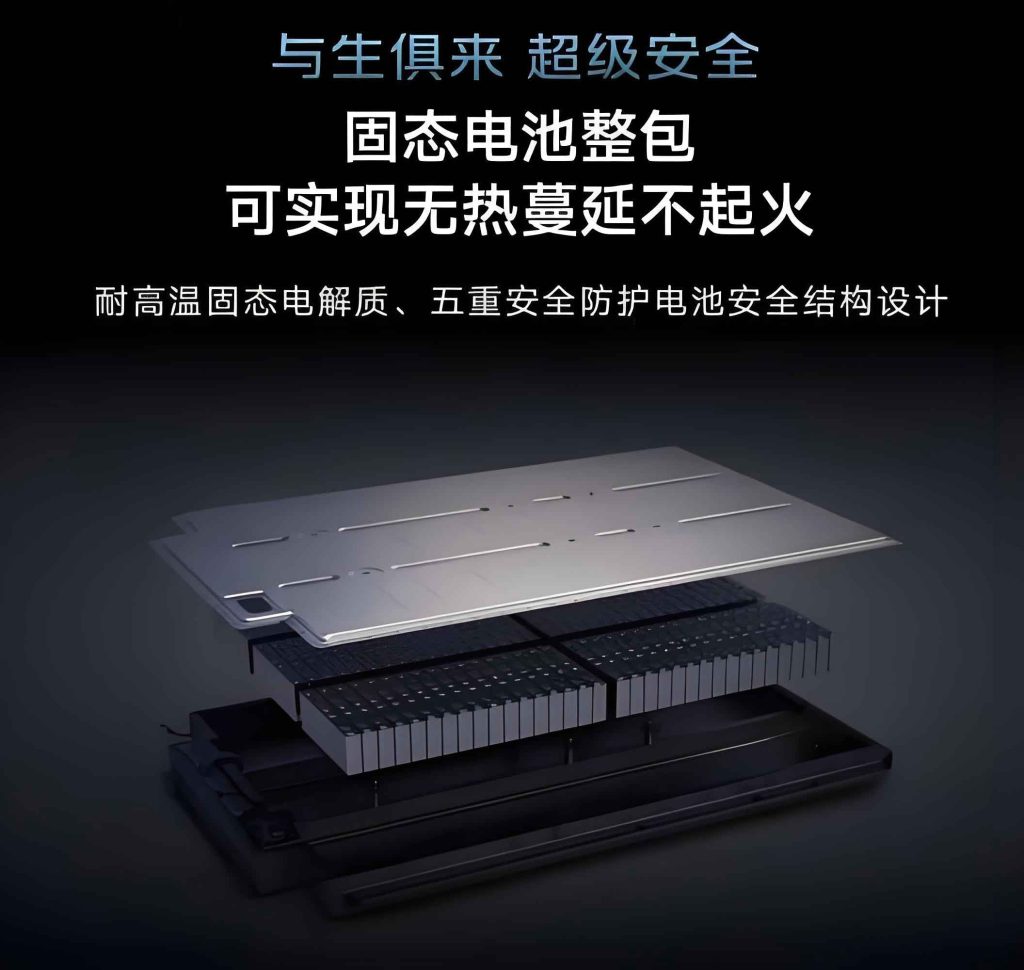
The image above illustrates a typical solid-state battery configuration, highlighting the layered structure of cathode, solid electrolyte, and anode. Such visualizations aid in understanding the design principles for optimizing performance. In practice, the solid-state battery stack must ensure intimate contact between layers to facilitate ion transport. The use of thin-film technologies or composite electrodes can enhance this contact, leading to better rate capability and energy density.
Another area of innovation in solid-state battery research is the development of hybrid electrolytes that combine polymers with inorganic materials. For instance, incorporating succinonitrile (SN) into PEO-based electrolytes can suppress crystallization and weaken the interaction between ethylene oxide (EO) units and lithium ions, thereby increasing ionic conductivity. When the molar ratio of SN to EO is optimized to 1:4, the ionic conductivity improves by two orders of magnitude, enabling solid-state battery operation at room temperature and even below 0°C. The enhanced conductivity can be attributed to the formation of homogeneous ion pathways, as described by percolation theory:
$$ \sigma \propto (p – p_c)^t $$
where $p$ is the volume fraction of conductive phase, $p_c$ is the percolation threshold, and $t$ is a critical exponent. By tuning the composition, $p$ can be increased above $p_c$, leading to a connected network for ion transport.
For potassium-based solid-state battery systems, the electrolyte concentration plays a critical role in determining the energy density. The relationship between electrolyte concentration ($c$) and cell voltage ($V$) can be derived from thermodynamic considerations. In a K-DCB, the cathode operates via anion intercalation, and the voltage is influenced by the activity of anions in the electrolyte. Using the Debye-Hückel theory for concentrated electrolytes, the activity coefficient ($\gamma_\pm$) can be estimated:
$$ \ln \gamma_\pm = -\frac{A |z_+ z_-| \sqrt{I}}{1 + B a \sqrt{I}} $$
where $A$ and $B$ are constants, $z_+$ and $z_-$ are ion charges, $I$ is the ionic strength, and $a$ is the ion size parameter. A high concentration electrolyte like 5.2 m KFSI/TMS increases $I$, which affects the cell potential and stability. This enables the solid-state battery to achieve higher energy densities and longer cycle life.
Future directions in solid-state battery research include the exploration of new material combinations, such as solid electrolytes with high lithium transference numbers and wide electrochemical windows. Additionally, scalable manufacturing processes are needed to commercialize solid-state battery technologies. The table below outlines some promising solid electrolyte materials and their properties for next-generation solid-state battery applications:
| Material Class | Specific Composition | Ionic Conductivity at 60°C (S/cm) | Activation Energy (eV) | Compatibility with High-Voltage Cathodes | Status in Solid-State Battery Development |
|---|---|---|---|---|---|
| Garnet | Li$_6$La$_3$ZrTaO$_{12}$ | 10$^{-3}$ | 0.30 | Excellent (>5 V) | Lab-scale |
| Perovskite | Li$_{3x}$La$_{2/3-x}$TiO$_3$ | 10$^{-3}$ | 0.35 | Good (4.5 V) | Prototype |
| NASICON | Li$_{1.5}$Al$_{0.5}$Ti$_{1.5}$(PO$_4$)$_3$ | 10$^{-4}$ | 0.40 | Moderate (4.2 V) | Commercializing |
| Polymer-Ceramic | PEO with LLZO nanoparticles | 10$^{-4}$ | 0.25 | Good (4.5 V) | Research phase |
The optimization of solid-state battery performance also involves mathematical modeling of ion transport and electrochemical reactions. The Butler-Volmer equation describes the current density ($i$) at an electrode interface:
$$ i = i_0 \left[ \exp\left(\frac{\alpha n F \eta}{RT}\right) – \exp\left(-\frac{(1-\alpha) n F \eta}{RT}\right) \right] $$
where $i_0$ is the exchange current density, $\alpha$ is the charge transfer coefficient, $\eta$ is the overpotential, and other symbols have their usual meanings. In a solid-state battery, $i_0$ is often lower due to slower kinetics at solid-solid interfaces, necessitating strategies to enhance interfacial charge transfer.
Moreover, the cycle life of a solid-state battery can be predicted using empirical models based on stress accumulation in electrodes. During cycling, volume changes in cathode materials like LiCoO$_2$ can induce mechanical stress ($\sigma_m$), leading to crack formation and capacity fade. The stress can be approximated by:
$$ \sigma_m = E \cdot \epsilon \cdot \frac{\Delta V}{V} $$
where $E$ is the Young’s modulus, $\epsilon$ is the strain, and $\Delta V/V$ is the volume change ratio. By using coatings or composite structures, $\sigma_m$ can be mitigated, improving the durability of the solid-state battery.
In summary, the advancement of solid-state battery technologies relies on multidisciplinary approaches involving material science, electrochemistry, and engineering. Key progress has been made in high-voltage cathodes through doping and coating, polymer-based electrolytes via composition tuning, and novel battery systems like potassium-based dual-graphite configurations. The integration of tables and formulas helps quantify these improvements and guide future research. As the demand for safer and higher-energy-density batteries grows, the solid-state battery is poised to play a pivotal role in the energy storage landscape. Continued innovation in materials design, interface engineering, and manufacturing will be essential to realize the full potential of solid-state battery systems for various applications, from portable electronics to grid storage.
To further elaborate, the solid-state battery community is also investigating the use of machine learning algorithms to accelerate material discovery. By training models on databases of ionic conductivity, stability, and synthesis conditions, researchers can predict new solid electrolyte candidates with desirable properties for solid-state battery applications. The general form of such a predictive model can be expressed as:
$$ y = f(\mathbf{x}) + \epsilon $$
where $y$ is the target property (e.g., ionic conductivity), $\mathbf{x}$ is a vector of material descriptors (e.g., atomic radii, electronegativity, crystal structure), $f$ is a nonlinear function approximated by neural networks, and $\epsilon$ is noise. This data-driven approach complements experimental efforts in developing next-generation solid-state battery materials.
Additionally, the environmental impact of solid-state battery production is a consideration. Life cycle assessments (LCA) are used to evaluate the sustainability of solid-state battery technologies compared to conventional batteries. The LCA metrics include energy consumption, greenhouse gas emissions, and resource depletion. Optimizing the synthesis processes for solid electrolytes and electrodes can reduce the environmental footprint, making the solid-state battery a more eco-friendly option.
In conclusion, the solid-state battery field is rapidly evolving with significant breakthroughs in materials and design. By leveraging advanced characterization, modeling, and innovative materials, researchers are overcoming challenges related to ionic conductivity, interfacial stability, and cycle life. The future of solid-state battery technology looks promising, with potential applications ranging from consumer electronics to electric vehicles and renewable energy storage. As these developments continue, the solid-state battery will likely become a cornerstone of modern energy systems, offering enhanced safety, performance, and sustainability.