
As an engineer and researcher in the automotive industry, I have witnessed the transformative impact of electronic control technology on new energy vehicles (NEVs). In the face of environmental degradation and fossil fuel depletion, NEVs have emerged as a critical solution, with electronic control systems at their core enabling enhanced performance, efficiency, and intelligence. This article delves into the applications of electronic control technology across various NEV subsystems, explores current challenges, and outlines future development trends, emphasizing the pivotal role of the motor control unit. I will incorporate tables and formulas to summarize key concepts, ensuring a comprehensive analysis that aligns with industry advancements.
The automotive sector has long grappled with the dual pressures of energy security and ecological preservation. Traditional internal combustion engine vehicles rely on petroleum-based fuels, contributing significantly to greenhouse gas emissions and air pollution. In contrast, NEVs—powered by clean energy sources like electricity, hydrogen, or biofuels—offer a sustainable alternative. However, their widespread adoption hinges on overcoming technical hurdles, particularly in electronic control systems. These systems are not mere add-ons but integral components that govern everything from power management to vehicle dynamics. Through my work, I have seen how electronic control technology, especially the motor control unit, drives innovation, making NEVs smarter, safer, and more reliable. This article reflects my insights and experiences, aiming to provide a detailed overview of this evolving field.
Applications of Electronic Control Technology in NEVs
Electronic control technology permeates every aspect of NEVs, creating a networked ecosystem that optimizes performance. Below, I detail its applications across key systems, with a focus on the motor control unit as a central element.
Battery Management System (BMS)
The BMS is crucial for monitoring and managing the battery pack, typically composed of lithium-ion or nickel-metal hydride cells. As I have designed and tested these systems, the primary goals are to extend battery life, ensure safety, and maintain optimal performance. The BMS uses sensors to track parameters such as voltage, current, temperature, and state of charge (SOC). Electronic control algorithms process this data to prevent overcharging, over-discharging, and thermal runaway. For instance, the SOC estimation often relies on a combination of coulomb counting and model-based approaches, expressed as:
$$SOC(t) = SOC_0 – \frac{1}{Q_n} \int_0^t \eta i(\tau) d\tau$$
where \(SOC_0\) is the initial SOC, \(Q_n\) is the nominal battery capacity, \(\eta\) is the efficiency, and \(i(\tau)\) is the current. A well-designed BMS, integrated with the motor control unit, ensures balanced cell operation and enhances overall vehicle efficiency. Table 1 summarizes BMS functions and their electronic control components.
| Function | Electronic Control Component | Description |
|---|---|---|
| State Estimation | Microcontroller with algorithms for SOC/SOH calculation | Estimates state of charge and state of health using sensor data and models. |
| Thermal Management | Thermal sensors and control circuits | Regulates battery temperature via cooling/heating systems to prevent extremes. |
| Cell Balancing | Active or passive balancing circuits | Equalizes charge among cells to maximize pack capacity and longevity. |
| Fault Detection | Diagnostic software and hardware monitors | Identifies anomalies like overvoltage or short circuits and triggers safeguards. |
Motor Control Unit (MCU) in Drive Systems
The motor control unit is the heart of the NEV powertrain, responsible for converting electrical energy into mechanical motion. In my projects, I have focused on optimizing MCUs for efficiency and responsiveness. NEVs commonly use brushless DC motors or permanent magnet synchronous motors, which require precise control of phase currents and rotor position. The MCU employs techniques like field-oriented control (FOC), which decouples torque and flux components. The control equations can be represented as:
$$i_d = 0 \quad \text{(for maximum torque per ampere)}$$
$$i_q = \frac{T_e}{\frac{3}{2} p \psi_f}$$
where \(i_d\) and \(i_q\) are the direct and quadrature axis currents, \(T_e\) is the electromagnetic torque, \(p\) is the number of pole pairs, and \(\psi_f\) is the permanent magnet flux linkage. The motor control unit dynamically adjusts these parameters based on driver inputs and vehicle conditions, ensuring smooth acceleration and regenerative braking.
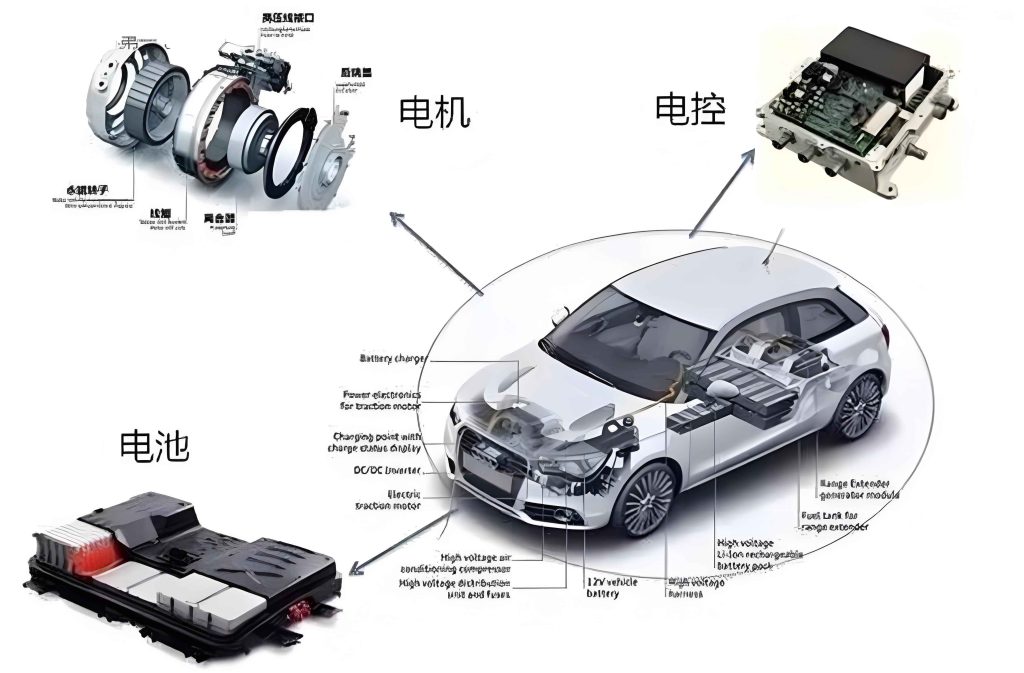
This image illustrates a typical motor control unit setup, highlighting its compact design and integration with power electronics. The motor control unit must also manage thermal dissipation and electromagnetic interference, challenges I have addressed through advanced packaging and filtering techniques.
Energy Regeneration System
Energy regeneration, or regenerative braking, is a hallmark of NEVs that enhances efficiency. As I have implemented in vehicle designs, this system recovers kinetic energy during deceleration and converts it back into electrical energy stored in the battery. The electronic control system coordinates the motor control unit to switch from drive mode to generator mode. The regenerated power \(P_{reg}\) can be approximated by:
$$P_{reg} = \eta_{reg} \cdot \frac{1}{2} m v^2 \cdot f_{brake}$$
where \(\eta_{reg}\) is the regeneration efficiency, \(m\) is vehicle mass, \(v\) is velocity, and \(f_{brake}\) is the braking force factor. The motor control unit plays a key role here by controlling the inversion process and ensuring seamless integration with the hydraulic brakes. Table 2 compares energy flows in traditional and regenerative braking systems.
| Aspect | Traditional Braking | Regenerative Braking with Electronic Control |
|---|---|---|
| Energy Destination | Dissipated as heat in brake pads | Converted to electricity and stored in battery |
| Control Mechanism | Hydraulic pressure only | Integrated control of motor control unit and brake actuators |
| Efficiency Gain | None | Up to 20-30% improvement in urban driving cycles |
| Electronic Components | Minimal | MCU, power converters, sensors, and control algorithms |
Chassis Control Systems
Chassis systems, including steering, braking, and suspension, rely heavily on electronic control for stability and comfort. In my experience, technologies like anti-lock braking systems (ABS) and electronic stability control (ESC) are enhanced in NEVs through integration with the powertrain. For example, the motor control unit can provide torque vectoring, adjusting power to individual wheels to improve handling. The control logic for ESC involves monitoring yaw rate and lateral acceleration, with corrective actions computed as:
$$\Delta T = K_p \cdot (r_{desired} – r_{actual}) + K_i \cdot \int (r_{desired} – r_{actual}) dt$$
where \(\Delta T\) is the torque adjustment, \(r\) is yaw rate, and \(K_p\), \(K_i\) are control gains. This synergy between the motor control unit and chassis controllers exemplifies the holistic approach in NEV design.
Body and Infotainment Systems
Electronic control extends to comfort and convenience features, such as climate control, navigation, and security. As I have developed these systems, they are increasingly interconnected via controller area network (CAN) buses. For instance, the air conditioning system uses sensors and actuators to maintain cabin temperature while minimizing energy draw from the battery—a critical consideration for range. The motor control unit may indirectly influence this by managing auxiliary loads. Security features, like remote monitoring, leverage telematics control units that communicate with cloud platforms, showcasing the convergence of electronic control and IoT.
Engine Control in Hybrid Systems
For hybrid NEVs, electronic control manages the internal combustion engine alongside electric motors. The engine control unit (ECU) coordinates with the motor control unit to optimize power split. Strategies like Atkinson cycle operation or start-stop functionality are governed by algorithms that prioritize efficiency. In my work, I have used models to describe the hybrid powertrain dynamics, such as:
$$P_{total} = P_{engine} + P_{motor} – P_{losses}$$
where \(P_{engine}\) and \(P_{motor}\) are powers from the engine and motor, respectively, controlled by their respective units to meet driver demand while reducing emissions.
Development Trends and Future Perspectives
Looking ahead, electronic control technology in NEVs is poised for significant advancements. Based on my research and industry collaborations, I identify several key trends that will shape the future, with the motor control unit remaining central.
Integration of Smart Electronic Control Pumps
Thermal management is evolving with smart pumps that use brushless DC motors for precise coolant flow control. These pumps, governed by dedicated electronic control units, adjust speed based on real-time temperature data, improving energy efficiency. The power consumption \(P_{pump}\) can be modeled as:
$$P_{pump} = \frac{\rho g H Q}{\eta_{pump}}$$
where \(\rho\) is fluid density, \(g\) is gravity, \(H\) is head, \(Q\) is flow rate, and \(\eta_{pump}\) is efficiency. By integrating with the motor control unit, these systems optimize overall thermal performance, a focus in my recent projects.
Cloud-Platform-Based Electronic Control Communication
The rise of connected vehicles enables electronic control systems to leverage cloud computing for enhanced functionality. I envision a future where motor control unit data is transmitted to the cloud for analytics, enabling predictive maintenance and over-the-air updates. This involves secure communication protocols and edge computing devices. The data flow can be represented as:
$$Data_{vehicle} \xrightarrow{5G/V2X} Cloud_{server} \xrightarrow{AI} Insights_{control}$$
This integration will make NEVs part of a larger smart transportation ecosystem, improving safety and efficiency.
Unified Vehicle Electronic Control System
Currently, NEVs employ distributed control units for different subsystems. A trend I advocate for is the development of a unified electronic control architecture, where functions like battery management, motor control unit operations, and chassis control are consolidated into a central processor. This reduces complexity and enhances interoperability. For example, a unified controller could optimize energy allocation using a cost function:
$$J = \min \int ( \alpha \cdot P_{batt} + \beta \cdot P_{loss} + \gamma \cdot T_{dev} ) dt$$
where \(\alpha, \beta, \gamma\) are weighting factors for battery power, losses, and torque deviation. Such systems would streamline diagnostics and upgrades.
Advancements in Fuel Cell Electronic Control
Fuel cell NEVs represent a promising zero-emission technology, and their electronic control systems require sophisticated management of hydrogen flow, air supply, and power electronics. The motor control unit in these vehicles interfaces with the fuel cell stack to regulate output. Key parameters include stack voltage \(V_{stack}\) and current \(I_{stack}\), related by:
$$P_{stack} = V_{stack} \cdot I_{stack} \cdot \eta_{fc}$$
where \(\eta_{fc}\) is fuel cell efficiency. My work in this area involves developing control strategies that balance durability and performance, often through model predictive control.
Enhanced Sensor Systems for Safety
Future NEVs will incorporate advanced sensors for scenarios like water wading, where electronic components are at risk. Electronic control systems can use water detection sensors to trigger protective measures, such as isolating the motor control unit. This aligns with the broader trend of robust environmental adaptability, ensuring NEV reliability under diverse conditions.
Conclusion
In summary, electronic control technology is the backbone of new energy vehicles, driving innovations from the motor control unit to holistic vehicle management. Through my engagement in this field, I have seen how applications in battery systems, drive trains, and energy recovery are continually refined, while future trends point toward greater integration, intelligence, and sustainability. The motor control unit, as a critical component, exemplifies the synergy between hardware and software that defines modern NEVs. As we advance, embracing technologies like cloud connectivity and unified control will be essential for overcoming challenges and realizing the full potential of clean transportation. This journey, filled with technical intricacies and collaborative efforts, underscores the transformative power of electronic control in shaping a greener automotive future.