
In the development of modern battery electric vehicles (BEVs), the noise, vibration, and harshness (NVH) performance of the electric drive unit is paramount. Unlike traditional internal combustion engine vehicles, the absence of masking engine noise makes other sound sources, particularly electromagnetic noise from the traction motor, significantly more perceptible and often detrimental to the overall sound quality. This paper presents a detailed investigation and resolution of a prominent whining noise issue encountered during the acceleration of a pure electric vehicle prototype. Through a systematic approach combining subjective evaluation, objective testing, and in-depth root cause analysis, the problem was identified as a forced vibration stemming from manufacturing tolerances within the motor, amplified by a structural resonance in the power electronics. The following sections document the complete diagnostic process, the theoretical underpinnings of the electromagnetic excitation, and the implementation and validation of effective countermeasures.
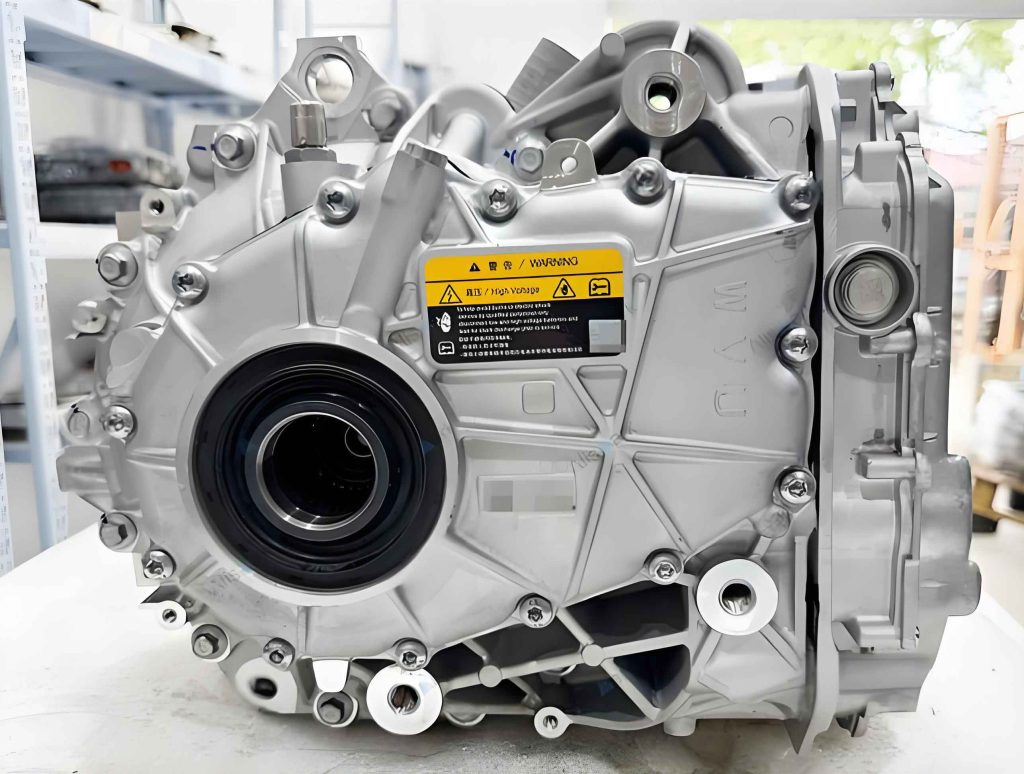
1. Problem Manifestation and Initial Objective Characterization
During vehicle-level subjective assessments, a distinct, low-frequency “buzzing” or “whining” noise was consistently reported by evaluators when the vehicle accelerated through approximately 70 km/h. This sound was described as unpleasant and easily identifiable, significantly degrading the cabin’s acoustic comfort. To quantify this issue, comprehensive objective tests were conducted.
Microphones were placed at key interior locations (e.g., driver’s ear) and accelerometers were mounted on the housing of the electric drive unit. Data was synchronized with vehicle Controller Area Network (CAN) signals, primarily motor speed and torque. The waterfall plot of the interior noise revealed a clear and dominant order component. The traction motor in this application is a 6-pole, 54-slot permanent magnet synchronous motor (PMSM). Its fundamental electromagnetic excitation order is defined by the number of pole pairs multiplied by the number of slots per pole pair, but a dominant and perceptually critical order often corresponds to twice the pole pair number (or other force wave modes). In this case, a strong 6th order component (relative to the motor rotational frequency) was identified. The sound pressure level (SPL) of this electromagnetic 6th order noise exhibited a pronounced peak of approximately 10 dB(A) above the surrounding background around 4500 RPM, which correlates directly to the problematic vehicle speed of 70 km/h.
2. Noise Source Isolation and Component-Level Analysis
To isolate the source from vehicle-level transfer paths, the complete electric drive unit was tested on a dynamometer within a semi-anechoic chamber. The unit was operated under loaded conditions simulating the problematic speed-torque point. Near-field acoustic measurements (average of 5 points at 1 meter) and detailed vibration measurements on the motor stator housing were taken.
The results confirmed the vehicle findings. The 6th order acoustic noise showed a distinct peak at 4500 RPM. More critically, the vibration spectrum on the motor housing displayed a very sharp peak at 450 Hz. Given the relationship between order, frequency (f), and rotational speed (N in RPM), this confirmed the source: $$f_{6th}(Hz) = \frac{Order \times N_{RPM}}{60} = \frac{6 \times 4500}{60} = 450 \, Hz$$. The high vibration level at this specific frequency indicated a strong forcing function at 450 Hz acting on the motor structure.
3. In-Depth Analysis of the Electromagnetic Noise Mechanism
3.1 Fundamental Theory of Electromagnetic Force Generation
The primary source of electromagnetic vibration and noise in a PMSM is the radial force acting on the stator core, resulting from the interaction of the magnetic fields across the air gap. This force density can be derived from the Maxwell Stress Tensor. The radial pressure \( p_r(\theta, t) \) at a point defined by the angular position \( \theta \) and time \( t \) is given by:
$$p_r(\theta, t) = \frac{1}{2\mu_0} \left( B_r^2(\theta, t) – B_t^2(\theta, t) \right)$$
where \( \mu_0 \) is the permeability of free space, \( B_r \) is the radial flux density, and \( B_t \) is the tangential flux density. For radial flux machines, \( B_r \) is dominant, so the expression is often simplified to:
$$p_r(\theta, t) \approx \frac{ B_r^2(\theta, t)}{2\mu_0}$$
The air-gap flux density \( B_r(\theta, t) \) is a product of the magnetomotive forces (MMF) and the air-gap permeance \( \Lambda(\theta, t) \):
$$B_r(\theta, t) = [F_{PM}(\theta, t) + F_{Armature}(\theta, t)] \cdot \Lambda(\theta, t)$$
where \( F_{PM} \) is the MMF of the permanent magnets and \( F_{Armature} \) is the MMF of the stator winding currents. Substituting this into the radial pressure equation leads to a complex expression with multiple spatial and temporal harmonics. The squared term results in force waves with a wide range of spatial orders \( r \) and temporal frequencies \( \omega \):
$$p_r(\theta, t) = \sum_{\mu} \sum_{\nu} P_{r,\mu\nu} \cos(r\theta – \omega_{\mu\nu}t – \phi_{\mu\nu})$$
For a 6-pole, 54-slot motor, the principal electromagnetic force waves that can effectively excite the stator structure are those with low spatial orders (e.g., r=0, 2, 4, 6…), as they can more readily couple with the structural modes of the stator. The 6th order force wave (r=6) is often a significant contributor.
3.2 The Critical Impact of Rotor-Stator Eccentricity
A perfectly concentric rotor and stator assembly produces a uniform air gap. However, manufacturing tolerances in the stator bore, rotor lamination stack, and bearing alignment can lead to eccentricity. This deviation causes a non-uniform air gap \( g(\theta, t) \) around the circumference. The air-gap permeance \( \Lambda(\theta, t) \) is inversely proportional to the air-gap length:
$$\Lambda(\theta, t) \approx \frac{\mu_0}{g(\theta, t)}$$
When eccentricity exists, the permeance is no longer constant. It can be modeled as a constant component plus a series of harmonic components. This modulation effect dramatically alters the spectrum of the radial magnetic force. For a static eccentricity (where the rotor center is offset but fixed), the air gap length can be expressed as:
$$g(\theta) = g_0 \left[1 – \delta_s \cos(\theta)\right]$$
where \( g_0 \) is the nominal air gap and \( \delta_s \) is the static eccentricity factor (0 < \( \delta_s \) < 1). The permeance becomes:
$$\Lambda(\theta) \approx \frac{\mu_0}{g_0} \left[1 + \delta_s \cos(\theta) + \delta_s^2 \cos^2(\theta) + … \right]$$
This term, when multiplied with the MMFs in the force equation, introduces additional spatial harmonics into the force wave spectrum. Crucially, it can amplify existing low-order force waves, such as the 6th order component. The generalized radial force under eccentric conditions can be represented as a modulation of the ideal force:
$$p_{r,SE}(\theta, t) \approx \left[1 + \delta \cos(\theta – \phi_e) \right] \cdot p_r(\theta, t)$$
where \( \delta \) is the combined eccentricity factor and \( \phi_e \) is its phase. This modulation creates sideband frequencies and increases the amplitude of force waves whose spatial order matches or is close to the modulating harmonic, leading to increased vibration at specific frequencies like the 6th order.
3.3 Experimental Validation of the Eccentricity Effect
To conclusively prove this mechanism, a controlled experiment was designed. Using a known-good electric drive unit, the concentricity between the stator and rotor was deliberately altered in a controlled manner to simulate different levels of air-gap deviation. The motor vibration was then measured under identical operating conditions. The results were striking, as summarized qualitatively below:
- Baseline (Minimal Eccentricity ~0.05mm): The 6th order vibration at 450 Hz was present but at a relatively low baseline amplitude.
- Moderate Eccentricity (~0.15mm): The amplitude of the 6th order vibration peak at 450 Hz increased significantly, approximately doubling.
- High Eccentricity (~0.25mm): The 6th order vibration peak became the dominant feature in the spectrum, with an amplitude roughly three times that of the baseline condition.
This experiment provided direct, empirical evidence that stator-rotor misalignment was a primary root cause of the excessive 6th order vibration. Subsequent dimensional inspection of three problematic motor units from the production line revealed consistent manufacturing deviations, particularly in stator bore cylindricity and coaxiality, as shown in the table below. All samples significantly exceeded the design specification of 0.05 mm.
| Sample ID | Stator Flatness (mm) | Stator Position (mm) | Stator Bore Cylindricity (mm) | Stator Bore Coaxiality (mm) |
|---|---|---|---|---|
| #1 | 0.032 | 0.029 | 0.191 | 0.270 |
| #2 | 0.058 | 0.015 | 0.087 | 0.262 |
| #3 | 0.043 | 0.020 | 0.146 | 0.205 |
3.4 Structural Resonance: The Amplification Path
While a strong forcing function (the amplified 6th order electromagnetic force) is necessary, its perceptibility as airborne noise is greatly intensified if it excites a structural resonance. Experimental modal analysis was performed on the inverter controller’s aluminum top cover, a large, thin-walled component directly attached to the electric drive unit housing. The analysis identified a prominent first-order “drumming” mode of the cover panel at 451 Hz, with a shape characterized by a central anti-node. The coincidence of this natural frequency (451 Hz) with the forcing frequency (450 Hz) created a classic forced resonance condition. The vibration response \( Y(\omega) \) near resonance is governed by:
$$|Y(\omega)| \approx \frac{F_0/m}{\sqrt{(\omega_0^2 – \omega^2)^2 + (2\zeta\omega_0\omega)^2}}$$
where \( F_0 \) is the force amplitude, \( m \) is the effective mass, \( \omega_0 \) is the natural frequency, \( \omega \) is the excitation frequency, and \( \zeta \) is the damping ratio. When \( \omega \approx \omega_0 \), the response is amplified significantly, especially with low damping \( \zeta \). This resonated cover then acted as an efficient acoustic radiator, converting the structural vibration into the pronounced airborne whine heard in the vehicle cabin. The final noise problem was therefore a combination of a source issue (eccentricity-amplified 6th order force) and a path issue (controller cover resonance).
4. Implementation and Validation of Optimization Measures
The remediation strategy targeted both the source and the path of the noise.
4.1 Source Optimization: Stator Manufacturing Process Enhancement
The root cause was the geometric inaccuracy of the stator bore. The core laminations are stacked and then typically bonded or welded. The final machining of the inner diameter (ID) is critical. The original process was found to lack sufficient stability and precision. The optimization focused on:
- Stamping Die Precision: Improving the consistency and concentricity of individual laminations.
- Stacking and Fixation: Implementing a more rigid and precise stacking fixture with real-time alignment monitoring to ensure a straight, uniform stack before final bonding.
- Machining Process: Upgrading the finishing operation (e.g., honing) with higher-precision equipment and implementing stricter in-process gauging to control cylindricity and coaxiality dynamically. The target was to consistently achieve values below 0.05 mm.
Motors assembled with stators from the optimized process were tested. The results showed a dramatic reduction in the source vibration. The 6th order vibration amplitude at 450 Hz was reduced by approximately 50%, and the corresponding near-field acoustic noise peak dropped by about 4 dB(A).
4.2 Path Optimization: Inverter Controller Cover Redesign
To break the amplification path, the structural dynamics of the controller cover needed to be altered. The goal was to shift its first natural frequency away from the critical 450 Hz excitation and/or increase its damping. The original cast aluminum cover was replaced with a sandwich-type design utilizing a constrained layer damping (CLD) treatment. The new cover consisted of:
- A steel outer skin for structural stiffness.
- A viscoelastic damping polymer layer.
- A steel constraining inner layer.
This design provides two benefits: 1) The increased stiffness (from steel) raises the natural frequency, moving it away from the 450 Hz excitation. 2) The constrained layer damping significantly increases the damping ratio \( \zeta \) for the cover’s modes, thereby reducing the resonant response amplitude according to the equation above. Bench tests on the modified electric drive unit confirmed the effectiveness. The 6th order noise peak at the problem frequency was further reduced by an additional 5 dB(A). The combined effect of source and path optimization led to a total reduction of approximately 9 dB(A) at the 450 Hz peak, effectively eliminating the perceptible whine.
| Optimization Area | Specific Measure | Primary Effect | Quantified Result (at 450 Hz) |
|---|---|---|---|
| Noise Source (Motor) | Stator Bore Process Control: Improved stacking & machining for concentricity & cylindricity. | Reduces amplitude of 6th order radial electromagnetic force. | ~4 dB(A) noise reduction; ~50% vibration reduction. |
| Noise Path (Structure) | Controller Cover Redesign: Replaced cast Al with damped steel sandwich panel. | Shifts natural frequency & increases damping, reducing resonant response. | ~5 dB(A) additional noise reduction. |
| Combined Effect | Implementation of both source and path optimizations. | Addresses root cause and prevents amplification. | ~9 dB(A) total noise reduction; problem subjectively eliminated. |
5. Conclusion and Broader Implications for NVH Development
This case study provides a comprehensive framework for diagnosing and resolving electromagnetic noise issues in electric drive units. The successful resolution hinged on a methodical, two-pronged approach: first, accurately identifying the source of the excitation (eccentricity-amplified 6th order electromagnetic force) through targeted testing and theoretical analysis; and second, characterizing and modifying the critical structural transfer path (controller cover resonance) that amplified the vibration into objectionable airborne noise.
The key technical lessons learned are:
- Manufacturing Precision is Critical: Sub-millimeter geometric tolerances in the motor assembly, particularly stator bore quality, have a direct and non-linear impact on electromagnetic NVH. Strict process control for concentricity and cylindricity is not just a dimensional requirement but an essential NVH performance requirement.
- System-Level NVH Integration: The electric drive unit must be treated as a fully coupled electromechanical-acoustic system. The interaction between electromagnetic forcing functions (orders, frequencies) and the structural modal properties of all components (housing, covers, brackets) must be analyzed concurrently during the design phase.
- Proactive Design for NVH: Potential issues can be mitigated early by design choices, such as selecting pole/slot combinations that minimize low-order force waves, designing stiffened and/or damped covers for known critical frequency ranges, and setting appropriate manufacturing tolerances based on NVH sensitivity analysis.
For future development, advanced tools such as multi-physics simulation coupling electromagnetic finite element analysis (FEA), structural dynamics, and acoustic boundary element methods (BEM) can be leveraged to predict such issues virtually before prototyping. Furthermore, active noise cancellation techniques or current harmonic injection strategies could be explored as complementary solutions for specific, hard-to-eliminate tonal content. This work underscores that achieving superior sound quality in electric vehicles demands a deep, integrated understanding of the electromagnetic, mechanical, and acoustic behaviors of the electric drive unit.