
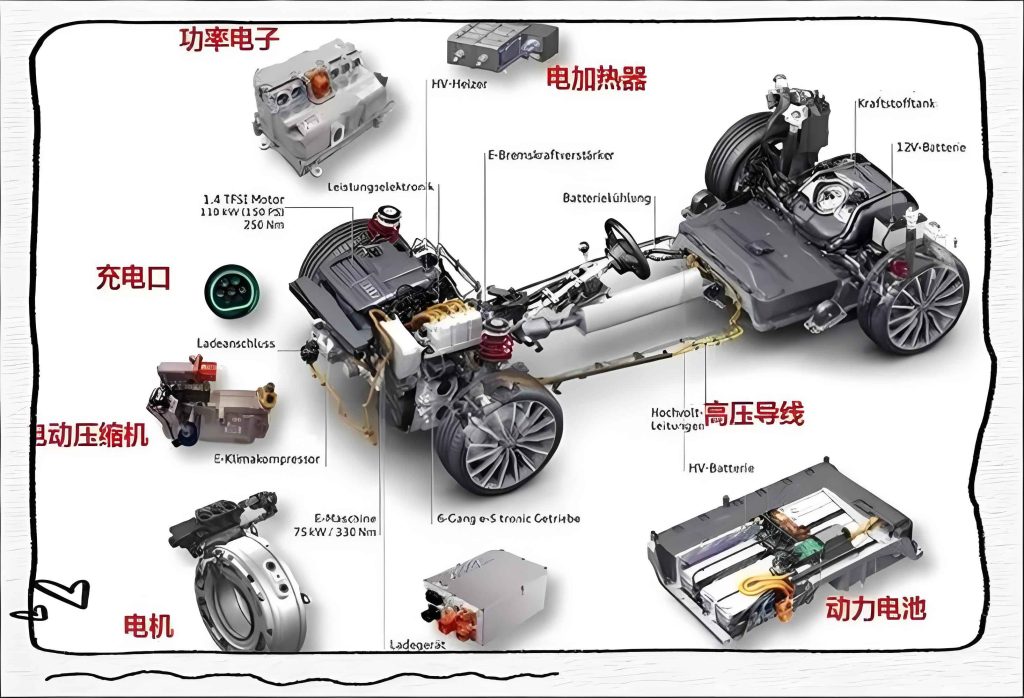
The proliferation of power electronic systems within modern electric vehicles (EVs) creates a highly complex and potentially problematic electromagnetic environment. Ensuring electromagnetic compatibility (EMC) is paramount for the reliable and safe operation of all vehicular subsystems. Among these, the electric drive system, comprising the inverter, motor, controller, and associated high-voltage cabling, is a primary contributor to conducted and radiated emissions due to its high-power, fast-switching operation. The rapid dv/dt and di/dt transients generated during the switching of Insulated Gate Bipolar Transistors (IGBTs) in the inverter are identified as the dominant interference sources. To analyze and mitigate these Electromagnetic Interference (EMI) issues effectively, accurate modeling and simulation are essential. This article details a co-simulation methodology for EMI modeling of an EV electric drive system, integrating the circuit-level precision of Saber with the control-system flexibility of MATLAB/Simulink, and validates the model against experimental measurements.
The core of the electric drive system‘s EMI signature lies in the power inverter. Therefore, creating a behaviorally accurate model of the switching devices, specifically the IGBTs, is the first critical step. A detailed physical model, while precise, is often parameter-intensive and computationally expensive for system-level EMI analysis. A behavioral model, focusing on replicating the static and dynamic switching characteristics, offers a favorable balance between accuracy and simulation efficiency. The equivalent circuit for such an IGBT behavioral model is adopted, featuring key elements like gate resistance, inter-terminal parasitic capacitances, and a voltage-controlled current source. The static parameters are extracted from the device datasheet’s output and transfer characteristic curves. The dynamic behavior is captured through the voltage-dependent junction capacitance curves (Ciss, Coss, Crss). The relationships are given by:
$$
C_{rss} = C_{cg}; \quad C_{oss} = C_{cg} + C_{ce}; \quad C_{iss} = C_{cg} + C_{ge}
$$
where \(C_{cg}\), \(C_{ce}\), and \(C_{ge}\) represent the collector-gate, collector-emitter, and gate-emitter parasitic capacitances, respectively. A double-pulse test circuit is constructed in Saber using a Toshiba MG200Q2YS40 IGBT model with parameters configured from its datasheet. The simulated dynamic switching times—rise time (\(t_r\)), turn-on time (\(t_{on}\)), fall time (\(t_f\)), and turn-off time (\(t_{off}\))—are extracted and show excellent agreement with the datasheet specifications, as summarized in the table below.
| Parameter | Datasheet Value (µs) | Simulation Result (µs) |
|---|---|---|
| Rise Time, \(t_r\) | 0.3 | 0.28 |
| Turn-on Time, \(t_{on}\) | 0.4 | 0.38 |
| Fall Time, \(t_f\) | 0.5 | 0.50 |
| Turn-off Time, \(t_{off}\) | 0.7 | 0.71 |
This validation confirms that the IGBT behavioral model accurately captures the high-frequency switching dynamics crucial for EMI prediction in the electric drive system.
The high-voltage cables connecting the DC-link to the inverter and the inverter to the motor are not ideal conductors; they possess parasitic resistance, inductance, and capacitance that significantly influence the propagation and coupling of EMI noise. A multiconductor transmission line theory is applied to model these cables. For the three-phase shielded motor cables, mutual couplings between phases are neglected due to shielding and physical separation, simplifying the model to three independent single-conductor transmission lines above a reference plane (the shield). The unit-length parameters—Resistance (\(R\)), Inductance (\(L\)), and Capacitance to shield (\(C\))—are calculated analytically and through field simulation.
The DC resistance per unit length is derived from the conductor’s resistivity (\(\rho\)) and cross-sectional area (\(S\)):
$$
R = \rho \frac{1}{S} = \rho \frac{1}{\pi r_1^2}
$$
The inductance per unit length comprises internal inductance (\(L_i\)) and external inductance (\(L_e\)). For a coaxial structure with inner radius \(a = r_1\) and an effective outer radius \(b\) (considering the shield), the total inductance is:
$$
L = L_i + L_e = \frac{\mu_0}{8\pi} + \frac{\mu_0}{2\pi} \ln\left(\frac{b}{a}\right)
$$
The capacitance per unit length between the inner conductor and the shield is determined by solving the electrostatic boundary problem using finite-element methods in software like ANSYS Maxwell. The energy-based formula yields the capacitance:
$$
C = \frac{\int_V \vec{E} \cdot \vec{D} \, dV}{U_1 U_2}
$$
where \(U_1\) and \(U_2\) are the potentials of the conductor and shield, respectively. Based on the physical layout of the test bench, cables of specific lengths are modeled in Saber using lumped RLGC segments. The calculated parameters for the system’s cabling are presented below.
| Parameter | DC Bus Cable (4m) | 3-Phase Cable (per phase, 1m) |
|---|---|---|
| \(R\) (mΩ) | 2.0796 | 0.5199 |
| \(L\) (µH) | 0.47064 | 0.11766 |
| \(C\) (nF) | 3.564 | 0.891 |
These cable models are integrated into the Saber schematic, completing the high-fidelity circuit representation of the inverter bridge and its passive network, which forms the noise-generating and propagating core of the electric drive system.
A complete electric drive system simulation requires not only the power circuit but also the control algorithm that dictates the switching patterns. While Saber excels at detailed circuit simulation, MATLAB/Simulink provides a superior environment for implementing complex control strategies. A co-simulation approach is therefore employed. In Simulink, a field-oriented control (FOC) scheme with Space Vector Pulse Width Modulation (SVPWM) for a Permanent Magnet Synchronous Motor (PMSM) is developed. This is a dual-loop control system: an outer speed loop and an inner current loop. The control law in the synchronous reference frame (d-q) can be summarized as:
Speed Loop:
$$
i_{q,ref} = PI\left(\omega_{ref} – \omega_{m}\right), \quad i_{d,ref} = 0
$$
Current Loop:
$$
\begin{aligned}
v_{d,ref} &= PI\left(i_{d,ref} – i_{d}\right) – \omega_e L_q i_q \\
v_{q,ref} &= PI\left(i_{q,ref} – i_{q}\right) + \omega_e (L_d i_d + \lambda_{pm})
\end{aligned}
$$
where \(\omega_{m}\) is the mechanical rotor speed, \(\omega_e\) is the electrical frequency, \(L_d\) and \(L_q\) are dq-axis inductances, and \(\lambda_{pm}\) is the permanent magnet flux linkage. The calculated reference voltages \(v_{d,ref}\) and \(v_{q,ref}\) are transformed back to the stationary frame and processed by the SVPWM algorithm to generate the six gate signals for the IGBTs. The PMSM is modeled using its standard mathematical equations in Simulink. The Saber co-simulation block acts as an interface, receiving the gate signals from Simulink and returning the measured phase currents and DC-link voltage to close the control loops. This integrated model enables the simulation of the electric drive system under realistic operating conditions, with the Saber side accurately rendering the high-frequency switching phenomena and conducted noise.
To validate the accuracy of the co-simulation model for EMI analysis, its predictions are compared against experimental measurements. The test is conducted following the standard current probe method (similar to GB/T 18655). A current clamp is placed at the inverter’s output to measure the common-mode (CM) current, a key EMI metric. The system is operated at a steady-state condition of 2000 RPM motor speed with a 50 N·m load torque and a 10 kHz SVPWM switching frequency. The simulation is run with a fine time step of 5 ns to capture high-frequency harmonics. The comparison of the CM current spectrum from 150 kHz to 30 MHz is shown in the table below, highlighting the agreement in trend and key resonances.
| Frequency Band | Simulation vs. Experiment Agreement | Notable Observations |
|---|---|---|
| Overall Trend (0-30 MHz) | Excellent | The spectral envelope and major resonant peaks are correctly predicted by the model. |
| Low-Frequency Band (< 10 MHz) | Very Good | Amplitude and frequency of switching harmonics and their sidebands match closely (within ~5 dB). |
| High-Frequency Band (10-30 MHz) | Moderate | Simulation results are generally 10-15 dB lower than measured levels. |
The discrepancies observed, particularly in the higher frequency range, can be attributed to several factors not fully captured in the initial model. First, the motor is represented as an ideal mathematical model in Simulink, lacking a detailed high-frequency equivalent circuit that includes parasitic capacitances (e.g., winding-to-frame capacitance, \(C_{motor}\)). This capacitance provides a critical path for common-mode current to flow to the chassis ground. Second, the experimental setup includes auxiliary equipment like the high-voltage DC power supply, which itself may introduce additional background noise not modeled in the simulation. Despite these limitations, the strong correlation in the overall spectral shape and low-frequency behavior validates the core accuracy of the co-simulation approach for modeling EMI in the electric drive system. The model successfully identifies the primary noise sources (IGBT switching) and the influence of cabling parasitics.
The developed co-simulation framework offers a powerful and practical tool for the EMI analysis and pre-compliance assessment of EV electric drive systems. The integration of Saber and MATLAB/Simulink leverages the respective strengths of each platform, enabling the study of complex control interactions alongside detailed high-frequency circuit phenomena. The validated model can be used to investigate the impact of various design parameters on EMI performance, such as:
- Switching Frequency and Modulation Strategy: Evaluating the spectral impact of changing the PWM frequency or employing alternative modulation techniques like discontinuous PWM or random PWM.
- Filter Design: Virtually prototyping and optimizing EMI filter components (X-capacitors, Y-capacitors, common-mode chokes) at the DC input or motor output of the inverter.
- Layout and Parasitics: Assessing the effect of DC-link busbar design, cable routing, and parasitic inductances/capacitances within the inverter module itself.
- Component Selection: Comparing the EMI signatures of different IGBT or SiC MOSFET modules with varying switching characteristics.
Future improvements to the model would involve enhancing the motor model with a high-frequency lumped-parameter equivalent circuit, incorporating more detailed parasitic elements from the inverter layout (e.g., module and heatsink capacitance), and including models of other system components like the DC-DC converter and battery impedance. Furthermore, extending the co-simulation to include 3D electromagnetic field solvers for critical radiating structures would enable coupled analysis of both conducted and radiated emissions from the electric drive system.
In conclusion, tackling EMI in electric vehicles requires a holistic and simulation-driven approach from the early design stages. The co-simulation methodology presented herein, combining precise circuit modeling with advanced control system simulation, provides a robust foundation for understanding, predicting, and mitigating interference in the critical electric drive system. By accurately modeling the primary noise generation and propagation mechanisms, engineers can make informed design choices to enhance EMC performance, thereby improving the overall reliability and electromagnetic cleanliness of the next generation of electric vehicles.