
As an engineer specializing in electric vehicle powertrains, I have encountered numerous noise, vibration, and harshness (NVH) issues, but the distinct 28th and 56th order whine in certain electric drive units presented a particularly challenging case. The electric drive unit is the core component for power transmission in electric vehicles, and its NVH performance directly impacts user comfort and product quality. In this article, I will detail the comprehensive process of identifying, analyzing, and ultimately solving this specific high-order whine problem. The focus will be on systematic testing, root cause analysis using dimensional inspections and spectral data, and the implementation of production consistency controls. Throughout this discussion, the term “electric drive unit” will be frequently referenced to emphasize its central role in the investigation.
The problem manifested as a pronounced whining noise during operation, which through order analysis was pinpointed to the 28th and 56th orders of the input shaft rotational speed. Given that these orders are integer multiples of the gear meshing frequency in a two-stage reduction gearset, the issue was strongly suspected to originate from gear transmission errors or imperfections. The electric drive unit in question comprised an input shaft, an intermediate shaft, and a differential assembly. The primary objective was to replicate the fault, isolate the responsible component, and identify the precise geometrical deviations causing the excitation.
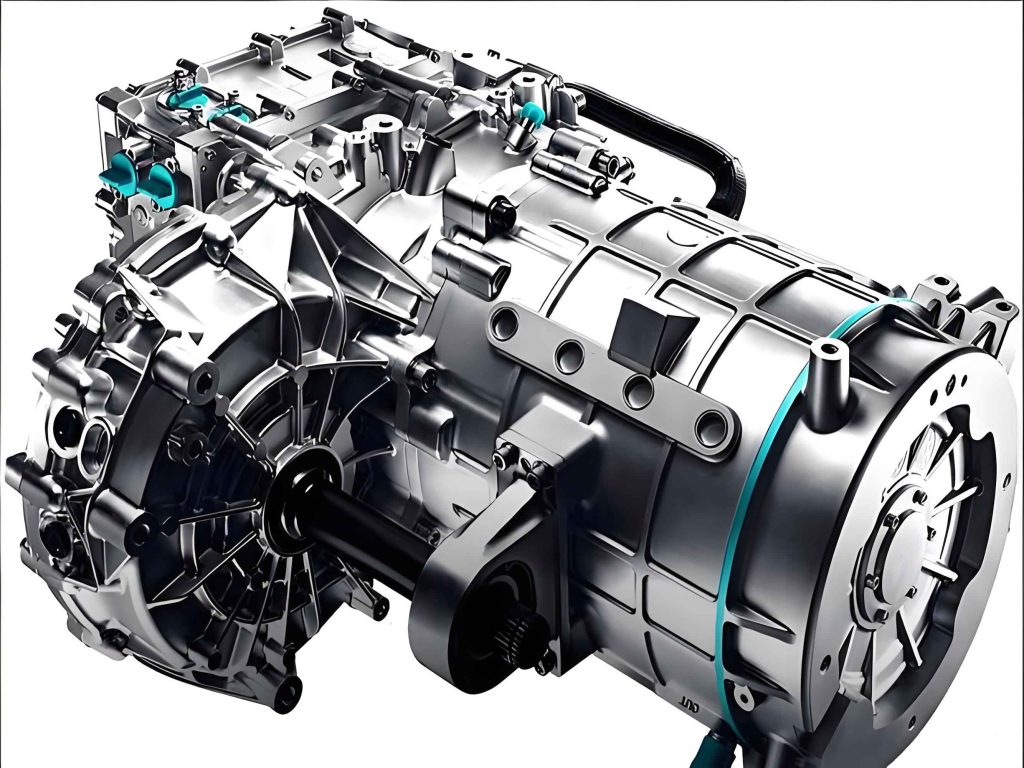
The investigation followed a structured workflow: fault reproduction on a dynamometer, comparative testing between a faulty unit and a known good unit, component swapping to isolate the fault, and finally, detailed metrological inspection of all suspect components. This methodical approach is crucial for diagnosing complex NVH issues in electric drive units.
Test Bench Analysis and Component Isolation
Initial testing was conducted on a NVH dynamometer under maximum torque conditions to replicate the real-world load scenario where the whine was most audible. The sound pressure and vibration data were processed to generate order cut plots and colormaps (order vs. RPM vs. amplitude). Comparing the faulty electric drive unit with a quiet reference unit revealed clear discrepancies.
The order colormap for the reference unit showed a relatively smooth noise floor, whereas the faulty unit exhibited intense, concentrated energy at the 28th and 56th orders across a wide speed range. The order cut plots provided quantitative evidence: the amplitude at the 28th order for the faulty unit was significantly higher, often by several decibels, compared to the reference. The same was true for the 56th order. The relationship between rotational orders and meshing frequency can be described by:
$$ O_{mesh} = Z $$
$$ f_{mesh} = O_{mesh} \times f_{rotation} = Z \times \frac{RPM}{60} $$
Where \( O_{mesh} \) is the meshing order (equal to the number of gear teeth \( Z \)), \( f_{mesh} \) is the meshing frequency in Hz, and \( f_{rotation} \) is the shaft rotational frequency. For a two-stage gear train, the dominant orders are typically the tooth counts of the driving gears. The 28th and 56th orders corresponded precisely to the tooth counts involved in the first and second meshing stages, confirming the gear-related origin.
To isolate the culprit, a component swap test was performed. The intermediate shaft from the faulty electric drive unit was installed into the known-good unit. The whine immediately reappeared in the previously quiet assembly. Subsequently, swapping both the intermediate and input shafts from the faulty unit did not further exacerbate the noise level beyond that caused by the intermediate shaft alone. This critical test pinpointed the intermediate shaft assembly as the primary source of the 28th and 56th order excitation. The input shaft’s contribution was found to be secondary.
Detailed Metrological Inspection of Components
With the intermediate shaft identified as the key contributor, a thorough dimensional and geometrical inspection campaign was launched on all major components of the suspect electric drive unit: the housing, the input shaft gear, and the intermediate shaft gear.
Housing Inspection
The front and rear housings were measured for critical bearing bore dimensions, positional tolerances, perpendicularity, coaxiality of register fits, mounting face flatness, and dowel pin locations. While most dimensions were within specification, a slight out-of-tolerance condition was detected in the positional tolerance of one bearing bore. Although housing misalignment can induce shaft misalignment and exacerbate gear misalignment, the component swap test had already demonstrated that the housing was not the direct cause of the whine. Its contribution was considered a potential amplifier rather than the fundamental exciter. The allowable deviation \( \Delta \) for such positional tolerances is typically defined by:
$$ \Delta = \sqrt{(\Delta_x)^2 + (\Delta_y)^2} $$
where \( \Delta_x \) and \( \Delta_y \) are deviations in orthogonal axes. In our case, the measured \( \Delta \) exceeded the design limit marginally.
Gear and Shaft Inspection
The gear inspection focused on key parameters that directly influence meshing smoothness and noise generation. The results are summarized in the table below.
| Component | Inspection Item | Specification Limit | Measured Value (Faulty Unit) | Judgment |
|---|---|---|---|---|
| Input Shaft | Journal Diameter | φ40.000 ± 0.010 mm | φ40.005 mm | 合格 |
| Radial Runout | ≤ 0.015 mm | 0.012 mm | 合格 | |
| Over Pin Measurement (M值) | 85.350 ± 0.030 mm | 85.345 mm | 合格 | |
| Gear Total Helix Deviation (FHβ) | ≤ 12 μm | 11.8 μm (接近上差) | Marginal | |
| Intermediate Shaft Gear | Over Pin Measurement (M值) | 102.500 ± 0.035 mm | 102.480 mm | 合格 |
| Gear Total Helix Deviation (FHβ) | ≤ 15 μm | 16.2 μm | 超差 | |
| Gear Helix Form Deviation (Cβ) | ≤ 8 μm | 9.1 μm | 超差 |
Beyond the standard gear tolerances, a visual and tactile inspection of the intermediate shaft gear tooth flanks revealed a slight but periodic pattern of indentations. This was not a gross damage but a subtle, regular waviness along the tooth surface. To quantify this, a Fourier analysis of the tooth flank topography was conducted. This analysis breaks down the surface profile into its constituent spatial wavelengths or “orders.” The results were telling:
The intermediate shaft from the faulty electric drive unit showed a pronounced 28th order component in its flank waviness, with an amplitude in the range of 0.11 to 0.12 micrometers. In contrast, the intermediate shaft from the quiet reference unit exhibited the same order waviness at a significantly lower amplitude of 0.07 to 0.08 micrometers. The input shaft gears from both units showed much smaller differences in their Fourier spectra. The relationship between surface waviness of order \( n \) and its amplitude \( A_n \) can be modeled as a periodic error:
$$ E(\theta) = \sum_{n=1}^{\infty} A_n \sin(n\theta + \phi_n) $$
where \( \theta \) is the angular position along the gear and \( \phi_n \) is the phase. The excitation force \( F_{ex} \) due to this transmission error is often proportional to its derivative, making higher-order waviness with sufficient amplitude a potent source of high-frequency noise.
The root cause analysis now became clear. The core issue within the problematic electric drive unit was a combination of factors centered on the intermediate shaft gear:
- Primary Cause: Tooth Flank Topography Defect. The periodic, slight indentations on the intermediate gear tooth flanks acted as a deterministic source of transmission error variation. Every time a tooth with this pattern engaged, it produced a periodic force fluctuation at the frequency corresponding to the 28th order of the intermediate shaft’s rotation (and its harmonic, the 56th order).
- Contributing Cause: Gear Macro-Geometry Errors. The exceeding of the total helix deviation (FHβ) and helix form deviation (Cβ) tolerances on the intermediate gear indicated imperfect lead profile and crowning. This macro-geometry error caused uneven load distribution across the tooth face during meshing, amplifying the impact of the micro-geometry waviness and contributing to the overall whine severity.
- Secondary Cause: Housing and Shaft Alignment. The slight housing bore positional error and the marginal input shaft gear FHβ created sub-optimal alignment conditions. While not the initiators, these factors reduced the system’s tolerance to the primary gear errors, allowing the whine to become audible.
The gear meshing dynamics can be simplified for analysis. The static transmission error \( \epsilon(t) \), a primary excitation, is a function of gear geometry deviations:
$$ \epsilon(t) = f(F_{H\beta}, C_{\beta}, R_a, Waviness) $$
The resulting dynamic force \( F_d(t) \) is related to the system’s dynamic stiffness \( k_d \) and damping \( c \):
$$ F_d(t) = k_d \cdot \epsilon(t) + c \cdot \frac{d\epsilon(t)}{dt} $$
The sound pressure \( p(t) \) radiated is proportional to the acceleration of the housing surfaces, which is driven by \( F_d(t) \).
Implementation of Corrective Actions and Validation
Having identified the root causes, the solution focused on ensuring production consistency to eliminate these specific deviations in future electric drive units. The corrective actions targeted both the manufacturing process for the housing and the gear grinding process.
| Problem Category | Root Cause Identified | Corrective and Preventive Action | Expected Outcome |
|---|---|---|---|
| Housing Dimensional Error | Use of manual fixtures without torque control, leading to inconsistent clamping and machining drift. | Replace all manual fixtures with hydraulic clamping fixtures featuring precise, repeatable torque control. | Eliminate positional tolerance drift; improve bore location consistency. |
| Gear Parameter Deviation & Flank Defect | Insufficient accuracy and stability of the prototype gear grinding equipment (a form grinding machine), coupled with a lack of in-process monitoring for surface waviness. | 1. Replace the form grinding machine with a high-precision CNC worm gear grinding machine (e.g., Mitsubishi series). 2. Implement mandatory 100% Fourier analysis (FFT) of tooth flank topography for critical gears, with strict limits on amplitudes at specific orders (e.g., 28th order). 3. Tighten the acceptance criteria for FHβ and Cβ, shifting the target to the mid-point of the tolerance band. |
Eliminate periodic flank waviness; ensure macro-geometry parameters are consistently within the central 50% of the tolerance zone. |
The effectiveness of these measures was rigorously validated. A batch of electric drive units manufactured under the new controls was subjected to the same NVH dynamometer test protocol. The results were definitive: the pronounced 28th and 56th order whine was absent. To ensure statistical significance, a continuous production run of 50 units was monitored, and a sample of 10 units was randomly selected for full NVH testing. All sampled units passed the noise criteria. Furthermore, dimensional qualification rates for the housing and gear components improved from approximately 92% to 100%. The process capability indices (Cpk) for key parameters showed marked improvement. For a critical dimension \( X \) with upper and lower limits (USL, LSL), Cpk is calculated as:
$$ C_{pk} = \min \left( \frac{USL – \mu}{3\sigma}, \frac{\mu – LSL}{3\sigma} \right) $$
where \( \mu \) is the process mean and \( \sigma \) is the process standard deviation. Post-improvement data showed Cpk values consistently above 1.67, indicating a highly capable process.
Conclusion and Broader Implications
This investigation into the 28th and 56th order whine in an electric drive unit yielded clear and actionable conclusions. First and foremost, the core root cause was traced to a specific micro-geometrical defect on the intermediate shaft gear tooth flanks—a periodic, low-amplitude waviness—compounded by macro-geometrical errors in helix deviation. The housing inaccuracies played a secondary, aggravating role. Secondly, the problem was decisively resolved not by a design change, but by implementing stringent production process controls. Upgrading machining fixtures and adopting a superior, more stable gear grinding process, coupled with enhanced in-process metrology (like flank FFT analysis), ensured consistent component quality.
This case study underscores several critical principles for NVH management in electric drive units. First, a systematic, data-driven approach combining NVH testing, component isolation, and precise metrology is essential for accurate diagnosis. Second, high-order whines are often sensitive to very subtle geometrical imperfections that may be within traditional tolerance bands but are detrimental to acoustic performance. Therefore, statistical process control and advanced surface finish analysis become indispensable tools. Finally, the pursuit of excellence in electric drive unit NVH is an ongoing effort that hinges on manufacturing precision and consistency. As the demand for quieter electric vehicles grows, the lessons learned from resolving such specific order-related issues will continue to inform best practices in the design, production, and validation of these critical powertrain components. The successful resolution of this whine not only improved the immediate product but also strengthened the overall quality assurance framework for future generations of electric drive units.