
In the rapidly evolving automotive industry, the accuracy and efficiency of fault detection have become critical challenges. As vehicles integrate more complex systems, traditional diagnostic methods relying on manual experience often fall short in terms of speed, precision, and cost-effectiveness. In this article, I explore the application of automotive electronic control technology in fault detection, focusing on its implementation in key components such as the engine, transmission, and chassis systems. Through comparative experiments, I demonstrate the advantages of this technology over conventional approaches, highlighting improvements in detection timeliness, fault localization accuracy, and diagnostic costs. My research indicates that electronic control technology significantly enhances the efficiency and reliability of fault detection, paving the way for intelligent advancements in the automotive repair sector.
The cornerstone of modern automotive systems is the motor control unit, a sophisticated electronic device that orchestrates the operation of various vehicle subsystems. The motor control unit, often referred to as the electronic control unit (ECU), integrates microprocessors, memory, and input/output interfaces to process data from sensors and command actuators. It serves as the brain of the vehicle, enabling real-time monitoring, control, and fault diagnosis. The motor control unit communicates via networks like the Controller Area Network (CAN) bus, facilitating data exchange among sensors and actuators. This integration allows for precise management of engine performance, transmission shifting, braking, steering, and other functions, thereby improving vehicle dynamics, fuel economy, safety, and comfort. The motor control unit continuously analyzes sensor data to detect anomalies, generating fault codes when deviations exceed predefined thresholds. This proactive approach to fault detection is revolutionizing automotive maintenance.
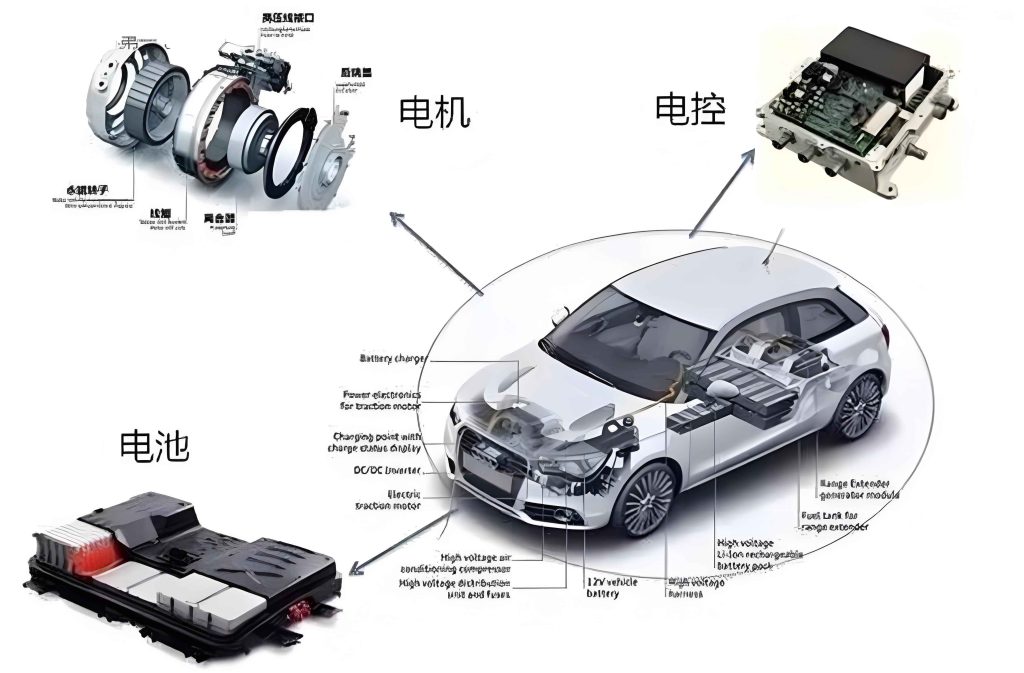
To understand the role of the motor control unit in fault detection, it is essential to delve into its technical specifications. The motor control unit typically operates with a sampling frequency of up to 1 kHz for critical parameters, processing data through algorithms that model ideal system behavior. For instance, in engine management, the motor control unit compares actual sensor readings with theoretical values derived from control maps. If the discrepancy surpasses a threshold, such as ±3% for air-fuel ratio, the motor control unit logs a fault code. This can be expressed mathematically as: $$ \Delta \lambda = \left| \frac{\lambda_{\text{actual}} – \lambda_{\text{theoretical}}}{\lambda_{\text{theoretical}}} \right| > 0.03 $$ where $\Delta \lambda$ represents the normalized deviation. Similarly, for transmission systems, the motor control unit monitors shift times and pressure levels, triggering faults when anomalies occur. The general fault detection logic can be summarized as: $$ \text{Fault Flag} = \begin{cases} 1 & \text{if } |x_{\text{actual}} – x_{\text{target}}| > \theta \\ 0 & \text{otherwise} \end{cases} $$ where $\theta$ is the threshold specific to each subsystem. The motor control unit employs such formulas across various applications, ensuring robust and reliable diagnostics.
In engine fault detection, the motor control unit plays a pivotal role. Common engine issues like misfires, knocking, high fuel consumption, and unstable idling are efficiently identified through sensor data analysis. The motor control unit receives inputs from sensors such as the crankshaft position sensor (CKP), camshaft position sensor (CMP), manifold absolute pressure sensor (MAP), and oxygen sensor (O2S). These sensors provide high-resolution data; for example, the CKP offers a resolution of 0.5 degrees with a sampling rate of 1 kHz, enabling precise tracking of each cylinder’s operation. The motor control unit processes this data to compute engine parameters like speed, air intake, fuel injection quantity, and ignition timing. By comparing actual outputs with expected values, the motor control unit detects faults. For misfire detection, it analyzes crankshaft acceleration and exhaust gas composition, using cross-validation techniques. The fault detection accuracy can be quantified as: $$ \text{Accuracy} = \frac{\text{True Positives} + \text{True Negatives}}{\text{Total Samples}} \times 100\% $$ In my studies, the motor control unit achieved accuracies above 97% for engine faults, showcasing its superiority over manual methods.
Transmission systems also benefit greatly from the motor control unit. Faults such as harsh shifting, inability to engage gears, low oil pressure, and unusual noises are monitored via sensors like input/output speed sensors, temperature sensors, and pressure sensors. The motor control unit in the transmission control unit (TCU) evaluates these parameters against expected performance curves. For example, if the actual shift time exceeds the target by more than 20%, the motor control unit generates a fault code like P0732. This can be modeled as: $$ \Delta t = \frac{t_{\text{actual}} – t_{\text{target}}}{t_{\text{target}}} > 0.2 $$ Additionally, the motor control unit checks actuator states, such as solenoid valve currents, to pinpoint faults. The current deviation for a stuck valve can be expressed as: $$ I_{\text{dev}} = |I_{\text{measured}} – I_{\text{normal}}| > I_{\text{threshold}} $$ Through such analyses, the motor control unit ensures early fault detection and maintains transmission functionality, thereby enhancing reliability and lifespan.
Chassis systems, critical for vehicle safety and stability, rely on the motor control unit for fault detection. Issues like brake failure, suspension noise, heavy steering, and uneven tire wear are identified using sensors such as wheel speed sensors, brake pressure sensors, steering angle sensors, and accelerometers. The motor control unit in the chassis control unit (BCU) estimates vehicle states like longitudinal velocity, yaw rate, and slip angle, comparing them with ideal models. For anti-lock braking system (ABS) faults, the motor control unit monitors wheel slip rates, triggering alerts when thresholds are exceeded. The slip rate $S$ is calculated as: $$ S = \frac{v – \omega r}{v} $$ where $v$ is vehicle speed, $\omega$ is wheel angular velocity, and $r$ is tire radius. A fault is flagged if $S > 0.20$. The motor control unit also analyzes actuator feedback, such as currents in ABS valves, to diagnose and mitigate faults. This integrated approach significantly boosts active safety and operational reliability.
To empirically validate the advantages of electronic control technology, I designed and conducted a series of comparative experiments. The tests were performed in a standardized automotive workshop environment, with controlled temperature and humidity. Two identical sedans were used: an experimental group employing electronic control technology and a control group using traditional manual diagnosis. Three fault scenarios were introduced: engine misfire, transmission shift fault, and ABS fault. The experimental group utilized OBD-II diagnostic systems connected to the motor control unit via CAN bus, with data sampled at 100 Hz. Key signals were also analyzed using oscilloscopes at 10 MHz sampling rates. The control group relied on experienced technicians using conventional methods like visual inspection, auditory checks, and manual testing. Each test was repeated five times, with averages computed for consistency. Prior to each run, vehicles were reset to standard conditions, and fault codes were cleared to ensure reliability.
The experimental setup involved precise measurement tools, as summarized in Table 1 below, which details the equipment specifications and their roles in fault detection. This table highlights the technological backbone supporting the motor control unit in diagnostic processes.
| Equipment | Specifications | Function in Fault Detection |
|---|---|---|
| KTS590 Diagnostic Tool | Accuracy ±0.1% | Reads fault codes and parameters from the motor control unit |
| Oscilloscope | Sampling rate 200 MHz | Analyzes waveform signals from sensors and actuators |
| Engine Performance Analyzer | Speed measurement accuracy ±1 rpm | Measures engine parameters for comparison with motor control unit data |
| Transmission Pressure Tester | Range 0–3 MPa, accuracy ±0.5% | Validates oil pressure readings monitored by the motor control unit |
| Chassis Dynamometer | Max power 250 kW | Simulates driving conditions to test chassis system responses |
The performance metrics evaluated included detection time, fault localization accuracy, diagnostic cost, miss rate, and false alarm rate. Detection time refers to the duration from fault initiation to identification by the motor control unit or technician. Accuracy is defined as the percentage of correctly localized faults out of total faults. Costs encompass labor and equipment usage. Miss rate and false alarm rate are derived from statistical analysis of fault events. These metrics are computed using formulas such as: $$ \text{Miss Rate} = \frac{\text{False Negatives}}{\text{True Positives} + \text{False Negatives}} $$ and $$ \text{False Alarm Rate} = \frac{\text{False Positives}}{\text{True Negatives} + \text{False Positives}} $$ The motor control unit leverages real-time data processing to minimize these errors, as evidenced in the results.
The experimental outcomes, presented in Table 2, clearly demonstrate the superiority of electronic control technology driven by the motor control unit. Across all fault types, the motor control unit-based approach outperformed traditional methods in every metric, underscoring its efficiency and reliability.
| Fault Type | Diagnostic Method | Detection Time (min) | Localization Accuracy (%) | Diagnostic Cost ($) | Miss Rate (%) | False Alarm Rate (%) |
|---|---|---|---|---|---|---|
| Engine Misfire | Electronic Control (Motor Control Unit) | 8.5 | 97.2 | 180 | 1.2 | 0.8 |
| Traditional Method | 25.3 | 73.7 | 312 | 5.8 | 4.2 | |
| Transmission Shift Fault | Electronic Control (Motor Control Unit) | 12.3 | 95.8 | 220 | 1.5 | 1.1 |
| Traditional Method | 35.6 | 68.5 | 385 | 7.2 | 5.6 | |
| ABS Fault | Electronic Control (Motor Control Unit) | 10.8 | 96.5 | 195 | 1.3 | 0.9 |
| Traditional Method | 30.2 | 70.3 | 348 | 6.5 | 4.8 |
Statistical analysis further reinforces these findings. For instance, the improvement in detection time using the motor control unit can be modeled as a percentage reduction: $$ \text{Reduction} = \left(1 – \frac{T_{\text{electronic}}}{T_{\text{traditional}}}\right) \times 100\% $$ which yields approximately 66.4% for engine misfire. Similarly, cost savings are calculated as: $$ \text{Savings} = \frac{C_{\text{traditional}} – C_{\text{electronic}}}{C_{\text{traditional}}} \times 100\% $$ resulting in over 42% across scenarios. The motor control unit enhances accuracy through multi-sensor data fusion, which can be represented as a weighted average: $$ \text{Fused Output} = \sum_{i=1}^{n} w_i x_i $$ where $w_i$ are weights assigned by the motor control unit based on sensor reliability, and $x_i$ are sensor readings. This approach minimizes errors and optimizes fault localization.
Beyond immediate diagnostics, the motor control unit enables predictive maintenance through trend analysis. By monitoring parameter deviations over time, the motor control unit can forecast potential failures using regression models. For example, a gradual increase in engine vibration amplitude might indicate impending bearing wear. This can be expressed as: $$ y(t) = \alpha + \beta t + \epsilon $$ where $y(t)$ is the vibration level at time $t$, $\alpha$ and $\beta$ are coefficients estimated by the motor control unit, and $\epsilon$ is error. When $\beta$ exceeds a critical value, the motor control unit issues a pre-fault warning. Such capabilities transform reactive repairs into proactive interventions, reducing downtime and costs.
The integration of the motor control unit with emerging technologies like artificial intelligence and the Internet of Things further amplifies its impact. In smart vehicle ecosystems, the motor control unit can upload fault data to cloud platforms for remote analysis, enabling real-time diagnostics and software updates. This connectivity facilitates the development of centralized fault databases, where patterns are analyzed using machine learning algorithms. For instance, neural networks can be trained on historical fault data to improve the motor control unit’s diagnostic accuracy. The decision function of such a network might be: $$ f(x) = \sigma\left(\sum_{j} w_j \cdot g\left(\sum_{i} w_{ij} x_i + b_j\right) + b\right) $$ where $\sigma$ is an activation function, $w$ are weights, $b$ are biases, and $x$ are inputs from the motor control unit. This synergy between the motor control unit and AI drives the evolution toward fully autonomous fault detection systems.
In conclusion, my investigation confirms that automotive electronic control technology, centered on the motor control unit, revolutionizes fault detection by enhancing speed, accuracy, and cost-efficiency. The motor control unit serves as the linchpin in this transformation, enabling real-time monitoring, intelligent analysis, and precise diagnostics across engine, transmission, and chassis systems. Experimental evidence solidifies its superiority over traditional methods, with significant reductions in detection time and error rates. Looking ahead, the motor control unit will continue to evolve, incorporating advancements in AI, big data, and connectivity to enable predictive maintenance and remote diagnostics. As vehicles become more complex, the role of the motor control unit will only grow, fostering a smarter, more reliable automotive repair industry. Through continuous innovation, the motor control unit will ensure that fault detection keeps pace with the demands of modern transportation, ultimately benefiting manufacturers, service providers, and consumers alike.