
In the context of global efforts to reduce carbon emissions and promote sustainable agriculture, the development of electric agricultural machinery has become a critical focus. As a researcher involved in this field, I aim to present a comprehensive study on the design and testing of an electric drive system specifically tailored for tractors used in greenhouse environments. This system prioritizes low cost, high efficiency, and high torque output to meet the demanding operational requirements of tasks such as plowing, rotary tillage, seeding, and transportation within confined大棚 spaces. The core of this work involves applying vector control techniques to a permanent magnet brushless DC motor (BLDCM), which serves as the driving unit. Throughout this article, I will delve into the theoretical analysis, simulation, and experimental validation of this electric drive system, emphasizing its applicability and performance in real-world scenarios.
The motivation behind this research stems from the growing need for mechanization in greenhouse farming, where labor shortages and environmental concerns are pressing issues. Traditional燃油 tractors are unsuitable due to emissions and operational constraints, making electric tractors an ideal alternative. However, the electric drive system for such tractors must overcome challenges like high overload capacity, cost sensitivity, and reliability under heavy loads. In this study, I address these by proposing a four-wheel drive configuration using轮毂-mounted BLDCMs controlled via space vector pulse width modulation (SVPWM). This approach not only enhances traction and stability but also eliminates the need for complex transmission systems, thereby reducing costs and improving overall efficiency.
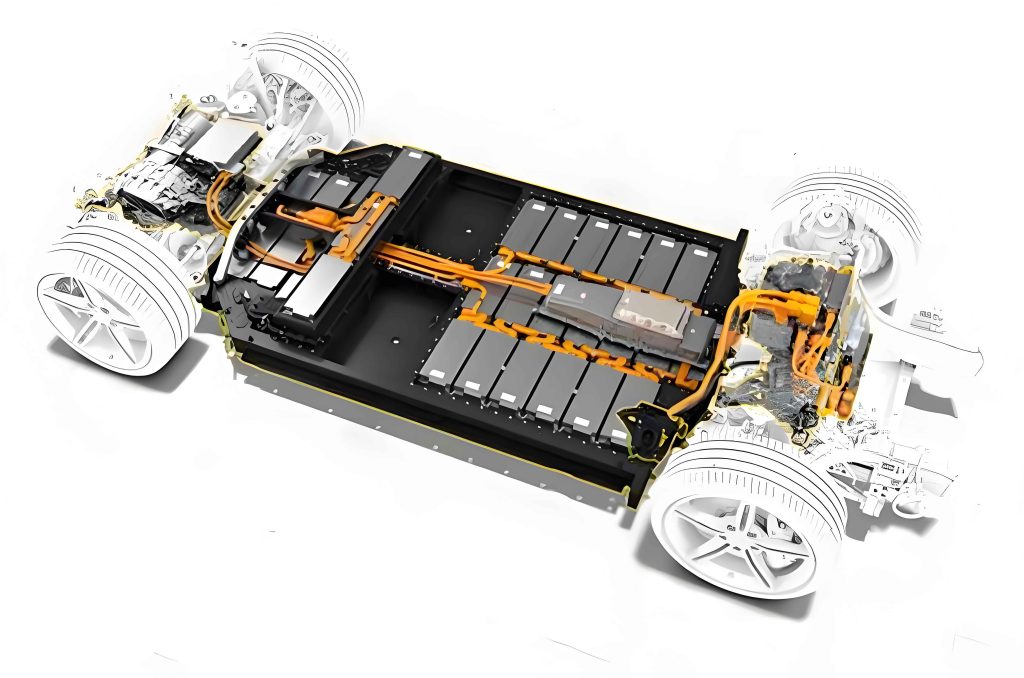
To begin, I analyze the dynamic performance requirements of the electric tractor under typical greenhouse operations. The primary forces involved include traction force, rolling resistance, and耕作 resistance. For a four-wheel drive tractor, the total驱动力 $F$ can be expressed as:
$$F = F_X + (1 + 20\%) F_L$$
where $F_X$ is the horizontal traction force needed for movement, and $F_L$ is the average耕作 resistance. The force $F_X$ is derived from the sum of forces on all wheels, considering factors like牵引阻力 and rolling resistance. For instance, the torque $T_{c1}$ for one rear wheel motor is given by:
$$T_{c1} = \frac{k_{c1} F R}{i \eta_{c1}}$$
Here, $k_{c1}$ is a torque distribution factor determined by the overall control algorithm, $R$ is the tire radius, $i$ is the传动比 (assumed as 1 for direct drive), and $\eta_{c1}$ is the传动 efficiency. This analysis helps in sizing the electric drive system components to ensure sufficient torque and power for various tasks.
Next, I develop the mathematical model of the BLDCM used in this electric drive system. The motor is modeled in the two-phase rotating coordinate system to facilitate SVPWM implementation. The voltage equations in the three-phase stationary frame are:
$$
\begin{bmatrix}
u_A \\
u_B \\
u_C
\end{bmatrix}
=
\begin{bmatrix}
R & 0 & 0 \\
0 & R & 0 \\
0 & 0 & R
\end{bmatrix}
\begin{bmatrix}
i_A \\
i_B \\
i_C
\end{bmatrix}
+
\frac{d}{dt}
\begin{bmatrix}
L_s – L_M & 0 & 0 \\
0 & L_s – L_M & 0 \\
0 & 0 & L_s – L_M
\end{bmatrix}
\begin{bmatrix}
i_A \\
i_B \\
i_C
\end{bmatrix}
+
\begin{bmatrix}
e_A \\
e_B \\
e_C
\end{bmatrix}
$$
where $R$ is the phase resistance, $L_s$ is the stator self-inductance, $L_M$ is the mutual inductance, and $e_A$, $e_B$, $e_C$ are the back-EMFs. The back-EMF for phase A, for example, is $e_A = \omega_r \psi_m f_A(\theta)$, with $\omega_r$ as the electrical angular velocity, $\psi_m$ as the永磁 flux linkage, and $f_A(\theta)$ as a trapezoidal function. Using Clarke and Park transformations, the equations are converted to the rotating frame:
$$
\begin{bmatrix}
u_d \\
u_q
\end{bmatrix}
=
\begin{bmatrix}
R i_d \\
R i_q
\end{bmatrix}
+
\begin{bmatrix}
L \frac{di_d}{dt} \\
L \frac{di_q}{dt}
\end{bmatrix}
+ M_p M_c
\begin{bmatrix}
e_A \\
e_B \\
e_C
\end{bmatrix}
$$
and the currents are transformed as:
$$
\begin{bmatrix}
i_d \\
i_q
\end{bmatrix}
= M_p M_c
\begin{bmatrix}
i_A \\
i_B \\
i_C
\end{bmatrix}
$$
where $M_p$ and $M_c$ are the Park and Clarke transformation matrices, respectively. The electromagnetic torque $T_e$ is calculated as:
$$T_e = \frac{e_a i_a + e_b i_b + e_c i_c}{\Omega}$$
with $\Omega$ being the mechanical angular velocity. This model forms the basis for designing the control strategy in the electric drive system.
The control methodology for the electric drive system employs a vector control approach with SVPWM. The system structure includes速度 and current loops, with the goal of maintaining $i_d = 0$ to maximize torque output. The block diagram illustrates how the speed reference $n^*$ is compared to the feedback $n$, processed through a PI controller to generate the torque current reference $i_q^*$. Similarly, the $i_d^*$ is set to zero. After PI regulation, the voltage components $u_d$ and $u_q$ are obtained, transformed back to the stationary frame, and used by the SVPWM module to generate PWM signals for the inverter. This method reduces谐波 and improves voltage utilization, crucial for the efficiency of the electric drive system.
For the four-wheel drive configuration, each wheel is equipped with an独立 BLDCM and controller, forming four independent electric drive systems. This setup allows for智能 torque distribution based on real-time conditions, enhancing traction and stability. The absence of transmissions lowers成本 and increases reliability. Key parameters of the motor used in this study are summarized in Table 1.
| Parameter | Symbol | Value | Unit |
|---|---|---|---|
| Rated Voltage | $U_N$ | 50 | V |
| Rated Speed | $n_N$ | 450 | r/min |
| Rated Power | $P_N$ | 350 | W |
| Phase Resistance | $R$ | 0.85 | Ω |
| Pole Pairs | $P$ | 23 | – |
| Back-EMF Coefficient | $K_e$ | 0.062 | V/(rad/s) |
| Moment of Inertia | $J$ | 1.6 × 10^{-5} | kg·m² |
Simulation of the vector control system was conducted in Matlab/Simulink to validate the design. The model included the BLDCM plant, coordinate变换 modules, PI controllers, and SVPWM generator. Under a speed reference of 500 r/min and a load torque step from 1 N·m to 2 N·m at 0.2 s, the results showed fast response and low torque ripple. The三相 currents exhibited near-sinusoidal waveforms with 120° phase shifts, and the $i_d$ and $i_q$ components behaved as expected, with $i_d$ around zero. These simulations confirmed the stability and dynamic performance of the electric drive system.
To further evaluate the electric drive system, an experimental platform was built using an STM32F103 microcontroller as the核心. The setup included the BLDCM, inverter, sensors, and a dynamometer for load testing. Key waveforms recorded during steady-state operation are shown in Table 2, highlighting the system’s performance.
| Waveform/Metric | Description | Observation |
|---|---|---|
| Three-phase Currents | Sinusoidal, 120° apart | Low harmonic distortion, smooth operation |
| Hall Signals vs. Phase Currents | Synchronized with current commutation | Accurate rotor position detection |
| Efficiency vs. Load | Measured at various torque levels | Peak efficiency >85% at 400-460 r/min |
| Maximum Torque | Under current limiting (30 A) | Approximately 85 N·m at stall |
The efficiency curve, plotted against speed and torque, revealed that the electric drive system achieves maximum efficiency above 85% in the range of 400-460 r/min, which corresponds to the typical operating conditions for greenhouse tractors during heavy-load tasks. This high efficiency is attributed to the SVPWM control and direct-drive configuration, minimizing energy losses. Moreover, the system demonstrated strong overload capacity, with a maximum output torque of 85 N·m when current-limited to 30 A. This capability ensures that the tractor can handle sudden load changes and difficult terrain within greenhouses.
In practical application, the four-wheel drive electric tractor equipped with this electric drive system exhibits several advantages. Firstly, its动力性 is enhanced by the独立 torque control of each wheel, allowing for optimal traction during plowing or运输. Secondly, the经济性 benefits from the low-cost BLDCMs and elimination of transmissions, reducing both initial investment and operational costs. Thirdly, the安全性 is improved through robust motor design and防尘防水 features, suitable for harsh agricultural environments. Lastly, the稳定性 is confirmed by the smooth current waveforms and reliable control under varying loads. These attributes make the electric drive system ideal for推广 in greenhouse farming.
From a broader perspective, the integration of such an electric drive system into agricultural machinery aligns with global trends towards electrification and sustainability. The use of BLDCMs with advanced control algorithms not only reduces carbon footprints but also enhances operational precision. Future work could focus on integrating智能 sensors and IoT technologies for autonomous operation in greenhouses. Additionally, optimizing the torque distribution algorithms for different crops and soil conditions could further improve the adaptability of the electric drive system.
In conclusion, this study successfully designs and tests an electric drive system for greenhouse tractors, leveraging vector-controlled BLDCMs to achieve high efficiency and torque. The analysis of tractor dynamics, motor modeling, and control策略 provides a solid foundation for implementation. Experimental results validate the system’s performance, with peak efficiency exceeding 85% and robust overload capacity. By enabling cost-effective and eco-friendly mechanization, this electric drive system has the potential to revolutionize greenhouse agriculture, contributing to food security and environmental goals. As research progresses, continued refinement of the electric drive system will undoubtedly unlock new possibilities for smart farming.