
In recent years, the global energy crisis and environmental pollution have intensified, driving the rapid development of new energy technologies. Among these, the electric vehicle car stands out as a key solution due to its zero emissions and low energy consumption. As a critical component of an electric vehicle car, the battery’s performance and safety directly impact the overall vehicle reliability. During charging and discharging processes, batteries generate significant heat from chemical reactions. If not dissipated effectively, this heat accumulation can lead to temperature rise, affecting efficiency, cycle life, and even causing thermal runaway risks. Therefore, the battery thermal management system (BTMS) is essential for ensuring optimal operation. This article focuses on the fluid-solid coupling heat transfer characteristics and optimization design of BTMS for electric vehicle car batteries. I will explore heat generation mechanisms, analyze coupling phenomena, and propose strategies to enhance system efficiency, ultimately contributing to the advancement of electric vehicle car technology.
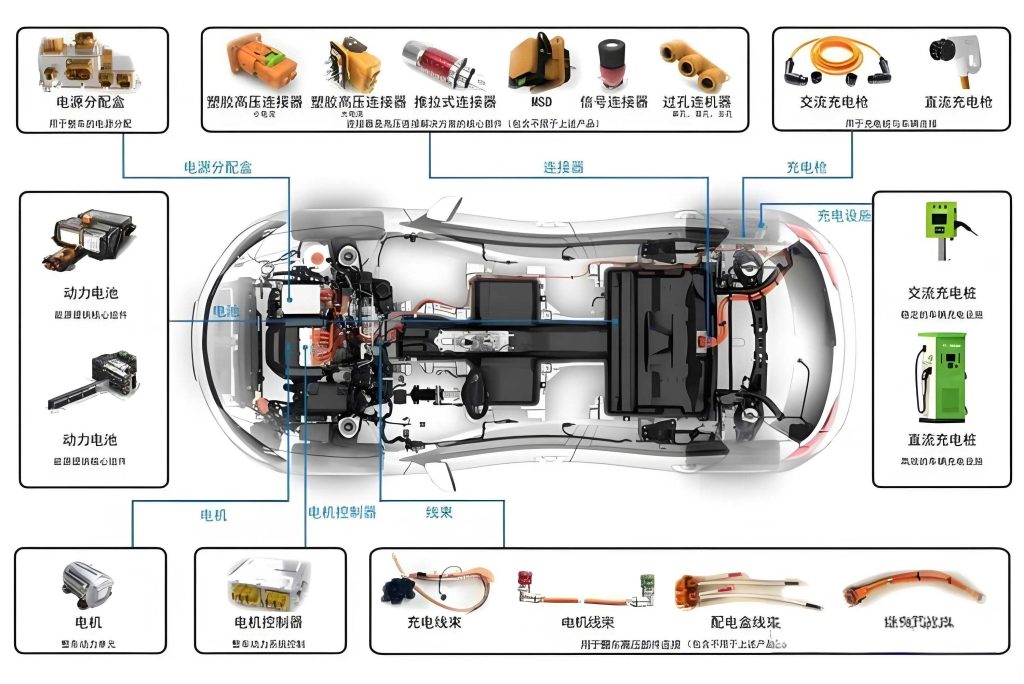
The importance of battery thermal management cannot be overstated for electric vehicle car applications. Battery performance is closely tied to temperature. In optimal temperature ranges, batteries achieve peak efficiency and longevity. For instance, low temperatures slow down electrochemical reactions, reducing charge-discharge efficiency and capacity—a common issue in winter that shortens the driving range of an electric vehicle car. Conversely, high temperatures accelerate side reactions, leading to faster aging and potential safety hazards like fires or explosions. Existing thermal management systems often rely on simple air or liquid cooling, but these methods may suffer from low cooling efficiency, especially under high-power conditions. Moreover, uneven temperature distribution within battery packs can cause localized hotspots, further degrading performance. To address these challenges, studying fluid-solid coupling heat transfer is necessary. This involves heat transfer between solid battery structures (e.g., electrodes, electrolytes) and cooling fluids (e.g., air, coolant). By optimizing this coupling, we can improve heat dissipation, reduce energy consumption, and enhance the safety of electric vehicle car batteries.
First, let’s delve into the heat generation and transfer within battery solid structures. During operation, electrochemical reactions in electrodes produce heat. For example, lithium-ion intercalation and deintercalation involve lattice changes and chemical bond transformations that release energy. The heat generation rate can be modeled using equations based on electrochemical kinetics. A common formula for volumetric heat generation $q”’$ in a battery cell is:
$$ q”’ = I \left( E_{\text{ocv}} – V \right) – I T \frac{dE_{\text{ocv}}}{dT} $$
where $I$ is the current, $E_{\text{ocv}}$ is the open-circuit voltage, $V$ is the terminal voltage, and $T$ is temperature. This heat conducts through solid components like electrodes and separators, governed by Fourier’s law of heat conduction:
$$ \mathbf{q} = -k \nabla T $$
Here, $\mathbf{q}$ is the heat flux vector, $k$ is the thermal conductivity, and $\nabla T$ is the temperature gradient. Due to complex internal structures, thermal conductivity varies across battery regions, leading to non-uniform temperature distributions. This is a key concern in electric vehicle car batteries, as it affects overall pack performance. To summarize heat generation factors, consider Table 1.
| Source | Description | Impact on Temperature |
|---|---|---|
| Electrochemical Reactions | Lithium-ion movement in electrodes | High heat during high-rate charging |
| Ohmic Losses | Resistance in materials and interfaces | Proportional to current squared |
| Side Reactions | Parasitic processes at high temperatures | Accelerates aging and heat buildup |
| Environmental Factors | Ambient temperature fluctuations | Affects heat dissipation rate |
Next, the cooling medium’s flow and heat transfer characteristics are crucial. In air-cooled systems, air acts as the fluid, with its velocity and direction influencing convection. The convective heat transfer is described by Newton’s law of cooling:
$$ q = h A (T_s – T_f) $$
where $q$ is the heat transfer rate, $h$ is the convective heat transfer coefficient, $A$ is the surface area, $T_s$ is the solid surface temperature, and $T_f$ is the fluid temperature. For liquid cooling, coolants like water or ethylene glycol mixtures offer higher heat capacity and conductivity. The effectiveness depends on fluid properties, which I compare in Table 2.
| Cooling Medium | Thermal Conductivity (W/m·K) | Specific Heat Capacity (J/kg·K) | Viscosity (Pa·s) | Suitability for Electric Vehicle Car |
|---|---|---|---|---|
| Air | 0.026 | 1005 | 1.8e-5 | Low-cost, but inefficient for high power |
| Water | 0.6 | 4180 | 1.0e-3 | High cooling capacity, but freezes at low temps |
| Ethylene Glycol Mixture (50%) | 0.4 | 3500 | 3.5e-3 | Good balance, anti-freeze properties |
| Dielectric Fluids | 0.1-0.2 | 2000-2500 | 5.0e-3 | Safe for direct contact, but lower performance |
Fluid-solid coupling interfaces are where heat exchange occurs between solids and fluids. The efficiency depends on factors like surface roughness, contact pressure, and wettability. The coupled heat transfer can be modeled using continuity equations. For instance, the energy equation for a fluid domain in a cooling channel is:
$$ \rho_f c_{p,f} \left( \frac{\partial T_f}{\partial t} + \mathbf{u} \cdot \nabla T_f \right) = \nabla \cdot (k_f \nabla T_f) $$
where $\rho_f$ is fluid density, $c_{p,f}$ is specific heat, $\mathbf{u}$ is velocity vector, and $k_f$ is fluid thermal conductivity. At the interface, matching conditions ensure heat flux continuity: $k_s \frac{\partial T_s}{\partial n} = k_f \frac{\partial T_f}{\partial n}$, with $n$ being the normal direction. Optimizing this interface is vital for electric vehicle car batteries to minimize thermal resistance.
Under different operating conditions, fluid-solid coupling characteristics vary significantly. For example, during rapid acceleration of an electric vehicle car, high discharge rates increase heat generation, demanding faster cooling. Environmental temperatures also play a role; in hot climates, the temperature difference between battery and coolant shrinks, reducing heat transfer driving force. To analyze this, consider dimensionless numbers like the Nusselt number $Nu = \frac{h L}{k}$, which correlates convection intensity, and the Reynolds number $Re = \frac{\rho u L}{\mu}$, indicating flow regime. Studies show that for an electric vehicle car battery pack, $Nu$ can increase with $Re$, but excessive flow may cause pressure drops. A balance is needed for efficient thermal management.
Now, let’s move to optimization design strategies. Cooling channel structure optimization is a primary approach. In liquid-cooled systems, channel layout affects flow distribution and heat exchange. Common designs include serpentine, parallel, and hybrid channels. The pressure drop $\Delta P$ in a channel can be estimated using the Darcy-Weisbach equation:
$$ \Delta P = f \frac{L}{D} \frac{\rho u^2}{2} $$
where $f$ is the friction factor, $L$ is channel length, $D$ is hydraulic diameter, and $u$ is flow velocity. Serpentine channels enhance heat transfer area but increase $\Delta P$, while parallel channels reduce $\Delta P$ but may lead to flow maldistribution. Table 3 compares these designs for electric vehicle car battery applications.
| Design Type | Advantages | Disadvantages | Best Use Case |
|---|---|---|---|
| Serpentine | High heat transfer area, uniform cooling | High pressure drop, energy consumption | High-power electric vehicle car batteries |
| Parallel | Low pressure drop, simple layout | Risk of uneven flow distribution | Moderate cooling needs in electric vehicle car |
| Hybrid | Balances heat transfer and pressure loss | Complex design and manufacturing | Advanced electric vehicle car systems |
| Mini-channel | Enhanced convection, compact size | Prone to clogging, high pumping power | Space-constrained electric vehicle car packs |
Cooling medium selection and optimization involve tailoring fluid properties. For electric vehicle car batteries, nanofluids—fluids with nanoparticle suspensions—can improve thermal conductivity. The effective conductivity $k_{\text{eff}}$ of a nanofluid is often modeled as:
$$ k_{\text{eff}} = k_f \left( 1 + \phi \cdot \beta \right) $$
where $\phi$ is nanoparticle volume fraction and $\beta$ is an enhancement factor. However, viscosity increases may offset benefits. Thus, multi-objective optimization is needed to maximize heat transfer while minimizing pumping power for an electric vehicle car.
Thermal management system control strategy optimization is another critical area. Traditional on-off controls based on temperature thresholds are inefficient. Advanced methods like fuzzy logic or neural networks enable adaptive control. A fuzzy control system uses rules such as: IF temperature is high AND rising rapidly, THEN increase cooling power. Mathematically, this can be represented with membership functions. Neural networks learn from data to predict optimal control actions, improving response times for electric vehicle car batteries under dynamic loads.
| Strategy | Principle | Advantages | Challenges |
|---|---|---|---|
| On-Off Control | Activates cooling at set temperature points | Simple, low cost | Poor precision, energy inefficiency |
| PID Control | Uses proportional-integral-derivative feedback | Better stability, reduced oscillations | Tuning complexity for nonlinear systems |
| Fuzzy Control | Employs linguistic rules for decision-making | Handles uncertainty, robust for electric vehicle car | Rule design requires expertise |
| Neural Network Control | Learns from data to optimize actions | High adaptability, predictive capability | Large datasets needed, computational cost |
Integrating the battery thermal management system with other vehicle systems offers further optimization. In an electric vehicle car, waste heat from batteries can be reused for cabin heating in winter, improving overall energy efficiency. This involves heat exchangers and coordinated control between BTMS and the vehicle thermal management system. The integrated heat transfer can be analyzed using energy balance equations. For instance, the total heat recovery $Q_{\text{recovery}}$ might be:
$$ Q_{\text{recovery}} = \dot{m} c_p (T_{\text{out}} – T_{\text{in}}) $$
where $\dot{m}$ is mass flow rate, $c_p$ is specific heat, and $T_{\text{out}}$ and $T_{\text{in}}$ are outlet and inlet temperatures. Such integration reduces auxiliary energy consumption, extending the driving range of an electric vehicle car.
In conclusion, the fluid-solid coupling heat transfer characteristics and optimization design of battery thermal management systems are pivotal for the advancement of electric vehicle car technology. By analyzing heat generation, fluid dynamics, and interface phenomena, we can develop more efficient cooling solutions. Optimization strategies—including channel design, medium selection, control algorithms, and system integration—collectively enhance performance, safety, and longevity of electric vehicle car batteries. Future research should focus on smart materials, real-time monitoring, and AI-driven control to further push the boundaries. As the electric vehicle car industry evolves, continuous innovation in thermal management will support sustainable mobility and a greener planet.
To summarize key formulas discussed, here is a list:
- Heat generation: $$ q”’ = I \left( E_{\text{ocv}} – V \right) – I T \frac{dE_{\text{ocv}}}{dT} $$
- Heat conduction: $$ \mathbf{q} = -k \nabla T $$
- Convective heat transfer: $$ q = h A (T_s – T_f) $$
- Fluid energy equation: $$ \rho_f c_{p,f} \left( \frac{\partial T_f}{\partial t} + \mathbf{u} \cdot \nabla T_f \right) = \nabla \cdot (k_f \nabla T_f) $$
- Pressure drop: $$ \Delta P = f \frac{L}{D} \frac{\rho u^2}{2} $$
- Nanofluid conductivity: $$ k_{\text{eff}} = k_f \left( 1 + \phi \cdot \beta \right) $$
- Heat recovery: $$ Q_{\text{recovery}} = \dot{m} c_p (T_{\text{out}} – T_{\text{in}}) $$
Through these approaches, the electric vehicle car battery thermal management system can achieve optimal temperature control, ensuring reliable operation in diverse conditions. The integration of fluid-solid coupling analysis with practical design innovations will drive the next generation of electric vehicle car batteries, making them more efficient and accessible globally.