
In the context of high-power-density operation in new energy vehicles, the electronic control system plays a pivotal role in ensuring battery safety. As a researcher focused on automotive electronics, I have observed that any instability in this system—such as voltage imbalances, current fluctuations, or thermal management disorders—can trigger severe risks like thermal runaway, overcharging, or over-discharging. Therefore, constructing a precise and rapid fault diagnosis and handling framework is essential. The electronic control system exhibits complex coupling characteristics, where faults often originate from multiple sources and evolve in a chain-like manner, demanding real-time diagnostic strategies. This article explores these strategies from a first-person perspective, emphasizing practical approaches to enhance battery safety.
The electronic control system architecture in new energy vehicles is hierarchical, with the vehicle control unit (VCU) at its core, coordinating various subsystems for efficient and safe operation. Key components include the motor control unit, which manages drive motor functions; the battery management system (BMS) for monitoring battery states; and auxiliary controllers like the high-voltage power distribution unit (PDU). These units communicate via CAN buses for high-speed data exchange, while lower-level modules, such as body control modules, use LIN buses for connectivity. This integrated setup ensures real-time coordination but also introduces vulnerabilities where faults can propagate. To illustrate this architecture, consider the following visual representation:
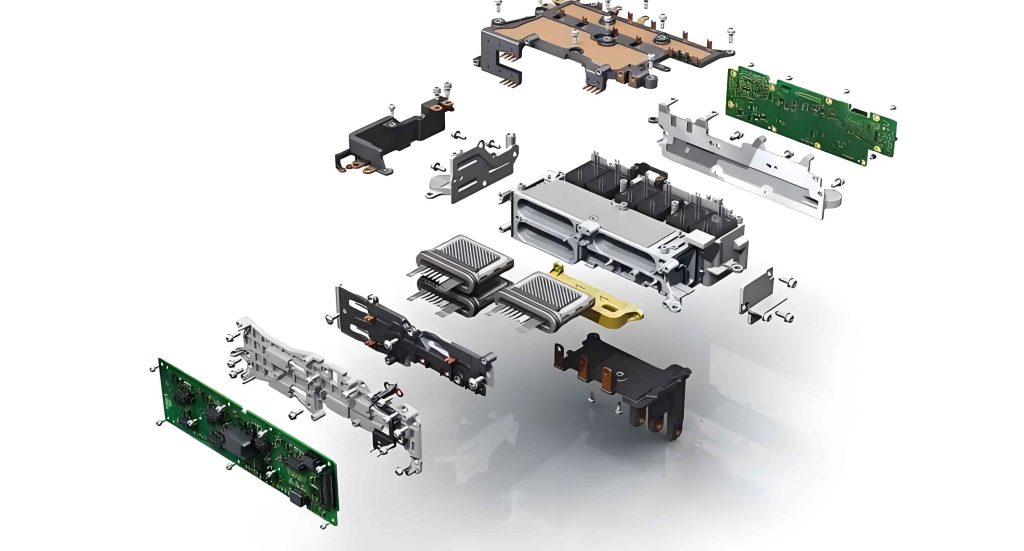
The motor control unit, in particular, is critical for regulating power output and interfacing with the battery system, making its stability vital for overall safety.
Faults in the electronic control system can be categorized into several types, each posing distinct threats to battery integrity. Voltage anomalies occur when cell polarization intensifies or active materials degrade, leading to deviations during charge-discharge cycles. For instance, voltage may spike during charging or drop prematurely during discharging, causing pack imbalances. Current deviations arise from sensor aging, such as in Hall elements, or resistor drift, resulting in measurement errors that mislead control algorithms. Thermal management failures stem from coolant flow reductions due to blockages or pump degradation, leading to localized overheating. Communication interruptions happen when CAN or LIN buses experience overloads, physical layer issues, or synchronization failures, disrupting data flow between critical nodes like the motor control unit and BMS. These faults are interconnected; for example, a current sensor error in the motor control unit can cause voltage misreadings, exacerbating battery stress.
To address these issues, I propose a comprehensive diagnostic and handling strategy based on multi-parameter monitoring and predictive algorithms. For voltage anomaly diagnosis, a high-precision sampling chain is established with a 10 ms cycle to track cell, module, and pack voltages. Thresholds are set to classify deviations: if the cell voltage difference exceeds 0.035 V, it is flagged as high-risk, triggering actions like balancing or current limitation. A table summarizing key parameters for voltage fault handling is provided below:
| Monitoring Item | Measured Value | Threshold | Handling Method |
|---|---|---|---|
| Cell Voltage Difference (V) | 0.062 | >0.050 | Activate protection, limit current |
| Pack Voltage Deviation (V) | 6 | >4 | Adjust bus voltage reference |
| Temperature Rise Rate (°C/min) | 1.6 | >1.2 | Enter rapid diagnosis |
| Balancing Current (A) | — | 0.5–1.2 | Initiate active balancing |
| Bus Voltage Fluctuation (V) | 17 | >12 | Reduce duty cycle |
| Voltage Jump Duration (cycles) | 4 | >3 | Cut off high-voltage output |
Current deviation faults require dual-path validation, comparing Hall sensor readings with shunt resistor values. If the offset exceeds 4 A, calibration routines are initiated for the motor control unit sensors, and inverter carrier frequencies are adjusted. For larger deviations above 6 A, closed-loop phase current regulation is applied to converge within 1–3 A. Transient deviations from load changes are managed by limiting the DC-side current change rate to 20 A/ms, ensuring the system adheres to target trajectories. This emphasizes the motor control unit’s role in maintaining current accuracy, as any error here directly impacts battery charging and discharging safety.
Thermal management failures are diagnosed using a predictive temperature model. By deploying layered temperature sensors in the battery pack, data on module temperatures, environmental conditions, and power losses are collected. The predicted temperature for the next control cycle is calculated as:
$$ \hat{T}_i(k+1) = \alpha T_i(k) + \beta T_i(k-1) + (1-\alpha-\beta) T_{env}(k) + \gamma P_i(k) $$
where \( \hat{T}_i(k+1) \) is the forecasted temperature for module \( i \), \( \alpha \) and \( \beta \) are historical temperature weights, \( T_{env}(k) \) is ambient temperature, \( \gamma \) is the influence coefficient of power loss on temperature rise, and \( P_i(k) \) is the current power dissipation. This formula enables real-time anomaly detection by comparing predicted and actual temperatures. A normalized residual index is then computed:
$$ r_i(k+1) = \frac{|\hat{T}_i(k+1) – T_i(k+1)|}{\delta_i + \lambda |P_i(k)|} $$
Here, \( r_i(k+1) \) represents the residual indicator, \( \delta_i \) is the allowable temperature difference baseline, and \( \lambda \) adjusts sensitivity based on power variations. If residuals exceed thresholds over consecutive cycles, targeted actions are triggered, such as increasing coolant pump speed or restricting high-rate discharge for affected modules. This approach highlights how integrating motor control unit data with thermal models can preempt overheating risks.
Communication interrupt faults are addressed by monitoring frame cycles on CAN and LIN buses. If critical nodes like the VCU, BMS, or motor control unit miss data frames for two consecutive periods, timeout判定 is triggered, and bus load is analyzed. Cross-bus consistency checks compare parameters from different domains to identify gateway issues. Recovery measures include resynchronizing node clocks for minor drifts or resetting transmission queues for error accumulations. The motor control unit’s communication integrity is especially vital, as delays can cascade into current or voltage control errors, jeopardizing battery safety.
A case study illustrates the practical application of these strategies. A fleet of 30 pure-electric SUVs, equipped with 72 kWh ternary lithium batteries and a 360 V nominal bus voltage, exhibited issues under summer high-temperature conditions: pack voltage fluctuations reached 18–22 V, cell voltage differences peaked at 0.068 V, three-phase current deviations hit 11 A, module temperatures rose to 57.8°C, and CAN frame losses occurred frequently, causing BMS protection triggers. From my analysis, these problems stemmed from multiple sources, including aging sensors in the motor control unit and cooling system blockages. A systematic improvement project was implemented, involving diagnosis via 72-hour continuous data collection, fault localization using the aforementioned methods, and corrective actions like active balancing, sensor recalibration, and cooling loop repairs. Post-treatment tests confirmed significant enhancements, as shown in the table below:
| Indicator | Pre-Improvement Value | Post-Improvement Value |
|---|---|---|
| Maximum Cell Voltage Difference (V) | 0.068 | 0.024 |
| Pack Voltage Fluctuation Amplitude (V) | 22 | 9 |
| Three-Phase Current Maximum Deviation (A) | 11 | 2 |
| Module Maximum Temperature (°C) | 57.8 | 45.3 |
| Module Temperature Difference (°C) | 8.2 | 2.1 |
| Coolant Flow Rate (L/h) | 117 | 155 |
| CAN Frame Loss Count (per 30 min) | 143 | 12 |
| Power System Derating Trigger Count | 6 | 0 |
This case underscores how coordinated diagnostics—centered on components like the motor control unit—can mitigate risks. The motor control unit’s recalibration, for instance, reduced current errors, while thermal management improvements lowered temperatures, collectively enhancing battery safety margins.
In conclusion, fault diagnosis and handling in new energy vehicle electronic control systems are paramount for battery safety. By establishing high-precision sampling networks, employing predictive algorithms, and implementing real-time corrective actions, we can address voltage anomalies, current deviations, thermal failures, and communication breaks. The motor control unit serves as a linchpin in this framework, influencing current regulation and system coordination. Future efforts should focus on integrating machine learning for adaptive threshold setting and enhancing the motor control unit’s fault tolerance through redundant designs. Through such strategies, we can bolster the safety redundancy of vehicles in complex environments, reducing thermal runaway risks and ensuring reliable operation.