
In recent years, the rapid expansion of new energy installations, particularly in photovoltaic and wind power, has marked a historic shift towards cleaner and more sustainable energy systems worldwide. This transition, however, brings significant challenges due to the intermittent nature of renewable energy generation, placing immense pressure on grid management. The solid-state battery, as a next-generation energy storage solution, plays a pivotal role in enabling “peak shaving and valley filling” for renewable energy, thereby stabilizing power grids. Moreover, the booming electric vehicle industry has fueled an urgent demand for batteries with higher energy density, power density, and safety. The solid-state battery, characterized by its solid electrodes and electrolytes, is widely regarded as a transformative technology for applications ranging from energy storage systems to electric vehicle powertrains. As global efforts to combat climate change intensify, the solid-state battery has become a focal point of innovation and policy support in major economies such as China, Japan, South Korea, and the United States. In this article, I will comprehensively analyze the policy frameworks, technological progress, and key players driving the development of solid-state battery technology, offering insights into future strategies and recommendations.
The solid-state battery represents a paradigm shift from conventional lithium-ion batteries by replacing liquid electrolytes with solid counterparts. This design offers inherent advantages, including enhanced safety by eliminating flammable components, higher energy density through enabling lithium metal anodes, and longer cycle life due to reduced side reactions. The fundamental energy density of a solid-state battery can be expressed as: $$E_d = \frac{C \times V}{m}$$ where \(E_d\) is the gravimetric energy density in Wh/kg, \(C\) is the capacity in Ah, \(V\) is the average voltage in V, and \(m\) is the mass in kg. For solid-state batteries, theoretical values can exceed 500 Wh/kg, significantly surpassing current lithium-ion batteries. Key performance metrics also include power density \(P_d = \frac{I \times V}{m}\) for high-power applications and interfacial stability governed by ionic conductivity \(\sigma_i\) across solid electrolyte interfaces. The ionic conductivity of solid electrolytes, often described by Arrhenius equation: $$\sigma_i = A \exp\left(-\frac{E_a}{kT}\right)$$ where \(A\) is a pre-exponential factor, \(E_a\) is activation energy, \(k\) is Boltzmann’s constant, and \(T\) is temperature, remains a critical challenge. Currently, solid-state batteries are categorized based on electrolyte materials into sulfide-based, oxide-based, and polymer-based types, each with distinct trade-offs in conductivity, stability, and manufacturability.
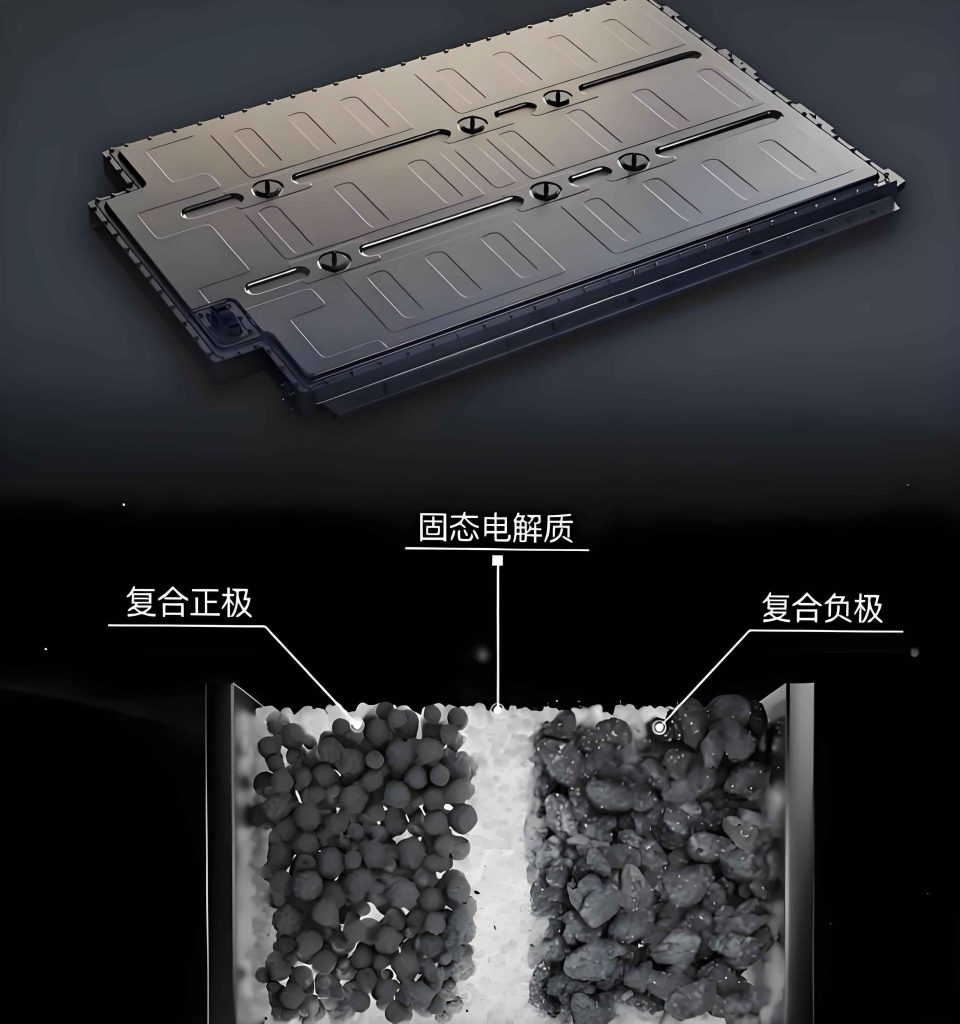
Applications of solid-state batteries span multiple domains. In electric vehicles, they promise extended driving ranges and faster charging. For energy storage systems, they offer safer grid-scale solutions. Consumer electronics benefit from compact, high-capacity designs. To illustrate the global landscape, I have summarized the policy and technological approaches of major countries in the table below, highlighting their focus on solid-state battery development.
| Country | Key Policies and Initiatives | Primary Technology Focus | Major R&D Entities | Funding and Support Mechanisms |
|---|---|---|---|---|
| China | Top-down design with multi-ministry coordination; plans like the New Energy Vehicle Industry Development Plan (2021-2035) and the High-Quality Development Action Plan for New Energy Storage Manufacturing. | Sulfide, oxide, and polymer routes; emphasis on all-solid-state battery standardization and industrialization by 2025-2030. | Research institutes (e.g., Chinese Academy of Sciences), universities, and leading battery manufacturers. | Government grants, standardization projects, and integration into national “dual carbon” goals. |
| Japan | Government-led innovation systems through NEDO; the Battery Industry Strategy targeting all-solid-state battery commercialization by 2030. | Sulfide solid electrolytes as core; collaborative projects involving companies like Toyota and Idemitsu Kosan. | NEDO, universities, and corporate alliances (e.g., 23 firms and 15 universities in 2018 project). | Subsidies (e.g., ¥166 billion in 2021), public-private R&D funds, and supply chain incentives. |
| South Korea | Business-friendly policies such as the 2030 Secondary Battery Industry Development Strategy and tax benefits under the Secondary Battery Industry Innovation Strategy. | Predominantly sulfide, with polymer and oxide research by companies like LG Energy Solution and SK Innovation. | Corporate-led R&D by Samsung SDI, LG Energy Solution, and SK Innovation. | Tax reductions, R&D credits, and a 38 trillion won five-year support plan for battery innovation. |
| United States | Federal initiatives like ARPA-E projects, Battery 500 Consortium, and the National Blueprint for Lithium Batteries (2021-2030) through FCAB. | Sulfide-based routes led by national labs; focus on domestic supply chain resilience. | Pacific Northwest National Laboratory, universities, and startups supported by DOE grants. | DOE funding, defense-related investments, and cross-agency collaborations for manufacturing. |
China has consistently strengthened its top-level design for solid-state battery technology. Early research dates back to the 1980s, with the establishment of the first solid-state ionics laboratory by the Chinese Academy of Sciences. Since then, policy evolution has been systematic. The “Action Plan for Promoting Automotive Power Battery Industry Development” in 2017 first proposed advancing solid-state battery research, setting a target of 500 Wh/kg by 2025. Subsequent policies, such as the “Science and Technology Support for Carbon Peaking and Carbon Neutrality Implementation Plan (2022-2030),” classified solid-state battery energy storage as a frontier technology. Recent documents, including the “2025 Industrial and Information Technology Standardization Work Points,” aim to establish standards for all-solid-state batteries, covering critical areas like sulfide electrolyte testing methods. This holistic approach underscores China’s ambition to lead in solid-state battery innovation and industrialization.
Japan’s strategy revolves around a collaborative innovation system involving government, industry, academia, and research institutions. Under NEDO’s leadership, Japan has prioritized sulfide solid electrolytes since the 1980s. Large-scale projects, such as the 100 billion yen initiative in 2018, have mobilized resources across sectors. The “Battery Industry Strategy” of 2022 sets a clear goal for all-solid-state battery commercialization by 2030. In 2024, subsidies totaling approximately 4.85 billion yuan were allocated through the “Battery Supply Assurance Program” to enhance mass production capabilities for companies like Toyota and Mitsui Kinzoku. This coordinated effort highlights Japan’s focus on overcoming technical bottlenecks, such as electrolyte performance and interface stability, through sustained R&D investments.
South Korea emphasizes creating a favorable environment for corporate innovation in solid-state battery technology. Companies like Samsung SDI, LG Energy Solution, and SK Innovation began active R&D around 2013, with Samsung showcasing early prototypes in 2017. The government’s “2030 Secondary Battery Industry Development Strategy” elevates solid-state battery development to a national priority, offering tax incentives and fund support. Subsequent policies, including the “Secondary Battery Industry Innovation Strategy,” provide additional benefits like R&D tax deductions and equipment investment credits. This approach leverages South Korea’s strong corporate sector to drive technological advancements, with a focus on sulfide routes while maintaining polymer and oxide research for diversification.
The United States has steadily funded solid-state battery research through agencies like the Department of Energy (DOE). Starting with ARPA-E projects in 2013, the U.S. launched the Battery 500 Consortium in 2016, targeting sulfide-based solid-state batteries. The formation of the Federal Consortium for Advanced Batteries (FCAB) in 2020 enhanced interagency coordination, as outlined in the “National Blueprint for Lithium Batteries (2021-2030),” which identifies solid-state battery technology as a key direction. DOE grants have supported universities and businesses in R&D and supply chain development, aiming to build a resilient domestic manufacturing base. This strategy reflects the U.S. commitment to foundational research and scaling innovations for commercial viability.
Technological progress in solid-state battery development is marked by ongoing breakthroughs in materials and engineering. The ionic conductivity of solid electrolytes is a central parameter, often modeled by the Nernst-Einstein relation: $$D_i = \frac{\sigma_i kT}{nq^2}$$ where \(D_i\) is the diffusion coefficient, \(n\) is charge carrier density, and \(q\) is charge. For sulfide electrolytes, conductivities can approach \(10^{-2}\) S/cm, rivaling liquid electrolytes, but stability issues persist. Oxide electrolytes, such as garnet-type Li\(_7\)La\(_3\)Zr\(_2\)O\(_{12}\) (LLZO), offer high stability but lower conductivity, typically around \(10^{-4}\) S/cm. Polymer electrolytes, like PEO-based systems, provide flexibility but require optimization for room-temperature performance. Interface engineering between electrodes and electrolytes is critical, with resistance \(R_{int}\) described by: $$R_{int} = \frac{\delta}{\sigma_{int}}$$ where \(\delta\) is interface thickness and \(\sigma_{int}\) is interfacial conductivity. Strategies such as coating layers and additive incorporation aim to minimize \(R_{int}\) to enhance overall battery performance.
| Electrolyte Type | Typical Ionic Conductivity (S/cm) | Advantages | Challenges | Representative Materials |
|---|---|---|---|---|
| Sulfide | \(10^{-3}\) to \(10^{-2}\) | High conductivity, good processability | Moisture sensitivity, interfacial degradation | Li\(_2\)S-P\(_2\)S\(_5\), Li\(_6\)PS\(_5\)Cl |
| Oxide | \(10^{-6}\) to \(10^{-4}\) | Excellent stability, wide voltage window | Brittleness, high sintering temperatures | LLZO, LiPON |
| Polymer | \(10^{-5}\) to \(10^{-4}\) (at 60°C) | Flexibility, ease of fabrication | Low room-temperature conductivity, mechanical strength | PEO with LiTFSI |
Looking ahead, the development strategy for solid-state battery technology must balance frontier research with industrialization. As countries approach the 2030 commercialization targets, several key actions are essential. First, advancing core technologies while accelerating pilot production and demonstration projects is crucial. The solid-state battery ecosystem requires scaled manufacturing processes, with cost reduction models often expressed as: $$C_{total} = C_{materials} + C_{processing} + C_{R&D}$$ where \(C_{total}\) is the total cost per kWh. Innovations in dry room processing and electrode stacking can lower \(C_{processing}\), making solid-state batteries economically viable.
Second, fostering collaborative innovation across sectors is vital. Given the high complexity and long development cycles of solid-state battery technology, governments should facilitate partnerships between universities, research institutes, and industries. For instance, joint R&D consortia can pool resources to address common challenges like electrolyte synthesis or interface optimization. A synergistic approach, as seen in Japan’s NEDO model, can amplify outcomes and reduce duplication.
Third, cultivating talent is foundational to sustained innovation. Specialized programs in materials science, electrochemistry, and battery engineering are needed to build a skilled workforce. Initiatives could include dedicated scholarships, international exchanges, and industry-academia training to equip researchers with hands-on experience in solid-state battery fabrication and testing. The human capital equation: $$I = f(T, R, C)$$ where \(I\) is innovation output, \(T\) is talent pool, \(R\) is research funding, and \(C\) is collaboration intensity, underscores the importance of investing in people.
In conclusion, the global race for solid-state battery leadership is intensifying, driven by the dual imperatives of energy transition and technological superiority. Countries like China, Japan, South Korea, and the United States are deploying diverse strategies tailored to their industrial bases and policy frameworks. The solid-state battery holds immense promise for revolutionizing energy storage and electric mobility, but realizing its potential demands concerted efforts in R&D, standardization, and market deployment. As innovation progresses, the focus will shift from government-led initiatives to market-driven adoption, with solid-state battery technology poised to become a cornerstone of a sustainable energy future. Through persistent collaboration and strategic investments, the vision of high-performance, safe, and cost-effective solid-state batteries can be achieved, paving the way for a cleaner and more resilient world.