
As we navigate the transformative era of automotive electrification, our commitment is unwavering: to lead as a premier provider of integrated electric drive systems. The shift towards electric vehicles presents both a challenge and an immense opportunity. For us, it is about evolving our core expertise in propulsion to master the complexities of electric drive systems. This journey is fueled by strategic acquisitions, innovative engineering, and a clear vision to deliver optimized, compact, and efficient solutions that power the future of mobility.
The automotive landscape is fundamentally changing. While autonomous driving and connectivity capture headlines, the essential function—moving from point A to point B—remains. This propulsion imperative is where we focus. Our strategy is to provide the complete electric drive system, from power electronics to the final drive. The acquisitions of industry leaders in electric motors and controllers were pivotal steps, allowing us to combine decades of mechanical drivetrain mastery with cutting-edge electrical and software capabilities. This fusion enables us to offer a seamless, integrated electric drive system that enhances performance, reliability, and efficiency for our customers.
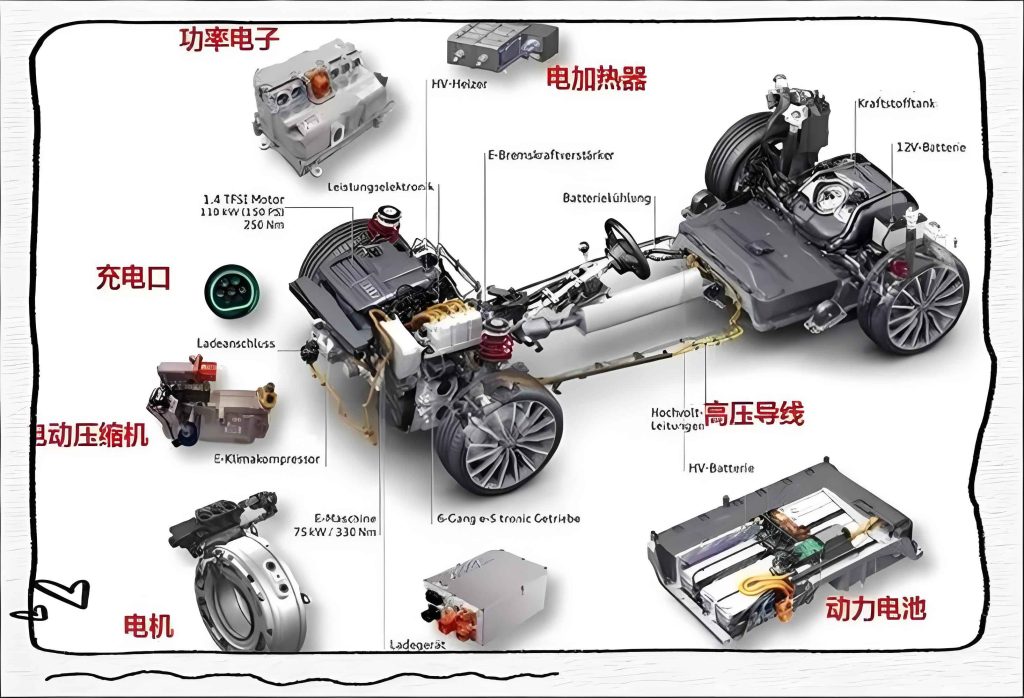
Our integrated electric drive system philosophy centers on providing a cohesive unit that combines the motor, power electronics, and transmission elements. This approach minimizes packaging space, reduces weight, and optimizes overall system efficiency. The core of any electric drive system is the electric machine. We have developed advanced motor technologies that offer superior power and torque density. One key innovation is our High Voltage Hairpin (HVH) winding technology. Compared to traditional round-wire windings, the rectangular conductors and multi-layer hairpin design significantly improve slot fill factor and thermal performance. The power output for such a motor can be expressed by the fundamental relationship between torque and rotational speed:
$$P = \tau \cdot \omega$$
Where \(P\) is the mechanical power in watts, \(\tau\) is the torque in newton-meters, and \(\omega\) is the angular velocity in radians per second. Our HVH motors, such as the HVH250, achieve exceptional continuous power ratings exceeding 95% of peak power, a critical factor for sustained performance in an electric drive system. The torque density improvement is substantial, which we can summarize in the following table comparing traditional vs. HVH technology for a given motor volume:
| Parameter | Traditional Round-Wire Motor | HVH Technology Motor |
|---|---|---|
| Peak Torque Density (Nm/L) | Base Value | ~150% of Base |
| Continuous Power Efficiency | 85-90% of peak | >95% of peak |
| Thermal Performance | Standard | Enhanced by ~30% |
| Packaging Flexibility | Moderate | High |
Beyond the motor itself, the complete electric drive system requires sophisticated control. Integrating the motor controller, often an inverter, directly with the motor and gearbox reduces parasitic losses and simplifies assembly. Our eDM (Electric Drive Module) is a prime example of this integration. It combines our eGearDrive electronic drive transaxle with an HVH motor. The next evolution includes fully integrating the power electronics controller, creating a unified module. The system efficiency \(\eta_{sys}\) of such an integrated electric drive system can be modeled as the product of the individual component efficiencies:
$$\eta_{sys} = \eta_{inverter} \cdot \eta_{motor} \cdot \eta_{gearbox}$$
Our goal is to maximize this overall efficiency. Through integration, we reduce interconnection losses, leading to system efficiencies greater than 93% across a wide operating range. The performance specifications for a typical eDM module highlight the capabilities of a modern, integrated electric drive system:
| eDM Module Specification | Value |
|---|---|
| Maximum Input Torque | 315 Nm |
| Peak Wheel Torque | 2500 Nm |
| Continuous Wheel Torque | 1450 Nm |
| Maximum Input Speed | 12000 rpm |
| System Efficiency (peak) | >93% |
| Weight Reduction vs. Discrete Components | 15 kg |
| Length Reduction | 104 mm |
Another cornerstone of our electric drive system technology portfolio is the proprietary S-winding stator. This innovation is crucial for applications ranging from 48V mild-hybrid systems to high-voltage pure electric drives. The S-winding process involves continuously forming copper wire into a precise “S” shape before inserting it into the stator stack. The mathematical advantage lies in the improved packing factor \(k_{fill}\), which is the ratio of copper cross-sectional area to the total slot area:
$$k_{fill} = \frac{A_{cu}}{A_{slot}}$$
Our S-winding technique achieves a \(k_{fill}\) significantly higher than traditional random-wound stators, approaching the levels of hairpin windings but with greater manufacturing flexibility for certain power ranges. The benefits are multifaceted, as shown below:
| Aspect | Traditional Stator | S-Winding Stator |
|---|---|---|
| Torque Density Increase | Base | >50% |
| Axial Length Reduction | 0% | ~30% |
| Thermal Performance | Standard | Improved (Better heat dissipation from distributed windings) |
| Torque Ripple Reduction | Higher | Lower, leading to superior NVH |
| Manufacturing Complexity | Varies | Reduced, with less scrap and shorter cycle time |
The reduced torque ripple is particularly important for refinement in an electric drive system. Torque ripple \(T_{ripple}\) can be expressed as the periodic variation around the average torque \(T_{avg}\):
$$T_{ripple} = \frac{T_{max} – T_{min}}{T_{avg}}$$
Our S-winding design minimizes this value, contributing to a smoother and quieter operation. This technology is versatile, deployed in products like integrated starter-generators (iBAS), P2 hybrid motors, and auxiliary electric drive systems for eAWD applications.
The 48V electrical architecture is a critical stepping stone in the electrification journey, and our solutions here are integral to optimizing the broader vehicle powertrain. Our 48V iBAS (integrated Belt-driven Alternator Starter) system, coupled with technologies like eBoosters, allows for significant engine downsizing and optimization. The control strategy focuses on the most efficient conversion of battery charge to motive power or recuperation. The potential fuel economy improvement \(\Delta FE\) can be estimated as a function of the electric system’s power \(P_{elec}\) and the recovered energy \(E_{regen}\) over a drive cycle:
$$\Delta FE \propto \frac{\int (P_{elec} \cdot \eta_{recup}) dt + E_{regen}}{E_{fuel}}$$
Where \(\eta_{recup}\) is the efficiency of the recuperation path. Our optimized systems have demonstrated the potential for up to a 20% improvement in fuel economy in real-world applications, showcasing how a supplemental electric drive system can transform conventional powertrains.
Our global manufacturing and engineering footprint is essential to realizing this electric drive system vision. The recent consolidation and expansion of our production facilities into a major regional center underscore this commitment. This center is dedicated to the manufacture and advanced engineering of key components for the electric drive system, including drive motors, P2 motors, 48V iBAS units, and vehicle control modules. It represents a hub for innovation, designed to scale rapidly and meet the surging demand for electrified solutions in one of the world’s most dynamic markets.
Looking forward, the evolution of the electric drive system is centered on further integration, higher voltage levels, and silicon carbide (SiC) power electronics. We are investing in these areas to push the boundaries of power density and efficiency. The next-generation integrated electric drive module will embody the ultimate fusion of motor, gearbox, and power electronics into a single, ultra-compact unit. The system’s volumetric power density \(\rho_{v}\) will be a key metric:
$$\rho_{v} = \frac{P_{max}}{V_{total}}$$
Where \(P_{max}\) is the peak power output and \(V_{total}\) is the total volume of the electric drive system. Our roadmap targets significant year-over-year improvements in this figure. Furthermore, we are developing advanced thermal management systems that are co-designed with the electric drive system. The heat dissipation requirement \(Q\) is governed by losses in the copper windings \(I^2R\) and the core:
$$Q \approx I_{rms}^2 R_{ac}(T) + P_{core}(f, B)$$
Here, \(I_{rms}\) is the RMS current, \(R_{ac}\) is the frequency-dependent AC resistance of the windings (a function of temperature T), and \(P_{core}\) represents the core losses dependent on frequency \(f\) and flux density \(B\). Our integrated cooling strategies, such as direct oil cooling of the stator and rotor, aim to minimize the temperature rise \(\Delta T\) for a given heat load, thereby allowing for sustained higher output from the electric drive system.
The software layer is becoming the defining intelligence of the modern electric drive system. Our capabilities extend beyond hardware into advanced control algorithms for torque vectoring, regenerative braking optimization, and predictive thermal management. The control logic for an integrated electric drive system in a hybrid vehicle, for instance, must solve a real-time optimization problem to split torque between the internal combustion engine and the electric motor(s). This can be framed as minimizing total energy consumption \(J\) over a trip:
$$J = \min \int_{0}^{t_{trip}} (\dot{m}_{fuel}(T_{eng}, \omega_{eng}) \cdot LHV + P_{batt}(T_{mot}, \omega_{mot}) \cdot \gamma_{elec}) dt$$
Subject to constraints like battery state-of-charge (SOC) limits, driver power demand, and component temperature limits. Our software solutions are designed to tackle these complex problems, ensuring that every electric drive system we deliver operates at its absolute peak efficiency.
In conclusion, our journey is one of continuous innovation and integration. The electric drive system is no longer a collection of discrete components but a meticulously engineered, software-defined propulsion unit. From high-voltage hairpin motors and S-winding stators to fully integrated eDM modules and intelligent 48V systems, we are building a comprehensive portfolio. Our strategy is clear: to be the partner of choice for automakers by providing complete, optimized, and scalable electric drive system solutions that accelerate the world’s transition to sustainable mobility. The future is electric, and we are powering its drive.