
The automotive industry is undergoing a profound transformation, especially in the realm of new energy vehicles. With the advent of the post-subsidy era, market dynamics are accelerating a reshuffle, putting financial strain on some vehicle manufacturers. This environment necessitates collaborative efforts between automakers and suppliers to absorb cost reductions. In this context, the integration of components has emerged as a primary pathway to drive down costs. Integrated design not only simplifies assembly for original equipment manufacturers (OEMs) and enhances product yield but also significantly reduces the number of suppliers, while achieving lightweighting and cost savings. The electric drive system, being at the heart of electric vehicles, has become a focal point for such integration efforts.
At recent major automotive exhibitions, numerous OEMs and component suppliers have showcased their “three-in-one” electric drive products, some nearing commercialization. This indicates a concentrated wave of mass production in the coming years. But what exactly is this integrated electric drive system? Is it the future mainstream approach? How mature is the technology? And will system suppliers displace traditional component providers of motors, inverters, and gearboxes? This article delves into these questions, exploring the evolution, technical challenges, competitive landscape, and future prospects of integrated electric drive systems.
The journey of the electric drive system from a collection of discrete components to an integrated unit reflects the industry’s push for efficiency and compactness. Initially, electric drive systems were non-integrated, with separate arrangements for the motor, inverter, gearbox, and power distribution systems, connected via wiring harnesses. This led to complex spatial layouts, large volumes, and significant weight. The first step toward integration was the “two-in-one” design, which combined the motor and gearbox. This was a significant improvement, optimizing space within the vehicle’s front compartment. However, the “three-in-one” integration takes it further by incorporating the inverter alongside the motor and gearbox, eliminating the need for high-voltage wiring harnesses that are essential in two-in-one systems.
The advantages of a three-in-one electric drive system are manifold. From a spatial perspective, the reduced volume allows for more flexible vehicle architecture, facilitating platform-based designs where the same system can be deployed across different models. For end-users, this translates to maximized cabin and storage space. Additionally, the lightweighting effect contributes to extended driving range for electric vehicles. The overall efficiency of the electric drive system can be expressed through a simplified formula: $$\eta_{total} = \eta_{motor} \times \eta_{inverter} \times \eta_{gearbox}$$ where $\eta_{total}$ represents the total efficiency, and each $\eta$ denotes the efficiency of the respective component. Integration often improves consistency, potentially enhancing overall system efficiency.
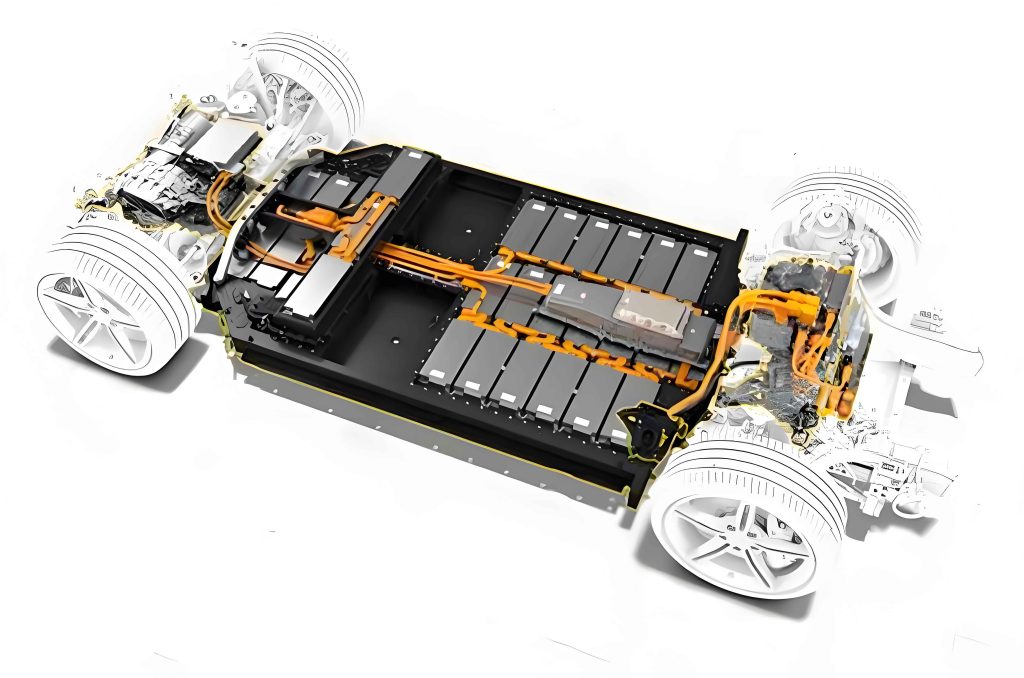
However, the integration of an electronic component (inverter) with mechanical parts (motor and gearbox) presents substantial technical challenges. The difficulty of three-in-one integration far exceeds that of two-in-one, as it is not merely about physical assembly but achieving synergistic performance where the whole is greater than the sum of its parts. Key considerations include integrated design capabilities, thermal management, lubrication, and precise layout. In non-integrated systems, components have larger surface areas exposed to air, aiding heat dissipation. In contrast, integrated designs with minimal gaps between parts necessitate sophisticated cooling solutions, often moving from simple air or liquid cooling to more complex systems. This requires advanced engineering to ensure all components operate within optimal temperature ranges. Despite these challenges, integrated electric drive systems can exhibit lower failure rates due to improved consistency and reduced interconnection points.
The thermal dynamics of an integrated electric drive system can be modeled using heat transfer equations. For instance, the heat generated by the motor and inverter must be dissipated effectively. The power loss, $P_{loss}$, in components can be approximated as: $$P_{loss} = I^2 R + K \omega$$ where $I$ is current, $R$ is resistance, $K$ is a constant, and $\omega$ is angular velocity. Effective cooling ensures that temperatures remain within limits, maintaining efficiency and longevity.
When it comes to the players mastering three-in-one electric drive technology, the landscape is diverse. Initially, pioneering OEMs drove this trend, recognizing the strategic importance of controlling core electric drive system technology, especially when supplier options were limited in the early days of electric vehicles. These OEMs invested heavily in R&D to develop proprietary integrated systems. On the other hand, component suppliers, sensing market opportunities, have increasingly entered the fray. Traditional powertrain giants, leveraging their expertise in transmissions, have expanded through acquisitions to gain capabilities in motors and inverters. Simultaneously, specialized motor and controller providers have evolved into full-system solution suppliers, with many local players emerging to compete.
The competitive dynamics are illustrated in the table below, comparing different integrator types:
| Player Type | Typical Background | Advantages in Electric Drive System | Challenges |
|---|---|---|---|
| OEMs (In-house) | Vehicle manufacturing | Control over core technology, system optimization for specific platforms | High R&D costs, scalability issues |
| International Tier-1 Suppliers | Traditional powertrain/components | Broad expertise, global scale, acquisition-driven technology integration | Adapting to rapid electrification, competition from newcomers |
| Specialized Electric Drive Firms | Motor/inverter production | Deep technical knowledge in electrification, agility | Need to master mechanical integration (gearbox), supply chain depth |
Another critical aspect is the performance metrics of integrated versus non-integrated systems. The following table summarizes key parameters based on industry trends:
| Parameter | Non-Integrated Electric Drive System | Two-in-One System (Motor+Gearbox) | Three-in-One System (Motor+Gearbox+Inverter) |
|---|---|---|---|
| Volume (relative) | 100% (baseline) | ~70-80% | ~50-60% |
| Weight (relative) | 100% | ~80-90% | ~65-75% |
| Power Density (kW/L) | Low (e.g., 1.5-2.0) | Medium (e.g., 2.5-3.0) | High (e.g., 3.5-4.5+) |
| System Efficiency (peak) | ~85-88% | ~88-90% | ~90-93% |
| Cost (relative) | 100% | ~90-95% | ~80-85% (long-term) |
| Assembly Complexity for OEM | High | Medium | Low |
Power density, a crucial metric for electric drive systems, is defined as: $$\rho_P = \frac{P_{output}}{V_{system}}$$ where $P_{output}$ is the output power in kilowatts (kW) and $V_{system}$ is the volume in liters (L). Integration typically boosts $\rho_P$ significantly.
The evolution towards three-in-one electric drive systems is not without its trade-offs. While integration reduces volume and weight, it demands meticulous design to manage electromagnetic interference (EMI), vibration, and noise. The compact layout can lead to heightened thermal stresses, requiring advanced materials and cooling techniques. For example, the use of direct oil cooling for the motor and inverter windings has become common in integrated systems to enhance heat dissipation. The overall reliability function, $R(t)$, for an integrated system can be modeled considering failure rates of individual components and their interactions: $$R(t) = e^{-\lambda_{integrated} t}$$ where $\lambda_{integrated}$ is the failure rate of the integrated electric drive system, which, with good design, may be lower than the sum of individual component failure rates due to reduced interfaces.
In terms of market adoption, three-in-one electric drive systems are more suitable for new vehicle platforms or dedicated electric vehicle architectures. Retrofitting existing platforms can be challenging due to spatial constraints. This has led to a surge in platform-based development among OEMs, where the electric drive system is a central modular component. The flexibility of integrated systems allows for scalability across vehicle segments, from compact cars to SUVs, by adjusting parameters like gear ratio and motor size. The torque output at the wheels, $T_{wheel}$, can be expressed as: $$T_{wheel} = T_{motor} \times i_{gearbox} \times \eta_{gearbox}$$ where $T_{motor}$ is motor torque, $i_{gearbox}$ is gear ratio, and $\eta_{gearbox}$ is gearbox efficiency. Integrated designs optimize these parameters holistically.
The supplier landscape for electric drive systems is becoming increasingly pluralistic. While established international suppliers hold advantages from decades of powertrain experience, the shift to electrification levels the playing field. New entrants, particularly from regions with strong electronics and manufacturing bases, are competing aggressively. This competition is driving innovation and cost reduction. For instance, in the three-in-one electric drive system domain, we see a race to improve efficiency, reduce rare-earth material usage in motors, and enhance inverter switching frequencies using wide-bandgap semiconductors like silicon carbide (SiC). The inverter efficiency, $\eta_{inverter}$, can be approximated as: $$\eta_{inverter} = 1 – \frac{P_{switching} + P_{conduction}}{P_{DC}}$$ where $P_{switching}$ and $P_{conduction}$ are switching and conduction losses, and $P_{DC}$ is input DC power. Advanced semiconductors reduce these losses.
Looking ahead, the electric drive system market is poised for significant growth and transformation. The three-in-one approach is currently the mainstream trend due to its relative maturity and tangible benefits. However, it is not necessarily the ultimate solution; future architectures might explore deeper integration, such as incorporating charging modules or even vehicle control units, leading to “multi-in-one” systems. The choice of integration level depends on OEM strategies, cost targets, and technical capabilities. From a cost-performance perspective, the debate between two-in-one and three-in-one electric drive systems continues, with market adoption serving as the ultimate validator.
Furthermore, the rise of software-defined vehicles adds another layer to electric drive system development. Integrated systems facilitate better control and optimization through centralized software, enabling features like torque vectoring, regenerative braking calibration, and thermal management strategies. The overall vehicle energy consumption, $E_{vehicle}$, can be linked to the electric drive system efficiency: $$E_{vehicle} \propto \frac{1}{\eta_{total}} \times (Aerodynamic Drag + Rolling Resistance + Acceleration Requirements)$$ Thus, improving the electric drive system efficiency directly enhances vehicle range.
In conclusion, the integration of electric drive systems represents a critical evolution in automotive electrification. The three-in-one configuration offers compelling advantages in space, weight, and cost, albeit with technical hurdles in thermal management and design complexity. As the market matures, we anticipate a vibrant ecosystem of OEMs and suppliers collaborating and competing to advance electric drive system technology. The future will likely see continued innovation, with integration serving as a key enabler for affordable, efficient, and high-performance electric vehicles. The electric drive system, in its integrated form, will remain a cornerstone of the automotive industry’s electric future.