
The imperative to mitigate climate change has positioned the battery electric car as a cornerstone of sustainable transportation strategies worldwide. However, the environmental benefits of these vehicles are intrinsically linked to the ecosystem that supports them, primarily the charging infrastructure. A holistic assessment of this infrastructure’s environmental impact, measured through its carbon footprint across the entire lifecycle, is therefore critical. This analysis delves into the carbon emissions associated with Electric Vehicle Supply Equipment (EVSE), examining stages from raw material extraction to decommissioning. Furthermore, it explores the technological, managerial, and policy-driven factors influencing this footprint and proposes a multifaceted optimization framework aimed at minimizing emissions, thereby ensuring that the growth of battery electric car adoption aligns with broader decarbonization goals.
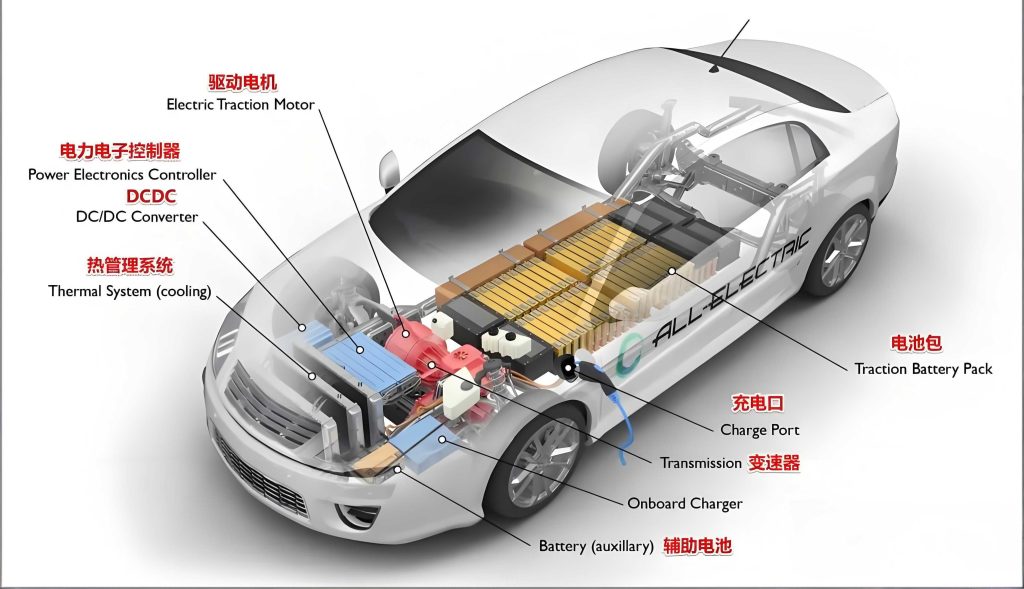
The transition to electric mobility, symbolized by the battery electric car, is a fundamental shift. Yet, its net environmental benefit is not guaranteed; it is a function of the electricity generation mix and the embodied carbon in the supporting infrastructure. Charging stations, comprising power electronics, structural components, and grid connections, require significant material and energy inputs. This article provides a detailed, quantitative analysis of the carbon footprint of EV charging infrastructure, moving beyond the operational phase to include upstream and downstream processes. By identifying key emission hotspots and influencing factors, we establish a foundation for targeted optimization strategies in design, operation, and strategic planning.
1. Carbon Footprint Analysis of EV Charging Infrastructure
The lifecycle carbon footprint of charging infrastructure is evaluated across four consecutive stages: Raw Material Production, Construction, Operation, and End-of-Life. A systematic breakdown reveals the relative contribution of each phase and identifies primary sources of emissions.
1.1 Carbon Emissions in the Raw Material Production Stage
This initial stage encompasses the mining, refining, and manufacturing processes for all foundational materials. Emissions are predominantly indirect, tied to the energy intensity of primary industrial processes.
- Structural Steel: The support canopies, frames, and reinforcements for charging stations and grid connections rely heavily on steel. The production of one metric ton of structural steel via the typical blast furnace-basic oxygen furnace (BF-BOF) route emits approximately 1.8 tons of CO2-equivalent (CO2e). For a medium-sized charging hub with 10 charging bays, the structural steel requirement can easily reach 30 tons, contributing around 54 tons CO2e at this stage alone. The emissions can be modeled as:
$$ E_{steel} = M_{steel} \times EF_{steel} $$
where \( E_{steel} \) is the total emission from steel, \( M_{steel} \) is the mass of steel used, and \( EF_{steel} \) is the emission factor (~1.8 tCO2e/t). - Copper for Conductors: Copper is essential for power cables, transformer windings, and internal busbars due to its high conductivity. Copper production, involving mining, concentration, smelting, and electrolytic refining, has a significant footprint. The lifecycle emission factor for refined copper is approximately 2.5 – 3.0 tCO2e per ton. A station requiring 5 tons of copper in its medium-voltage connection and internal wiring contributes 12.5 to 15 tons CO2e.
- Electronic Components & Power Electronics: The core of a charger—the AC/DC rectifier, DC/DC converter, control boards, and semiconductor modules (IGBTs, SiC MOSFETs)—involves energy-intensive fabrication. Silicon wafer production, doping, lithography, and packaging for power semiconductors are particularly carbon-intensive due to ultra-pure material requirements and cleanroom operations. While the mass is low compared to steel, the emission per kilogram is exceedingly high. The carbon footprint of a 150 kW fast-charging module’s electronics can be equivalent to several tons of CO2e.
1.2 Carbon Emissions in the Construction Stage
This phase includes all on-site activities: site preparation, foundation laying, equipment installation, and civil works. Emissions are direct, arising from fossil fuel combustion in construction machinery and transportation.
- Site Preparation and Civil Works: Excavators, bulldozers, and compactors used for land leveling and foundation work run on diesel. Emissions depend on machinery power rating and operational hours. For example, a 200 kW excavator consuming 20 liters of diesel per hour, operating for 100 hours over the project, emits:
$$ E_{constr} = F_{diesel} \times LHV_{diesel} \times EF_{diesel} $$
Where \( F_{diesel} \) is fuel consumption (liters), \( LHV_{diesel} \) is the lower heating value (~0.85 kgCO2e/MJ per liter), leading to ~2.68 kgCO2e per liter. Thus, 2000 liters of diesel results in roughly 5.36 tons CO2e. - Material Transportation: Delivering pre-fabricated kiosks, transformers, cables, and concrete involves heavy-duty trucks. Emissions scale with distance and payload. Transporting 50 tons of equipment over an average distance of 200 km might emit:
$$ E_{trans} = \sum (M_i \times D_i \times EF_{truck}) $$
where \( M_i \) is mass, \( D_i \) is distance, and \( EF_{truck} \) is the emission factor for freight transport (e.g., 0.1 kgCO2e/ton-km). This could add another 1 ton CO2e. - Crane Operations for Installation: Lifting heavy transformers and prefabricated units requires mobile cranes. A single crane day (8 hours) can consume 80-120 liters of diesel, adding 0.21 – 0.32 tons CO2e per day.
1.3 Carbon Emissions in the Operational Stage
This is typically the longest and most dynamic phase, where emissions are directly tied to the electricity consumption of charging events and ancillary services. The carbon intensity of the grid (\( CI_{grid} \), kgCO2e/kWh) is the critical variable.
The total operational emissions for a station over time \( T \) can be expressed as:
$$ E_{op}(T) = \int_0^T (P_{charge}(t) \cdot \eta^{-1} + P_{aux}) \cdot CI_{grid}(t) \, dt $$
where \( P_{charge}(t) \) is the power delivered to the battery electric car, \( \eta \) is the charger efficiency (e.g., 0.93), \( P_{aux} \) is auxiliary power for cooling, lighting, and displays, and \( CI_{grid}(t) \) varies temporally.
A detailed breakdown for a hypothetical 10-bay station with mixed charger types over one year is shown in Table 1.
| Emission Source | Specification | Annual Energy Consumption (MWh) | Annual CO2e Emissions (tons) | Notes |
|---|---|---|---|---|
| Fast Chargers (150 kW) | 4 units, Avg. utilization: 15%, Efficiency: 93% | ~788 MWh | ~394 | Energy delivered to battery electric car: ~733 MWh. Losses: ~55 MWh. |
| Standard Chargers (22 kW) | 6 units, Avg. utilization: 20%, Efficiency: 95% | ~231 MWh | ~115.5 | Energy delivered: ~220 MWh. Often used for longer parking periods. |
| Auxiliary Systems | Lighting, HVAC, Monitoring | 18 MWh | 9 | Relatively constant load. |
| Transformer & Grid Losses | Station transformer (1 MVA) | ~15 MWh | 7.5 | No-load and load losses. |
| Total Operational Emissions | ~1052 MWh | ~526 tons | Fast charging dominates due to high power and significant energy throughput. |
This table highlights that the energy delivered to the battery electric car and the associated conversion/transmission losses constitute the overwhelming majority of the operational carbon footprint. The variability of \( CI_{grid}(t) \) offers a major lever for reduction, as charging during periods of high renewable penetration (low \( CI_{grid} \)) can drastically cut emissions.
1.4 Carbon Emissions in the End-of-Life Stage
Decommissioning involves dismantling, waste transport, processing, and disposal/recycling. Emissions arise from equipment operation for dismantling, transportation fuel, and the chemical/energy processes of material recovery.
- Dismantling and Collection: Using equipment similar to construction, emissions are relatively minor but non-zero.
- Recycling vs. Virgin Material Production: The primary carbon benefit at End-of-Life comes from avoiding virgin material production. Recycling metals like steel and copper saves 50-80% of the emissions associated with primary production. The net emission (\( E_{EoL} \)) can be expressed as:
$$ E_{EoL} = E_{dismantle} + E_{transport} + E_{processing} – E_{virgin\,avoided} $$
For a station with 30 tons of steel and 5 tons of copper, \( E_{virgin\,avoided} \) could be approximately \( (30 \times 1.4) + (5 \times 2.0) = 52 \) tons CO2e (using conservative savings estimates), potentially making the net EoL impact negative (a credit) if recycling rates are high and processes efficient. - Electronic Waste Challenge: Power electronic modules and circuit boards contain complex mixes of materials. Unsophisticated processing can lead to emissions from inefficient thermal recovery or hazardous substance releases. Advanced, dedicated e-waste recycling is crucial to capture this value and minimize footprint.
2. Analysis of Factors Influencing the Carbon Footprint
2.1 Technological Factors
Technology choices fundamentally dictate the efficiency and resource intensity of the infrastructure.
- Charger Conversion Efficiency (\(\eta\)): Improving efficiency from 90% to 96% for a 150 kW charger reduces losses from 10% to 4% of input energy. For a unit delivering 100 MWh annually to battery electric cars, this saves 6.25 MWh of grid electricity, reducing emissions by ~3.1 tons CO2e/year (at CI=0.5 kg/kWh). Wide-bandgap semiconductors (SiC, GaN) are key enablers for higher frequency switching with lower losses.
$$ \Delta E_{saved} = E_{delivered} \times \left( \frac{1}{\eta_{old}} – \frac{1}{\eta_{new}} \right) \times CI_{grid} $$ - On-site Renewable Energy Integration: Co-locating PV canopies or wind turbines directly displaces grid electricity. A 500 kWp solar array at a sunny site might generate 700 MWh/year, offsetting up to 350 tons CO2e annually. The degree of offset depends on the temporal correlation between generation and battery electric car charging demand.
- Material Innovation and Durability: Using low-carbon concrete, recycled steel, or alternative materials reduces upstream emissions. Extending the operational lifespan from 10 to 15 years amortizes the embodied carbon of production and construction over more energy services, effectively reducing the footprint per charge event.
2.2 Managerial Factors
Operational intelligence can significantly modulate the carbon footprint without major hardware changes.
- Smart Charging & Grid Interaction: Algorithms can schedule or modulate charging power (\(P_{charge}(t)\)) in response to \(CI_{grid}(t)\) signals or local renewable output. Shifting 30% of a station’s load from high-CI to low-CI periods can reduce its operational carbon intensity by 15-25%.
- Predictive and Preventive Maintenance: Ensuring connectors, cables, and cooling systems are in optimal condition maintains high efficiency (\(\eta\)). A 2% point drop in efficiency due to poor contact or dust accumulation increases emissions proportionally. Regular maintenance prevents this degradation.
- Load Management and Peak Shaving: For stations with multiple chargers, dynamic power sharing prevents simultaneous peak demand, which might trigger the use of less efficient, high-emission peaker plants on the grid. This lowers the effective \( CI_{grid} \) for the station’s consumption.
2.3 Policy and Regulatory Factors
Policy sets the market rules and economic incentives that guide technological and managerial decisions.
- Carbon Pricing or Trading Schemes: Putting a price on carbon emissions makes low-carbon infrastructure investments more economically attractive. It internalizes the environmental cost, favoring efficient chargers and renewable integration.
- Grid Carbon Intensity Transparency and Standards: Regulations mandating real-time or forecasted \(CI_{grid}\) data enable smart charging algorithms. Setting a maximum average carbon intensity for publicly funded charging networks drives decarbonization.
- Green Procurement and Subsidies: Public tenders for charging networks can include strict criteria for embodied carbon, energy efficiency, and renewable readiness. Capital subsidies for PV-canopy integration or high-efficiency chargers accelerate their deployment.
- End-of-Life Regulations: Extended Producer Responsibility (EPR) laws mandating recycling targets for EVSE ensure materials are recovered, maximizing the \(E_{virgin\,avoided}\) credit and minimizing landfill emissions.
3. Optimal Design Framework for Low-Carbon Charging Infrastructure
Building on the footprint analysis and influencing factors, an optimal design framework integrates technological, managerial, and strategic spatial planning.
3.1 Technological Optimization
1) Maximizing Energy Conversion Efficiency: Deploy chargers utilizing state-of-the-art topologies and components. This includes:
– Topology: Use Three-Level Neutral-Point-Clamped (3L-NPC) or T-type converters combined with LLC resonant stages for DC output, achieving \(\eta > 95\%\) across a wide load range.
– Components: Mandate Silicon Carbide (SiC) MOSFETs for DC fast chargers >50 kW. Their lower switching and conduction losses directly reduce \(P_{loss}\).
– Thermal Management: Implement advanced liquid cooling for cables and power modules. Maintaining optimal temperature improves component longevity and efficiency. The efficiency gain \(\Delta \eta\) translates directly into carbon savings as defined in the formula above.
2) Deep Integration of Local Renewable Energy (RE): Move beyond token solar panels to designed symbiosis.
– RE-Centric Design: Size on-site generation (solar, possibly small wind) to meet a significant fraction of the station’s baseload (lighting, auxiliary) and a target percentage of its annual energy demand (e.g., 30-50%). Include battery storage to time-shift renewable energy to peak charging hours for the battery electric car.
– Control Architecture: Implement a local energy management system (EMS) that prioritizes direct consumption of on-site RE, uses storage to avoid grid imports during high-CI periods, and only draws from the grid as a complement during low-CI windows.
$$ E_{grid, import} = \max(0, \, E_{charge\,demand} – E_{RE, gen}(t) – E_{storage, discharge}(t)) $$
The goal is to minimize this imported quantity during high \(CI_{grid}\) periods.
3) Design for Durability, Repairability, and Recyclability: Employ modular designs where power electronics modules can be easily replaced or upgraded. Use standardized connectors and avoid proprietary glues/seals that hinder disassembly. Conduct a Design for Disassembly (DfD) assessment to maximize the future \(E_{virgin\,avoided}\) credit.
3.2 Managerial and Operational Optimization
1) Implementation of Carbon-Aware Smart Charging: Develop or procure charging management software where the optimization objective includes minimizing carbon emissions, not just cost or grid stress. The algorithm receives \(CI_{grid}(t)\) forecasts and schedules charging sessions for each battery electric car accordingly, within the user’s time constraints.
$$ \text{Objective: } \min \sum_{t, i} (P_{charge,i}(t) \cdot CI_{grid}(t)) $$
where \(i\) sums over all connected vehicles.
2) Lifecycle Performance Monitoring and Digital Twin: Install submetering to track the actual energy consumption and efficiency (\(\eta_{actual}\)) of each charger continuously. Compare against a digital twin’s baseline model to detect performance degradation for prompt maintenance, ensuring the system operates at its design efficiency throughout its life.
3) User Engagement for Low-Carbon Behavior: Through mobile apps, inform users of the real-time carbon intensity and offer incentives (lower fees, loyalty points) for choosing “green charging” slots. Educating battery electric car drivers transforms them into active participants in grid decarbonization.
3.3 Spatial and Systemic Layout Optimization
1) Strategic Placement to Minimize Grid Reinforcement Needs: Use spatial analytics and grid modeling to site high-power charging hubs in locations with existing grid capacity or where planned renewable generation clusters are located. This avoids or defers carbon-intensive grid upgrade projects (new lines, substations) triggered by EV load.
2) Integrated Planning with Renewable Energy Zones: Coordinate EV infrastructure roll-out plans with regional renewable energy development plans. Proactively build high-capacity charging corridors powered by nearby utility-scale solar or wind farms, creating a visible “green highway” for the battery electric car.
3) Optimizing Power Delivery Architecture: For large charging plazas, consider a centralized DC bus architecture. One large, highly efficient AC/DC rectifier feeds a common DC bus, to which multiple charging dispensers are connected. This architecture often has higher overall efficiency than multiple independent AC/DC chargers and provides more flexibility for integrating local DC-coupled solar PV and storage.
$$ \eta_{system} = \eta_{central\,rectifier} \times \eta_{DC/DC\,dispenser} $$
This can be more efficient than \( \eta_{distributed\,AC/DC\,charger} \) for high-power sites.
4. Conclusion
The journey towards sustainable electric mobility hinges on a comprehensive understanding and mitigation of the environmental impacts embedded within its supporting infrastructure. This analysis demonstrates that the carbon footprint of EV charging infrastructure is substantial and multifaceted, spanning raw materials, construction, long-term operation, and end-of-life treatment. The operational phase, powered by the electricity grid, currently dominates, but embodied carbon from materials is significant and will grow in relative importance as grids decarbonize.
The path forward lies in a holistic optimization framework. Technological leaps in power electronics efficiency and deep integration of renewables are essential. These must be coupled with intelligent, carbon-aware management systems that optimize charging in real-time based on grid conditions. Furthermore, strategic spatial planning that aligns charging infrastructure development with clean energy resources and grid capacity is crucial for systemic efficiency.
By rigorously applying this integrated approach—combining advanced technology, smart operations, and forward-looking policy—we can minimize the lifecycle carbon footprint of charging networks. This ensures that the promise of the battery electric car is fully realized, contributing effectively to a truly sustainable and decarbonized transportation future. The continued evolution of each component in this system, guided by lifecycle carbon analysis, will be paramount in achieving climate goals.