
The proliferation of electric vehicles has brought forth stringent demands on vehicle maneuverability, particularly in low-speed scenarios such as parking, urban congestion, and navigating tight spaces. Precise steering control is paramount in these situations, not only for driver convenience but also as a foundational technology for advanced driver-assistance systems (ADAS) and fully autonomous driving. Traditional steering control strategies, often designed for internal combustion engine vehicles or simplified dynamic models, frequently struggle to maintain accuracy and stability during low-speed, single-wheel steering maneuvers in electric vehicle cars. A primary challenge stems from the influence of load resistance torque, which, if unaccounted for, can lead to issues like excessive deviation from the intended path after a turn or insufficient return-to-center, compromising both safety and handling precision.
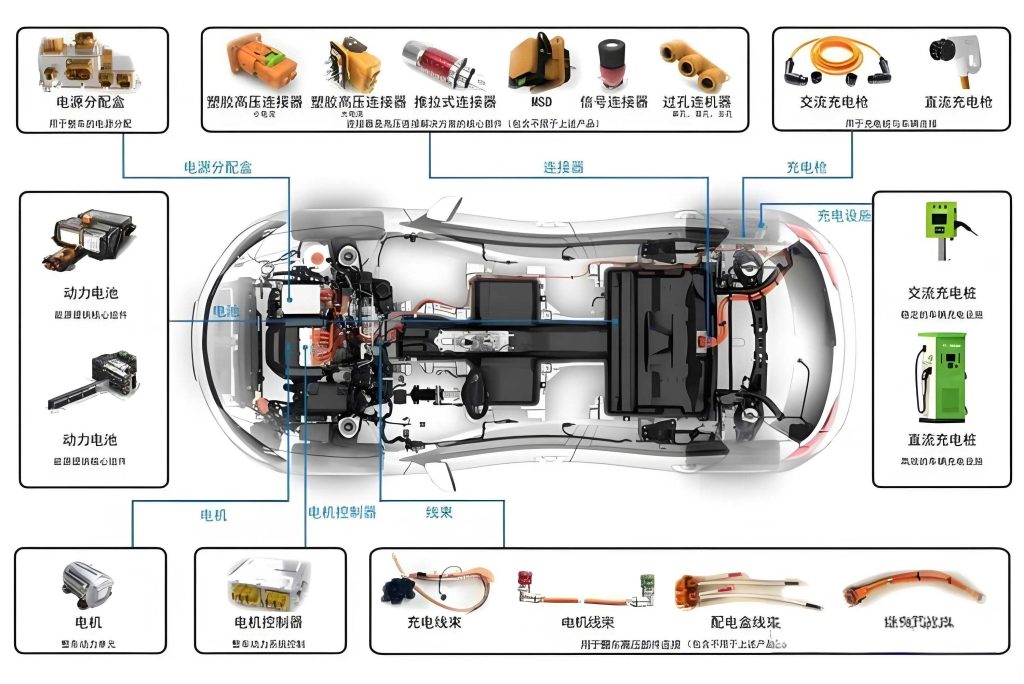
This paper addresses this critical gap by proposing a novel control methodology specifically tailored for single-wheel, low-speed steering in electric vehicle cars, with explicit consideration of the load resistance torque. The core of the method lies in accurately characterizing this torque and integrating it into an adaptive control framework. The subsequent sections detail the computational model for the load resistance torque, the design of the adaptive Proportional-Derivative (PD) controller, and comprehensive experimental validation demonstrating the method’s superiority over existing approaches.
1. Computational Modeling of Single-Wheel Low-Speed Steering Load Resistance Torque
The accurate estimation of the load resistance torque acting on the steering system of an electric vehicle car during low-speed, single-wheel turns is the cornerstone of the proposed control strategy. This torque is a composite quantity arising from several physical interactions at the tire-road interface and within the steering geometry. Failing to model these components accurately leads to control inputs that are either excessive or deficient, directly causing the overshoot or undershoot problems observed in conventional methods.
The total load resistance torque $$ \xi_{q-v} $$ for a single wheel during low-speed steering is modeled as the sum of four key components: the friction torque between the tire and road ($$ \xi_{f-v} $$), the aligning torque due to the kingpin inclination angle ($$ \xi_{\phi} $$), the aligning torque due to the caster angle ($$ \xi_{\kappa} $$), and the aligning torque due to the pneumatic trail or drag distance ($$ \xi_{z} $$).
$$ \xi_{q-v} = \xi_{f-v} + \xi_{\phi} + \xi_{\kappa} + \xi_{z} $$
1.1 Tire-Road Friction Torque ($$ \xi_{f-v} $$)
This component represents the moment that must be overcome to initiate and sustain tire slippage relative to the road surface during steering. It is integrated over the tire contact patch. The model considers the pressure distribution $$ q(\alpha, \beta) $$ within the contact patch (longitudinal position $$ \alpha $$, lateral position $$ \beta $$), the sliding friction coefficient $$ \phi(v) $$ (which is velocity-dependent), and the steering geometry including the scrub radius ($$ w $$) and toe angle ($$ \epsilon $$).
$$ \xi_{f-v} = -\iint \phi(v) \cdot q(\alpha, \beta) \cdot \text{sign}\left( \frac{d}{dt} \left( \alpha \sin \epsilon – \beta \cos \epsilon + w \right) \right) \cdot \left( \sqrt{(\alpha – \frac{h_t}{2})^2 + (\beta – \frac{r_t}{2})^2} \right) d\alpha d\beta $$
Where $$ h_t $$ and $$ r_t $$ are the length and width of the tire contact patch, respectively. The velocity-dependent friction coefficient is empirically modeled as:
$$ \phi(v) = \delta(v) \cdot e^{-0.2385v} + 0.4673 \cdot \chi^{0.4615} $$
Here, $$ \delta(v) $$ is a function relating equivalent friction to wheel speed $$ v $$, and $$ \chi $$ is a road condition parameter. The contact pressure distribution is often modeled using a simplified parabolic function:
$$ q(\alpha, \beta) = \frac{u_z}{h_t r_t} \left[ 1 – \left( \frac{2\alpha}{h_t} \right)^m \right] \left[ 1 – \left( \frac{2\beta}{r_t} \right)^m \right] $$
where $$ u_z $$ is the vertical load on the wheel and $$ m $$ is a constant (typically between 2 and 10) defining the shape of the pressure distribution.
1.2 Aligning Torque from Kingpin Inclination ($$ \xi_{\phi} $$)
The kingpin inclination angle $$ \eta $$ creates a vertical force component during steering that acts to return the wheel to the straight-ahead position. This generating torque is calculated based on the front axle load $$ F_1 $$, tire deflection $$ \epsilon_t $$, and tire radius $$ \gamma $$.
$$ \xi_{\phi} = -\frac{F_1}{2} \iint q(\alpha, \beta) \cdot \tan(\eta) \cdot \left( \alpha + \frac{\gamma \sin \epsilon}{\sin \eta} – \frac{\epsilon_t}{2} \right) d\alpha d\beta $$
1.3 Aligning Torque from Caster Angle ($$ \xi_{\kappa} $$)
The caster angle $$ \mu $$ creates a lever arm ($$ \lambda $$) between the tire contact point and the steering axis in the longitudinal plane. The aligning torque is the product of the lateral force $$ \iota_G $$ and this lever arm.
$$ \xi_{\kappa} = -\iota_G \cdot \lambda = -\iota_G \cdot \gamma \sin \mu $$
The lateral force $$ \iota_G $$ itself is modeled using a simplified Pacejka “Magic Formula” type representation:
$$ \iota_G = H_1 \sin\left[ T_1 \arctan\left( S_1 A – \varpi_1 (S_1 A – \arctan(S_1 A)) \right) \right] $$
where $$ A $$ is the wheel slip angle, and $$ H_1, S_1, T_1, \varpi_1 $$ are fitting parameters for the lateral force characteristic.
1.4 Aligning Torque from Pneumatic Trail ($$ \xi_{z} $$)
The pneumatic trail is the distance between the center of the tire contact patch and the point where the resultant lateral force acts. It generates a significant aligning torque. This torque is also modeled with a Pacejka-style formula, using a separate set of parameters ($$ H_2, S_2, T_2, \varpi_2 $$).
$$ \xi_{z} = H_2 \sin\left[ T_2 \arctan\left( S_2 \iota_G – \varpi_2 (S_2 \iota_G – \arctan(S_2 \iota_G)) \right) \right] $$
The comprehensive calculation of $$ \xi_{q-v} $$ provides a crucial real-time input that accurately reflects the instantaneous load condition during low-speed steering of the electric vehicle car. This model forms the basis for the adaptive controller.
2. Adaptive PD Controller Design for Single-Wheel Low-Speed Steering
With an accurate model of the load resistance torque $$ \xi_{q-v} $$, the next step is to design a control law that can effectively compensate for its effects and achieve precise steering angle tracking. A conventional fixed-gain PD controller is insufficient because the optimal control parameters depend heavily on varying operating conditions. Therefore, an adaptive PD controller is proposed, where the proportional gain $$ K_P $$ and derivative gain $$ K_D $$ are not constants but functions of key vehicle states.
The controller structure is illustrated in the following conceptual diagram. The primary inputs are the real-time estimated road adhesion coefficient $$ \psi $$, the vehicle speed $$ \varsigma $$, and the calculated single-wheel low-speed motor steering load resistance torque $$ \xi_{q-v} $$. These three parameters form the input vector $$ \zeta $$ for the adaptation mechanism.
$$ \zeta = \{ \psi, \ \varsigma, \ \xi_{q-v} \} $$
The adaptation mechanism maps this input vector to the optimal controller gains. The output steering angle command $$ \rho $$ for the target wheel (e.g., the left front wheel in our test case) is then generated by the PD controller based on the steering angle error $$ \eta $$ (difference between desired and actual angle) and its derivative $$ \mu $$.
$$ \rho = K_P(\psi, \varsigma, \xi_{q-v}) \cdot \eta + K_D(\psi, \varsigma, \xi_{q-v}) \cdot \mu $$
The core challenge is to find the optimal functional forms for $$ K_P(\zeta) $$ and $$ K_D(\zeta) $$. This was accomplished through an extensive co-simulation study using Trucksim and Simulink. A Design of Experiments (DoE) approach was followed, testing a wide range of operating conditions relevant to low-speed maneuvers for the electric vehicle car.
| Parameter | Test Range | Step Size |
|---|---|---|
| Vehicle Speed ($$ \varsigma $$) | 1 km/h to 4 km/h | 1 km/h |
| Road Adhesion Coef. ($$ \psi $$) | 0.2 to 0.8 | 0.2 |
| Load Resistance Torque ($$ \xi_{q-v} $$) | 50 Nm to 65 Nm | 5 Nm |
For each unique combination of $$ (\psi, \varsigma, \xi_{q-v}) $$, the steering response was evaluated based on three key performance indicators (KPIs): Return Overshoot, Residual Lateral Acceleration, and Return Time. The PD gains that yielded the best compromise among these KPIs for each condition were recorded. This generated a large dataset mapping the three-dimensional input space $$ \zeta $$ to the optimal 2D gain space $$ (K_P, K_D) $$.
Subsequently, a polynomial regression analysis was performed to fit continuous functions to this data. Third-order polynomials were found to provide an excellent fit with high coefficients of determination (R²). The resulting optimal gain functions are:
$$ K_P(\psi, \varsigma, \xi_{q-v}) = -2.166\psi + 0.08678\varsigma^2 + 18.95\xi_{q-v} – 0.001874\varsigma^2\psi – 0.08563\xi_{q-v}\varsigma – 85.32\psi^2 + 2.2458 \times 10^{-5}\varsigma^3 $$
$$ \text{(R² = 0.92)} $$
$$ K_D(\psi, \varsigma, \xi_{q-v}) = 0.08075\psi^2 + 0.000685\varsigma^2 + 95.32\xi_{q-v} – 0.001865\xi_{q-v}\psi – 0.08965\psi^2 – 23.58\varsigma + 2.8451 \times 10^{-5}\varsigma^3 $$
$$ \text{(R² = 0.88)} $$
These equations constitute the adaptation law. In real-time operation, the controller continuously monitors $$ \psi $$, $$ \varsigma $$, and $$ \xi_{q-v} $$, calculates the appropriate $$ K_P $$ and $$ K_D $$ using these polynomials, and applies them in the PD control law. This ensures that the steering control for the electric vehicle car is always tuned for the current low-speed driving condition, effectively compensating for the variable load resistance torque.
3. Experimental Validation and Performance Analysis
The proposed control method was rigorously tested and compared against two established benchmark strategies from recent literature: a Four-Wheel Steering Intervention based Electric Power Steering (EPS) Control Strategy (Benchmark A) and a Vehicle Rear-Wheel Steering System Control Strategy (Benchmark B). The test vehicle was a simulated electric vehicle car with tire specifications 255/70 R22.5. Key vehicle parameters used in the load torque model are summarized below.
| Parameter | Symbol | Value | Unit |
|---|---|---|---|
| Tire Contact Width | $$ r_t $$ | 0.2 | m |
| Tire Contact Length | $$ h_t $$ | 0.6 | m |
| Toe Angle | $$ \epsilon $$ | 30 | ° |
| Scrub Radius | $$ w $$ | 0.05 | m |
| Vertical Load | $$ u_z $$ | 8500 | N |
| Front Axle Load | $$ F_1 $$ | 4200 | N |
| Tire Radius | $$ \gamma $$ | 0.6 | m |
| Caster Angle | $$ \mu $$ | 6 | ° |
The performance was evaluated across three critical metrics: Steering Angle Error, Steering Angle Stability, and Steering Angle Drift.
3.1 Steering Angle Control Error
The steering angle error was recorded over thousands of test cycles under varied low-speed conditions. A positive error indicates overshoot (the wheel turns more than commanded), while a negative error indicates undershoot. The results demonstrate the superior accuracy of the proposed method for the electric vehicle car.
- Proposed Method: The steering angle error consistently remained within a very tight band of ±0.3°. The occurrences of both overshoot and undershoot were infrequent and of minimal magnitude.
- Benchmark A (4WS EPS): Exhibited pronounced and frequent overshoot, with error magnitudes significantly larger than the proposed method.
- Benchmark B (Rear Steering): Suffered from severe undershoot problems, failing to achieve the target steering angle, which is particularly detrimental for precise low-speed maneuvering.
The primary reason for the excellent performance of the proposed method is the accurate feedforward compensation provided by the calculated load resistance torque $$ \xi_{q-v} $$. By knowing and proactively counteracting this disturbance, the controller achieves much finer tracking accuracy.
3.2 Steering Angle Stability
This metric evaluates the smoothness of the steering angle trajectory during the turn. An unstable angle with oscillations leads to an unsteady vehicle path. The test involved commanding a step change in steering angle and observing the response.
- Proposed Method: The steering angle increased smoothly and monotonically to the target value without any oscillatory behavior or instability. This indicates excellent single-turn accuracy and a stable vehicle trajectory.
- Benchmark Methods: Both benchmark strategies showed clear instability in the steering angle response. The angle oscillated around the target value before settling, which would translate into a wobbly, unsteady path for the electric vehicle car, reducing comfort and predictability.
The adaptive nature of the PD controller is key here. By continuously optimizing $$ K_P $$ and $$ K_D $$ based on real-time conditions, the controller maintains an ideal damping ratio, preventing oscillations and ensuring a critically damped or overdamped response.
3.3 Steering Angle Drift Control
In scenarios where a constant steering angle must be held (e.g., maintaining a turn circle), some control systems exhibit “drift,” where the actual angle slowly deviates from the commanded value over time. This was tested by holding a fixed steering command for 30 seconds.
- Proposed Method: Showed exceptional stability with no observable drift. The steering angle remained constant at the commanded value throughout the test duration.
- Benchmark Methods: Both exhibited varying degrees of drift. Benchmark A showed a significant drift, while Benchmark B showed a smaller but still noticeable drift. This long-term inaccuracy is a critical flaw for autonomous parking systems where precise positional control is required.
The drift resistance of the proposed method stems from the integral action implicitly provided by the accurate modeling of steady-state load components (like the aligning torques $$ \xi_{\phi}, \xi_{\kappa}, \xi_{z} $$) within the $$ \xi_{q-v} $$ calculation. The controller effectively provides a continuous compensating torque that negates the steady-state resistance, holding the wheel position firmly.
4. Conclusion and Future Work
This paper presented a comprehensive solution for the challenge of single-wheel low-speed steering control in electric vehicle cars. The method’s innovation is two-fold: first, the development of a high-fidelity model for the single-wheel low-speed motor steering load resistance torque, which incorporates friction and the major aligning torque components; second, the design of an adaptive PD controller whose gains are optimally tuned in real-time as functions of road adhesion, vehicle speed, and the calculated load torque.
Experimental validation confirmed the method’s outstanding performance. It achieved steering angle errors below 0.3°, significantly outperforming benchmark strategies which suffered from substantial overshoot or undershoot. Furthermore, it provided perfectly stable steering responses without oscillations and demonstrated zero drift when holding a constant angle. These attributes are essential for enhancing the safety, comfort, and precision of electric vehicle cars in demanding low-speed automation scenarios like automated valet parking.
The study, however, has a defined scope. The control strategy was developed and validated primarily for a single wheel (the left front wheel). While this is a critical step, real-world application requires coordinated control across all wheels, especially for vehicles with independent four-wheel steering capabilities. The complex mechanical and dynamic couplings between wheels during a turn were not the focus of this initial research.
Therefore, future work will naturally extend in this direction. The immediate next step is to generalize the proposed single-wheel control law into a coordinated multi-wheel control framework. This involves investigating torque vectoring strategies that distribute steering effort among all wheels while considering their mutual interactions and individual load conditions. The goal is to develop a holistic low-speed maneuvering controller that leverages the independent control potential of electric vehicle cars to achieve unprecedented levels of agility and precision in confined spaces.