
The explosive growth of the global battery electric car industry is a defining trend of our era. With annual sales reaching approximately 14 million units in 2023 and projections pointing relentlessly upward, the logistical backbone supporting this trade—maritime transport—faces unprecedented pressure and novel risks. As a specialist in automotive safety and maritime logistics, I have observed a concerning correlation between the scaling of battery electric car exports/imports and the frequency and severity of fire incidents aboard Roll-on/Roll-off (ro-ro) vessels. These are not mere operational hiccups; they represent catastrophic events causing hundreds of millions in losses, environmental damage, and most tragically, loss of life. The inherent properties of lithium-ion batteries, the unique fire dynamics of a battery electric car, and the specific architecture of ro-ro ships combine to create a perfect storm of hazards. This article, from my professional perspective, delves into a comprehensive, technical risk analysis grounded in international regulations and proposes a multi-layered framework for mitigation, aiming to safeguard this critical supply chain.
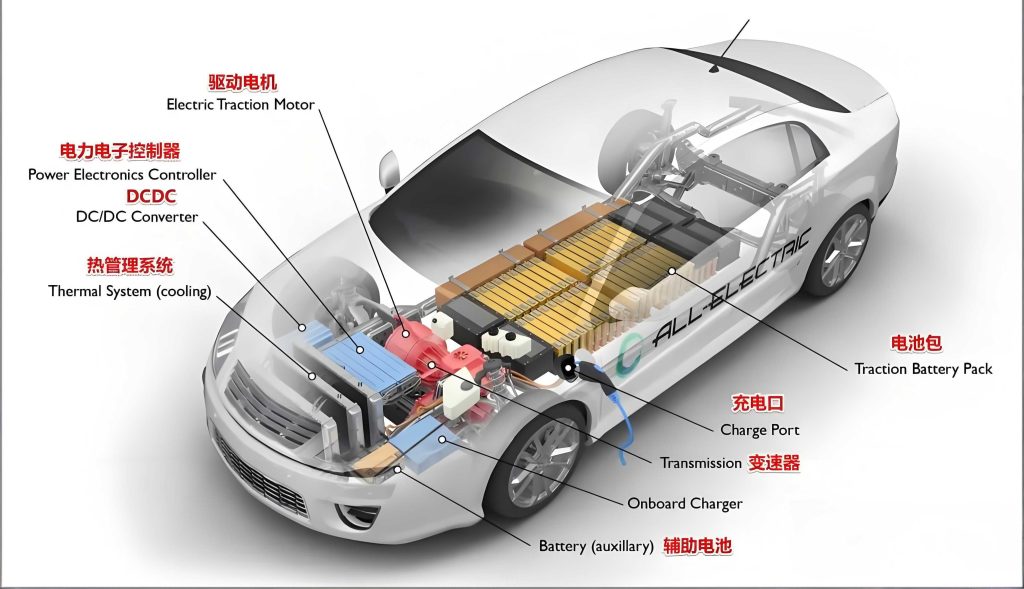
The primary mode for shipping battery electric cars is via specialized car carriers, or ro-ro ships, prized for their efficiency. However, this very efficiency can amplify risk. The traditional design paradigms of these vessels, optimized for internal combustion engine vehicles, are being stress-tested by the new energy reality of the battery electric car. The cornerstone of safety in this domain rests on two pivotal documents: the International Maritime Dangerous Goods (IMDG) Code and the United Nations Manual of Tests and Criteria (Rev. 8). The IMDG Code, particularly its Amendment 41-22 which became mandatory in January 2024, provides the regulatory framework. It specifies that a battery electric car can be transported as non-dangerous goods only if it meets stringent criteria under Special Provision 961. If not, it must be declared and handled as a Class 9 miscellaneous dangerous good, as per Special Provision 962. The critical link is that the lithium-ion battery within the battery electric car must be type-tested in accordance with Section 38.3 of the UN Manual.
| UN Number | Proper Shipping Name | Class | Applicable Special Provisions for Battery Electric Cars | Key Requirement |
|---|---|---|---|---|
| UN 3171 | BATTERY-POWERED VEHICLE or BATTERY-POWERED EQUIPMENT | 9 (or Non-DG if criteria met) | SP 388, SP 961, SP 962, SP 971 | SP 961: Transport as non-dangerous goods if specific conditions are fulfilled (e.g., batteries securely installed, switches isolated). SP 962: Transport as Class 9 if SP 961 not met but battery complies with IMDG 2.9.4 (UN Manual Test T.1-T.8). |
The UN Manual’s tests, summarized below, are designed to simulate extreme transport conditions. However, compliance is only the first, and sometimes fragile, line of defense.
| Test Designation | Test Name | Simulated Hazard |
|---|---|---|
| T.1 | Altitude Simulation | Low-pressure conditions during air transport. |
| T.2 | Thermal Test | Temperature cycling and seal integrity. |
| T.3 | Vibration | Vibrational stresses during transport. |
| T.4 | Shock | Impacts from shocks or jolts. |
| T.5 | External Short Circuit | Short circuit from terminal contact. |
| T.6 | Impact/Crush | Mechanical abuse leading to internal short circuit. |
| T.7 | Overcharge | Failure of charging control systems. |
| T.8 | Forced Discharge | Reverse current or excessive discharge. |
Risk Analysis: A Four-Pillar Framework
1. Regulatory Non-Compliance and Systemic Gaps
The first and most fundamental risk stems from the imperfect implementation of existing regulations. The complexity of the IMDG Code’s special provisions can lead to misinterpretation. A shipper or their agent, whether due to negligence, a lack of expertise, or pursuit of cost savings, might incorrectly declare a battery electric car as a general cargo item when it should be classified as Class 9. This misdeclaration is catastrophic, as it leads the carrier to forgo the specific stowage, segregation, and emergency preparedness measures mandated for dangerous goods. Furthermore, the integrity of the UN type-tests (T.1-T.8) is paramount. Batteries that have not undergone rigorous, certified testing, or whose management systems are subpar, become latent ignition sources. The risk is not merely theoretical; it is a direct contributor to the fire incidents we have witnessed.
2. The Inherent Volatility of Lithium-Ion Battery Chemistry
At the heart of every battery electric car lies its electrochemical energy storage system. The popular lithium-ion chemistries, primarily Lithium Nickel Manganese Cobalt Oxide (NCM) and Lithium Iron Phosphate (LFP), have distinct risk profiles. Thermal runaway is the core failure mechanism—a self-sustaining, exothermic reaction that becomes uncontrollable. It can be triggered by:
- Mechanical Abuse (e.g., crush, penetration): This directly causes an internal short circuit. The risk during ro-ro handling is significant.
- Electrical Abuse (e.g., overcharge, external short): Leads to joule heating and eventual separator breakdown.
- Thermal Abuse (e.g., exposure to high ambient temperature): Accelerates parasitic reactions within the cell.
The heat release during thermal runaway can be modeled as a combination of reaction enthalpies. The critical temperature for onset ($T_{onset}$) and the total heat released ($Q_{total}$) vary significantly:
$$ Q_{total} = \sum \Delta H_{i} $$
$$ T_{onset}(NCM811) < T_{onset}(NCM622) < T_{onset}(LFP) $$
$$ Q_{total}(NCM) > Q_{total}(LFP) $$
While LFP batteries are generally more thermally stable and have a higher $T_{onset}$, their risk profile is not negligible. Research indicates that the flammable gas vented during an LFP battery thermal runaway (rich in $H_2$ and $C_2H_4$) can have a lower Lower Flammability Limit (LFL) and generate higher peak explosion overpressures ($P_{max}$) compared to some NCM gases, posing a severe explosion hazard in confined spaces like a ship’s hold.
$$ \text{Explosion Risk Index} \propto \frac{(dP/dt)_{max} \cdot K_{G}}{LFL} $$
Where $(dP/dt)_{max}$ is the maximum rate of pressure rise and $K_{G}$ is the gas constant. This underscores that every battery electric car, regardless of chemistry, carries a potent energy-based hazard.
| Battery Chemistry | Key Risk Characteristic | Relative Thermal Stability | Notable Hazard in Confinement |
|---|---|---|---|
| NCM (e.g., 811, 622) | Higher specific energy; lower thermal runaway onset temperature; faster fire growth. | Lower | Intense, rapid fire with high heat release rate (HRR). |
| LFP | Lower specific energy; higher thermal runaway onset temperature; generation of highly explosive gas mixture. | Higher | Significant gas explosion hazard post-venting. |
3. The Unique Fire Dynamics of a Battery Electric Car
A fire in a battery electric car is fundamentally different from a conventional vehicle fire. It presents a multi-stage, multi-threat emergency:
- Difficult Early Detection: A thermal runaway can initiate deep within the battery pack with little initial external sign, delaying alarm.
- Extreme Fire Power and Re-ignition Tendency: Once the fire breaches the pack, it involves not only plastics and upholstery but also the massive energy of the battery. Full-scale fire tests show peak Heat Release Rates (HRR) for a single battery electric car can reach 8 MW or more, classifying it as an “ultra-fast” fire. The fire growth coefficient $\alpha$ in the $t^2$-fire model is exceptionally high:
$$ \dot{Q} = \alpha t^2 $$
where $\dot{Q}$ is the HRR (kW), and $\alpha$ can approach 1.0 kW/s². This intense thermal radiation ($\dot{q}”_{rad}$) can easily ignite adjacent vehicles, leading to cascading failures:
$$ \dot{q}”_{rad} = \frac{\dot{Q} \cdot \chi_{r}}{4 \pi r^2} $$
where $\chi_{r}$ is the radiative fraction and $r$ is the distance from the fire. - Prolonged Duration and Toxic Off-Gassing: The “deep-seated” nature of a battery fire means it can burn or smolder for hours, requiring sustained cooling. The off-gases include a lethal cocktail of $CO$, $HF$, $HCl$, and other organic compounds.
- Ineffectiveness of Standard Suppressants and Secondary Stability Threats: Traditional gaseous or foam systems are largely ineffective at stopping thermal runaway within a battery pack. The only proven method is copious, sustained application of water for cooling. However, on a ro-ro ship, this creates a critical secondary hazard: the accumulation of tons of water in the cargo decks, creating a substantial free surface effect that drastically reduces the vessel’s metacentric height ($GM$) and stability, risking capsize.
$$ \text{Free Surface Effect} \propto \frac{\rho \cdot i}{ \nabla } $$
where $\rho$ is water density, $i$ is the second moment of area of the free surface, and $\nabla$ is the ship’s displacement.
4. The Amplifying Nature of Ro-Ro Ship Architecture
The ro-ro ship, designed for throughput, inadvertently compounds the risks associated with transporting a battery electric car.
- Loading/Unloading Risks: The process of driving battery electric cars over ramps and through narrow internal ramps/hoistable decks presents acute mechanical abuse risks. A misjudgment can lead to underbody scraping (“scraping the belly”) or side impacts, potentially damaging the battery pack enclosure.
- In-Transit Risks: Once stowed, three main risks emerge. Shifting and Collision: In heavy seas, inadequate lashing can allow a multi-ton battery electric car to break free, impacting others. Water Ingress: Vehicles on weather decks are exposed to green water and spray; poor drainage can lead to saltwater pooling around and possibly into a battery electric car. Heat Buildup: The enclosed, densely packed cargo decks can become ovens in tropical routes, creating a thermal abuse environment for every battery electric car on board.
- Structural and Detection Deficiencies: The vast, undivided car decks allow unimpeded fire and smoke spread. The complex geometry obstructs water spray and hampers manual firefighting. Detection systems designed for open-flame hydrocarbon fires may not respond adequately to the initial off-gassing or smoldering phase of a battery electric car fire.
A Multi-Layered Mitigation Strategy: From Regulation to Innovation
Addressing these interconnected risks requires a holistic strategy encompassing regulation, technology, ship design, and emergency response.
1. Strengthening the Regulatory Compliance Ecosystem
Mandatory, auditable training for shippers, freight forwarders, and carriers on the specific IMDG requirements for battery electric cars is non-negotiable. Digital platforms for verifying UN type-test certificates linked to each Vehicle Identification Number (VIN) could prevent non-compliant units from being loaded. Port state control must prioritize inspections focusing on the declaration and stowage of battery electric cars.
2. Implementing a Rigorous Pre-Loading and Stowage Protocol
- State of Charge (SOC) Management: A critical yet often overlooked factor. The optimal SOC for shipping a battery electric car is a trade-off between minimizing energy available for a fire and preventing damage from deep discharge. A scientifically determined “transport SOC” (e.g., 30-50%) should be mandated and verified pre-loading. The self-discharge rate $\lambda$ over the voyage duration $t$ must be considered:
$$ SOC_{arrival} = SOC_{loading} \cdot e^{-\lambda t} $$
$SOC_{arrival}$ must remain above a safe minimum threshold. - Enhanced Loading Procedures: Designated marshals using protected routes to prevent scraping. Post-loading inspection of the underbody and battery pack area of a random sample of battery electric cars.
- Advanced Stowage Planning: Deliberate segregation of battery electric cars based on chemistry, using fire-resistant partitions or designated “risk zones.” Increased spacing between each battery electric car to reduce thermal radiation exposure and allow firefighting access.
3. Engineering the Next Generation of “Battery-Electric-Ready” Ro-Ro Ships
Future vessel designs must internalize the hazard profile of the battery electric car. This includes:
- Horizontal and Vertical Subdivision: Creating smaller, fire-tight compartments using automated, drop-down fire curtains or bulkheads to contain an incident.
- Integrated Detection and Suppression: A multi-sensor network (thermal imaging, gas detection, CCTV analytics) for early warning. A hybrid fixed firefighting system combining:
- A high-capacity, targeted deluge system for the battery electric car zone.
- High-expansion foam capability to quickly blanket and isolate adjacent vehicles.
- Under-deck efficient drainage and pumping systems to immediately remove firefighting water, stabilizing the vessel. The required pumping capacity $Q_{pump}$ must exceed the anticipated application rate $Q_{water}$:
$$ Q_{pump} > Q_{water} = A_{zone} \cdot R $$
where $A_{zone}$ is the protected area and $R$ is the water application density (e.g., $l/min/m^2$).
- Enhanced Ventilation and Thermal Management: Active temperature monitoring and forced cooling systems for cargo decks.
4. Revolutionizing Onboard Emergency Response
Crew training must evolve beyond standard firefighting. Specific competencies must include:
- Recognition and Assessment: Identifying the signs of a battery electric car thermal runaway (hissing, venting, specific smoke color).
- Containment-Focused Tactics: Immediate deployment of fire-resistive blankets or mobile water barriers to shield adjacent vehicles, prioritizing containment over immediate extinguishment of the primary unit.
- Sustained, Strategic Cooling: Understanding that applying water to the underbody/battery area of a burning battery electric car is a long-duration operation (potentially hours) to prevent reignition.
- Stability Awareness: Continuous monitoring of list and trim during firefighting, coordinating dewatering operations in real-time.
- Post-Incident Management: Protocols for handling a “cold” but damaged and potentially unstable battery electric car, including quarantine areas and specialist shore-based recovery plans.
Conclusion and Forward Look
The maritime transport of the battery electric car is an indispensable component of the global energy transition. However, its safety cannot be assumed; it must be engineered, regulated, and executed with a profound respect for the unique risks involved. The framework presented here—from stringent adherence to and evolution of the IMDG Code, through targeted risk mitigation at every touchpoint in the logistics chain, to the fundamental rethinking of vessel design and crew response—charts a necessary course. The goal is clear: to ensure that the green promise of the battery electric car is not dimmed by the black smoke of preventable tragedies at sea. Continuous collaboration between chemists, automotive engineers, naval architects, classification societies, and regulators is paramount. As the volume of battery electric cars on our seas continues to swell, so too must our commitment to making their journey as safe as humanly and technologically possible.