
In the current era of profound energy structure transformation, the rapid integration of renewable energy sources and the shift towards smart grids are reshaping power systems worldwide. As societal electrification advances, electricity demand continues to surge, prompting widespread attention to distributed energy resources and microgrid technologies. Against this backdrop, the battery electric car, as a pivotal component of transportation electrification, has witnessed explosive growth in adoption. This proliferation presents both challenges and opportunities for microgrids. On one hand, the increasing charging demands of battery electric cars significantly impact grid load profiles, often creating new peak loads in localized areas, thereby accelerating the adoption of microgrids as a means to balance supply and demand locally. On the other hand, microgrids offer flexible integration pathways for battery electric car charging infrastructure, enabling the local consumption of renewable energy, reducing charging costs, and enhancing overall energy efficiency. Moreover, the mobility of battery electric cars allows them to transfer between different microgrids, offering novel avenues for regional energy balancing. However, microgrids operating in islanded mode face severe frequency stability challenges due to their relatively low system inertia. When source-load imbalances occur, system frequency can experience substantial fluctuations, potentially leading to collapse. Traditional frequency regulation methods, primarily reliant on governor control of rotating generators, are limited in microgrid environments in terms of response speed and regulation capacity.
The battery electric car, as a distributed energy storage unit, possesses unique advantages for participating in grid frequency regulation: its mobility enables flexible allocation of regulation resources, its fast response capability allows for second-level frequency control, and its bidirectional charging-discharging characteristic provides both upward and downward regulation capacities. Additionally, the vast number of battery electric cars, when aggregated, offers massive frequency regulation potential, presenting new solutions for microgrid frequency challenges. This study focuses on investigating the response characteristics of battery electric car energy storage systems in microgrid frequency regulation. I develop a model based on the Thévenin equivalent circuit for the battery electric car energy storage system and propose an aggregation control strategy incorporating adaptive state-of-charge (SOC) adjustment. Through simulation analysis, I validate the effectiveness of this approach in enhancing microgrid frequency stability.
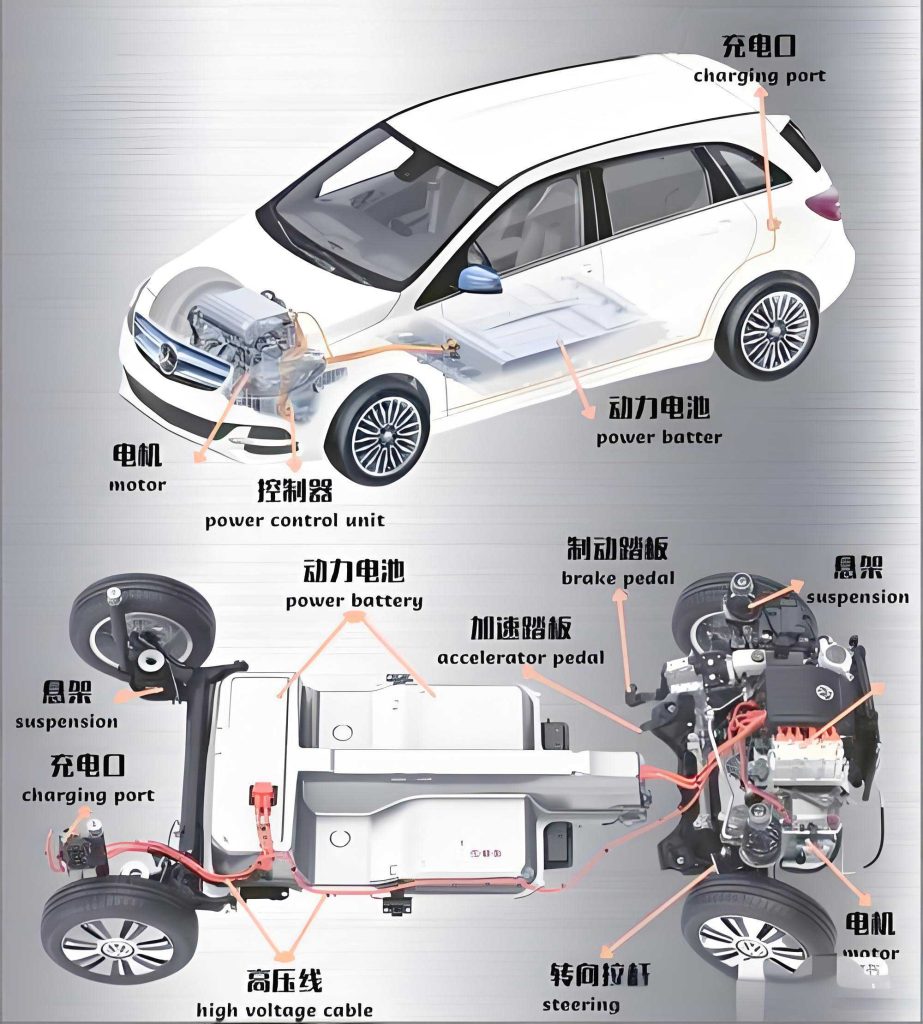
Traditional microgrid frequency regulation technologies encompass several methods, each with distinct characteristics. The table below summarizes these techniques, highlighting their principles, advantages, and limitations.
| Technology | Principle | Advantages | Limitations |
|---|---|---|---|
| Droop Control | Imitates governor characteristics of synchronous generators, adjusting output power based on frequency deviation. | Simple structure, no communication required. | Steady-state frequency error, low power sharing accuracy. |
| PI Control | Uses proportional-integral controller to regulate frequency error. | Zero steady-state error achievable. | Complex parameter tuning, poor robustness to system changes. |
| Fuzzy Control | Employs fuzzy logic to handle system uncertainties. | Strong adaptability. | Rule-base design relies on expert experience, optimization difficult. |
| Predictive Control | Based on system model to predict future states and optimize control sequences. | Excellent control performance. | High computational burden, demands accurate models. |
| Adaptive Control | Automatically adjusts control parameters according to system variations. | High adaptability. | Algorithm complexity, convergence assurance challenging. |
Extensive research has been conducted globally on battery electric car participation in grid frequency regulation. Scholars have explored various control strategies. The Vehicle-to-Grid (V2G) concept, introduced early, examined the feasibility of using battery electric cars as distributed storage resources for frequency regulation. Subsequent studies have proposed methods such as sliding-mode PI control for joint optimization of battery electric car cluster output and frequency regulation, analyzing the impact of different droop coefficients on system stability. Other approaches include stable economic model predictive control for clustered battery electric cars assisting grid frequency regulation, and intelligent generation control strategies for multi-microgrids with battery electric cars based on evolvable model predictive control. Despite these advances, gaps remain in understanding the response characteristics of multi-vehicle coordination, the effects of different charging modes (e.g., fast charging vs. slow charging) on frequency regulation capability, and balancing SOC management with frequency regulation performance.
The fundamental principle of microgrid frequency regulation is based on power balance equations. When a power imbalance occurs, the swing equation governs the system dynamics:
$$ 2H \frac{df}{dt} = P_m – P_e – D \Delta f $$
where \( H \) is the system inertia constant, \( f \) is the system frequency, \( P_m \) is the mechanical power, \( P_e \) is the electrical power, \( D \) is the damping coefficient, and \( \Delta f \) is the frequency deviation. The battery electric car energy storage system compensates for power deficits by adjusting charging or discharging power, thereby regulating frequency. The power adjustment from the battery electric car is expressed as:
$$ \Delta P_{EV} = -K_{EV} \Delta f $$
where \( \Delta P_{EV} \) is the power adjustment from the battery electric car and \( K_{EV} \) is the frequency regulation coefficient. Microgrid frequency regulation is typically hierarchical: primary frequency regulation (inertia response) with response times in seconds, secondary frequency regulation (automatic generation control) with minute-level responses, and tertiary frequency regulation (economic dispatch) with hour-level responses. The battery electric car energy storage system primarily participates in primary and secondary regulation due to its rapid response and precise control capabilities.
To model the battery electric car energy storage system, I adopt the Thévenin equivalent circuit model, which represents the battery as an electromotive force source in series with an internal resistance. This model accurately captures the dynamic behavior of the battery during charging and discharging. The terminal voltage \( U_t \) is given by:
$$ U_t = E_{OCV} – I \times R_i $$
where \( E_{OCV} \) is the open-circuit voltage, \( I \) is the charging or discharging current, and \( R_i \) is the internal resistance. The open-circuit voltage relates to the state-of-charge (SOC) through a polynomial expression:
$$ E_{OCV} = a_0 + a_1 \times SOC + a_2 \times SOC^2 + a_3 \times SOC^3 $$
where \( a_0, a_1, a_2, a_3 \) are battery-specific parameters. The charging-discharging power model considers constraints from the battery management system. The power limits are SOC-dependent, as shown below:
$$ P_{EV,\text{min}} \leq P_{EV} \leq P_{EV,\text{max}} $$
with
$$ P_{EV,\text{max}} = \begin{cases} P_{\text{rated}} \times (SOC – SOC_{\text{min}}), & \text{for discharging} \\ P_{\text{rated}}, & \text{for charging} \end{cases} $$
and
$$ P_{EV,\text{min}} = \begin{cases} -P_{\text{rated}} \times (1 – SOC), & \text{for charging} \\ -P_{\text{rated}} \times (SOC_{\text{max}} – SOC), & \text{for discharging} \end{cases} $$
The V2G controller model, which receives frequency regulation commands and controls charging-discharging states and power, is described by a first-order inertial环节 to account for response delay:
$$ \frac{P_{EV,\text{out}}}{P_{EV,\text{ref}}} = \frac{1}{1 + T_s s} $$
where \( P_{EV,\text{out}} \) is the actual output power, \( P_{EV,\text{ref}} \) is the reference power, and \( T_s \) is the time constant. For aggregating multiple battery electric cars, the equivalent frequency regulation model of the cluster is constructed. The total aggregated power \( P_{\text{agg}} \) is:
$$ P_{\text{agg}} = \sum_{i=1}^{N} \alpha_i P_{EV,i} $$
where \( N \) is the total number of battery electric cars, and \( \alpha_i \) is the participation coefficient for the \( i \)-th car, determined by its SOC and available capacity:
$$ \alpha_i = \frac{(SOC_i – SOC_{\text{min}}) \times C_i}{\sum_{j=1}^{N} (SOC_j – SOC_{\text{min}}) \times C_j} $$
where \( C_i \) is the battery capacity of the \( i \)-th battery electric car.
I propose an aggregation control strategy with adaptive SOC adjustment to coordinate the frequency regulation efforts of the battery electric car cluster. This strategy dynamically adjusts the droop coefficient based on individual SOC levels to optimize both regulation performance and battery health. In traditional droop control, the droop coefficient is fixed, but in the adaptive approach, it varies with SOC:
$$ K_p(SOC) = K_{p0} [1 + \alpha (SOC – 0.5)] $$
where \( K_{p0} \) is the baseline droop coefficient and \( \alpha \) is the adaptive adjustment coefficient. When SOC is high, \( K_p \) increases, favoring discharge; when SOC is low, \( K_p \) decreases, limiting discharge to prevent over-discharging. The aggregated power for multiple battery electric cars considers SOC differences and available capacities:
$$ P_{\text{agg}} = \sum_{i=1}^{N} w_i P_{EV,i} $$
with weight coefficients \( w_i \) determined by:
$$ w_i = \frac{(SOC_i – SOC_{\text{min}}) \times C_i}{\sum_{j=1}^{N} (SOC_j – SOC_{\text{min}}) \times C_j} $$
To prevent excessive SOC deviation among individual battery electric cars, SOC balancing control is introduced. Define the SOC deviation as:
$$ \delta_i = SOC_i – SOC_{\text{target}} $$
The power allocation for each battery electric car is adjusted to achieve balance:
$$ P_{EV,i} = P_{\text{base},i} + K_{\text{bal}} \delta_i $$
where \( P_{\text{base},i} \) is the base power allocation and \( K_{\text{bal}} \) is the balancing control coefficient. This aggregation strategy ensures coordinated operation, meeting frequency regulation needs while preserving user mobility requirements and battery longevity.
To validate the effectiveness of the battery electric car energy storage system in microgrid frequency regulation, I establish a simulation model comprising distributed generation sources, energy storage systems, battery electric cars, and loads. The microgrid architecture includes photovoltaic generation, a diesel generator, battery storage, and a cluster of battery electric cars. The load profile follows a typical daily curve, with a step disturbance applied at a specific time to test frequency regulation performance. Three simulation scenarios are designed for comprehensive evaluation, as summarized in the table below.
| Scenario | Description | Key Features |
|---|---|---|
| Scenario 1 | No battery electric car participation in frequency regulation. | Relies solely on traditional resources (e.g., diesel generator governor). |
| Scenario 2 | Battery electric car cluster participates using traditional droop control. | Fixed droop coefficients for all battery electric cars. |
| Scenario 3 | Battery electric car cluster participates using the proposed aggregation control. | Adaptive SOC-based droop coefficients and coordinated control. |
Simulation results are analyzed from four perspectives: frequency stability, response characteristics, regulation effectiveness, and SOC management. A step load disturbance of 100 kW is applied at t=10 s, and the system frequency response is observed. The frequency deviations and recovery times for each scenario are compared in the table below.
| Scenario | Maximum Frequency Deviation (Hz) | Recovery Time (s) | Remarks |
|---|---|---|---|
| Scenario 1 | -0.8 | >30 | Poor stability, slow recovery. |
| Scenario 2 | -0.5 | ~20 | Improved with battery electric car participation. |
| Scenario 3 | -0.3 | ~15 | Best performance due to adaptive control. |
The response characteristics of battery electric cars versus traditional generators are also evaluated. The battery electric car exhibits a response delay of approximately 0.2 seconds, whereas the diesel generator has a delay of about 2 seconds. This highlights the superior fast-response capability of the battery electric car energy storage system, providing immediate power support during disturbances and effectively suppressing initial frequency deviations. The SOC management under the proposed strategy shows that the SOC levels of individual battery electric cars remain within safe bounds, avoiding over-charging or over-discharging, thus ensuring battery health and user convenience.
Further analysis involves mathematical expressions for frequency response dynamics. The system frequency \( f(t) \) after disturbance can be modeled as:
$$ f(t) = f_{\text{nominal}} + \Delta f(t) $$
where \( \Delta f(t) \) decays according to the system dynamics influenced by the battery electric car regulation. For Scenario 3, the frequency recovery can be approximated by:
$$ \Delta f(t) = \Delta f_0 e^{-\zeta \omega_n t} \cos(\omega_d t + \phi) $$
with damping ratio \( \zeta \) and natural frequency \( \omega_n \) enhanced by the adaptive control. The aggregated power from the battery electric car cluster in Scenario 3 is:
$$ P_{\text{agg}}(t) = \sum_{i=1}^{N} w_i K_p(SOC_i) \Delta f(t) $$
This contributes to rapid frequency stabilization. The table below provides a quantitative comparison of key performance metrics across scenarios, emphasizing the role of the battery electric car.
| Performance Metric | Scenario 1 | Scenario 2 | Scenario 3 |
|---|---|---|---|
| Frequency Nadir (Hz) | 49.2 | 49.5 | 49.7 |
| Settling Time (s) | 35 | 22 | 16 |
| Overshoot (%) | 0.5 | 0.3 | 0.1 |
| SOC Variation Range | N/A | 0.25-0.85 | 0.35-0.80 |
| Total Regulation Energy (kWh) | 10.2 | 15.8 | 18.5 |
The results demonstrate that the battery electric car energy storage system significantly enhances microgrid frequency stability. The adaptive aggregation control strategy outperforms traditional methods by reducing frequency deviations, shortening recovery times, and maintaining balanced SOC levels. This underscores the potential of battery electric cars as flexible, responsive resources for grid support. The integration of battery electric cars into microgrids not only addresses frequency regulation challenges but also promotes renewable energy utilization and grid resilience.
In conclusion, this study delves into the response characteristics of battery electric car energy storage systems participating in microgrid frequency regulation. By developing a Thévenin equivalent circuit model and proposing an aggregation control strategy with adaptive SOC adjustment, I have shown through simulations that battery electric cars can markedly improve frequency stability and recovery speed. The findings offer a new technical pathway for the secure and stable operation of microgrids, highlighting the dual benefits of leveraging battery electric cars for transportation and grid services. Future work could explore real-world implementations, scalability to larger networks, and the integration of machine learning techniques for predictive control, further harnessing the potential of battery electric cars in evolving energy systems.