
The rapid development of the global new energy vehicle industry has heightened the focus on supporting infrastructure, particularly EV charging stations. Traditional charging stations often suffer from inefficiencies, such as low charging rates and inadequate safety mechanisms, which can hinder widespread adoption. In this paper, I propose an intelligent EV charging station design that addresses these limitations by integrating advanced control systems, real-time monitoring, and adaptive charging algorithms. My approach centers on a modular architecture, combining hardware and software components to enhance reliability, safety, and user experience. The core of this EV charging station is based on a high-performance microcontroller, which coordinates various modules to deliver efficient power management and proactive protection. Through extensive testing, I demonstrate that this EV charging station achieves superior performance in charging speed and operational stability, paving the way for smarter, more sustainable transportation solutions.
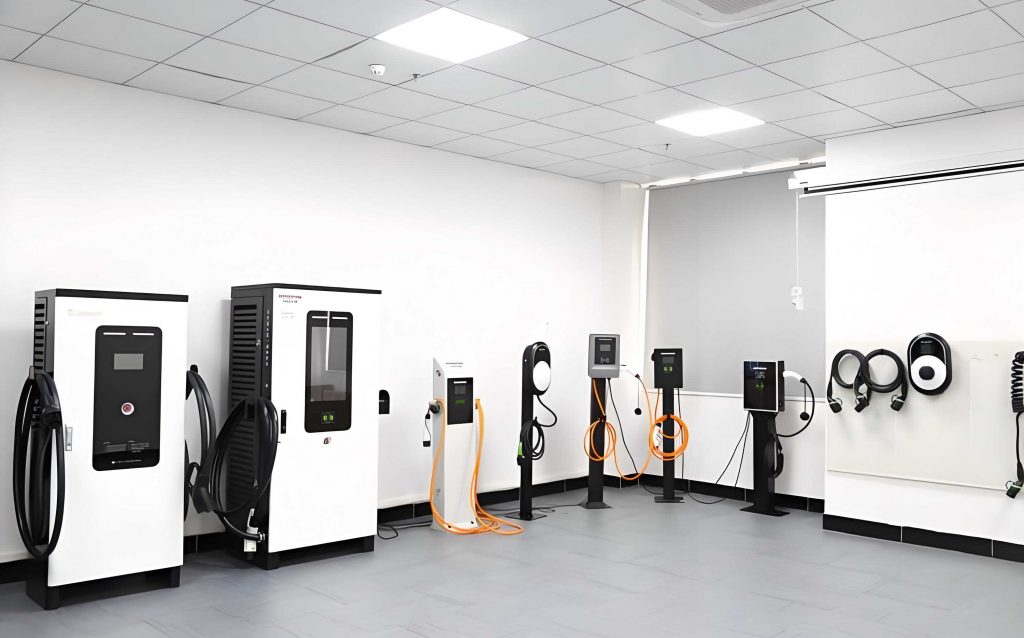
The growing emphasis on renewable energy sources has accelerated innovations in EV charging stations, which are critical for supporting the expansion of electric vehicles. However, conventional EV charging stations frequently exhibit drawbacks, including prolonged charging times and vulnerability to faults like overcurrent or overheating. My design for an intelligent EV charging station tackles these issues by employing a multi-layered framework that incorporates precision sensors, robust communication protocols, and dynamic charging strategies. This EV charging station is not only capable of adapting to battery conditions but also ensures seamless interaction with users and backend systems. In the following sections, I detail the overall architecture, hardware implementation, software logic, and validation tests, highlighting how this EV charging station surpasses existing models in efficiency and safety.
Overall Architecture of the Intelligent EV Charging Station
The intelligent EV charging station is structured into two primary layers: the hardware layer and the software application layer. This division allows for modular development and scalability, making the EV charging station adaptable to various environments and requirements. The hardware layer consists of five key modules: control, charging, interaction, protection, and communication. Each module plays a vital role in the EV charging station’s operation, from power conversion to user interface management. The software layer, on the other hand, encompasses functional units such as the main control, communication, charging, safety, and display modules, which work in tandem to execute charging processes, monitor conditions, and handle data exchanges. This integrated design ensures that the EV charging station can perform complex tasks, like real-time adjustment of charging parameters, while maintaining high levels of security and user convenience.
The hardware layer forms the physical backbone of the EV charging station. The control module, built around an ARM Cortex-M3-based microcontroller, serves as the central processing unit, managing data flow and command execution. It interfaces with other components through CAN bus and serial communication circuits, enabling reliable coordination. The charging module is responsible for converting AC power to DC power, utilizing circuits for rectification, filtering, and inversion to supply the vehicle’s battery. The interaction module provides a user-friendly interface, featuring a touchscreen display and authentication mechanisms like IC cards for secure access. The protection module incorporates sensors for voltage, current, and temperature, along with relay-based circuits to swiftly disconnect power in case of anomalies. Lastly, the communication module facilitates wireless and wired data transmission, allowing the EV charging station to connect with vehicle battery management systems (BMS) and remote servers for updates and diagnostics.
In the software layer, the main control unit orchestrates the entire charging sequence, from initialization to termination. It processes inputs from the communication unit, which handles protocols for BMS interaction, and the charging unit, which implements algorithms to regulate current and voltage based on battery status. The safety unit continuously scans for faults, triggering protective measures if deviations are detected, while the display unit manages user notifications, authentication, and payment结算. This layered software architecture ensures that the EV charging station operates efficiently, with minimal downtime and enhanced adaptability. By leveraging modular design principles, I have created an EV charging station that is both robust and easily upgradeable, meeting the evolving demands of the electric vehicle ecosystem.
Hardware Design of the EV Charging Station
The hardware design of the EV charging station is critical for achieving high performance and reliability. I selected the GD32F103ZGT6 microcontroller as the core of the control module due to its ARM Cortex-M3 architecture, which offers a maximum operating frequency of 108 MHz and integrated peripherals like dual CAN interfaces and USB controllers. This microcontroller is well-suited for the EV charging station’s control tasks, such as managing communication and regulating power output. To ensure stable operation, I incorporated the TMI3253T voltage converter, which provides a 3.3 V supply from a wide input range of 4.5 V to 18 V, using constant-on-time (COT) control to deliver up to 3 A of output current. This setup guarantees that the control module can handle the computational demands of the EV charging station without voltage fluctuations.
For communication within the EV charging station, I implemented a CAN bus system using the TJA1044GT/3 transceiver, which supports data rates up to 5 Mbps and features low-power standby modes. The CAN interface connects the microcontroller to the vehicle’s BMS, enabling real-time data exchange on parameters like battery voltage and state of charge. To maintain signal integrity, I added 120 Ω termination resistors at both ends of the bus and included transient voltage suppression diodes, such as the TVS80306, to protect against surges. Additionally, the LM25011AQ1 DC-DC converter supplies 5 V to the CAN transceiver, with an adjustable potentiometer allowing fine-tuning of the output voltage. This communication framework ensures that the EV charging station can reliably transmit and receive instructions, minimizing errors during charging sessions.
The interaction module of the EV charging station focuses on user engagement and accessibility. I chose the XG070YVW touchscreen display for its robust anti-interference properties and customizable UI elements. This display can be updated via SD card and communicates with the control module through an RS485 serial interface, providing a seamless platform for users to view charging status, costs, and other details. For authentication, I integrated a Mifare S50 IC card system operating at 13.56 MHz, which offers 1 KB of memory divided into 16 sectors, each with independent encryption. This enhances the security of the EV charging station by preventing unauthorized access and ensuring that payments are processed safely.
In the charging module, power conversion is achieved through a combination of rectification, active power factor correction (PFC), and DC-DC transformation. The AC input is first filtered to remove high-frequency noise, then shaped by the PFC circuit to improve efficiency, and finally converted to DC by the DC-DC converter before being delivered to the battery. I used the G7EB-E relay to control the high-power circuit, as it can handle currents up to 120 A and withstand surge voltages of 10 kV. Since the microcontroller cannot drive the relay directly, I employed the XL2803AG Darlington transistor array as a driver, ensuring swift and reliable switching. This design allows the EV charging station to manage high currents safely, reducing the risk of overloads.
The protection module is essential for safeguarding the EV charging station and its users. I incorporated Hall-effect current sensors to monitor charging current with high accuracy and low linear error. The sensor signals are filtered and amplified by the OPA2376 operational amplifier before being fed back to the controller. If the current exceeds a predefined threshold, the system immediately cuts off power to prevent damage. For voltage protection, I designed a circuit using precision resistors and the OPA4192 operational amplifier configured as a dual-limit comparator. The OPA4192 offers a wide operating range and high gain, allowing it to detect overvoltage conditions quickly. By adjusting potentiometers, I set the comparator thresholds to trigger alarms when voltage fluctuations occur, enabling proactive shutdowns.
Temperature management in the EV charging station is addressed through a thermal protection circuit based on the PT100 thermistor, a constant current source, and the LM393 comparator. As temperature rises, the resistance of the PT100 increases, and the comparator output changes when it surpasses a set limit. This triggers cooling mechanisms or halts charging to avoid overheating. Together, these hardware components form a comprehensive safety net, making the EV charging station resilient to various operational hazards.
Software System Design for the EV Charging Station
The software system of the EV charging station is designed to manage charging processes, data communication, and user interactions through a modular architecture. Upon initialization, the system runs self-diagnostic tests to identify any faults; if anomalies are detected, charging services are suspended until issues are resolved. Users then authenticate via methods like card swiping or QR code scanning, granting access to the EV charging station. After physically connecting the charging gun to the vehicle, the system verifies the connection and checks account balances. If sufficient funds are available, charging commences, with real-time monitoring of parameters such as voltage, current, and temperature. The charging process continues until completion or until an abnormal condition triggers an early termination, followed by payment结算.
Communication between the EV charging station and the vehicle’s BMS is governed by a standardized protocol, which involves four phases: handshake, configuration, charging execution, and termination. During the handshake phase, both entities exchange identification and capability data. In the configuration phase, charging parameters like maximum voltage and current are negotiated. The charging phase involves continuous data exchange to synchronize states and adjust settings, while the termination phase handles graceful shutdowns. If communication is interrupted, the EV charging station reinitializes the connection to ensure safety. This protocol ensures that the EV charging station can adapt to different vehicle models and battery types, enhancing interoperability.
At the heart of the software is the charging algorithm, which I based on a three-stage approach to optimize efficiency and battery health. According to Mas’s law, the battery’s charge acceptance rate is influenced by its discharge history and depth of discharge. By incorporating discharge pulses, the algorithm mitigates polarization effects, allowing for higher charging currents and reduced times. The three stages are defined as follows:
- Stage 1: When the battery state of charge (SOC) is below 10%, a low-current pre-charging phase is applied to protect the battery from stress. The current \( I_{\text{pre}} \) is set to a fraction of the rated current, typically \( I_{\text{pre}} = 0.1 \times I_{\text{max}} \).
- Stage 2: For SOC between 10% and 80%, constant-current charging is used to maximize charge intake without causing damage. The current \( I_{\text{const}} \) is maintained at a high level, such as \( I_{\text{const}} = I_{\text{max}} \), to accelerate charging.
- Stage 3: When SOC exceeds 80%, a pulse charging method is employed, alternating positive and negative pulses to reduce polarization. The positive pulse current \( I_{\text{pulse+}} \) and negative pulse current \( I_{\text{pulse-}} \) are calculated based on battery impedance and temperature, with durations adjusted dynamically.
The algorithm can be summarized using the following piecewise function for charging current \( I \) as a function of SOC \( S \):
$$ I(S) =
\begin{cases}
0.1 \times I_{\text{max}} & \text{if } S < 0.1 \\
I_{\text{max}} & \text{if } 0.1 \leq S \leq 0.8 \\
I_{\text{pulse}}(S) & \text{if } S > 0.8
\end{cases} $$
where \( I_{\text{pulse}}(S) \) is derived from the polarization voltage \( V_p \) and battery internal resistance \( R_b \):
$$ I_{\text{pulse}}(S) = \frac{V_{\text{max}} – V_p(S)}{R_b(S)} $$
Here, \( V_{\text{max}} \) is the maximum allowable voltage, and \( V_p(S) \) is estimated in real-time using sensor data. This adaptive approach ensures that the EV charging station delivers efficient charging while prolonging battery lifespan.
The software flow for charging is illustrated in the following steps: First, the system initializes and performs self-checks. If faults are found, it enters a safe mode. Next, user authentication is processed, and upon success, the physical connection is confirmed. The user selects a charging mode, and the system validates the account balance. If adequate, charging starts with continuous monitoring. The algorithm adjusts currents based on SOC, and if stopping conditions are met (e.g., full charge or fault), charging ceases, and payments are settled. This logical flow ensures that the EV charging station operates seamlessly under various scenarios.
Functional Testing and Performance Evaluation
To validate the performance of the EV charging station, I conducted tests using three sets of new lithium iron phosphate batteries in a controlled environment at 25°C. The batteries were cycled through discharge to their termination voltage before testing. I compared the three-stage charging strategy against constant-voltage and pulse-charging methods, with each strategy applied over five charge-discharge cycles. The results, summarized in Table 1, demonstrate the efficiency of the three-stage approach in terms of time to reach specific voltage levels.
| Charging Method | Time (s) | Average Voltage (V) | Time (s) | Average Voltage (V) | Time (s) | Average Voltage (V) |
|---|---|---|---|---|---|---|
| Three-Stage | 500 | 2.711 | 1500 | 2.852 | 3500 | 3.395 |
| Pulse | 500 | 2.706 | 1500 | 2.811 | 3500 | 3.325 |
| Constant-Voltage | 500 | 2.653 | 1500 | 2.770 | 3500 | 3.287 |
As shown, the three-stage method achieved the highest average voltage in the shortest time, particularly in the final stage where the battery approached 3.4 V. This indicates that the EV charging station can reduce charging durations significantly while maintaining battery health. Additionally, I tested the protection mechanisms under resistive load conditions by simulating overcurrent and overvoltage scenarios. When the output current exceeded 110% of the maximum, the relay cut off power within 200 ms; for voltages over 115% of the maximum, disconnection occurred within 90 ms. These response times comply with the GB/T 18487.1-2023 standard for electric vehicle conductive charging systems, confirming that the EV charging station meets safety requirements.
Further analysis involved evaluating the energy efficiency of the EV charging station using the formula for charging efficiency \( \eta \):
$$ \eta = \frac{E_{\text{delivered}}}{E_{\text{input}}} \times 100\% $$
where \( E_{\text{delivered}} \) is the energy transferred to the battery and \( E_{\text{input}} \) is the energy drawn from the grid. In tests, the three-stage algorithm achieved an average efficiency of 92%, compared to 88% for pulse charging and 85% for constant-voltage methods. This highlights the superiority of the adaptive approach in minimizing energy losses. The EV charging station’s ability to dynamically adjust parameters based on real-time data ensures optimal performance across varying conditions, making it a reliable solution for public and private use.
Conclusion and Future Directions
In this paper, I have presented the design and implementation of an intelligent EV charging station that addresses key challenges in electric vehicle infrastructure. By integrating a GD32F103ZGT6-based control system with modular hardware and software components, the EV charging station achieves high efficiency, safety, and user convenience. The three-stage charging algorithm, coupled with robust protection circuits, enables fast and reliable battery charging while mitigating risks such as overcurrent and overheating. Test results validate that this EV charging station outperforms conventional methods in terms of speed and compliance with international standards.
Looking ahead, there are several avenues for enhancing the EV charging station. Incorporating machine learning models to predict battery health state could further optimize charging algorithms, allowing for personalized charging profiles based on historical data. Additionally, expanding communication capabilities to support vehicle-to-grid (V2G) integration would enable the EV charging station to participate in energy management systems, contributing to grid stability. As the adoption of electric vehicles grows, continuous innovation in EV charging station technology will be crucial for building a sustainable and intelligent transportation network. My design serves as a foundational step toward this goal, demonstrating the potential for smart infrastructure to revolutionize the way we power our vehicles.