
In recent years, electric bicycles have become a primary mode of short-distance urban transportation due to their convenience, affordability, and environmental benefits. The rapid growth in the number of electric bicycles has highlighted the urgent need for robust charging infrastructure, particularly EV charging stations. These stations serve as essential energy replenishment points, and the accuracy of their energy metering is critical. Traditional metering devices in EV charging stations often rely on single parameters like current or voltage for energy estimation, which can lead to significant errors due to factors such as charging environment variations and battery characteristics. These inaccuracies frequently result in billing disputes between users and operators, hindering the healthy development of the EV charging station industry. To address these challenges, we propose an intelligent metering device for EV charging stations based on multi-parameter fusion. This device integrates advanced algorithms to process multiple physical parameters, including voltage, current, and temperature, achieving high-precision energy metering. Additionally, it incorporates communication modules for remote monitoring and management, providing real-time operational data to support efficient EV charging station operations.
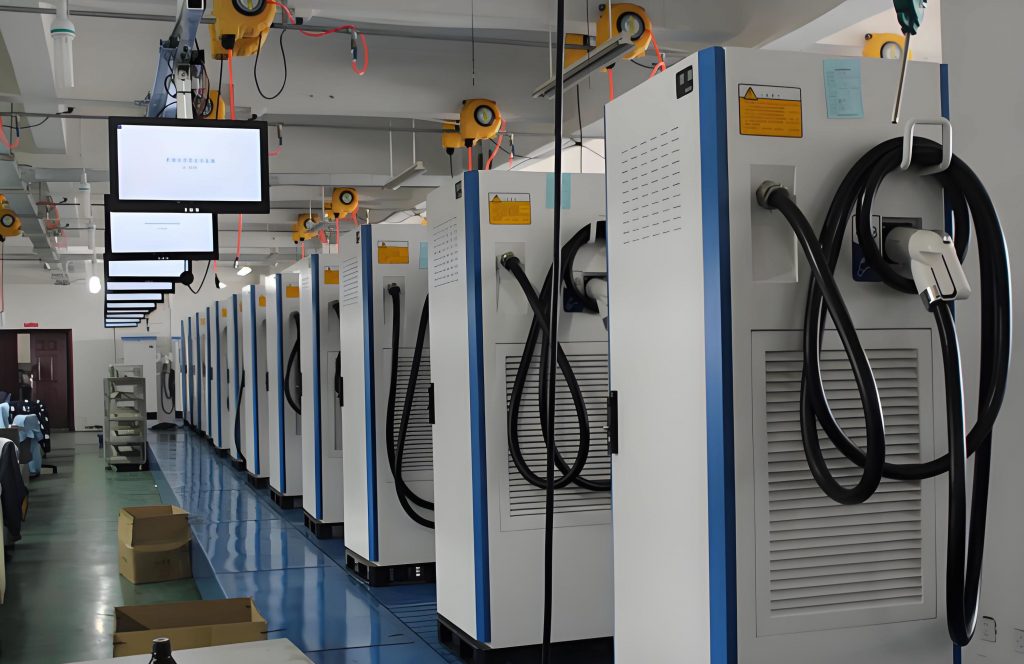
The design of this metering device for EV charging stations aims to achieve several key objectives. First, it ensures high accuracy in energy measurement, minimizing errors to meet strict billing requirements. Second, it enables real-time monitoring of charging parameters such as voltage, current, and battery temperature, allowing for prompt detection of anomalies. Third, it supports remote communication functions, facilitating data transmission to management platforms and enabling remote control operations like starting or stopping charging sessions. Finally, the device is built for stability and reliability, capable of withstanding harsh outdoor environments common to EV charging stations. The system architecture is structured in layers: the data acquisition layer collects parameters via sensors; the data processing layer preprocesses and fuses the data using algorithms; the communication layer handles data transmission; and the application management layer provides interfaces for monitoring and user services. This hierarchical design enhances scalability and maintainability for EV charging station applications.
In terms of hardware, the system comprises a controller, voltage and current acquisition circuits, temperature acquisition circuits, communication circuits, and power supply circuits. The main controller is the MSP430FR5969 microcontroller from TI, chosen for its low power consumption and rich peripheral resources, making it ideal for EV charging station environments. Voltage acquisition uses a resistive voltage divider combined with linear optocoupler isolation to reduce noise and ensure safety. Current acquisition employs the ACS712 Hall-effect current sensor, known for its high accuracy and linearity. Temperature acquisition is handled by the DS18B20 digital temperature sensor, which uses a single-wire communication protocol for simplicity. The communication circuit includes a 4G module (EC200S-CN) for remote data exchange and an RS485 interface for local connectivity. Improvements over traditional designs include enhanced accuracy in voltage and current measurements, with voltage accuracy increased by approximately 15% and current error reduced to ±0.5%. The 4G module’s stability has been boosted by 20%, and power supply circuits incorporate EMI filters and decoupling capacitors to improve reliability by 10%.
The software architecture is modular, consisting of data acquisition, data processing, communication, control, and fault diagnosis modules. These modules interact via message queues and shared data areas, ensuring efficient operation in EV charging stations. The data acquisition program is triggered by timer interrupts, using the ADC module of the MSP430FR5969 to sample voltage and current signals. Multiple samples are averaged to improve accuracy, with outlier rejection (e.g., removing maximum and minimum values). Temperature data is read via the DS18B20’s protocol. The data processing module calculates real-time charging power using the formula: $$ P = UI $$ where \( P \) is power, \( U \) is voltage, and \( I \) is current. To mitigate harmonics and interference, a Fast Fourier Transform (FFT)-based algorithm is applied for spectral analysis, extracting fundamental components for precise power calculation. The steps for FFT digital filtering are as follows:
- Data Acquisition and Preprocessing: Read voltage and current signals from the buffer. Apply a window function (e.g., Hanning window) to reduce spectral leakage. Assume a sampling frequency \( f_s \) and sample points \( N \).
- Fast Fourier Transform (FFT): Perform FFT on the windowed signals to obtain their spectra.
- Spectral Analysis and Fundamental Extraction: Analyze the spectra and extract the fundamental component (e.g., 50 Hz or 60 Hz) using frequency thresholds.
- Inverse FFT (IFFT): Convert the extracted fundamental components back to the time domain via IFFT.
- Power Calculation: Compute power using the processed signals: $$ P = U_{\text{fundamental}} \times I_{\text{fundamental}} $$
- Filter Validation: Compare spectra and time-domain signals before and after filtering to verify effectiveness.
- Optimization: Ensure the sampling frequency meets the Nyquist criterion (\( f_s > 2f_{\text{max}} \)), and increase \( N \) for better resolution. Harmonic suppression can be enhanced by setting additional frequency thresholds.
Additionally, temperature data is used to correct energy calculations via a temperature-energy correction model derived from experimental data. The model is expressed as: $$ Q_{\text{corrected}} = Q (aT^2 + bT + c) $$ where \( Q_{\text{corrected}} \) is the corrected energy, \( Q \) is the raw energy, \( T \) is the temperature, and \( a \), \( b \), and \( c \) are model parameters fitted using the least squares method. This correction accounts for variations in battery efficiency at different temperatures, improving accuracy in EV charging station metering.
The communication program handles data exchange with the management platform, packaging data such as energy, charging time, status, and temperature into frames sent via the 4G module. It also receives and parses control commands from the server. The control program executes operations like starting or stopping charging based on commands and real-time data, adjusting parameters dynamically (e.g., reducing current if temperature is too high). The fault diagnosis program monitors system status, detects issues like short circuits or sensor failures, and triggers protective actions while logging data for analysis. This comprehensive software design ensures reliable and intelligent operation of EV charging stations.
To validate the metering device for EV charging stations, we conducted experiments using a test platform with a programmable DC power supply simulating electric bicycle batteries, the metering device, and a server as the management platform. Error tests involved comparing the device’s measurements with a high-precision power analyzer under various voltage and current settings. The results, summarized in Table 1, demonstrate high accuracy across different charging scenarios.
| Test Group | Set Voltage (V) | Set Current (A) | Standard Energy (Ah) | Device Energy (Ah) | Error (%) |
|---|---|---|---|---|---|
| 1 | 48 | 2 | 1.000 | 1.003 | 0.3 |
| 2 | 60 | 3 | 1.500 | 1.505 | 0.33 |
| 3 | 48 | 1.5 | 0.750 | 0.752 | 0.27 |
| 4 | 60 | 2.5 | 1.250 | 1.254 | 0.32 |
| 5 | 48 | 2.2 | 1.100 | 1.103 | 0.27 |
As shown, all errors are within ±0.5%, surpassing the industry standard of ±1%, confirming the device’s suitability for precise billing in EV charging stations. Stability tests were conducted over 72 hours under simulated real-world conditions, including voltage fluctuations and electromagnetic interference. Data was recorded hourly, and the results, summarized in Table 2, indicate minimal fluctuations and no failures, highlighting the device’s robustness for EV charging station applications.
| Test Time (h) | Charging Power (W) | Input Voltage (V) | High-Power Device On Time (min) | Data Anomalies or Failures |
|---|---|---|---|---|
| 1 | 100.2 | 220 | 15 | No |
| 2 | 100.1 | 218 | 20 | No |
| 3 | 100.3 | 222 | 18 | No |
| 4 | 100.2 | 219 | 22 | No |
| … | … | … | … | No |
| 72 | 100.1 | 220 | 19 | No |
Functional tests verified remote communication and fault diagnosis capabilities. Commands from the server, such as starting or stopping charging, were executed promptly with data transmitted accurately and delays under 1 second. Simulated faults, like short circuits, were quickly detected, with alerts sent to the server and protective measures activated. These tests confirm the device’s reliability and intelligence in managing EV charging stations.
In conclusion, the intelligent multi-parameter fusion based metering device for EV charging stations achieves high accuracy, stability, and functionality through optimized hardware and advanced software algorithms. It addresses limitations of traditional metering methods and supports remote management, contributing to the smart evolution of EV charging stations. Future work could involve integrating additional sensors, such as for battery internal resistance, to assess battery health more comprehensively. Artificial intelligence algorithms could be incorporated for data analysis and personalized charging recommendations, while 5G technology might enhance communication speed. These advancements will further improve the efficiency and user experience of EV charging stations, supporting the growth of sustainable transportation infrastructure.