
The increasing prevalence of electric vehicles (EVs) has underscored the critical importance of safety, particularly concerning the power battery system. The EV battery pack, a complex assembly comprising numerous battery cells, modules, electrical components, and a protective casing, is susceptible to severe damage from road debris impacts, potentially leading to thermal runaway events like fires or explosions. Traditional physical testing for such collision scenarios is costly, time-consuming, and limited in scope. Consequently, computational modeling, especially using the finite element method, has become indispensable for analyzing impact responses and guiding safety design. However, high-fidelity modeling of an entire EV battery pack with all its detailed components demands prohibitive computational resources. This study addresses this challenge by developing efficient yet high-fidelity modeling strategies for EV battery pack bottom collision analysis, balancing computational cost with predictive accuracy.
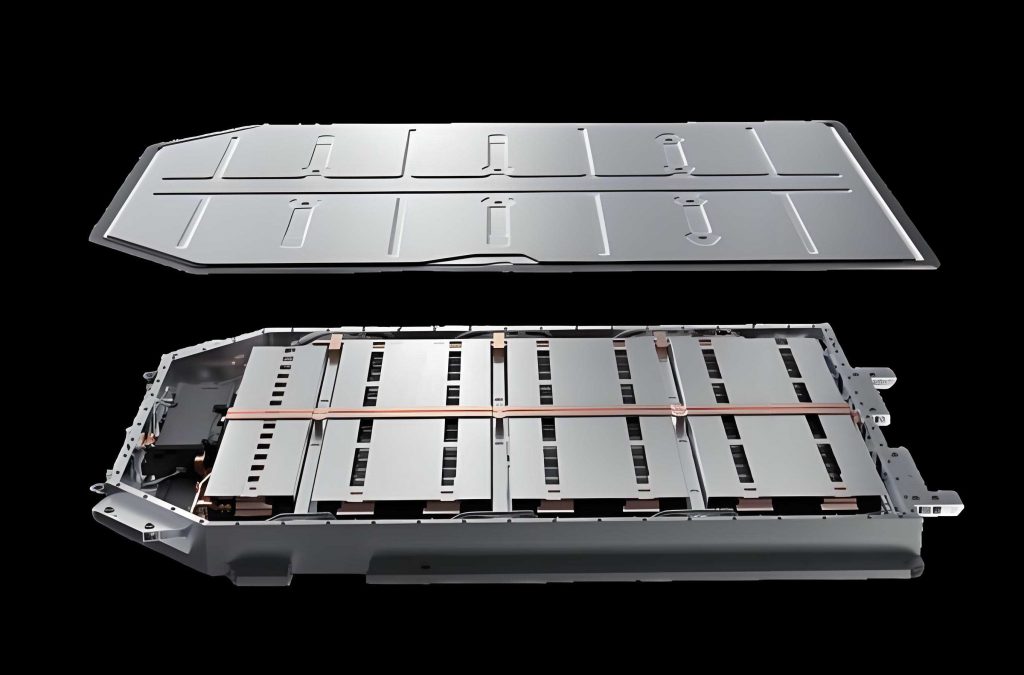
The core of the modeling challenge lies in the EV battery pack’s structural complexity. A typical EV battery pack contains hundreds or thousands of individual lithium-ion cells, often arranged into modules, all housed within a structural casing. Capturing the detailed mechanical behavior of each cell and its interactions during a high-speed impact event requires immense computational power if modeled explicitly. Therefore, simplification strategies are essential. This work introduces and compares two hierarchical simplification approaches: a hybrid reduced-order model and a centroid module structural model with equivalent contact. Both methods prioritize detailed modeling in the central impact zone while simplifying peripheral regions, significantly enhancing computational efficiency without substantially compromising the accuracy of critical response parameters like stress and displacement.
The foundation of any EV battery pack model is the representation of the individual battery cell. A common 18650-type cylindrical lithium-ion cell consists of a metallic shell (e.g., steel or aluminum) housing a jellyroll interior (anode, separator, cathode, and electrolyte). Modeling each layer explicitly is impractical for pack-level simulations. Hence, a homogenization approach is adopted. The cell is represented by two primary components: the outer shell and a homogenized core representing the internal jellyroll. The shell material is modeled using the Johnson-Cook constitutive model, which accounts for strain hardening, strain rate sensitivity, and thermal softening, making it suitable for high-strain-rate events like impact. The flow stress is given by:
$$\sigma = (A + B \varepsilon^n) \left[1 + C \ln\left(\frac{\dot{\varepsilon}}{\dot{\varepsilon}_0}\right)\right](1 – T^*)$$
Here, $\sigma$ is the von Mises flow stress, $\varepsilon$ is the equivalent plastic strain, $\dot{\varepsilon}$ is the plastic strain rate, $\dot{\varepsilon}_0$ is a reference strain rate, and $T^*$ is the homologous temperature. Parameters $A$, $B$, $C$, $n$, and $m$ are material constants. Damage initiation and evolution are also described by a Johnson-Cook fracture criterion:
$$\varepsilon_f = [D_1 + D_2 \exp(D_3 \sigma^*)] [1 + D_4 \ln \dot{\varepsilon}^*] [1 + D_5 T^*]$$
where $\varepsilon_f$ is the equivalent plastic strain at failure, $D_1$ to $D_5$ are failure parameters, $\sigma^*$ is the stress triaxiality ratio, and $\dot{\varepsilon}^*$ is the dimensionless strain rate.
The homogenized battery core exhibits anisotropic elastic properties and foam-like plastic behavior. Its plastic hardening is often represented by a simple power-law model:
$$\sigma = A + B \varepsilon^N$$
where $A$, $B$, and $N$ are material parameters derived from experimental crush data. This representation effectively captures the core’s compressive behavior under impact loading within an EV battery pack.
For module-level modeling, a pragmatic approach is taken. An EV battery pack module typically holds several cells in a frame. In a bottom collision, the impact is highly localized. Therefore, only the modules directly in the impact zone and their immediate neighbors are modeled in detail using the homogenized cell models housed within a simplified module casing. The module casing, often made of aluminum alloy like 7075, is also modeled with the Johnson-Cook material model. The impactor is simplified as a rigid hemispherical-cone shape with a defined mass and initial velocity, representing road debris like stones.
The first major simplification for the full EV battery pack is the Hybrid Reduced-Order Model. The guiding principle is “local fidelity, global efficiency.” The central region of the EV battery pack, where the impactor strikes, is modeled with fine detail, including explicit battery cells and module casings. All other modules in the pack, which experience negligible direct deformation, are simplified using the lumped mass method. Their entire mass is concentrated at their individual centroids, and these mass points are rigidly connected to the EV battery pack’s lower casing at their respective locations. This eliminates the need to mesh and compute the dynamics of these distant modules in detail. The connections between the detailed central modules and the surrounding lumped masses, as well as the contacts between cells and casing, are managed through a general contact algorithm. The governing dynamics for the lumped masses are simplified from the general equation of motion:
$$M \ddot{X} + C \dot{X} + K X = F$$
For the lumped mass points representing non-critical modules, the stiffness ($K$) and damping ($C$) matrices relative to the pack casing are considered negligible for the impact response, leaving only the mass ($M$) terms connected rigidly. This dramatically reduces the degrees of freedom.
The second, more advanced model is the Centroid Module Structural Model with Equivalent Contact. The hybrid model, while efficient, can sometimes lead to unrealistic kinematic behavior, such as tilting of the central detailed block, because the surrounding lumped masses offer no structural boundary or contact resistance. To address this, the lumped masses are replaced by simplified, lightweight structural modules. These simplified modules have the same total mass and centroid location as the detailed modules they represent, but their geometry is a simple block. Crucially, contact interfaces are defined between these simplified blocks and the detailed central modules, as well as between adjacent simplified blocks. This restores the physical constraint and force transfer that would occur through module-to-module contact in a real EV battery pack, improving the fidelity of the global structural response during impact.
To evaluate these methods, a detailed full model of an EV battery pack serves as the benchmark. This benchmark model includes all modules and cells explicitly. Three scenarios are analyzed: a frontal bottom impact (positive impact) and an oblique bottom impact. Key performance metrics are computational time (CPU minutes), maximum stress in battery components, and maximum displacement at the impact center. The impact energy balance, particularly the hourglass energy, is monitored to ensure simulation validity, keeping it below 5% of the total energy.
| Model Type | Scenario | Computational Time (min) | Max Cell Shell Stress (MPa) | Max Cell Core Stress (MPa) | Center Displacement (mm) |
|---|---|---|---|---|---|
| Detailed Full Model (Benchmark) | 20 m/s Frontal Impact | 348 | 613.8 | 343.4 | N/A |
| Hybrid Reduced-Order Model | 20 m/s Frontal Impact | 76 | 648.2 | 289.6 | N/A |
| Detailed Full Model | 30 m/s Frontal Impact | 361 | N/A | 405.9 | 57.74 |
| Hybrid Reduced-Order Model | 30 m/s Frontal Impact | 83 | N/A | 463.7 | 44.80 |
| Centroid Module Structural Model | 30 m/s Frontal Impact | 114 | N/A | 414.5 | 61.68 |
| Detailed Full Model | Oblique Impact (20√2 m/s) | 350 | 704.2 | N/A | 70.60 |
| Hybrid Reduced-Order Model | Oblique Impact (20√2 m/s) | 85 | 637.3 | N/A | 68.14 |
| Centroid Module Structural Model | Oblique Impact (20√2 m/s) | 114 | 698.7 | N/A | 70.49 |
The results clearly demonstrate the efficiency gain. For the 20 m/s frontal impact, the hybrid model achieves a computational speed-up of approximately 4.6 times (348 min vs. 76 min) compared to the detailed full model for the EV battery pack. The maximum stress in the battery shell shows an error of only 5.6%, while the core stress error is 15.7%. The higher error in core stress is attributed to differences in force distribution and local damage patterns between the models.
At a higher impact velocity of 30 m/s, the hybrid model’s efficiency remains strong (4.3x faster). However, its accuracy diminishes, with a 14.2% overestimation in core stress and a 22.4% underestimation in displacement. This discrepancy arises because the lack of surrounding structural contact in the hybrid model allows the central detailed block to behave less rigidly, affecting force propagation and rebound dynamics. In contrast, the centroid module structural model, while taking about 1.4 times longer to compute than the hybrid model (114 min vs. 83 min), offers remarkable accuracy. Its maximum core stress error is only 2.1%, and the displacement error is 6.8% relative to the full EV battery pack model. The model successfully restores the boundary constraints, leading to more realistic global stiffness and impactor rebound behavior.
The oblique impact scenario further validates the superiority of the centroid module structural model for the EV battery pack. In oblique impacts, the sliding and interaction between modules become more significant. The hybrid model, with its lumped masses, fails to capture these interactions properly, leading to unrealistic module rotation and skewed force paths. This results in a 9.5% error in shell stress and a 3.5% error in displacement. The centroid module structural model, with its equivalent contact surfaces, closely mimics the full model’s behavior, showing minimal errors of 0.8% in stress and 0.2% in displacement. This confirms that incorporating simplified structural boundaries with contact is crucial for capturing complex, multi-directional impact mechanics in an EV battery pack.
A deeper analysis of the dynamic response provides further insight. The time-history curves of impact force at the pack’s bottom plate show a characteristic rapid rise as the impactor penetrates the casing, followed by a drop as material fails and a subsequent oscillation due to interaction with the battery cells. The centroid module structural model replicates this signature closely. To quantitatively validate the model, the displacement and velocity of the impactor itself, as well as the displacement at the epicenter of the impact zone, are compared between the centroid model and the detailed full model for the 30 m/s frontal case. The time-displacement curve for the impact center point follows the same trend: rapid inward displacement (cell compression) followed by a partial rebound. The average error in displacement history is calculated as:
$$\sigma_{disp} = \frac{1}{n} \sum_{i=1}^{n} \frac{|x_{1,i} – x’_{1,i}|}{x_{1,i}} \times 100\%$$
where $x_{1,i}$ is the displacement from the full model and $x’_{1,i}$ is from the centroid model at time step $i$. The calculated average error is 1.6%. For the impactor rigid body motion, the displacement history shows an average error of 0.99%, and the velocity history an average error of 7.99%. These small errors confirm that the centroid module structural model accurately captures the overall system dynamics and energy exchange during the collision event of the EV battery pack.
The stress distribution within the critical zone also merits discussion. In the detailed full model of the EV battery pack, the initial failure of the battery pack casing leads to a redistribution of stress. The hybrid model, due to its simplified boundary, sometimes shows a more concentrated stress field, while the centroid model provides a smoother, more physically plausible stress gradient that matches the full model well. This is essential for accurately predicting failure initiation sites within the EV battery pack.
The methodologies presented herein have broader implications for the design and analysis of EV battery packs. The ability to run rapid, high-fidelity simulations enables parametric studies that would be infeasible with full-detail models. For instance, designers can efficiently evaluate the effect of module arrangement, casing thickness, or material grades on the crashworthiness of the EV battery pack under various impact angles and speeds. The centroid module structural model strikes an excellent balance, making it suitable for iterative design optimization loops. Furthermore, the principle of local fidelity with global simplification can be extended to other complex systems in vehicle crash analysis.
It is important to acknowledge the limitations of the current approach. The homogenized cell model, while efficient, may not capture all failure modes of a lithium-ion cell, such as internal short circuit initiation, which depends on detailed layer separation. The current models also do not account for thermal effects or electrical responses that could follow mechanical abuse. Future work could integrate these simplified mechanical models with coupled thermal-electrical simulations for a more comprehensive safety assessment of the EV battery pack. Additionally, the simplification of module geometry in the centroid model could be refined using morphing techniques to better approximate the actual stiffness distribution.
In conclusion, this study successfully develops and validates two efficient modeling strategies for EV battery pack collision analysis. The hybrid reduced-order model offers maximum computational speed, suitable for rapid screening, with acceptable accuracy for lower-severity impacts. The centroid module structural model with equivalent contact provides a superior compromise, delivering near-full-model accuracy for critical response parameters like stress and displacement at a computational cost roughly one-third of the detailed model. By enabling faster, high-fidelity simulations, these methods empower engineers to enhance the crash safety of EV battery packs through more thorough virtual testing and design exploration, contributing significantly to the overall safety of electric vehicles.