
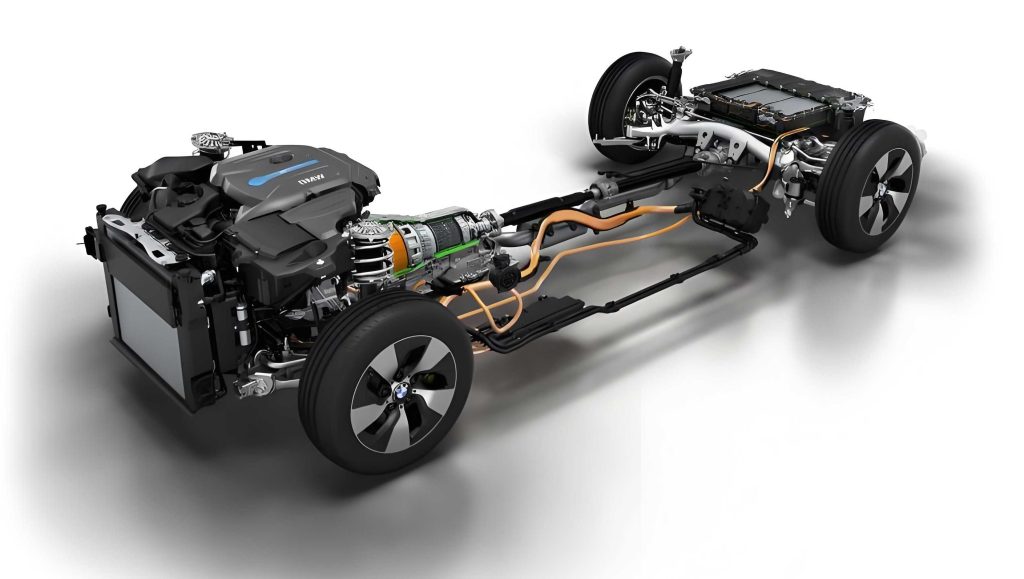
Under the overarching goals of carbon peak and carbon neutrality, the transition to new energy vehicles has become a cornerstone strategy for mitigating atmospheric pollution and climate change. The hybrid electric vehicle, leveraging its dual-power architecture, presents a significant advantage in energy efficiency and stands as a pivotal technology in the automotive industry’s electrification transformation. Consequently, understanding the real-world emission characteristics of the hybrid electric vehicle is of paramount importance. However, the propulsion system and energy management strategy of a hybrid electric vehicle differ fundamentally from those of conventional internal combustion engine vehicles, leading to distinct emission profiles. Standardized laboratory cycles and even regulated Real Driving Emission (RDE) test protocols possess inherent limitations in fully capturing the complexities of urban driving, often characterized by frequent stops, congestion, and low-speed operation. This study aims to bridge this gap by constructing a representative urban driving cycle based on collected real-world trajectory data, analyzing transient emission rates from RDE testing of hybrid electric vehicles in Charge-Sustaining (CS) mode, and subsequently integrating these emission rates into the constructed cycle to assess their true urban emission footprint.
1. Materials and Methods
1.1 Test Vehicles and Data Acquisition
Real-world trajectory data for driving cycle construction were collected from 20 light-duty hybrid electric vehicles in daily use within a major metropolitan city in China. A Columbus V-990 MARK II GPS logger recorded second-by-second vehicle speed and position data over a continuous 14-day period for each vehicle, capturing a wide variety of driving conditions.
For the RDE emission testing, four light-duty hybrid electric vehicles compliant with the China VI emission standard were selected. Key vehicle parameters are summarized in Table 1. Prior to testing, the battery State of Charge (SOC) for each test hybrid electric vehicle was preconditioned to the nominal balance point to ensure operation in CS mode throughout the test.
| Parameter | Vehicle V1 | Vehicle V2 | Vehicle V3 | Vehicle V4 |
|---|---|---|---|---|
| Displacement (L) | 1.5 | 1.5 | 1.5 | 2.0 |
| Engine Power (kW) | 78 | 78 | 78 | 107 |
| Electric Motor Power (kW) | 132 | 145 | 145 | 135 |
| Curb Weight (kg) | 1500 | 1790 | 1500 | 1989 |
| Emission Standard | China VI | China VI | China VI | China VI |
1.2 Portable Emission Measurement System (PEMS) and Test Route
Real-world emissions were measured using a state-of-the-art PEMS. The system comprised a HORIBA OBS-ONE gas analyzer for measuring Carbon Monoxide (CO) via Non-Dispersive Infrared (NDIR) and Nitrogen Oxides (NOx) via Chemiluminescence Detection (CLD). Particulate Number (PN) was measured using a Condensation Particle Counter (CPC). A mass flow meter quantified exhaust volume, while a GPS and weather station recorded vehicle dynamics and ambient conditions. An On-Board Diagnostics (OBD) scanner was used to collect relevant vehicle data. The RDE tests were conducted on a predefined route complying with regulatory requirements, encompassing urban (speed < 60 km/h), rural (60 ≤ speed ≤ 90 km/h), and motorway (speed > 90 km/h) sections with proportional distance coverage. The total test duration was approximately 90 minutes.
1.3 Construction of the Real-World Urban Driving Cycle
The construction of a representative driving cycle involved a multi-step procedure applied to the collected GPS data, implemented using Python.
Step 1: Micro-trip Segmentation and Feature Extraction. The continuous speed-time data were divided into “micro-trips,” defined as driving segments between two successive idling periods (vehicle speed = 0 km/h). After data cleaning to remove errors and noise, 11,675 valid micro-trips were obtained. For each micro-trip, 16 characteristic parameters were calculated to describe its kinematic features. These parameters included:
$$ \text{Average Speed } (\bar{v}), \text{ Average Running Speed } (\bar{v}_{run}), \text{ Speed Standard Deviation } (\sigma_v), \text{ Proportion of Idling/Acceleration/Cruise/Deceleration Time, Maximum Acceleration, etc.} $$
This resulted in a feature matrix X of dimensions 11,675 × 16.
Step 2: Dimensionality Reduction and Micro-trip Clustering. To handle the high dimensionality and reduce redundancy, Principal Component Analysis (PCA) was applied to the feature matrix X. The first five principal components, which cumulatively explained over 82% of the total variance, were retained, transforming the matrix into a lower-dimensional score matrix Z (11,675 × 5). The K-Means clustering algorithm was then applied to matrix Z to group micro-trips with similar kinematic patterns. The optimal number of clusters (k=3) was determined using the Elbow Method and Silhouette Coefficient. The three clusters represented distinct driving patterns: Cluster 1 (low-speed, congested), Cluster 2 (medium-speed, urban fluent), and Cluster 3 (high-speed, free-flow).
Step 3: Driving Cycle Synthesis. A target cycle duration of approximately 1800 seconds was set, following the convention of standard cycles like WLTC. The time share for each cluster in the final cycle was determined by its proportion in the total dataset. Micro-trips were selected from each cluster based on high correlation coefficients (r ≥ 0.9) with their cluster centroid and concatenated to meet the required duration for that cluster, finally forming a complete, representative urban driving cycle.
1.4 Definition of Micro-Operating Modes and Emission Factor Calculation
To decouple emission behavior from specific speed traces and enable the integration of emission rates into any driving cycle, Vehicle Specific Power (VSP) was used to define micro-operating modes. VSP is a powerful parameter that approximates the instantaneous engine load demand per unit vehicle mass. For light-duty vehicles, it is calculated as:
$$ \text{VSP} = v \times (1.1a + 9.81 \times \sin(\theta) + 0.132) + 3.02 \times 10^{-4} \times v^3 $$
where \( v \) is the instantaneous speed (m/s), \( a \) is the instantaneous acceleration (m/s²), and \( \theta \) is the road grade angle (assumed 0 in this study). Based on VSP and instantaneous speed, the driving condition was classified into 29 discrete bins (Bin 0 to Bin 3Y), as defined in Table 2. Bin 0 represents braking events.
| Speed (km/h) | Vehicle Specific Power, VSP (kW/t) | |||
|---|---|---|---|---|
| VSP < -4 | -4 ≤ VSP < 4 | 4 ≤ VSP < 8 | VSP ≥ 8 | |
| v < 40 | Bin11, Bin12, Bin13 | Bin14, Bin15, Bin16, Bin17, Bin18 | – | – |
| 40 ≤ v < 80 | Bin21, Bin22, Bin23 | Bin24, Bin25, Bin26, Bin27, Bin28, Bin29, Bin2X, Bin2Y | Bin36, Bin37, Bin38, Bin39 | – |
| v ≥ 80 | Bin35 | – | Bin3X | Bin3Y |
| Note: Bin1 represents idling (v=0). Bin0 represents braking (defined by specific deceleration criteria). | ||||
The average emission rate for a specific pollutant \( j \) in a micro-mode \( i \) is calculated from the RDE data as:
$$ \overline{ER}_{i,j} = \frac{1}{T_i} \sum_{t=1}^{T_i} ER_{i,j,t} $$
where \( \overline{ER}_{i,j} \) is the average emission rate (g/s or #/s) for pollutant \( j \) in bin \( i \), \( T_i \) is the total time spent in bin \( i \) during the RDE tests, and \( ER_{i,j,t} \) is the instantaneous emission rate at second \( t \).
The emission factor for a given driving cycle \( k \) is then estimated by integrating these bin-specific average emission rates with the time distribution of the same bins in the target cycle:
$$ EF_{j,k} = \frac{3600 \times \sum_i (\overline{ER}_{i,j} \cdot P_{i,k})}{\bar{v}_k} $$
where \( EF_{j,k} \) is the emission factor for pollutant \( j \) over cycle \( k \) (mg/km or #/km), \( P_{i,k} \) is the total time (s) spent in bin \( i \) during cycle \( k \), and \( \bar{v}_k \) is the average speed (km/h) of cycle \( k \). This method allows for a robust estimation of emissions under the constructed real-world conditions based on measured RDE emission patterns.
2. Results and Discussion
2.1 Characteristics of the Constructed Real-World Urban Driving Cycle
The synthesized driving cycle, designated as the Metropolitan Real Driving Cycle (MRDC), has a total duration of 1809 seconds and an average speed of 30.24 km/h, with a maximum speed of 98 km/h. It consists of 12 segments selected from the three clusters. The speed-acceleration frequency distribution reveals a significant concentration of data points in low-speed regions, with nearly 25% of the total time spent in idling (Bin 1). A high frequency of braking events (Bin 0) and operation in low-VSP bins like Bin13 and Bin14 is also observed. This confirms that the MRDC effectively captures the stop-and-go nature, congestion, and frequent acceleration/deceleration events typical of dense urban traffic, contrasting sharply with smoother standard cycles. The statistical parameters of the MRDC are summarized in Table 3.
| Parameter | Value |
|---|---|
| Total Duration (s) | 1809 |
| Total Distance (km) | 15.2 |
| Average Speed (km/h) | 30.24 |
| Maximum Speed (km/h) | 98 |
| Average Running Speed (km/h) | 38.75 |
| Percentage of Idling Time (%) | 24.8 |
| Percentage of Acceleration Time (%) | 29.5 |
| Percentage of Deceleration Time (%) | 27.9 |
| Percentage of Cruising Time (%) | 17.8 |
2.2 Transient Emission Rates from RDE Testing of Hybrid Electric Vehicles
The analysis of second-by-second RDE data for the tested hybrid electric vehicles in CS mode reveals distinct patterns for different pollutants. CO emission rates show multiple high peaks distributed across various speed ranges (e.g., 14 km/h, 20-40 km/h, 90-110 km/h), not strictly correlated with high acceleration events as is common for conventional vehicles. This is likely attributable to the frequent engine stop-start cycles and shifts in operating points inherent to the energy management strategy of a hybrid electric vehicle, which can lead to sub-optimal combustion and aftertreatment temperatures during engine re-starts, mimicking “cold-start-like” emission events even during warmed-up operation.
In contrast, NOx emission peaks are more concentrated during medium-to-high speed operations (50-100 km/h) and are positively correlated with acceleration, indicating they are linked to higher engine load demands. PN emissions exhibit characteristics similar to CO, with major peaks clustered in the low-to-medium speed range (10-50 km/h), suggesting a strong influence from combustion instability during transient engine operations typical of urban driving for a hybrid electric vehicle.
2.3 Emission Rates across Micro-Operating Modes and Fitted Emission Factors
A more systematic analysis is achieved by examining the average emission rates for each pollutant across the defined VSP-speed bins, as derived from the RDE data. The results, presented in Table 4, show clear trends. For all three pollutants within a given speed interval, the emission rate generally increases with increasing VSP (i.e., moving from lower to higher bins). For instance, CO emission rates rise from Bin11 to Bin18 in the low-speed interval. This confirms that engine load, represented by VSP, is a primary driver of emissions even for a hybrid electric vehicle when its engine is active.
Comparing across speed intervals reveals that CO emission rates in high-speed bins (e.g., Bin3Y) are significantly higher than those in low-speed bins (e.g., Bin18), reflecting the increased power demand. NOx rates are notable in medium and high-speed bins, while PN shows a more pronounced increasing trend with VSP in the low-speed interval compared to the high-speed interval. These patterns underscore the complex interplay between driving dynamics, the energy management strategy of the hybrid electric vehicle, and resulting tailpipe emissions.
| Pollutant | Low-speed Bin (v < 40 km/h) | Emission Rate | Medium-speed Bin (40 ≤ v < 80 km/h) | Emission Rate | High-speed Bin (v ≥ 80 km/h) | Emission Rate |
|---|---|---|---|---|---|---|
| CO (mg/s) | Bin11 | 1.10 | Bin22 | 2.04 | Bin35 | 4.50 |
| Bin18 | 2.19 | Bin2X | 3.49 | Bin3Y | 6.12 | |
| NOx (mg/s) | Bin11 | ~0 | Bin22 | 0.005 | Bin35 | 0.008 |
| Bin18 | 0.002 | Bin2X | 0.018 | Bin3Y | 0.010 | |
| PN (10¹⁰ #/s) | Bin11 | 0.15 | Bin22 | 0.45 | Bin35 | 0.80 |
| Bin18 | 1.02 | Bin2X | 1.55 | Bin3Y | 1.20 |
By applying the time distribution of the MRDC’s micro-modes (Pi,k) to the corresponding average bin emission rates (ERi,j), the real-world urban emission factors for the hybrid electric vehicle fleet were estimated. The fitted emission factors for the MRDC are: CO = 194.38 mg/km, NOx = 10.89 mg/km, and PN = 4.13 × 10¹⁰ #/km. All values are well below the China VI regulatory limits (500 mg/km for CO, 35 mg/km for NOx, 6.0 × 10¹¹ #/km for PN).
Table 5 compares these fitted emission factors with results from other RDE studies on both hybrid electric vehicles and conventional gasoline vehicles. The CO and NOx emission factors for the tested hybrid electric vehicles in CS mode fall within the range reported for modern gasoline vehicles. Notably, the PN emission factor is higher than that reported for some Euro 6 gasoline vehicles. This comparative analysis suggests that while the hybrid electric vehicle offers clear fuel economy benefits, its tailpipe emissions in CS mode, particularly for CO and PN, may not demonstrate a consistent advantage over modern, well-controlled conventional vehicles. This highlights the critical impact of the engine operating strategy in a hybrid electric vehicle, where frequent stops and starts and operation at potentially non-optimal loads for the aftertreatment system can offset the expected emission reductions.
| Vehicle Type | Emission Standard | Test Basis / Location | CO (mg/km) | NOx (mg/km) | PN (#/km) |
|---|---|---|---|---|---|
| Hybrid Electric Vehicle (This Study) | China VI | Fitted to MRDC | 194.38 | 10.89 | 4.13×10¹⁰ |
| Hybrid Electric Vehicle | China V | RDE, Shanghai | ~280 | ~8.1 | ~8.5×10¹¹ |
| Gasoline Vehicle | China VI | RDE, Kunming | 77.9 ± 37.2 | 7.70 ± 5.7 | 2.39×10¹¹ ± 1.45×10¹¹ |
| Gasoline Vehicle | Euro 6 | RDE, Italy | 161.0 ± 28.0 | 19.5 ± 4.5 | 1.90×10¹⁰ ± 0.20×10¹⁰ |
| Gasoline Vehicle | Euro 6 | RDE, Poland | 95 | 10.9 | 5.20×10⁹ |
3. Conclusion
This study developed an integrated methodology to assess the real-world urban emissions of hybrid electric vehicles by constructing a representative driving cycle from collected trajectory data and coupling it with transient emission rates obtained from RDE testing. The constructed Metropolitan Real Driving Cycle (MRDC), with an average speed of 30.24 km/h and a high proportion of idling and low-speed operation, effectively represents congested urban driving conditions distinct from standardized cycles.
RDE testing of hybrid electric vehicles in Charge-Sustaining mode revealed that CO and PN emission peaks are prevalent during low-to-medium speed operation, often linked to transient engine events, while NOx peaks are associated with higher load demands at medium and high speeds. Emission rates consistently increased with Vehicle Specific Power within the same speed interval, confirming the role of engine load.
The integration of RDE-based modal emission rates with the MRDC’s time distribution yielded fitted emission factors of 194.38 mg/km for CO, 10.89 mg/km for NOx, and 4.13 × 10¹⁰ #/km for PN. A comparative analysis indicated that the CO and PN emissions from the tested hybrid electric vehicles in CS mode were comparable to, or in some cases higher than, those from modern conventional gasoline vehicles. This underscores that the energy efficiency benefit of the hybrid electric vehicle does not automatically guarantee superior tailpipe emission performance in all scenarios. The operational strategy, particularly engine start-stop frequency and load-point selection, plays a decisive role. Future work should investigate emissions in Charge-Depleting (CD) mode and develop emission models that account for the dynamic interaction between driving conditions, battery SOC, and the energy management strategy of the hybrid electric vehicle to enable a more comprehensive environmental assessment.