
In the rapidly evolving automotive industry, particularly within the domain of electrified vehicles, comprehensive and efficient testing methodologies are paramount. Traditional testing approaches for hybrid car powertrains often present significant limitations. Bench testing, while controlled, fails to replicate the complex, interactive dynamics of a complete vehicle operating in real-world environments. Conversely, proving ground testing, though realistic, is heavily dependent on weather conditions, is time-consuming, costly, and can pose safety risks, especially when evaluating performance under extreme or failure-mode scenarios. To bridge this gap between isolated component testing and full-vehicle validation, our team developed an advanced Powertrain-in-the-Loop (PTiL) test system. This system integrates the actual hardware of a hybrid car powertrain with high-fidelity virtual vehicle and environment models running in real-time, creating a closed-loop, “virtual proving ground” within the laboratory.
The core philosophy of our PTiL system is hardware-software co-simulation. The physical hardware under test (HUT)—comprising the engine, electric motors, power electronics, and associated control units—interacts dynamically with a simulated vehicle body, driver, tires, and road. This interaction forms a closed loop: commands from the virtual driver and vehicle control unit (VCU) actuate the real hardware, and the resulting torque and speed outputs from the powertrain are fed back into the virtual vehicle model to calculate the new vehicle state. This allows for the safe, repeatable, and efficient evaluation of hybrid car powertrain performance, energy management strategies, and controller software under a vast array of driving conditions that would be difficult or dangerous to perform consistently with a prototype vehicle.
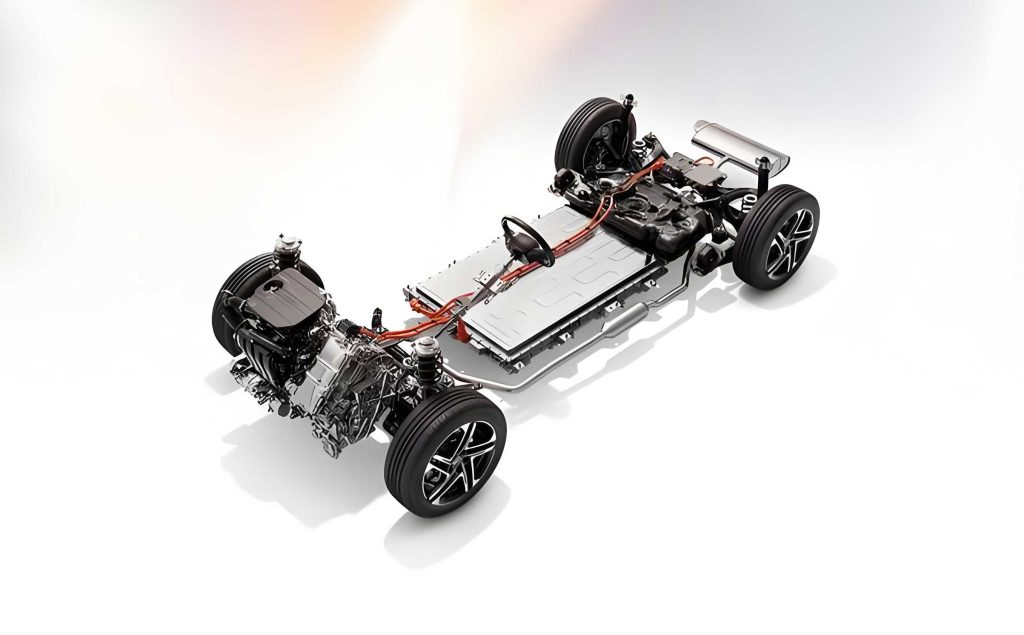
The architecture of our Hybrid Powertrain-in-the-Loop test system is a sophisticated integration of mechanical, electrical, and software subsystems. It can be conceptually divided into three primary segments: the Powertrain Hardware Under Test (HUT), the Road Load Simulation System, and the Real-Time Simulation & Control System. A summary of the key components is provided in the table below.
| System Segment | Key Components | Primary Function |
|---|---|---|
| Powertrain HUT | Internal Combustion Engine (ICE) with ECU, Traction Motors with MCUs, Generator, Transmission, Vehicle Control Unit (VCU), Battery Simulator. | Represents the physical powertrain of the hybrid car. Executes control strategies and provides mechanical power output. |
| Road Load Simulation | Four (4) High-dynamic AC Load Dynamometers, Torque/Speed Flanges, Cooling & Climate Control System, Central Data Acquisition Unit. | Applies precise load and inertia to the powertrain outputs, simulating vehicle road loads, gradients, and tire dynamics. |
| Real-Time Simulation & Control | dSPACE SCALEXIO Real-Time Computer, High-Fidelity Vehicle Model (AMESim/Simulink), Host PC with ControlDesk GUI. | Hosts the virtual vehicle, driver, and environment. Manages real-time I/O, executes models, and provides test automation and monitoring. |
The interaction between these systems is governed by a continuous exchange of signals. The virtual vehicle model, running on the dSPACE real-time processor, calculates the demanded wheel torque $T_{wheel, demand}$ based on driver inputs (accelerator/brake pedal) and vehicle dynamics. This demand is converted into speed or torque setpoints for the four load dynamometers. The dynamometers apply these loads to the physical traction motors of the hybrid car powertrain. The actual output speed $\omega_{motor}$ and torque $T_{motor}$ from each motor are measured and fed back into the vehicle model. The model then uses these values, along with a tire model, to calculate the new vehicle speed $v$, position, and dynamics, closing the loop. The VCU receives signals like battery State of Charge (SOC) from the virtual battery model and vehicle state from the virtual model to make energy management and torque distribution decisions for the real hardware.
The mathematical foundation of the vehicle model is critical for fidelity. The longitudinal dynamics are typically described by:
$$ m \cdot \dot{v} = F_{traction} – F_{aero} – F_{roll} – F_{grade} $$
where $m$ is the vehicle mass, $\dot{v}$ is the acceleration, $F_{traction}$ is the total force at the wheels (from motor feedback), $F_{aero} = \frac{1}{2} \cdot \rho \cdot C_d \cdot A \cdot v^2$ is aerodynamic drag, $F_{roll} = m \cdot g \cdot C_r \cdot \cos(\theta)$ is rolling resistance, and $F_{grade} = m \cdot g \cdot \sin(\theta)$ is grade resistance. The tire model, especially for handling split-µ conditions, is more complex, often using a simplified Pacejka “Magic Formula”:
$$ F_x = D \cdot \sin(C \cdot \arctan(B \cdot \kappa – E \cdot (B \cdot \kappa – \arctan(B \cdot \kappa)))) $$
where $F_x$ is the longitudinal tire force, $\kappa$ is the slip ratio, and $B, C, D, E$ are parameters dependent on tire properties and normal load.
The development and validation of the complete PTiL system followed a structured, three-phase workflow to ensure robustness and accuracy before conducting complex tests.
Phase 1: Virtual Vehicle Model Development and Calibration. We developed a high-fidelity, multi-domain vehicle model using AMESim and Simulink. This model included subsystems for vehicle dynamics (chassis, suspension, tires), driver behavior, and a simplified battery/energy management model. The model parameters (mass, inertia, drag coefficient, tire characteristics) were meticulously calibrated against data from a baseline hybrid car. This involved running standard maneuvers (coast-down, constant speed cruising) in simulation and comparing outputs like velocity and energy consumption with real vehicle data, iteratively tuning parameters until the error was minimized. The calibrated model was then compiled into real-time code for the dSPACE platform.
Phase 2: Open-Loop and Low-Speed Closed-Loop Bench Verification. Before connecting the powerful dynamometers, we performed “dry-run” tests. The physical powertrain controllers (VCU, MCUs, ECU) were powered and connected to the real-time simulator via CAN. Simple driver inputs were given in the simulation, and we verified that the VCU responded correctly—issuing appropriate torque commands, managing engine start/stop, and switching between EV and hybrid modes—based on the virtual vehicle’s state. This phase validated the basic functional integration and communication integrity without mechanical loads.
Phase 3: Full Closed-Loop, Loaded System Validation. This is the final integration phase. The powertrain was mechanically coupled to the four dynamometers. We began with simple, benign driving cycles (e.g., low-speed urban driving) to tune the closed-loop control dynamics between the dynamometers and the vehicle model. The key was to ensure the dynamometers could accurately emulate the inertia and road load felt by the powertrain in the virtual world. Once stable, we progressed to more dynamic maneuvers. The results from a standard acceleration test on the PTiL were compared to logged data from the same maneuver performed by the real hybrid car. Key performance indicators (KPIs) like 0-50 km/h acceleration time and average motor speeds were compared to quantify the system’s accuracy.
A prime application and validation test for our PTiL system was simulating a challenging split-µ (split friction) acceleration maneuver. This scenario, where the left and right sides of the vehicle are on surfaces with drastically different coefficients of friction (e.g., ice and asphalt), is ideal for testing the traction control system (TCS) and torque vectoring capabilities of a hybrid car with independent wheel control. It is also a safety-critical test that is difficult to perform reliably in the real world due to the need for specialized, consistent low-friction surfaces.
Test Setup: We constructed a 3D road model in our simulation environment with the left-side surface friction coefficient set to $\mu_{left} = 0.2$ (ice) and the right-side to $\mu_{right} = 0.8$ (dry asphalt). The test vehicle was the target hybrid car with four independent electric motors. The test procedure involved launching the vehicle from standstill on this split surface with 100% accelerator pedal input in its default all-wheel-drive mode. The vehicle’s task was to accelerate straight without significant deviation or yaw, relying on its TCS to manage wheel slip.
Results and Analysis: The PTiL system successfully executed the test. Upon acceleration, the left-side motors on the virtual ice immediately began to slip as torque exceeded the available grip. The TCS, implemented in the real VCU, detected the slip difference and intervened by reducing torque to the slipping left wheels and redistributing it to the higher-traction right wheels. The virtual vehicle maintained a relatively straight path, mirroring the expected behavior. We then compared the quantitative outputs from the PTiL test with data from an actual physical test conducted on a split-µ track. The comparison of key metrics is summarized below:
| Performance Metric | PTiL Test Result | Physical Vehicle Test Result | Deviation |
|---|---|---|---|
| 0-50 km/h Acceleration Time | 4.88 s | 5.52 s | 11.6% |
| Avg. Front Left Motor Speed | 2624 rpm | 2507 rpm | 4.7% |
| Avg. Front Right Motor Torque | 119.6 Nm | 131.5 Nm | 9.0% |
| Avg. Rear Left Motor Torque | 39.4 Nm | 36.0 Nm | 9.5% |
The average deviation across all major KPIs was below 15%, with most below 10%. This confirmed that the PTiL system could accurately replicate the core dynamic response and control interactions of the hybrid car powertrain in a complex scenario. However, a detailed analysis of the time-series torque data revealed areas for model refinement. For instance, the torque trace from the physical vehicle’s left rear motor (on ice) showed higher-frequency fluctuations than the PTiL output. This discrepancy is attributed to the real ice surface having micro-variations in friction and the physical suspension inducing minor load transfers, effects that were simplified in our initial tire and road model. Future work will involve implementing more sophisticated, stochastic tire-road interaction models to capture these transient phenomena.
The development and successful application of this Hybrid Powertrain-in-the-Loop test system demonstrate a paradigm shift in validation strategies for modern electrified vehicles. By seamlessly blending real hardware with virtual environments, the system provides an unparalleled testing platform that offers the repeatability and control of a laboratory bench with the functional and dynamic complexity of real-world driving. It enables front-loading of validation tasks, allowing engineers to debug energy management algorithms, calibrate traction and stability controls, and assess thermal performance under extreme “what-if” scenarios long before a full prototype is available. This significantly de-risks the development process, reduces reliance on costly and weather-dependent proving ground tests, and accelerates the time-to-market for advanced, high-performance hybrid car technologies. As vehicle systems grow more complex, the role of such integrated, virtual-physical testing methodologies will only become more central to achieving rigorous, efficient, and comprehensive vehicle development.