
The pursuit of enhanced energy efficiency in hybrid cars extends beyond the design of sophisticated Energy Management Strategies (EMS). A critical, complementary approach lies in the intelligent planning of vehicle speed to reduce the overall propulsion power demand. In real-world traffic, particularly in car-following scenarios, the motion of preceding vehicles imposes significant constraints on the ego-vehicle’s driving strategy. Fluctuations in the speed of vehicles ahead force the following hybrid car to adjust its velocity, often leading to suboptimal fuel economy, compromised driving comfort, and potential safety risks. With the advancement of Intelligent Transportation Systems (ITS) and Vehicle-to-Everything (V2X) communication, a wealth of real-time traffic information becomes accessible. Leveraging this data to co-optimize speed planning and energy management presents a profound opportunity to holistically improve the safety, comfort, and economic performance of hybrid cars.
Conventional eco-driving strategies in car-following contexts often consider only the immediate preceding vehicle. However, the propagation of traffic waves in a lane means that the dynamic behavior of multiple vehicles ahead can cascade and influence the ego-vehicle’s optimal control actions. This paper addresses this multi-vehicle influence by proposing a novel, integrated control framework. First, we employ a data-driven eXtreme Gradient Boosting (XGBoost) algorithm to accurately predict the future speed profiles of preceding vehicles, providing a necessary preview for planning. Building upon this prediction, we innovate a Variable Time Headway (VTH) strategy by integrating the Artificial Potential Field (APF) method. This APF-VTH strategy dynamically determines the desired following distance by accounting for the collective influence—both attractive and repulsive—of multiple preceding vehicles. Finally, within a Model Predictive Control (MPC) framework, we formulate and solve a coordinated optimization problem that simultaneously determines the optimal velocity trajectory and power-split decisions for a series-parallel plug-in hybrid car, balancing objectives of safety, economy, and comfort.
1. Modeling of the Series-Parallel Plug-in Hybrid Car
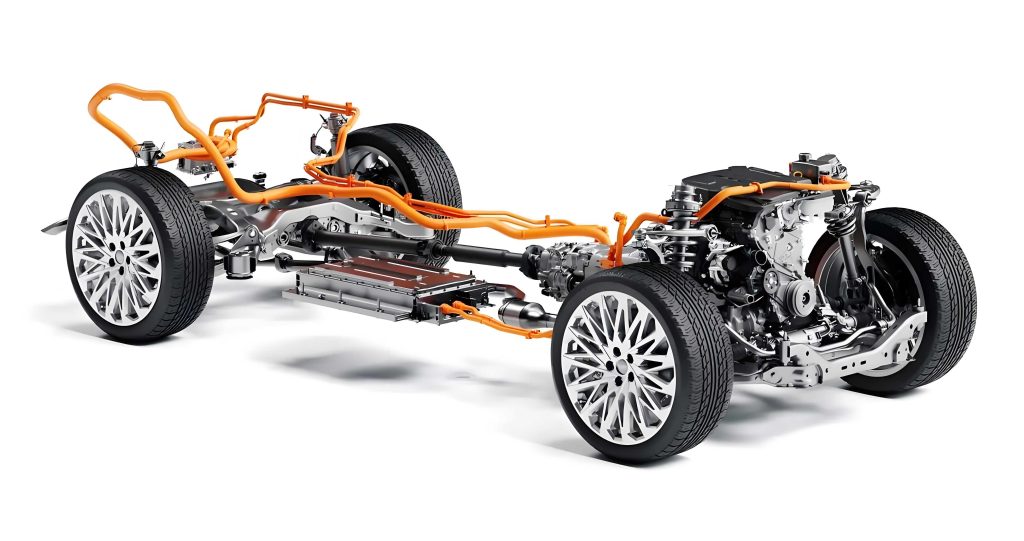
To implement the energy management aspect of the coordinated strategy, a control-oriented model of the target series-parallel PHEV is established. The powertrain configuration includes an Internal Combustion Engine (ICE), an Integrated Starter Generator (ISG) motor, a traction motor, a power battery pack, and relevant driveline components, as detailed in the schematic. Key parameters are summarized in Table 1.
| Component | Parameter | Value |
|---|---|---|
| Vehicle | Curb Mass (kg) | 1820 |
| Frontal Area (m²) | 2.67 | |
| Aerodynamic Drag Coefficient | 0.34 | |
| Rolling Resistance Coefficient | 0.012×(1+u²/19440) | |
| Tire Radius (m) | 0.331 | |
| Engine | Max Power (kW) | 80 |
| Max Torque (Nm) | 175 | |
| Max Speed (rpm) | 5000 | |
| ISG Motor | Max Power (kW) | 90 |
| Max Torque (Nm) | 270 | |
| Traction Motor | Max Power (kW) | 150 |
| Max Torque (Nm) | 300 | |
| Max Speed (rpm) | 15000 | |
| Battery Pack | Type | LiFePO4 |
| Total Capacity (Ah) | 59.8 | |
| Gear Ratios | Engine-ISG | 0.5 |
| Engine-Wheels | 2.7 | |
| Traction Motor-Wheels | 10.7 |
1.1 Longitudinal Vehicle Dynamics
The vehicle is modeled as a point mass. The longitudinal dynamics equation governing the motion of the hybrid car is given by:
$$F_t = \delta m \frac{du}{dt} + mgf \cos\theta + \frac{C_D A}{21.15}u^2 + mg \sin\theta$$
where \(F_t\) is the traction force at the wheels, \(\delta\) is the rotational mass factor, \(m\) is the vehicle mass, \(u\) is the vehicle speed, \(g\) is gravitational acceleration, \(f\) is the rolling resistance coefficient, \(\theta\) is the road grade, \(C_D\) is the aerodynamic drag coefficient, and \(A\) is the frontal area. The total power demand at the wheels \(P_{req}\) is:
$$P_{req} = \frac{1}{\eta_T} \left( \frac{\delta m u}{3600} \frac{du}{dt} + \frac{mgf u \cos\theta}{3600} + \frac{C_D A u^3}{76140} + \frac{mg u \sin\theta}{3600} \right)$$
where \(\eta_T\) is the driveline efficiency.
1.2 Powertrain Component Models
Engine: The engine fuel consumption rate \(\dot{m}_f\) (g/s) is modeled via a static fuel consumption map based on engine speed \(n_e\) and torque \(T_e\):
$$\dot{m}_f = f_{fuel}(n_e, T_e)$$
ISG & Traction Motor: The efficiencies of the ISG motor \(\eta_{ISG}\) and the traction motor \(\eta_{em}\) are obtained from respective efficiency maps:
$$\eta_{ISG} = f_{ISG}(n_{ISG}, T_{ISG}), \quad \eta_{em} = f_{em}(n_{em}, T_{em})$$
Auxiliary Power Unit (APU): In series mode, the engine-ISG combination (APU) is assumed to operate on its optimal fuel consumption line, \(P_{APU}^*\), derived from a combined optimization of engine and ISG efficiency maps. The instantaneous fuel consumption is calculated accordingly.
Battery: A first-order equivalent circuit model is used. The battery State of Charge (SOC) dynamics and terminal voltage \(U\) are:
$$\dot{SOC} = -\frac{I_b}{Q_b}, \quad U = U_{oc} – I_b R_0$$
where \(I_b\) is the battery current, \(Q_b\) is the battery capacity, \(U_{oc}\) is the open-circuit voltage, and \(R_0\) is the internal resistance.
Battery Thermal Model: A lumped thermal model accounting for core temperature \(T_c\) and surface temperature \(T_s\) of a cylindrical cell is integrated to assess battery health and efficiency impact:
$$
\begin{aligned}
\dot{T}_c &= \frac{T_s – T_c}{R_c C_c} + \frac{Q_w}{C_c} \\
\dot{T}_s &= \frac{T_c – T_s}{R_c C_s} + \frac{T_f – T_s}{R_u C_s}
\end{aligned}
$$
where \(Q_w\) is the heat generated, \(R_c, R_u\) are thermal resistances, \(C_c, C_s\) are heat capacities, and \(T_f\) is the coolant temperature.
Emission Model: Engine-out emissions (CO, HC, NOx) are modeled via emission maps \(f_{emis}(n_e, T_e)\). A weighted sum is used to form a composite emission index \(m_{emis}\) for multi-objective optimization.
2. Artificial Potential Field-Based Time Headway Strategy for Multiple Preceding Vehicles
Traditional car-following strategies, such as Constant Time Headway (CTH) or speed-dependent VTH, primarily consider only the immediate preceding vehicle. For a connected hybrid car, information from multiple preceding vehicles can be utilized to formulate a more anticipatory and smoother following strategy.
2.1 Formulation of the APF-VTH Strategy
The Artificial Potential Field method, traditionally used for obstacle avoidance, is adapted here to model the interactive forces from multiple preceding vehicles. The influence of the \(i\)-th preceding vehicle on the ego hybrid car is modeled as a combination of an attractive field \(U_{att}^i\) (when the preceding vehicle is accelerating or moving faster) and a repulsive field \(U_{rep}^i\) (when it is decelerating or moving slower).
Attractive Potential Field:
$$U_{att}^i = -\frac{K_{av}(u_f^i – u_0)^2}{2 \Delta x_i} – \frac{K_{aa} (a_f^i)^2}{2 \Delta x_i}$$
This field exerts an attractive force \(F_{att}^i = -\nabla U_{att}^i\), encouraging the hybrid car to close the gap when safe and efficient to do so.
Repulsive Potential Field:
$$U_{rep}^i = \frac{K_r}{\Delta x_i^2} + \frac{K_{rv}(u_f^i – u_0)^2}{2 \Delta x_i^2} – \frac{K_{ra} a_f^i}{2 \Delta x_i}$$
This field exerts a repulsive force \(F_{rep}^i = -\nabla U_{rep}^i\), discouraging the hybrid car from getting too close, especially when the preceding vehicle is slowing down.
Here, \(u_f^i\), \(a_f^i\), and \(\Delta x_i\) are the speed, acceleration, and distance of the \(i\)-th preceding vehicle relative to the ego hybrid car. \(u_0\) is the ego vehicle’s speed. \(K_{av}, K_{aa}, K_r, K_{rv}, K_{ra}\) are tuning parameters.
The total influence from \(n\) preceding vehicles is summed with weighting factors \(\omega_i, \zeta_i\). This net influence is then used to modulate a base time headway \(th_0\), resulting in the APF-based variable time headway \(th_{APF}\):
$$th_{APF} = th_0 – K_{\alpha} \sum_{i=1}^{n} \omega_i F_{att}^i – K_{\beta} \sum_{i=1}^{n} \zeta_i F_{rep}^i$$
A saturation function \(sat(\cdot)\) is applied to ensure \(th_{APF}\) remains within safe bounds \([th_{min}, th_{max}]\). The desired following distance \(S_{des}\) for the hybrid car is then:
$$S_{des} = th_{APF} \cdot u_0 + S_0$$
where \(S_0\) is a minimum standstill distance. This strategy allows the hybrid car to react more smoothly to the collective traffic flow ahead, rather than just the immediate predecessor.
3. MPC-Based Coordinated Optimization of Speed Planning and Energy Management
The core of the proposed strategy is a Model Predictive Control framework that co-optimizes the velocity trajectory and power distribution for the hybrid car over a prediction horizon.
3.1 Preceding Vehicle Speed Prediction
Accurate prediction of preceding vehicle speeds is crucial. An XGBoost model is trained on real-world driving data (e.g., from NGSIM datasets) and standard driving cycles. Using historical speed data from the preceding vehicles as input, the model predicts their speed profiles over the prediction horizon \(T_p\). Comparative analysis showed XGBoost provided lower Root Mean Square Error (RMSE) compared to Backpropagation Neural Networks (BPNN) and Support Vector Machines (SVM), especially for short-term prediction (e.g., 3-second horizon).
3.2 Problem Formulation and Cost Function
At each control step, the ego hybrid car’s future speed profile is parameterized by a constant acceleration \(a\) over \(T_p\): \(u_0(t+k) = u(t) + a \cdot k \Delta t\), where \(a\) is chosen from a discrete set within physical limits.
For each candidate speed sequence, a cost function evaluating safety, economy, and comfort over the prediction horizon is computed:
1. Following Safety Cost \(J_{fol}\): Penalizes deviations of the actual gap \(S_{real}\) from the desired APF-based gap \(S_{des}\), with severe penalties for violating minimum \(S_{min}\) and maximum \(S_{max}\) safe distances.
$$J_{fol}(t) = \begin{cases}
\infty & \text{if } S_{real} < S_{min} \\
f_1 \cdot (S_{des} – S_{real})^2 & \text{if } S_{min} \le S_{real} < S_{des} \\
f_2 \cdot (S_{real} – S_{des})^2 & \text{if } S_{des} \le S_{real} < S_{max} \\
f_3 \cdot (S_{real} – S_{max})^2 & \text{if } S_{real} \ge S_{max}
\end{cases}$$
2. Economic Cost \(J_{eco}\): Represents the equivalent fuel and electricity cost. For the optimization within the MPC horizon, a simplified multi-objective strategy (e.g., a rule-based strategy informed by offline Pareto-optimal solutions considering fuel, emissions, and battery temperature) is used to evaluate the energy cost for a given speed profile.
$$J_{eco}(t) = C_{fuel} \cdot \dot{m}_f(t) + C_{elec} \cdot P_{bat}(t)$$
3. Comfort Cost \(J_{com}\): Penalizes acceleration to ensure smooth driving for the hybrid car’s occupants.
$$J_{com}(t) = a(t)^2$$
Total Cost: The combined cost for a candidate control sequence is:
$$J_{total} = \sum_{k=0}^{N_p} \left[ \psi_1 J_{fol}(t+k) + \psi_2 J_{eco}(t+k) + \psi_3 J_{com}(t+k) \right]$$
where \(\psi_1, \psi_2, \psi_3\) are weighting factors.
3.3 Optimization and Real-time Strategy
The MPC solver evaluates all feasible constant-acceleration sequences over the prediction horizon. For each sequence, it calculates the required power profile, uses a fast Multi-Objective Equivalent Consumption Minimization Strategy (MO-ECMS) or a pre-trained Random Forest-Rule (RF-Rule) policy to estimate the instantaneous economic cost, and computes the safety and comfort costs. The acceleration sequence yielding the minimum \(J_{total}\) is selected. Only the first control action (acceleration and corresponding EMS mode/torque commands) is applied to the hybrid car, and the process repeats at the next time step.
The RF-Rule policy is derived offline. A MO-ECMS with balanced weighting is run on multiple standard cycles to generate a dataset mapping features (e.g., velocity, acceleration, power demand, SOC, battery temperature) to the optimal operating mode (EV, Series, Parallel). A Random Forest classifier is trained on this data. Online, this classifier quickly determines the operational mode, and corresponding optimized rule-based strategies (e.g., four fixed operating points for series mode, torque optimization for parallel mode) allocate power.
4. Simulation Results and Analysis
The proposed coordinated strategy (C-APF-RF) was tested in a simulated car-following scenario with two preceding vehicles on a 43 km route based on CLTC-P cycles. The lead vehicle followed a CLTC-P profile, the first preceding vehicle followed it using a Full Velocity Difference (FVD) model, and the ego hybrid car employed the proposed controller. Comparisons were made against hierarchical strategies (where speed is determined by a separate FVD model and energy is managed by strategies like CDCS, MO-ECMS, or RF-Rule) and coordinated strategies with different headway policies (CTH, VTH).
4.1 Performance of APF-VTH Strategy
Analyzing just the car-following performance (without energy management), the APF-VTH strategy demonstrated superior comfort. While all strategies maintained safe following distances, the APF-VTH strategy resulted in smoother acceleration profiles.
| Metric | CTH | VTH | APF-VTH |
|---|---|---|---|
| Acceleration Range (m/s²) | [-1.4, 1.1] | [-1.6, 1.2] | [-1.3, 0.9] |
| Mean Absolute Acceleration (m/s²) | 0.2612 | 0.2678 | 0.2518 |
| Acceleration Variance (m/s²)² | 0.1405 | 0.1541 | 0.1278 |
The APF-VTH strategy’s acceleration variance was 9.1% and 17.1% lower than CTH and VTH, respectively, indicating a significant improvement in driving comfort for the hybrid car by proactively responding to the multi-vehicle traffic flow.
4.2 Coordinated vs. Hierarchical Control
The coordinated optimization strategies consistently outperformed their hierarchical counterparts. By planning a smoother, more economical speed profile, the coordinated controller reduced the power demand, leading to less frequent and more efficient engine operation.
| Strategy | Fuel Used (L) | Final Batt. Temp. (K) | CO₂ (g) | Total Cost (¥) |
|---|---|---|---|---|
| F-CDCS (Hierarchical) | 0.8128 | 303.57 | 1820.9 | 9.844 |
| F-MO-ECMS (Hierarchical) | 0.7171 | 299.88 | 1404.6 | 9.196 |
| F-RF-Rule (Hierarchical) | 0.7288 | 299.91 | 1437.1 | 9.265 |
| C-APF-RF (Coordinated) | 0.6262 | 299.54 | 1245.9 | 8.411 |
| C-APF-DP (Coordinated, econ. only) | 0.5928 | 300.13 | 1278.5 | 8.197 |
The C-APF-RF strategy reduced fuel consumption by approximately 9% compared to the best hierarchical strategy (F-MO-ECMS) and lowered the total operating cost by 8.5%. It also achieved lower battery temperature rise and comparable or better emission performance. The C-APF-DP strategy, using DP for economic evaluation in the prediction horizon, achieved the best fuel economy but with slightly higher battery temperature, demonstrating the trade-off managed by the multi-objective RF-Rule within the coordinated framework.
4.3 Impact of Different Headway Strategies within Coordinated Control
Comparing coordinated strategies using different headway calculations confirms the benefit of the APF-based method.
| Strategy | Fuel Used (L) | Total Cost (¥) |
|---|---|---|
| C-CTH-RF | 0.6771 | 8.790 |
| C-VTH-RF | 0.6750 | 8.774 |
| C-APF-RF | 0.6262 | 8.411 |
The C-APF-RF strategy provided a 4.3% reduction in total cost compared to the C-CTH-RF strategy. The APF-VTH policy enabled the hybrid car to plan a more anticipatory and less perturbed velocity profile, which directly translated into lower energy consumption.
5. Conclusion
This paper presented a novel coordinated optimization framework for speed planning and energy management of a hybrid car in multi-preceding-vehicle following scenarios. The key contributions are threefold. First, an Artificial Potential Field-based variable time headway strategy was developed to dynamically determine a safe and efficient desired following distance by synthesizing the dynamic influence of multiple vehicles ahead. Second, an accurate XGBoost predictor was employed to forecast preceding vehicle speeds. Third, within a Model Predictive Control framework, a cost function balancing safety, economy (fuel, electricity, emissions, battery thermal management), and comfort was minimized to simultaneously derive the optimal acceleration and power-split commands for the hybrid car.
Simulation results demonstrated that the proposed coordinated strategy significantly outperforms conventional hierarchical control approaches. Furthermore, the APF-based headway strategy within the coordinated framework proved superior to fixed or ego-speed-based variable headway strategies, yielding smoother driving and a 4.3% reduction in total operating cost. This work underscores the significant potential of leveraging connected vehicle information and co-optimization techniques to unlock higher levels of efficiency, safety, and comfort for the next generation of intelligent hybrid cars.