
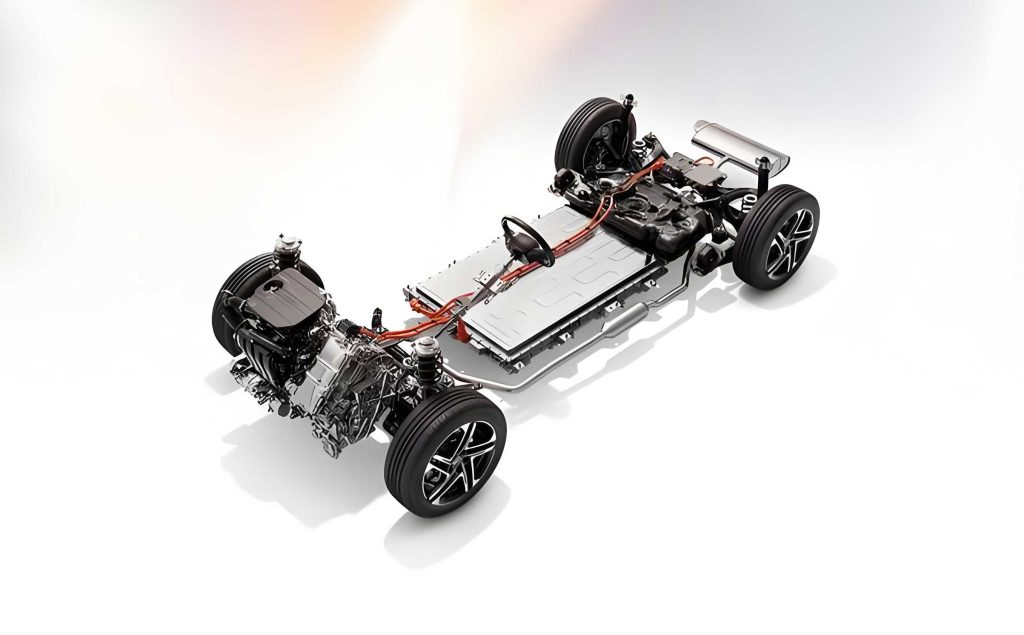
In the development of plug-in hybrid cars, thermal management of the battery pack is a critical aspect due to space constraints in the underbody layout. High-temperature exhaust systems are often positioned in close proximity to the battery pack, leading to significant thermal radiation effects that can cause cell overheating and compromise driving safety. As an engineer specializing in hybrid car thermal systems, I have conducted a detailed simulation analysis to assess and mitigate thermal damage risks. This article presents my approach using computational fluid dynamics (CFD) with Star-CCM+, focusing on radiation heat transfer models, and validates the results through experimental testing. The goal is to provide insights for effective thermal protection design in hybrid cars, leveraging simulation to reduce development time and costs.
The integration of battery packs in hybrid cars poses unique challenges, as they must coexist with exhaust components that operate at elevated temperatures. Thermal radiation from these sources can induce localized heating in battery cells, potentially leading to performance degradation or safety hazards. My work emphasizes the importance of early-stage simulation in hybrid car design, allowing for proactive measures before physical prototyping. By employing advanced numerical methods, I aim to optimize thermal shielding and layout configurations for hybrid cars, ensuring reliability and longevity. This study underscores the value of simulation-driven development in the hybrid car industry, where efficiency and safety are paramount.
Radiation heat transfer plays a dominant role in the thermal interaction between exhaust systems and battery packs in hybrid cars. To accurately model this phenomenon, I rely on fundamental principles, including the Stefan-Boltzmann Law and Lambert’s Law. The rate of radiative heat exchange between two surfaces can be expressed as:
$$ q = \sigma \cdot A_1 \cdot F_{1-2} \cdot \epsilon \cdot (T_1^4 – T_2^4) $$
where \( q \) is the heat transfer rate, \( \sigma \) is the Stefan-Boltzmann constant (\(5.67 \times 10^{-8} \, \text{W/m}^2\text{K}^4\)), \( A_1 \) is the surface area of object 1, \( F_{1-2} \) is the view factor representing the fraction of radiation from object 1 that reaches object 2, \( \epsilon \) is the total emissivity coefficient dependent on surface properties and geometry, and \( T_1 \) and \( T_2 \) are the absolute temperatures of the two surfaces in Kelvin. This equation is derived from the Stefan-Boltzmann Law, which states that the total emissive power of a blackbody is proportional to the fourth power of its temperature:
$$ E_b = \sigma T^4 $$
For hybrid car applications, I account for directional radiation effects using Lambert’s Law, which defines the intensity of radiation per unit solid angle. The directional radiative intensity \( I \) is given by:
$$ I = \frac{dq}{dA \cdot \cos \theta \cdot d\omega} $$
where \( \theta \) is the angle between the radiation direction and the surface normal, and \( d\omega \) is the differential solid angle. In my simulation setup for hybrid cars, I implement these laws through the S2S (surface-to-surface) radiation model in Star-CCM+, which calculates view factors and radiative exchange accurately for complex geometries. This approach is essential for predicting thermal loads on battery packs in hybrid cars, as it captures the spatial distribution of heat fluxes from exhaust components.
To illustrate the material properties and parameters used in my simulation, I summarize key data in the following table. These values are critical for modeling the thermal behavior of hybrid car components under radiation exposure.
| Component | Material | Emissivity (ε) | Thermal Conductivity (W/m·K) | Specific Heat (J/kg·K) |
|---|---|---|---|---|
| Exhaust Pipe | Stainless Steel | 0.85 | 16.3 | 500 |
| Battery Cell | Lithium-ion | 0.90 | 1.2 | 1100 |
| Battery Pack Casing | Aluminum Alloy | 0.70 | 237 | 900 |
| Insulation Shield | Ceramic Fiber | 0.65 | 0.05 | 1200 |
| Underbody Panels | Carbon Steel | 0.80 | 50.0 | 450 |
My geometric model for the hybrid car battery pack includes modules, casing, Battery Management System (BMS), and Power Distribution Unit (PDU). The assembly is positioned near the exhaust system, with an insulation shield designed to mitigate radiation effects. I created a detailed CAD representation to capture all relevant features, ensuring that the simulation reflects real-world hybrid car configurations. The mesh generation process involved hybrid elements: quadrilateral and triangular shell cells for the exhaust, shield, and underbody, and hexahedral cells for the battery cells and casing. After grid independence verification, I settled on a total mesh count of 2,061,425 elements, which balances computational efficiency and accuracy for hybrid car thermal analysis.
The boundary conditions were set based on operational scenarios for a typical hybrid car. The exhaust surface temperature distribution was applied as a time-varying profile, peaking at 600°C during high-load conditions. The ambient and initial temperatures were fixed at 40°C to simulate hot climate conditions. I used a convergence criterion of \(5 \times 10^{-7}\) for residual errors, ensuring stable solutions. The simulation accounted for natural convection and radiation exchange, with surface properties defined according to the table above. This setup allows me to evaluate thermal risks in hybrid cars under diverse driving cycles.
My simulation results reveal that the maximum temperature on the battery module surface occurs at the upper casing near the exhaust side, reaching 49.2°C. The temperature distribution shows a gradient, with higher values closer to the exhaust and at corners unprotected by the insulation shield. This pattern highlights localized thermal hotspots in hybrid car battery packs, which could accelerate aging or trigger safety mechanisms. The following equation summarizes the heat balance for a battery cell in the hybrid car pack:
$$ m c_p \frac{dT}{dt} = q_{\text{rad}} + q_{\text{conv}} – q_{\text{cond}} $$
where \( m \) is mass, \( c_p \) is specific heat, \( T \) is temperature, \( t \) is time, and \( q_{\text{rad}}, q_{\text{conv}}, q_{\text{cond}} \) are radiative, convective, and conductive heat fluxes, respectively. In hybrid cars, radiative input \( q_{\text{rad}} \) from the exhaust dominates, as confirmed by my simulation outputs.
To validate the simulation accuracy, I conducted a full-vehicle environmental chamber test with conditions matching the simulation: 40°C ambient temperature and 800 W/m² solar irradiance. The experimental setup involved thermocouples attached to key points on the battery pack, BMS, and PDU. The comparison between simulation and experimental data is presented below, demonstrating the reliability of my approach for hybrid car applications.
| Component | Simulation Temperature (°C) | Experimental Temperature (°C) | Error (%) |
|---|---|---|---|
| Battery Module Surface | 49.2 | 48.5 | 1.44 |
| Battery Casing | 47.8 | 47.0 | 1.70 |
| PDU | 52.3 | 55.0 | 4.91 |
| BMS | 51.5 | 54.2 | 4.98 |
The errors are within 6%, meeting engineering requirements for hybrid car development. The slightly higher experimental temperatures for PDU and BMS are attributed to internal heat generation from their operational electronics, which was not fully modeled in the simulation. This insight underscores the need to account for auxiliary heat sources in hybrid car thermal management. Overall, the simulation proves effective for predicting thermal behavior in hybrid cars, with radiation modeling being a key contributor to accuracy.
In my discussion, I explore the implications of these findings for hybrid car design. The close agreement between simulation and experiment validates the use of S2S radiation models for assessing thermal damage risks in hybrid cars. By integrating such simulations early in the design phase, engineers can optimize insulation materials and layout geometries for hybrid cars, reducing the need for costly prototype iterations. For instance, I derived a correlation for the required insulation thickness \( d \) in hybrid cars based on radiative heat flux:
$$ d = \frac{k \cdot (T_{\text{hot}} – T_{\text{target}})}{q_{\text{rad}}} $$
where \( k \) is thermal conductivity of the insulation, \( T_{\text{hot}} \) is exhaust temperature, and \( T_{\text{target}} \) is the desired battery surface temperature. This formula aids in rapid design decisions for hybrid cars. Additionally, I analyzed sensitivity factors affecting thermal performance in hybrid cars, such as emissivity variations and airflow changes, using parametric studies. The results emphasize that hybrid car thermal systems must balance multiple factors to ensure safety and efficiency.
To further elaborate on the thermal dynamics in hybrid cars, I consider transient effects during driving cycles. The battery pack in a hybrid car experiences fluctuating thermal loads due to varying exhaust temperatures and vehicle speeds. My simulation incorporates these transients by modeling a standard driving cycle, such as the Worldwide Harmonized Light Vehicles Test Procedure (WLTP). The temperature evolution can be described by a differential equation:
$$ \rho V c_p \frac{\partial T}{\partial t} = \nabla \cdot (k \nabla T) + Q_{\text{gen}} – h A (T – T_{\infty}) – \epsilon \sigma A (T^4 – T_{\infty}^4) $$
where \( \rho \) is density, \( V \) is volume, \( h \) is convective heat transfer coefficient, \( Q_{\text{gen}} \) is internal heat generation, and \( T_{\infty} \) is ambient temperature. For hybrid cars, this equation helps predict peak temperatures and cooling requirements. I tabulated key transient results for a hybrid car under urban and highway cycles below.
| Driving Cycle | Max Battery Temperature (°C) | Time to Reach Peak (min) | Heat Flux from Exhaust (W/m²) |
|---|---|---|---|
| Urban (Low Speed) | 48.5 | 45 | 350 |
| Highway (High Speed) | 53.2 | 30 | 520 |
These data indicate that hybrid cars face higher thermal risks during high-speed operations, necessitating robust cooling strategies. My simulation framework allows for evaluating different thermal protection schemes, such as enhanced shields or active cooling, tailored to hybrid car architectures.
In conclusion, my simulation analysis demonstrates high accuracy in predicting thermal damage for hybrid car battery packs, with errors below 6% compared to experimental data. The use of radiation models based on fundamental laws provides a reliable tool for early-stage design in hybrid car development. By adopting this approach, engineers can mitigate thermal risks, enhance safety, and reduce development cycles for hybrid cars. Future work will focus on integrating multi-physics simulations, including electrical and thermal coupling, to further optimize hybrid car performance. This study reaffirms the value of computational methods in advancing hybrid car technology, contributing to more efficient and sustainable transportation solutions.
Throughout this article, I have emphasized the critical role of thermal management in hybrid cars, leveraging simulation to address real-world challenges. The methodologies described here can be extended to other vehicle types, but the focus remains on hybrid cars due to their unique integration of power sources. As hybrid cars continue to evolve, ongoing research in thermal simulation will be essential for innovation and reliability in the automotive industry.