
The thermal management of the battery pack is a critical challenge in modern hybrid car technology. During charge and discharge cycles, electrochemical reactions within the cells generate heat. Coupled with the confined packaging space typical in hybrid car architectures, this can lead to significant heat accumulation and non-uniform temperature distribution across the battery module. Elevated or uneven temperatures directly accelerate battery degradation, reduce usable capacity, increase the risk of thermal runaway, and ultimately compromise the safety, performance, and lifespan of the hybrid car’s propulsion system. Therefore, precise and reliable temperature monitoring is not just a diagnostic feature but a fundamental prerequisite for implementing effective battery thermal management strategies (BTMS) and ensuring the hybrid car operates within its optimal efficiency and safety envelope.
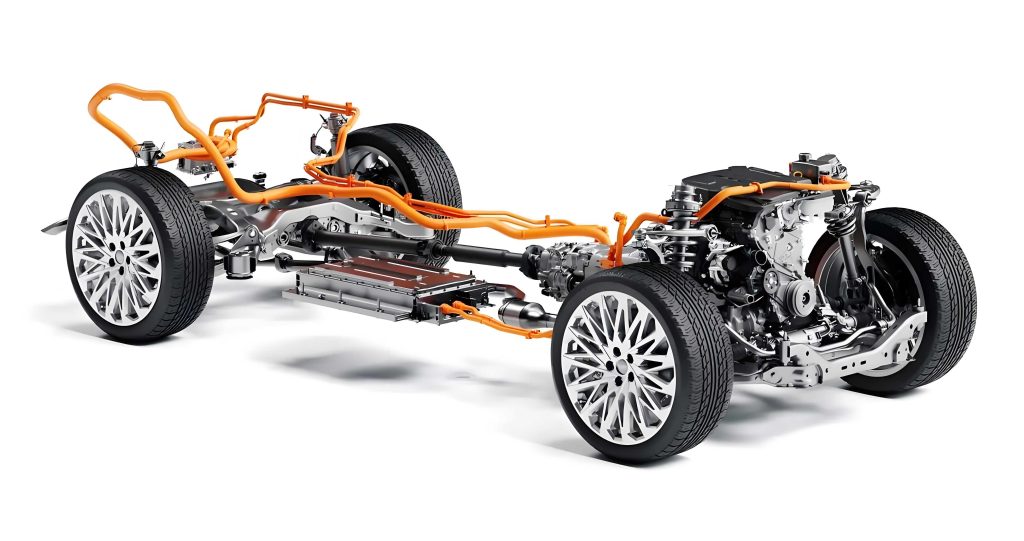
This article presents a dedicated hardware and software co-design for a high-precision, multi-channel temperature sampling circuit, engineered specifically for the battery management system (BMS) of a hybrid car. The design aims to overcome common limitations in existing solutions, such as low sampling accuracy, poor real-time response, and vulnerability to signal drift.
1. Hardware Architecture and Circuit Design
The core objective of the hardware design is to accurately translate the physical temperature of multiple points within the hybrid car’s battery pack into stable, measurable voltage signals for the microcontroller unit (MCU). The design employs Negative Temperature Coefficient (NTC) thermistors as the primary sensing elements. These sensors are strategically embedded at critical locations within the battery module to capture hotspot temperatures and gradient profiles.
The fundamental sensing principle is based on the resistance-voltage relationship. The NTC thermistor’s resistance ($R_{TEMP}$) decreases predictably with increasing temperature. By placing the thermistor in a voltage divider network with a precision reference voltage ($V_{REF}$), a temperature-dependent analog voltage ($V_{TEMP}$) is generated:
$$V_{TEMP} = \frac{R_{TEMP}}{R_{FIXED} + R_{TEMP}} \times V_{REF}$$
where $R_{FIXED}$ is a fixed, high-precision resistor. This analog signal, however, is susceptible to noise and loading effects. A key innovation in this hybrid car BMS design is the incorporation of a dual-stage buffering and signal conditioning stage immediately after the voltage divider.
The heart of the multiplexing system is the NLV74HCT4851 analog multiplexer/demultiplexer IC. This component is selected for its wide operating temperature range (-65°C to 150°C), compatible supply voltage (2.0V to 6.0V, powered by a stable +5V rail), and low on-resistance. It functions as an 8-channel analog switch, allowing a single high-precision analog-to-digital converter (ADC) channel on the MCU to sequentially sample temperatures from up to eight different sensor locations. The channel selection is controlled digitally via three address lines (A, B, C) and an enable pin from the MCU, ensuring minimal crosstalk and efficient use of MCU resources.
The conditioned signal from the selected channel is then fed into the MCU’s ADC. To enhance system integrity, the design includes diagnostic features for open-circuit or short-circuit detection on the sensor lines by using pull-up/pull-down resistors at the multiplexer inputs.
The following table summarizes key component specifications for the hybrid car’s temperature sampling circuit:
| Component | Specification / Part Number | Key Parameter / Purpose |
|---|---|---|
| Temperature Sensor | NTC Thermistor | R25 = 10kΩ, B25/85 = 3435K, Tolerance ±1% |
| Analog Multiplexer | NLV74HCT4851 | 8-Channel, 5V Supply, Low On-Resistance |
| Voltage Reference | REF5040 | 4.096V, Ultra-Low Noise, High Precision |
| Operational Amplifier | OPA2188 | Dual, Low-Noise, Rail-to-Rail Output |
| Fixed Resistor (RFIXED) | Precision Thin-Film | 10kΩ, Tolerance ±0.1%, Low TCR |
2. Temperature Calculation Principle and Battery Protection Logic
2.1 Signal Processing and Temperature Derivation
The raw ADC output is a digital value ($N_{ADC}$) proportional to the sensed voltage $V_{TEMP}$. The relationship is given by:
$$N_{ADC} = \frac{V_{TEMP}}{V_{REF}} \times (2^{n} – 1)$$
where $n$ is the ADC resolution (e.g., 12 bits = 4095). Combining this with the voltage divider equation, we can solve for the thermistor resistance:
$$R_{TEMP} = R_{FIXED} \times \frac{N_{ADC}}{(2^{n} – 1 – N_{ADC})}$$
Finally, the temperature ($T$ in Kelvin) is derived from the thermistor’s resistance using the Steinhart-Hart equation, which provides high accuracy over a wide range:
$$\frac{1}{T} = A + B \cdot \ln(R_{TEMP}) + C \cdot [\ln(R_{TEMP})]^3$$
where $A$, $B$, and $C$ are unique coefficients provided by the thermistor manufacturer. For computational efficiency in the hybrid car’s BMS microcontroller, a lookup table (LUT) method is often employed. A pre-calculated table mapping $N_{ADC}$ values directly to temperature in °C is stored in non-volatile memory, with linear interpolation used between table entries for enhanced resolution.
2.2 Integrated Battery Protection Strategies
The accurately sampled temperature data is the primary input for the hybrid car’s battery protection algorithms. The BMS implements a hierarchical thermal management strategy:
Level 1: Cooling/Heating Control: Based on predefined temperature thresholds (e.g., $T_{cool\_on}$ = 30°C, $T_{cool\_off}$ = 25°C, $T_{heat\_on}$ = 5°C, $T_{heat\_off}$ = 10°C), the BMS activates or deactivates the battery thermal management system. This could involve triggering coolant pumps, fans, or resistive heating pads to maintain the hybrid car’s battery within its optimal operating window (typically 15°C to 35°C).
Level 2: Power Derating: If temperatures approach critical levels (e.g., $T_{derate}$ > 45°C or $T_{derate}$ < 0°C), the BMS communicates with the hybrid car’s Vehicle Control Unit (VCU) to limit charge and discharge currents. This proactive power derating prevents further temperature rise and protects the battery from stress.
Level 3: Fault Mitigation: In the event of a sensor fault diagnosis (e.g., plausibility check, out-of-range value, open-circuit detection), the BMS enters a fail-safe mode. It may ignore the faulty sensor and rely on neighboring ones, or if the fault is critical, it will severely limit system power and illuminate a warning on the hybrid car’s dashboard, prompting driver intervention.
The decision logic can be summarized in the following state table:
| Temperature Condition ($T_{max}$ from all sensors) | BMS Action | Hybrid Car System Impact |
|---|---|---|
| $T_{heat\_on}$ ≤ $T$ ≤ $T_{cool\_on}$ | Normal Operation | Full performance available. |
| $T$ < $T_{heat\_on}$ | Activate Battery Heater | Possible slight reduction in regenerative braking efficiency until temperature rises. |
| $T$ > $T_{cool\_on}$ | Activate Battery Coolant System | No direct performance impact; system maintains temperature. |
| $T_{derate\_low}$ ≤ $T$ ≤ $T_{derate\_high}$ | Linear Power Derating | Maximum available power/regeneration is gradually reduced. |
| $T$ ≤ $T_{fault\_low}$ OR $T$ ≥ $T_{fault\_high}$ | Critical Fault Mode | Severe power limitation (< 20%), warning light, “Service Required” message. |
3. Software Design and Sampling时序 (Sequence) Optimization
To ensure accurate, real-time monitoring without overburdening the MCU, a carefully timed sampling sequence is implemented. The design goal is to balance data freshness, noise rejection through averaging, and computational load. The sequence for one complete scan of all eight channels in the hybrid car’s battery pack is as follows:
Step 1 – Channel Switching & Settling (Time t0 to t0+1ms): The MCU sets the address lines (A, B, C) and enable pin on the NLV74HCT4851 to select the first channel (e.g., Channel 0). A mandatory settling time is allowed for the analog signal path to stabilize after the multiplexer switch.
Step 2 – Burst Sampling & Digital Averaging (Per Channel): For each selected channel, the ADC performs a burst of $m$ consecutive conversions (e.g., $m$ = 10) at a high rate (e.g., every 200µs). These $m$ samples are stored in a temporary buffer. This burst sampling helps to mitigate the effects of random noise.
$$V_{TEMP\_avg}[k] = \frac{1}{m} \sum_{i=1}^{m} N_{ADC\_i}[k]$$
where $k$ is the channel index (0 to 7).
Step 3 – Data Conversion & Storage: The averaged ADC value $V_{TEMP\_avg}[k]$ is converted to a temperature value $T[k]$ using the LUT and interpolation method. This value is stored in the primary temperature data array for use by the BMS algorithms.
Step 4 – Sequential Channel Iteration: Steps 1-3 are repeated for channels 1 through 7. The timing is critical. The entire process for one channel, including switching, settling, burst sampling, and computation, is allocated a fixed time slot, $t_{slot}$ (e.g., 12.5ms).
Step 5 – Full Cycle Completion & System Update: After all eight channels are sampled, one full scanning cycle is complete. The total cycle time is $T_{cycle} = 8 \times t_{slot} = 100ms$. At this point, the BMS has a fresh, comprehensive temperature map of the hybrid car’s battery pack (updated at 10 Hz). This data is used for all protection and management functions before the next cycle begins.
The timing budget for a single-channel operation is detailed below:
| Task | Duration (Typical) | Description |
|---|---|---|
| Channel Switch Command | 10 µs | MCU writes to GPIO pins. |
| Analog Signal Settling | 900 µs | Allows for multiplexer switching and RC settling. |
| ADC Burst Sampling (10 samples) | 2 ms | 10 conversions @ 200 µs each. |
| In-Software Averaging & LUT Conversion | 9.59 ms | Fixed-point arithmetic and table lookup. |
| Total per Channel ($t_{slot}$) | ~12.5 ms | Allows 8-channel scan in 100 ms. |
4. Circuit Performance and Validation Testing
4.1 Functional and Timing Verification
The circuit’s functionality was verified using precision resistors to simulate thermistor values at known temperatures. For example, an 81.23 kΩ resistor simulates a very low temperature (e.g., -40°C), while a 1.98 kΩ resistor simulates a high temperature (e.g., 80°C). Oscilloscope measurements confirmed the correct operation of the NLV74HCT4851 multiplexer. The digital control signals (address lines) showed clean transitions, and the analog output demonstrated stable levels corresponding to the simulated resistances. The measured full 8-channel scan period was 100.8 ms (±0.5 ms), which aligns perfectly with the designed 10 Hz refresh rate, confirming the robustness of the software时序 for the hybrid car application.
4.2 Accuracy and Precision Analysis
A comprehensive calibration and accuracy test was performed in a controlled thermal chamber. The hybrid car battery module, instrumented with the designed sampling circuit and with reference-grade platinum RTD (Resistance Temperature Detector) sensors, was subjected to a temperature profile from -40°C to 85°C. The BMS-reported temperatures from each channel were logged and compared against the reference RTD readings. The results demonstrated significant improvement over a conventional direct-ADC sampling approach without signal conditioning.
The key performance metrics are summarized below:
| Test Parameter | Designed Circuit (This Work) | Conventional Sampling Circuit | Test Standard / Condition |
|---|---|---|---|
| Absolute Accuracy | ±0.5°C | ±2.5°C | Across -40°C to 85°C range |
| Resolution | 0.1°C | 0.5°C | Effective after software processing |
| Channel-to-Channel Consistency | ±0.2°C | ±1.0°C | At steady-state 25°C |
| Long-Term Drift (24h @ 60°C) | < 0.1°C | > 0.8°C | Primary drift source: voltage reference |
| Noise (RMS) | 2 LSB (ADC) | 12 LSB (ADC) | Measured with shorted input |
The enhanced accuracy of this design directly translates to more precise thermal management for the hybrid car. It allows for tighter control bands, enabling the hybrid car’s battery to operate closer to its optimal temperature more consistently, thereby improving efficiency and longevity. The reduced noise and drift also increase the reliability of fault detection algorithms.
5. Conclusion and Application Outlook
This article detailed the design and validation of a high-performance temperature sampling circuit tailored for the battery management system of a hybrid car. By employing a precision analog front-end with buffering and conditioning, an 8-channel multiplexer for scalability, and a deterministic software sampling sequence with digital filtering, the design achieves superior accuracy, stability, and real-time performance compared to conventional approaches. The integration of this sampling data into a hierarchical battery protection strategy—encompassing active thermal control, power derating, and fault mitigation—is essential for safeguarding the health and performance of the hybrid car’s most critical and costly energy component.
The implications extend beyond the immediate application. As hybrid car technology evolves towards higher energy densities and faster charging capabilities, the demand for precise thermal monitoring will only intensify. This circuit architecture provides a reliable foundation. Future work may involve integrating the analog front-end and multiplexer into a single Application-Specific Integrated Circuit (ASIC) for further miniaturization and reliability gains, or implementing more advanced digital signal processing techniques, such as Kalman filtering, to predict temperature trends and enable even more proactive management in the next generation of hybrid cars.